ITOM for Higher Education: Beyond Capacity Guesswork | Virima

A university’s highest-stakes days for IT are not a surprise. Registration windows and final exam dates sit on the academic calendar a year or more in advance, often down to the minute a class-standing tier can open the student information system (SIS). That makes it strange how often the systems behind those days still fail.
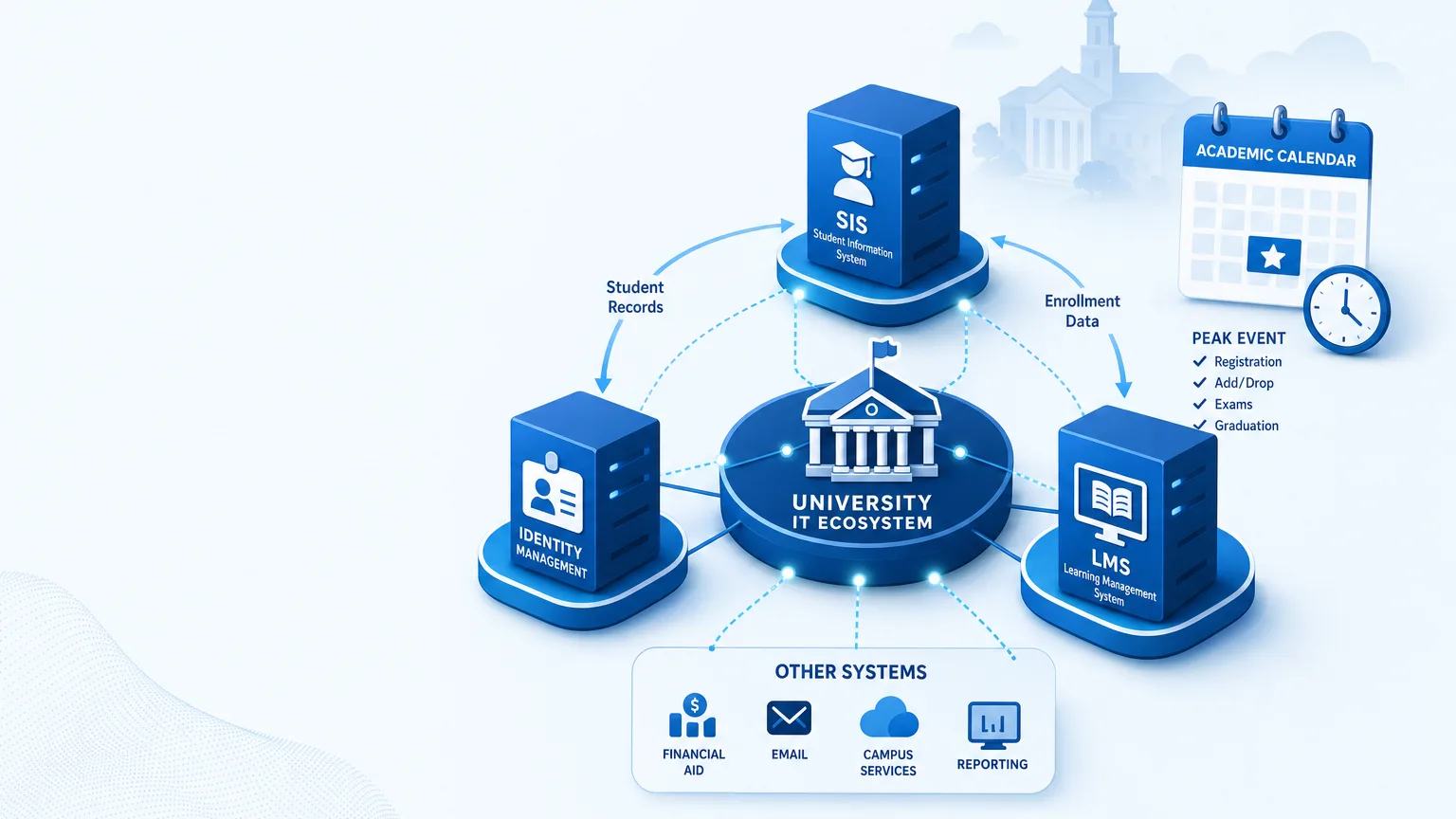
When a registration portal or learning management system (LMS) stalls on one of those dates, the default story is demand nobody forecast. In higher education that story is usually wrong. The load event was known. What broke was a dependency few teams stress-tested for that exact window. ITOM for higher education is less about guessing capacity and more about seeing the chain behind SIS, LMS, identity, and integrations before the published date arrives.
These Aren’t Unpredictable Traffic Spikes
Most uptime writing borrows the retail frame: estimate Black Friday volume, add headroom, hope the estimate holds. Campus peaks do not work that way. A registrar publishes enrollment opens by class year months ahead. Exam weeks are fixed on the same calendar the faculty handbook uses. Academic Technology and the Registrar’s Office plan staffing around those days long before Infrastructure does.
Student newspapers still report course registration crashes as a near-annual beat. The Ithacan and peers cover the same pattern semester after semester: queues, timeouts, students locked out of preferred sections. Recurrence is the signal. Isolated bad luck would not look like a campus tradition.
The operational implication is simple. If the date is known, the failure mode is rarely “we had no idea traffic would arrive.” The open question is which link in the path will saturate first when thousands of concurrent sessions hit at once.
Where Uptime Breaks: The Authentication Bottleneck
Public postmortems keep pointing upstream of the application students blame.
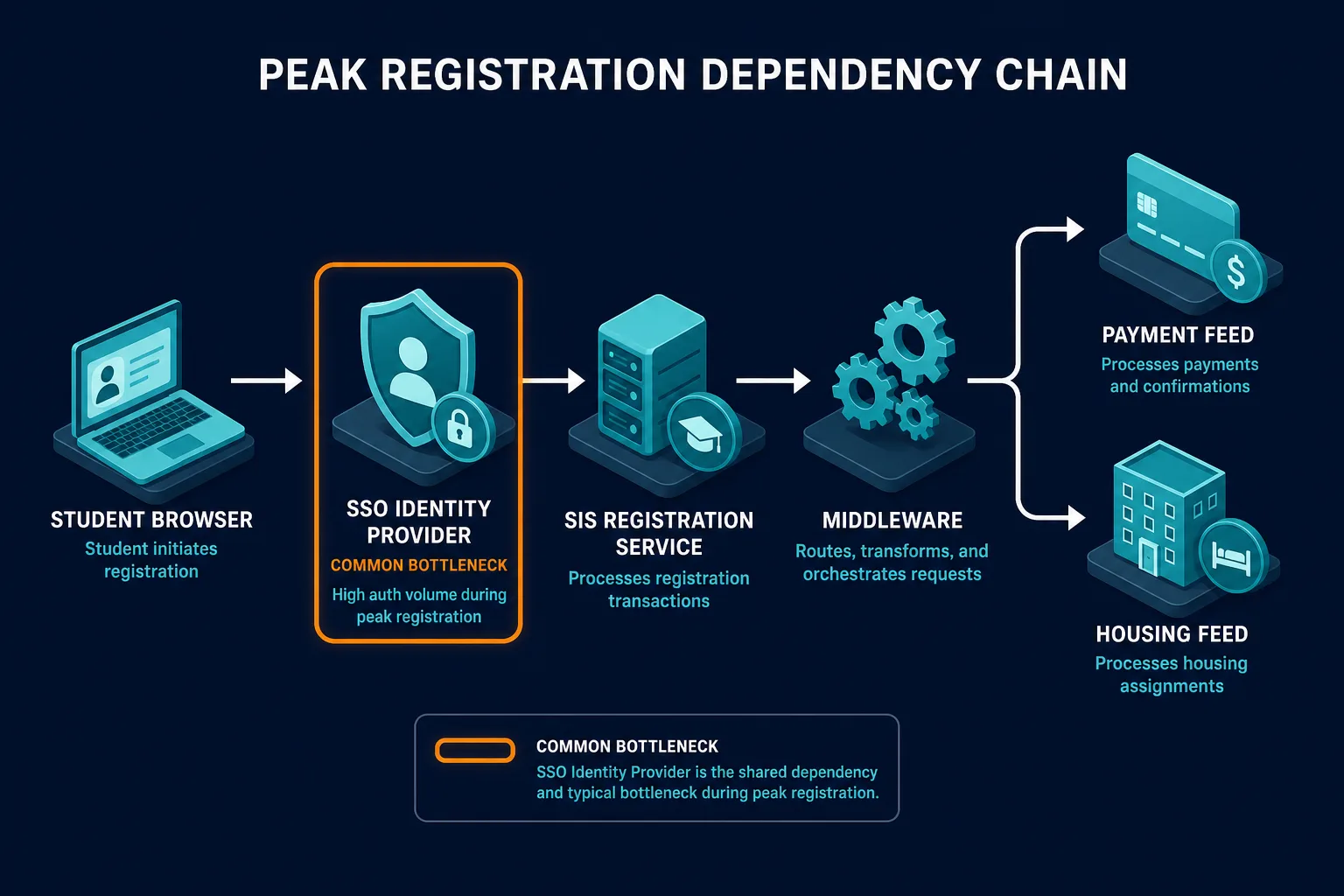
When Stanford’s Axess enrollment stack failed during a heavily covered registration period, the university’s explanation, as reported by The Stanford Daily, centered on a web-authentication bottleneck. Simultaneous login attempts overwhelmed the identity layer. The registration application itself was not the first component to run out of room. Students still experienced “Axess is down.” Operators were fighting a dependency most capacity plans treat as someone else’s system.
That pattern generalizes. A peak registration window exercises:
- Identity and single sign-on (SSO)
- The SIS or registration engine
- Integration middleware between SIS, billing, and housing
- Payment or deposit services for confirmed seats
- Caching, reverse proxies, and session stores in front of all of the above
Capacity added only to the app tier leaves the identity path untouched. The next cohort still piles into the same login choke point on the next published open.
When the Stakes Are Highest: Finals Week Has No Slack
Registration pain is about lost sections and angry queues. Finals week raises the cost again. A system that runs quietly for most of the term has almost no tolerance for multi-hour loss when exams, submissions, and proctoring all concentrate on the same few days.
In May 2026, a cyberattack on Instructure’s Canvas LMS disrupted service during finals season across a large set of institutions. Coverage from outlets including WTOP described schools postponing exams and assignments. Public reporting also named campuses such as the University of Illinois among those forced to adjust schedules. That incident was a third-party security event, not a local capacity miss and not something dependency mapping alone would have blocked. It still states the stakes cleanly: on exam week, LMS uptime is academic continuity. A delayed retail checkout is not the right comparison.
For campus ITOM, the durable lesson is separation of causes. Security incidents, vendor SaaS outages, and local dependency failures all present as “the system is down” to students. Readiness work still has to name which class of failure you are preparing for. Identity and integration reviews address the recurring local pattern. Vendor status and continuity plans address the SaaS pattern. Mixing the two into one vague “we need more servers” ticket wastes the window the calendar already gave you.
The Trap: Capacity Spend Without Dependency Visibility
After a registration-day failure, the instinctive fix is scale: more app servers, larger database instances, a wider content delivery footprint. Sometimes that is required. Often it is incomplete.
If the bottleneck sat in SSO token issuance, a larger registration cluster never sees the traffic. If middleware between SIS and billing serializes under fan-out, horizontal scale on the UI tier only moves the queue. If a shared session store or certificate path was never sized for the known open, the spend lands on the wrong bill code and the same outage shape returns next term.
IT directors inherit both the outage and the budget narrative. Without a map of what the registration or exam service actually depends on today, post-incident reviews argue about symptoms. Registrar and Academic Technology partners hear “we scaled it” and still see the same login failures when the next window opens.
Dependency visibility does not replace capacity planning where compute is the true constraint. It stops capacity planning from being the only tool in the kit.
Is a course registration outage always a capacity problem?
No. Many registration failures start in identity, middleware, or shared session paths upstream of the registration application. When the academic calendar already fixed the peak date, the missing work is often a dependency and impact review of that full chain, not only more servers for the front-end app.
Getting Ahead of a Date You Already Know
Because peak dates are published, readiness can be scheduled the way a change window is scheduled. Treat each major registration open and each finals block as a planned event with a pre-event review, not only as a monitoring spike you hope to survive.
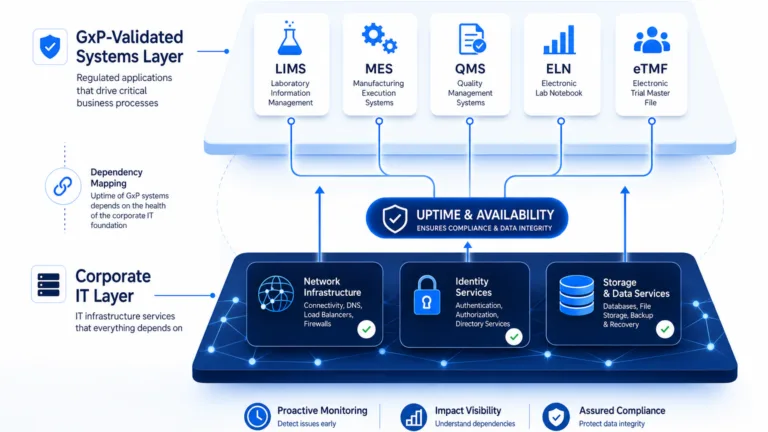
A practical review for ITOM for higher education covers the mission-critical services for that date and the configuration items (CIs) behind them. Service definitions still come from the owners (which apps and sites compose “undergraduate registration” or “finals LMS access”). Once those definitions exist, operators need an application-to-infrastructure dependency picture for blast-radius and impact analysis. A configuration management database (CMDB) fed by discovery keeps that picture tied to what is running now, not to a diagram last updated two terms ago.
Virima’s role in that workflow is pre-event dependency and impact review. ViVID builds service maps after service composition is provided. Discovery and CMDB workflows refresh CI and relationship data on a scheduled basis (not passive real-time event streams). Operational dashboards and change-risk views help operators see infrastructure context in one place. None of that sizes peak CPU for you, and none of it claims an outage cannot happen. It answers a narrower question: before the known date, which links in the chain are in scope for stress, patch, certificate, and integration checks?
Campus teams that already invest in finding devices and infrastructure across the estate start the review with fewer blind spots about what exists. The peak-load problem then becomes which of those assets sit on the critical path for SIS, LMS, and SSO on the published day. Pair this readiness work with the companion view of campus device visibility so inventory and dependency maps stay aligned through each term.
See how Trusted Runtime Truth frames live, explainable dependency context for operations teams that have to act before a known window, not only after tickets pile up.
Where to Start: Scope the Next Calendar Checkpoints
Keep the first pass small enough to finish before the next open.
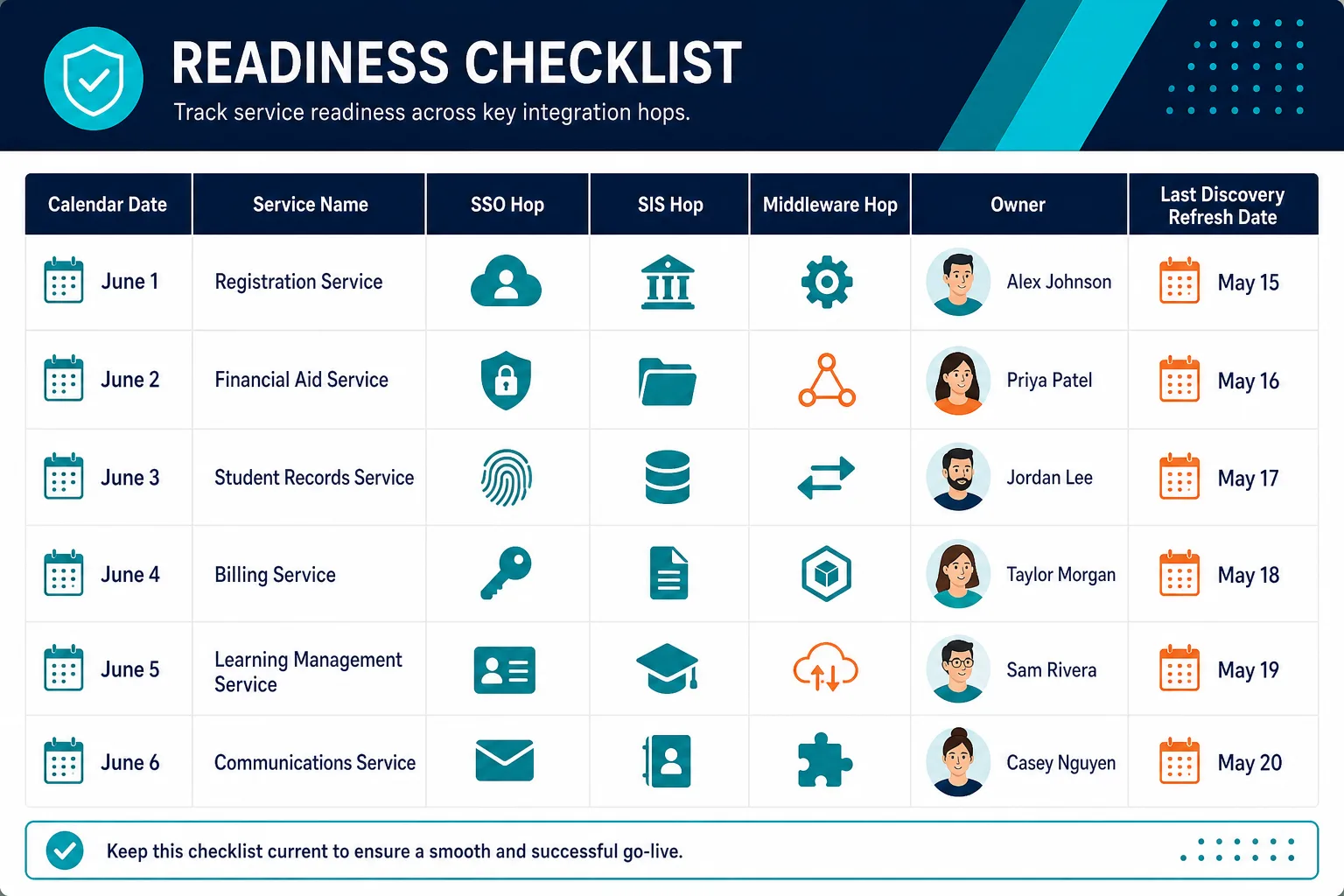
- Pull the next 12 months of registration windows and exam periods from the official academic calendar. Put each date on the operations calendar as a readiness checkpoint with an owner in Infrastructure and a partner in the Registrar’s Office or Academic Technology.
- Name the business services for those dates (for example undergraduate registration, graduate registration, finals LMS and proctoring). Record which applications and sites belong in each service definition.
- Map the dependency chain under each service, including identity/SSO, middleware, payment or deposit paths, and shared platforms the front end hides from students. Once owners supply composition, build the application-to-infrastructure map so operators can see blast radius under those named campus services.
- Prioritize identity and authentication paths in the first review cycle. Public incidents keep showing the blamed app is not always the failing layer.
- Run the same pre-event risk questions you would run for a major change: what CIs sit on the path, what changed since last term, what certificates and integrations expire near the window, who is on-call for each hop.
- Separate local dependency work from vendor SaaS continuity. LMS or SIS SaaS status pages and contractual remedies belong in the packet beside, not instead of, the campus-owned chain.
Repeat the loop each term. The calendar will not stop publishing peak days. The only variable you control is whether the weak link was visible before students found it.
Peak Dates Are Known; Weak Links Are Findable
Registration-day and finals-week outages are rarely honest demand surprises. The dates were public. What usually failed was a dependency outside the narrow box labeled “the registration system” or “the LMS,” left unreviewed until the window opened.
ITOM for higher education earns its keep when it turns those published dates into scheduled dependency and impact reviews: current CI data, service maps for the systems Registrar and Academic Technology care about, and a clear split between capacity work and upstream identity or integration work. That is how teams stop replaying the same student-newspaper story every term.
When service definitions exist, service mapping turns those definitions into the dependency picture operators use before a known registration or exam window. Discovery-sourced CMDB records keep the picture current enough to review certificates, identity hops, and middleware before students queue at the login page.
Map the dependencies behind your next peak date before it arrives. Request a demo of how Virima supports discovery-sourced CMDB data, service maps, and pre-event impact review for campus-critical systems.
Frequently Asked Questions
Why do course registration systems crash at the same time every semester?
Because the peak is scheduled. Class-standing opens and term enrollment windows concentrate logins and writes into short bursts. When identity, middleware, or shared session layers were never reviewed for that burst, the same failure shape returns on the next published date.
Is a registration or exam-period outage really a capacity problem?
Sometimes compute or database capacity is the constraint. Often the first break is upstream: SSO, integration middleware, or a shared dependency the registration or LMS UI sits on. Treating every peak failure as “need more servers” can fund the wrong fix while the weak link stays untested.
What broke when Stanford’s Axess system struggled during enrollment?
Reporting from The Stanford Daily described a web-authentication bottleneck under a surge of simultaneous logins, not a simple story that only the registration application ran out of capacity. Students still saw enrollment fail; the stressed layer sat in the identity path.
How can campus IT prepare for a peak-load event that is already on the calendar?
Schedule readiness like a change window. Define the business services for that date, map dependencies including SSO and middleware, refresh CI data before the window, and assign owners with Registrar and Academic Technology partners. Separate local dependency checks from vendor SaaS continuity plans.
How does Virima support ITOM for higher education peak dates?
Virima helps teams run pre-event dependency and impact review: discovery-informed CMDB records, ViVID service maps once service composition is provided, and ITOM-oriented views for infrastructure and change-risk context. It does not replace capacity sizing or claim to prevent third-party SaaS security incidents.