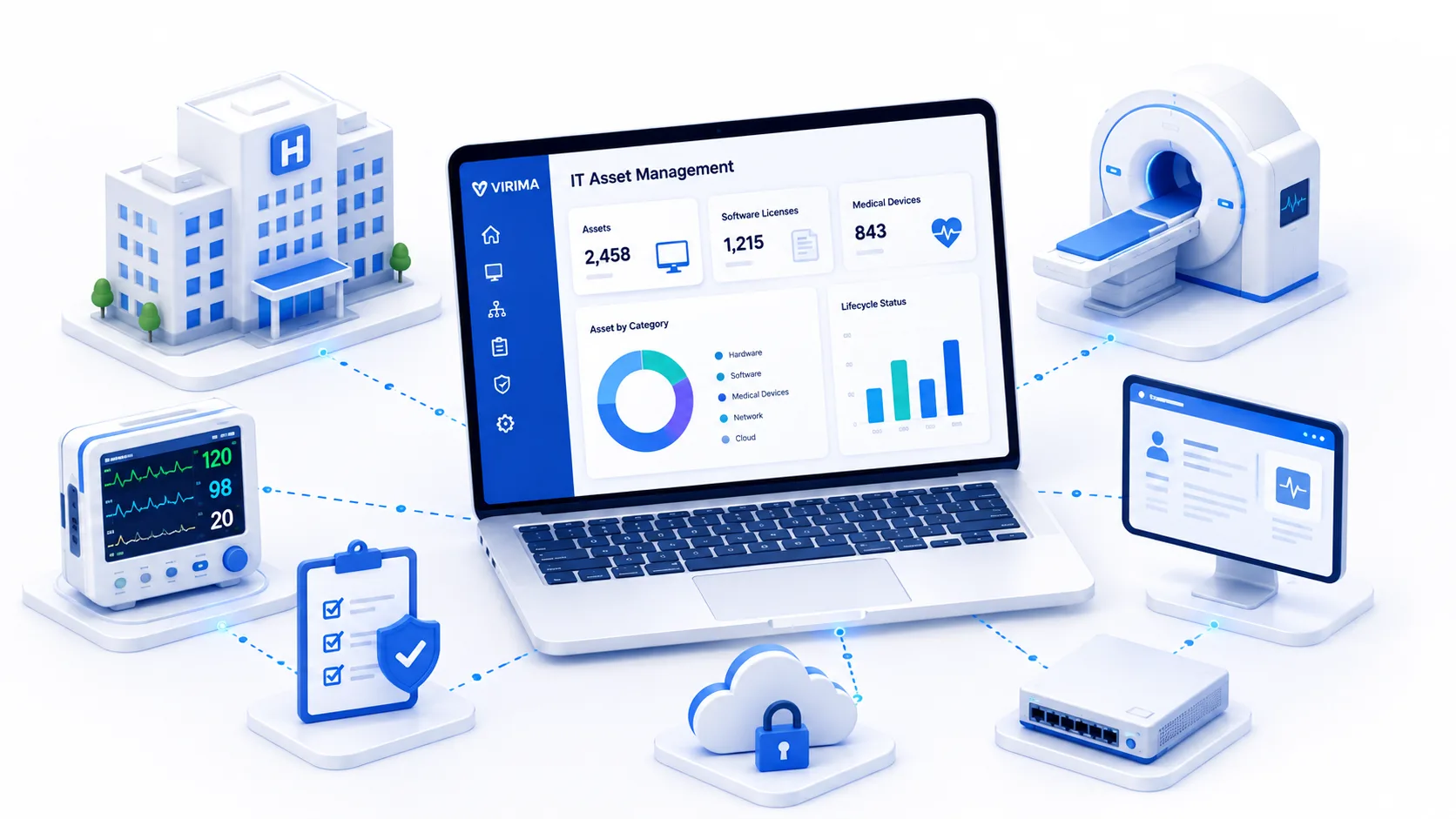
The Complete Guide to Healthcare IT Asset Management

Healthcare IT asset management covers tracking, governing, and maintaining IT infrastructure, software, and networked medical devices across a healthcare organization. It protects patient safety, ensures HIPAA compliance, and supports clinical operations. In contrast to general enterprise ITAM, it spans both traditional computing assets and FDA-regulated medical equipment. That scope demands coordination between IT and clinical engineering under continuous regulatory scrutiny.
The financial stakes are clear. IBM’s 2024 Cost of a Data Breach Report shows that healthcare has carried the highest average breach cost of any industry for 14 consecutive years. That figure reached $9.77 million per incident. When the systems holding protected health information (PHI) are the same ones organizations struggle to inventory, the gap creates a direct liability for patient safety and regulatory compliance.
What is ITAM in healthcare?
Healthcare IT asset management (ITAM) tracks clinical hardware, software licenses, vendor support, and lifecycle states across hospital environments. It connects medical devices to their software components, maintenance contracts, and entitlement history to reduce security risks and software spend.
Why Healthcare ITAM Differs from Every Other Industry
Healthcare IT asset management is not the same as healthcare asset tracking. Real-time location systems (RTLS) show where a ventilator is physically located. IT ITAM, however, reveals what network segment it sits on and which vulnerabilities it carries. It also shows what clinical systems it connects to and what will break if it goes offline. Both matter in a healthcare environment, but they answer different questions and require different tools. Virima operates in the IT/CMDB layer, not the physical tracking layer.
Three factors make healthcare ITAM harder than most other industry verticals.
Regulatory complexity
HIPAA governs every system that processes PHI. FDA rules cover networked medical devices. Joint Commission Environment of Care standards require documented maintenance and calibration records for biomedical equipment. As a result, these regulations do not run in parallel; they intersect at the asset level.
Multi-site sprawl
Health systems span hospitals, clinics, imaging centers, and administrative offices. Each site mixes enterprise IT with specialized medical equipment. That equipment follows its own management lifecycle, often with different vendors, support models, and end-of-support timelines.
Dense clinical integration dependencies
EHR systems connect to laboratory information systems, radiology PACS, pharmacy platforms, and networked devices. As a result, change management and incident response both require knowing those relationships before something breaks. Waiting until an incident call is too late.
Clinical Hardware Now Carries a Software Lifecycle
Modern medical devices operate as connected computing platforms. A diagnostic scanner or bedside monitor depends on embedded operating systems, commercial software, and vendor management applications. The physical casing may have a decade-long service life, while the software components inside require frequent patching, licensing renewals, and security updates.
Federal regulatory frameworks reflect this coupled lifecycle. Guidance from the U.S. Food and Drug Administration requires manufacturers of qualifying cyber devices to provide software bills of materials (SBOMs). The FDA notes that software component transparency helps healthcare facilities identify vulnerabilities throughout a device’s commercial life. Hardware lifecycles and software lifecycles now move at different speeds.
When software support ends, physical hardware carries unmanaged operational risk. An unsupported operating system on a lab workstation exposes surrounding networks to known vulnerabilities. Replacing physical equipment is expensive, while ignoring the underlying software lifecycle creates compliance and operational gaps.
CMDB Accuracy: The Foundation Healthcare IT Asset Management Is Built On
HIPAA compliance depends on accurate, current records of every system that processes protected health information. A discovery-sourced CMDB provides that foundation: it records what PHI-bearing systems exist, how they connect, who owns them, and their current configuration. Without it, risk assessments rely on manual inventories. Those inventories go stale between audits, leaving organizations certifying exposure they can no longer see.
Beyond compliance, CMDB accuracy is what makes clinical change management safe. When a patch window is proposed for an application server, the question isn’t “is it patched?” It’s “what breaks in clinical workflows if this goes wrong, and who needs to know first?” ViVID™ service maps make that question answerable before the change window opens. Specifically, they show how clinical systems, infrastructure, and services connect to each other. Maintaining real-time visibility into dependency chains before any change is approved.
Effective healthcare ITAM starts by closing the discovery gap. Many healthcare organizations have an incomplete picture. Medical devices sit on isolated network segments, use proprietary protocols, and resist standard agent deployment. For these environments, agentless IT discovery covers network scanning, SNMP queries, DHCP log analysis, and integration with clinical engineering systems. That combination is often the only reliable way to build an inventory that includes the full environment, not just the assets IT directly controls.
Once that inventory exists, the CMDB becomes the system of record for HIPAA audits, change approvals, incident triage, and vendor risk assessments. High-frequency discovery cycles keep it from drifting.
→ Explore Virima’s Trusted Runtime Truth for agentic IT in healthcare environments
The Asset Categories That Require Healthcare-Specific Rules
Healthcare IT teams manage asset categories that rarely appear in other industries, each with its own compliance and lifecycle profile.
Clinical information systems
EHR platforms anchor clinical operations. Tracking them means visibility into server hardware, database instances, and application licenses. It also covers integration points with laboratory information systems (LIS), radiology information systems (RIS), and pharmacy platforms. Notably, LIS and RIS often run on legacy platforms under extended support, with networking requirements that fall outside standard IT tooling.
Networked medical devices
Infusion pumps, patient monitors, ventilators, and diagnostic equipment sit on your network but may not surface through conventional discovery. They follow distinct security update cycles and often cannot be patched on demand. FDA clinical validation requirements restrict software changes, so IT and clinical engineering must coordinate on every update.
Imaging systems
CT scanners, MRI machines, and ultrasound systems typically ship with dedicated workstations and storage. Those components belong in the same asset ecosystem as the imaging systems themselves, with maintenance windows coordinated between vendor support, clinical engineering, and IT.
Telehealth and remote care
Video conferencing hardware, remote monitoring devices, and mobile health applications extend the asset inventory beyond facility walls. Many of these platforms are cloud-based, which pushes the compliance boundary beyond the physical network perimeter. Remote patient-monitoring devices that operate in patients’ homes require lifecycle tracking, maintenance schedules, and retrieval workflows. Most IT asset programs have not yet established processes for these.
HIPAA Compliance and Your IT Asset Inventory
HIPAA requires documented administrative, physical, and technical safeguards for every system that processes PHI. For IT asset management, that means role-based access controls tied to asset records and audit logging of PHI-system access. It also covers encryption tracking for portable devices, regular access reviews, and documented disposal procedures for end-of-life equipment.
The HHS HIPAA Security Rule requires an accurate, current inventory as the foundation for all required safeguards (see also NIST SP 800-66 Rev. 2). Your ITAM program must answer four questions on demand for every PHI-bearing system:
| Audit Question | ITAM Requirement |
| What systems process or store PHI, and where are they? | Current, discovery-sourced asset inventory with physical location and network segment |
| Who has access, and has that access been reviewed recently? | Documented user access rights, privileged account records, periodic review logs |
| What is the security and patch status of each asset? | Vulnerability status records, compensating control documentation, patch history |
| How are PHI-bearing assets disposed of? | Documented media sanitization and disposal procedures for every end-of-life device |
Organizations relying on manual spreadsheets typically cannot produce consistent responses across all four categories. That gap is exactly what HIPAA auditors test. Connecting asset records to your SIEM lets security events correlate with specific assets and users. That turns an audit log from a compliance checkbox into a usable investigation tool. And supports the data analytics workflows security teams depend on for investigations.
Software Licensing Does Not End at the Workstation
Healthcare software licensing extends across complex clinical ecosystems. A connected medical device relies on supporting application servers, management consoles, database instances, middleware, and virtualization layers. Each supporting component carries its own vendor contract, metric, and renewal cycle.
The physical device and its supporting software stack have separate entitlements. An imaging machine may operate under a multi-year hardware warranty while its diagnostic software relies on annual user licenses. Central management consoles may require per-node client access licenses. Managing the hardware unit without tracking adjacent software entitlements risks compliance gaps during vendor audits.
Reclaiming unused entitlements requires explicit lifecycle tracking. Guidance from the U.S. Department of Health and Human Services emphasizes that stored or inactive devices continue consuming software licenses until formal retirement workflows reclaim them. Unused clinical workstations sitting in storage often draw active software license fees because nobody closed the entitlement record.
How does software licensing impact clinical hardware management?
Clinical hardware relies on supporting servers, databases, and management consoles that require separate software licenses. Inactive or stored medical hardware can continue consuming software licenses until ITAM retirement workflows reclaim those entitlements, causing unnecessary software subscription spend across health systems.
Medical Device Asset Management: Where IT and Clinical Engineering Meet
Most medical devices use non-standard protocols. Others sit on isolated network segments that standard IT discovery tools cannot reach. For these devices, effective asset management requires agentless network scanning, SNMP queries, DHCP log analysis, and integration with clinical engineering maintenance management systems (CMMS). Organizations using only agent-based discovery typically leave many networked clinical devices outside their inventory. That creates both security blind spots and HIPAA exposure.
Once discovered, medical devices require a lifecycle approach that goes beyond standard IT refresh cycles:
- Calibration and maintenance: many devices require daily, weekly, or monthly calibration in addition to annual preventive maintenance. Track those obligations alongside the clinical engineering team, not in a separate system.
- End-of-life planning: clinical validation and regulatory approvals extend lead times well beyond a standard hardware refresh. Build early warnings for devices nearing the end of manufacturer support.
- Vulnerability management: devices often cannot be patched on demand because FDA validation requirements restrict software changes. Instead, alternative security controls take the place of direct patches. These include network segmentation, access restrictions, and anomaly monitoring. Each control requires a documented risk assessment reviewed on a defined schedule.
FDA registration numbers, medical device reporting (MDR) data, and recall notices belong in the same system as the rest of your asset inventory. The FDA’s guidance on medical device cybersecurity confirms that manufacturers and health systems share responsibility for security posture across the full device lifecycle.
Why AI Agents in Healthcare IT Need Trusted Runtime Truth
AI-assisted operations are arriving in healthcare IT. Service desk automation, infrastructure monitoring, change risk scoring, and clinical decision support all involve some level of autonomous action. Each of those use cases depends on the same thing: an accurate, current picture of what is in the environment, how it is connected, and who owns it.
AI agents in clinical IT need to know which systems are PHI-bearing and which devices are in active patient use. They also need to assess the potential impact of any proposed change before acting. A discovery-sourced CMDB gives an AI agent the asset context it needs. It can also flag when data needs refreshing before a decision is made. Rather than operating on inventory records that may be months out of date. This approach builds on today’s foundation of service-map rescans and confidence scoring. It extends toward agentic operations rather than replacing what exists.
Healthcare IT teams building toward agentic operations should treat CMDB accuracy as a patient-safety precondition, not an infrastructure hygiene task.
Retirement Starts Before Equipment Leaves the Building
The asset lifecycle does not end when clinical staff stop using a device. Equipment often moves to storage rooms or secondary facilities long before physical disposal. These idle assets remain connected to administrative databases, network management systems, and software license pools.
Formal retirement processes ensure complete lifecycle closure. HHS IT asset management policies recommend explicit tracking for stored equipment, software license reclamation, and secure data sanitization before final disposal. Leaving a retired asset in active status creates security risks and ongoing licensing costs.
Retirement requires agreement across technical, financial, and inventory records. IT teams must revoke network access and software licenses. Clinical engineering must update service status, and finance must reconcile asset registers and depreciation schedules. Automated workflows ensure every record closes before equipment leaves the facility.
Why is formal asset retirement critical in healthcare ITAM?
Formal asset retirement ensures that inactive or stored medical devices are sanitized, disconnected from clinical networks, and removed from active license pools. Proper retirement workflows reclaim software entitlements and eliminate unmanaged security exposure from forgotten hardware.
Building a Healthcare ITAM Program That Holds Up
Three structural elements distinguish programs that survive audit scrutiny from those that collapse under it.
Cross-functional ownership
IT operations, clinical engineering, information security, and compliance each need a seat in ITAM governance. Define clear asset ownership by category. IT typically holds computing equipment and software, while clinical engineering holds biomedical devices. For networked medical devices that cross both domains, document the handoff points between teams.
Clinical-aware lifecycle processes
Clinical systems require extended validation windows before changes. They also need specialized disposal procedures for PHI-bearing equipment and change management that accounts for patient workflow impact. Build those requirements into your ITAM processes before an incident forces them. That decision separates a managed program from a reactive one.
ITSM integration
Asset data that lives separately from your service desk creates double-entry, stale records, and missed incident context. Bidirectional sync with ITSM platforms keeps asset records accurate inside the workflows teams already use. Supported platforms include ServiceNow, Jira Service Management, Ivanti, Xurrent, and Halo. No separate system is needed.
For independent analysis of how discovery-driven CMDB accuracy affects operational outcomes, see the EMA ServiceOps report.
What to Look for in a Healthcare ITAM Platform
Healthcare environments need a platform built for clinical complexity. A product adapted from a general enterprise tool rarely fits. Seven capabilities separate purpose-fit platforms from everything else:
| Capability | Why It Matters in Healthcare |
| Agentless discovery | Medical devices cannot accept agents; discovery must reach them through network scanning, SNMP, and API methods |
| Clinical engineering CMMS integration | Bridges IT and biomedical device records without manual re-entry |
| HIPAA-aligned access controls and audit logging | Role-based access and encrypted asset records are required safeguards, not optional features |
| High-frequency discovery cycles | Inventory that drifts between manual audits creates the compliance gaps HIPAA auditors look for |
| Service dependency mapping | Shows how clinical systems connect before changes are approved, not after incidents occur |
| Bidirectional ITSM sync | Reduces double-entry and keeps asset data accurate inside the ticketing workflows teams already use |
| Audit-ready reporting | HIPAA, Joint Commission, FDA, and CMS compliance evidence on demand, not assembled the week before an audit |
Virima’s IT asset management platform combines agentless discovery, a discovery-sourced CMDB, and ViVID™ service maps. Together, they give healthcare IT teams asset visibility for regulatory compliance, incident response, and change management without the overhead of manual CMDB maintenance.
→ See how Virima keeps healthcare IT operations audit-ready with discovery-driven CMDB accuracy
See Everything. Move Faster. Stay Audit-Ready.
Healthcare IT asset management rewards a specialized approach because the environment leaves no room for stale data. A program combining agentless discovery, a discovery-sourced CMDB, and clinical-aware lifecycle processes gives your team strong asset visibility. With ITSM integration in place, you can support regulatory compliance, respond to incidents, and approve changes with confidence.
Frequently Asked Questions
What makes healthcare IT asset management different from ITAM in other industries?
Healthcare ITAM must account for life-critical systems, FDA-regulated medical devices, and HIPAA compliance obligations. Dense clinical system dependencies add another layer of complexity. In contrast to general enterprise ITAM, it requires coordination between IT and clinical engineering across both clinical and enterprise IT assets.
Why should healthcare facilities track software licenses on medical hardware?
Medical hardware depends on management applications, supporting servers, and databases that require software licenses. Inactive or stored devices often continue consuming active software licenses, leading to unnecessary subscription spend if entitlements are not reclaimed upon retirement.
How is healthcare IT asset management different from RTLS/physical asset tracking?
RTLS systems track the physical location of devices using RFID or BLE technology. Healthcare IT asset management governs the IT layer: software licenses, networked device configurations, CMDB records, and HIPAA-related access controls across clinical environments.
How do I track medical devices that do not respond to standard IT discovery tools?
Most medical devices use non-standard protocols or sit on isolated network segments. Effective approaches combine agentless network scanning, SNMP queries, DHCP log analysis, and integration with clinical engineering CMMS systems.
What role does Virima play in healthcare IT asset management?
Virima provides automated discovery, software normalization, contract tracking, and CMDB reconciliation. It reconciles clinical and enterprise IT asset records with software licenses and lifecycle states to support IT operations and security teams.