Why Cloud Discovery Misses Short-Lived SaaS Resources

At a technology or SaaS company, most new infrastructure is never requested from IT, so cloud discovery rarely catches it before it is already running. It is declared in a Terraform or CloudFormation file, applied by a CI/CD pipeline, and running in production before anyone outside the engineering team knows it exists. That pattern is not a security lapse. It is the operating model that lets the company ship and scale.
The friction shows up one layer later. Discovery tools built for multi-year hardware still run on daily or weekly cadences. Containers, functions, and Spot capacity can appear and vanish inside that window. The asset record never catches the resource, and the next scan finds nothing to inventory. SOC 2 and ISO 27001 still expect a current inventory. Enterprise buyers still ask for evidence of ongoing cloud visibility before a deal closes. Incident teams still need to know what was running when something breaks.
This piece explains why scheduled discovery structurally lags engineering-led cloud, what that lag costs beyond “messy data,” and what closing the gap requires without routing every provision through a ticket queue.
Why shadow cloud at a SaaS company is an operating model
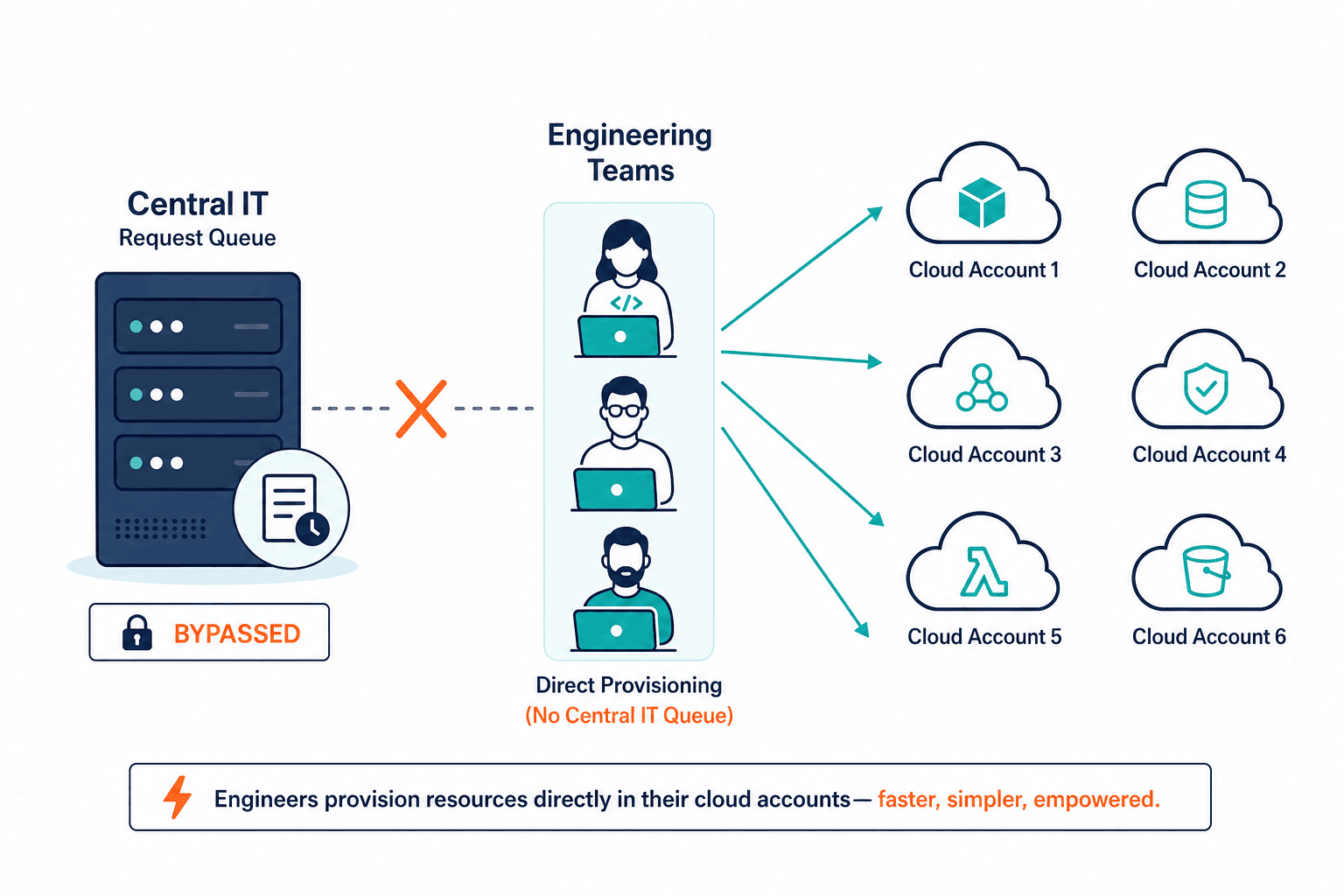
Traditional “shadow IT” usually means unsanctioned SaaS apps or personal devices outside policy. Shadow cloud at a software company is different. The infrastructure is often fully sanctioned. Engineers hold permission to create accounts, apply IaC, and ship. Central IT and security are not in the request path for each resource. They learn about it afterward, if discovery reaches that account at all.
Multi-account sprawl makes the pattern structural. Many SaaS firms run dozens or hundreds of AWS accounts or Azure subscriptions under one organization umbrella. Accounts map to teams, products, sandboxes, and environments. Provisioning authority sits with Platform Engineering, Cloud Ops, and product squads because routing every change through a central CAB would erase the velocity the business needs.
So the inventory problem is not “engineers went rogue.” It is that ownership of create rights moved to engineering while the system of record is still built for a slower, ticket-driven estate.
What is shadow cloud at a SaaS company?
Shadow cloud is sanctioned infrastructure engineers provision through Infrastructure as Code (IaC) and self-service accounts faster than central inventory workflows record it. Unlike classic shadow IT, the resources usually sit inside company policy. The gap is visibility and ownership tags, not an unsanctioned purchase path.
The velocity mismatch: why scheduled discovery lags
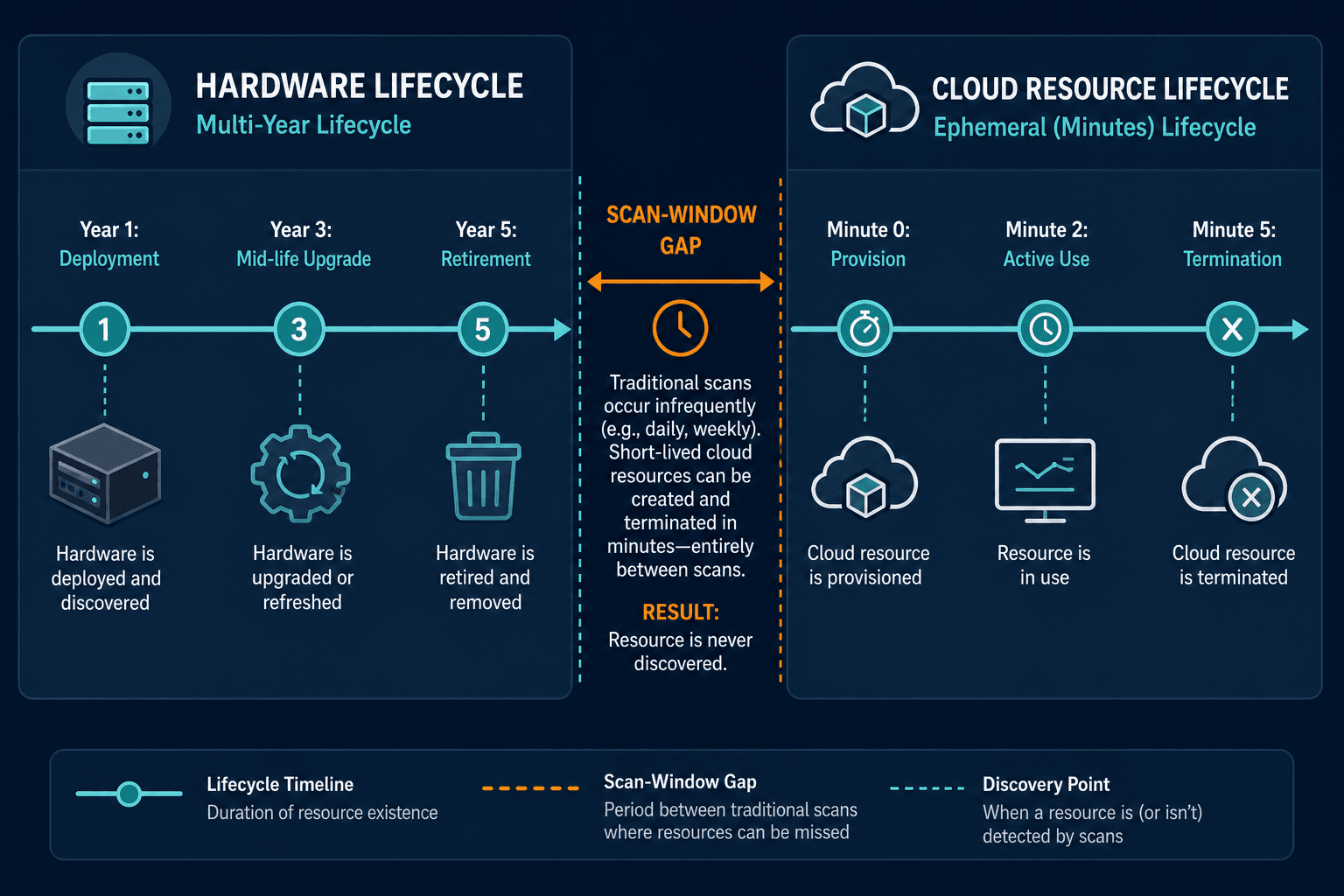
Ephemeral cloud resource discovery has to keep pace with capacity that’s ephemeral by design in cloud-native stacks. Production containers often live for minutes. AWS Lambda invocations finish in well under a second. Spot instances can be reclaimed with roughly two minutes of warning. Autoscaling groups can cycle through large numbers of instances in a single day as load shifts.
Most generic discovery and CMDB platforms still treat cloud as another scan type on a model built for physical and long-lived virtual machines. Daily or weekly jobs fit hardware with multi-year lifespans. They fit poorly when a workload exists for thirty minutes. That resource has little chance of landing in a twenty-four-hour scan window. By the next run it is gone, and no configuration item (CI) was ever written.
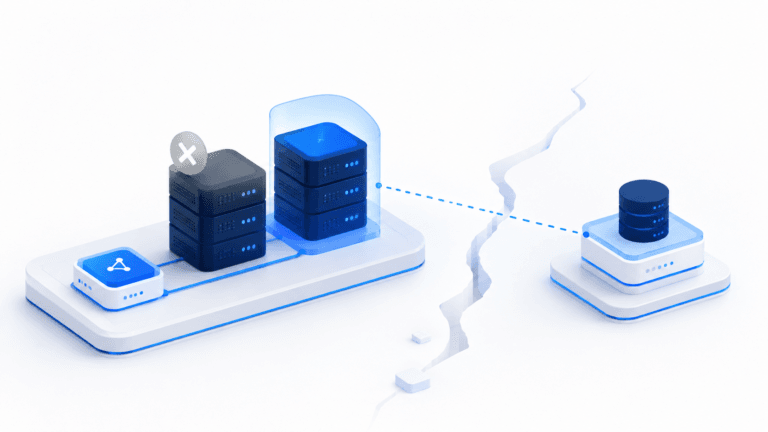
Distributed accounts compound the miss. If connectors cover only the accounts central IT listed years ago, new team accounts never enter the scan set. The control plane holds a live record of the resource. The CMDB was never updated with it.
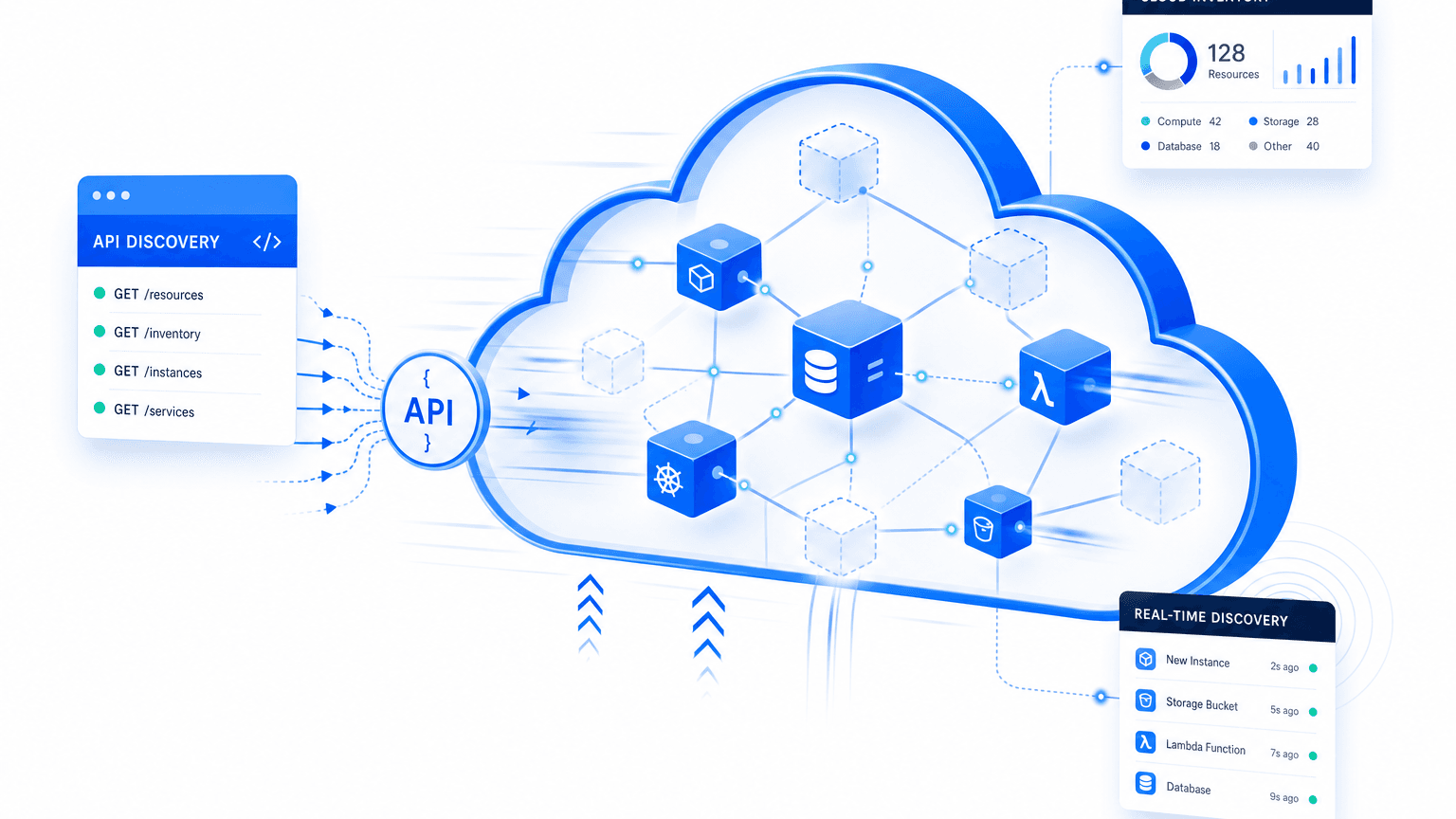
Agent-based and pure network discovery also hit hard limits on serverless functions and managed services with little or no durable host footprint and no agent target. API-based discovery against the provider control plane is the method that can see those classes of resource at all. For a full comparison of methods, see Virima’s guide to agent-based and agentless discovery.
Why do cloud resources at SaaS companies go undiscovered so often?
Scan windows measured in days miss workloads measured in minutes. Multi-account sprawl leaves new subscriptions outside the connector list. Agent and network methods also miss serverless and managed services with no host footprint. The miss is a cadence and coverage design issue, not a missing tool checkbox.
Where this becomes a business problem
Inventory drift isn’t just a data-quality complaint — it’s a business problem. Sixty-nine percent of organizations point to tool sprawl and visibility gaps as their top barrier to effective cloud security, according to Fortinet’s 2026 Cloud Security Report, covered by Cybersecurity Insiders, 2026. CMDB drift is a direct symptom of that same gap. It shows up in three places that stop deals and audits.
First, audit evidence. SOC 2 and ISO 27001 programs expect organizations to maintain an accurate inventory of relevant information assets, including cloud infrastructure in scope. Guides aimed at engineering teams stress combining network scanning, agents, and cloud inventory tooling so the list matches what auditors will sample (Konfirmity’s SOC 2 asset inventory guide is one practical walkthrough). Auditors increasingly reject static cloud-console screenshots as configuration evidence — reviews now expect timestamped, programmatic exports, such as AWS Config or Azure Resource Graph, proving a control operated continuously through the audit window, not just on the day it was checked. Ephemeral capacity with no durable record becomes an evidence gap when the control asks what you ran, who owned it, and when it changed.
Second, revenue friction. Enterprise vendor security questionnaires increasingly ask SaaS vendors how they maintain ongoing asset visibility — a spreadsheet export from last quarter doesn’t answer that. A thin answer can stall procurement even when product security is strong (see Virima’s roundup of IT asset management statistics for more on how stale inventories create audit and procurement friction).
Third, incident and change risk. When a resource never entered the CMDB, triage starts from “we do not know what was running.” Blast-radius analysis, owner contact, and change impact all degrade. Platform and Cloud Ops leads feel that failure in the war room as much as in the audit workroom.
Virima helps teams produce fresher asset-inventory evidence for those workflows. It does not certify a customer’s SOC 2 or ISO 27001 status. Confirm control language and sampling with your compliance team and auditor.
See how trusted runtime truth supports governed operations.
Why CSPM and cost tools do not replace inventory
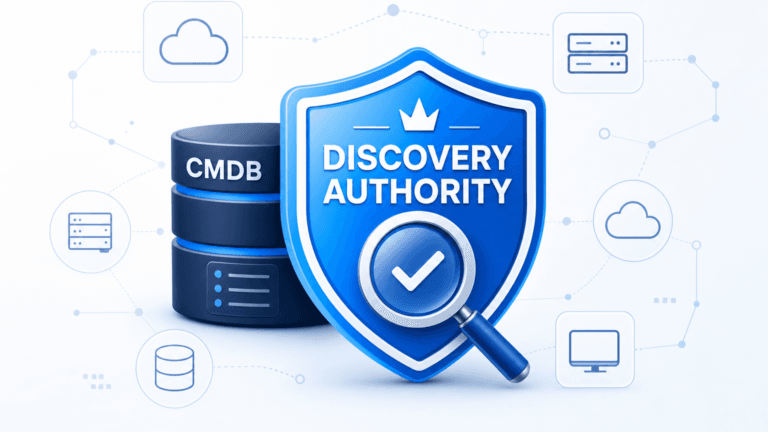
Cloud security posture management (CSPM) and cloud-native application protection platform (CNAPP) products already pull frequent, API-based inventories. Tools in that class are strong at misconfiguration, exposure, and posture scoring. That inventory exists to drive security findings. It is not designed as the CI system of record that feeds change management, IT asset management (ITAM), and IT service management (ITSM) workflows with lifecycle and relationship context.
FinOps and cloud cost platforms surface spend and rightsizing from billing data. Billing lines are not the same as CIs with owners, relationships, and retirement state.
Provider-native tools such as AWS Config and Azure Resource Graph are accurate inside one cloud. They stay siloed. They do not reconcile a multi-cloud asset inventory into one CMDB or push cleanly into the ITSM stack the ops team already runs.
The open need for IT Operations, Platform Engineering, and Cloud Ops is a reconciled, audit-usable CI layer across connected accounts, with churn handled on both create and delete paths. CSPM can sit beside that layer. It does not substitute for it.
Do CSPM tools already solve cloud asset inventory for IT ops?
CSPM platforms inventory cloud resources to score posture and risk. IT operations still needs configuration items with ownership, relationships, retirement, and ITSM handoff. Treat CSPM as complementary security visibility. Treat the CMDB path as the operational system of record for change, incident, and asset processes.
What closing the gap requires
Slowing engineers down is the wrong fix. The operating model depends on IaC and self-service. The inventory layer has to move closer to cloud cadence instead.
Three requirements matter in practice.
- API-based discovery on the control plane. Query AWS and Azure APIs so serverless functions, managed services, and other low-footprint resources can appear without an agent install or a routable host scan.
- High-frequency discovery cycles across connected accounts. Run connectors often enough — hours, not days — across the accounts and subscriptions you actually use so the window between provision and first record shrinks. That narrows the gap. It is not event-stream or webhook “real-time” capture, and it should not be sold that way.
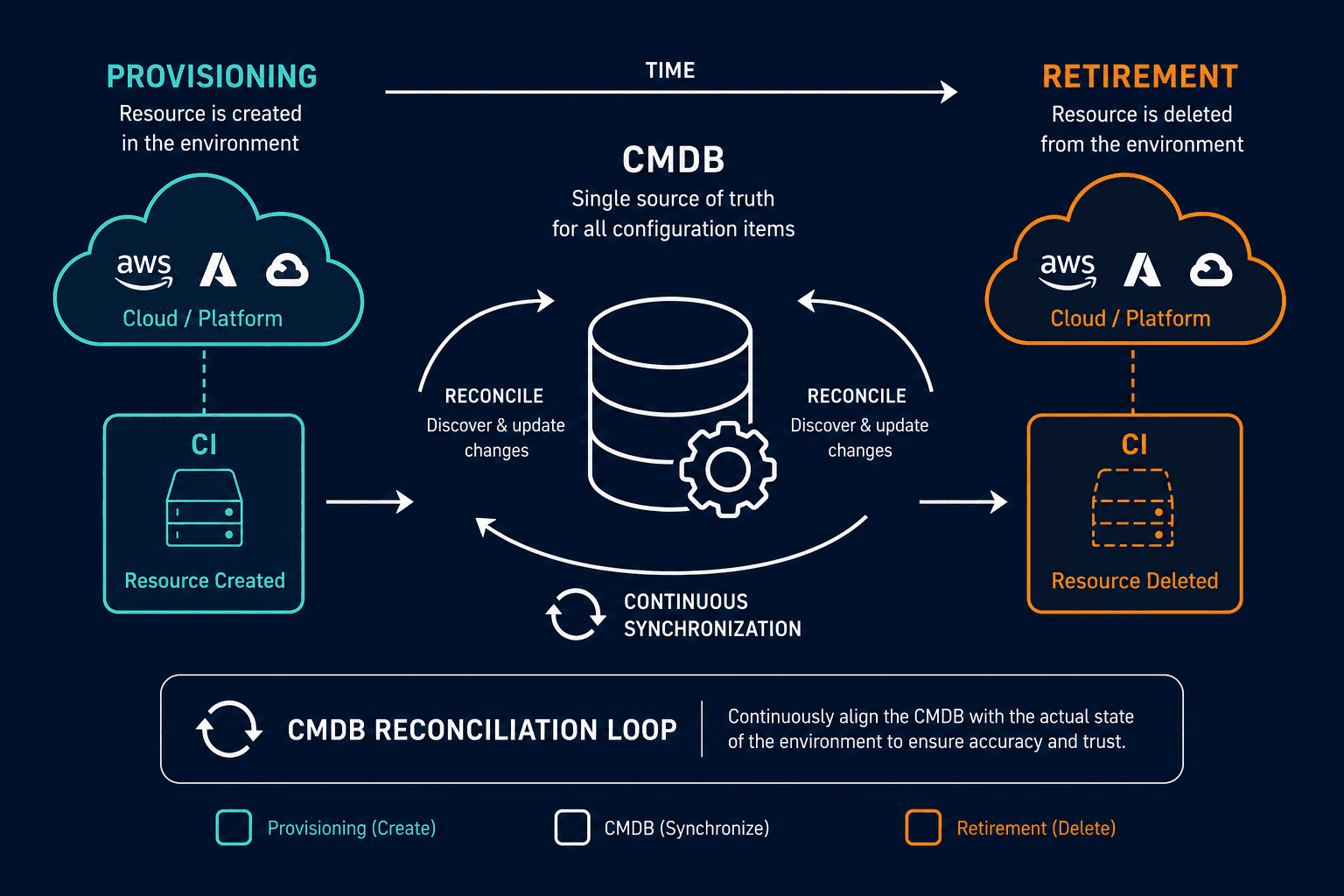
- A CMDB that expects churn. Add new CIs when resources appear. Retire or mark absent when they disappear. The durable configuration item is the resource definition, not the instance — a Lambda function spec or Auto Scaling group template, not the individual containers or invocations it spawns. An inventory that only inserts and never ages out silently fills with ghosts, which is as damaging as blind spots for audit and incident work.
That combination is what cloud asset discovery for SaaS companies actually requires — not a bigger scan window, but a different discovery model. Virima’s IT discovery approach includes API-based cloud discovery for AWS and Azure, feeding the same CMDB used for on-premises, network, and virtual estates. Teams can keep ITAM processes and service maps aligned as cloud CIs change, and sync into the ITSM tools already in use, including ServiceNow, Jira Service Management, Ivanti, HaloITSM, Xurrent, and Hornbill. Frame the outcome as high-frequency, reconciled discovery, not continuous event listening.
See the scope checklist below to find where your CMDB is already behind provisioning.
Where to start: scope discovery against provisioning reality
Start with coverage truth, not a tool bake-off.
- List every cloud account and subscription in use today, including ones product teams opened outside the original central IT roster. That list is your real scan boundary.
- Separate ephemeral classes from long-lived ones. Containers, functions, and autoscaling pools need tighter cycle priority than core databases and stable VMs.
- Compare current SOC 2 or ISO 27001 inventory exports to what discovery returns on a clean cycle. Close gaps before an auditor or a customer questionnaire finds them (Device42 vs Virima: CMDB, Service Mapping, and ITSM Integration Compared (2026)).
- Flag resources with no owner, cost center, or team tag. Missing ownership is the SaaS signature of shadow cloud the same way an unowned system signals M&A-era drift in other industries.
Platform Engineering and Cloud Ops should own the account map and tagging bar. IT Operations and GRC should own evidence quality and CMDB fitness. CTOs should treat the gap as a velocity-versus-governability tradeoff they can measure, not a cultural lecture about “shadow IT.”
Match discovery cadence to how you already ship
At a technology or SaaS company, engineers provisioning without a ticket is the model working. The failure mode is an asset record still tuned for slower estates. Closing the gap means API-based coverage across the accounts you run, high-frequency discovery cycles that narrow provision-to-record delay, and a CMDB that retires what the cloud already deleted.
That combination supports audit evidence, vendor reviews, and incident triage without asking Platform Engineering to give back self-service.
Frequently Asked Questions
Why do scheduled scans miss ephemeral cloud resources?
Daily or weekly jobs are tuned for long-lived hardware. Containers, functions, and Spot capacity can start and stop inside that window, so the next scan never sees them and no CI is written.
How is shadow cloud different from traditional shadow IT?
Classic shadow IT is often unsanctioned apps or devices. Shadow cloud is usually approved infrastructure created through IaC and team accounts faster than central inventory records it.
What does SOC 2 expect for cloud asset inventory?
Programs expect a current inventory of in-scope assets, including cloud resources, with enough fidelity for sampling. Exact control wording varies. Confirm requirements with your auditor. Inventory tooling supports evidence. It does not replace certification.
Does Virima support both agent-based and API-based discovery for the same environment?
Yes. Virima combines agent-based, agentless, and API-based discovery so IT teams can cover on-premises hardware, virtual machines, and cloud control-plane resources like serverless functions from one platform, feeding a single CMDB instead of separate silos.
How does Virima approach cloud discovery for technology and SaaS companies?
Virima uses API-based connectors for AWS and Azure, high-frequency discovery cycles across connected accounts, and reconciliation into a shared CMDB with ITSM integrations. The goal is a narrower provision-to-record gap, not claimed real-time event capture.