Hybrid Cloud Asset Discovery for Atlanta Enterprises: The Blind Spot Nobody’s Fixing

In late January 2024, Fulton County, Georgia, which encompasses the core of metropolitan Atlanta, suffered a devastating ransomware attack that paralyzed municipal and county infrastructure. The LockBit ransomware syndicate breached network perimeters, forcing IT administrators to take critical digital systems offline across county offices. Essential online services froze for weeks, including court case management systems, property tax collection portals, marriage license processing, and administrative telephony across regional municipal buildings. The crisis revealed how urgently regional organizations need authoritative hybrid cloud asset discovery for Atlanta enterprises before unmonitored infrastructure gaps become public vulnerabilities.
National reporting from the Associated Press confirmed that recovery teams spent months restoring degraded operations and inspecting compromised endpoints. Local technology retrospectives from StateScoop revealed that the recovery forced local officials to approve emergency procurement contracts exceeding ten million dollars to rebuild disrupted infrastructure. County leadership later confirmed that the intrusion initiated when a single compromised credential granted attackers lateral access into interconnected municipal subnets. The incident highlighted what occurs when enterprise environments lack an authoritative, real-time inventory of hardware assets, active network interfaces, and operational system dependencies.
The digital footprint of the Atlanta metropolitan region has expanded dramatically alongside its economic prominence. Commercial real estate analysis reported by DataCenterFrontier, covering CBRE research, documented that Atlanta surpassed Northern Virginia in new data center construction during 2024, maintaining nearly 2,900 megawatts under active development across regional facilities. Local organizations operate sprawling hybrid architectures combining on-premises server suites, private cloud hypervisors, and multi-tenant public cloud instances. When regional technology teams run distributed workloads across disparate infrastructure pools, visibility gaps multiply. Closing this enterprise operational gap requires disciplined Hybrid Cloud Asset Discovery for Atlanta Enterprises to establish ground truth before unexpected operational disruptions cascade across production environments.
What is hybrid cloud asset discovery?
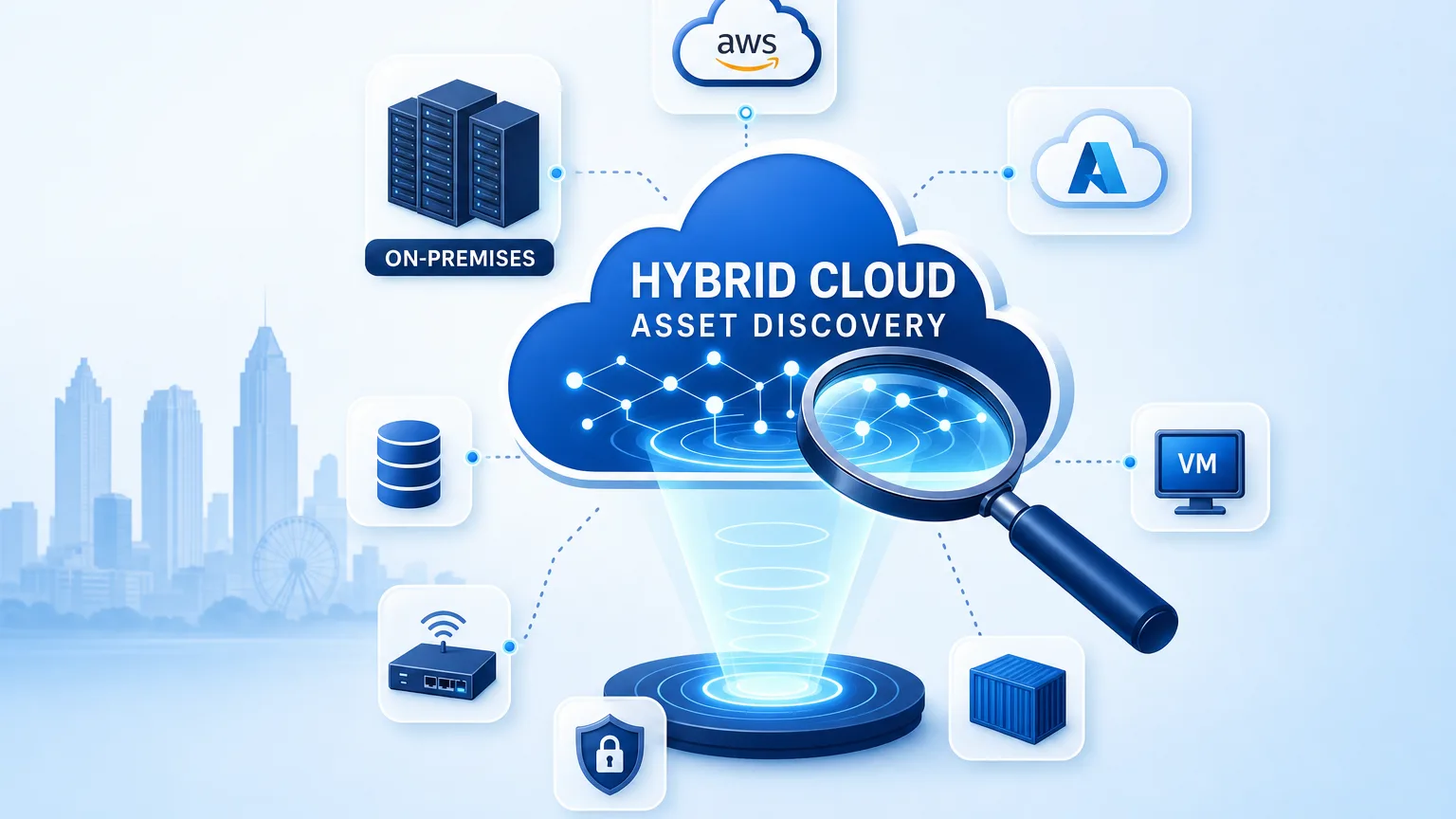
Enterprise IT teams define hybrid cloud infrastructure according to standards established in NIST SP 800-145, which classifies hybrid cloud as a composition of two or more distinct deployment models bound together by standardized technology enabling application portability. Within the ITIL 4 Service Configuration Management practice, asset discovery represents the automated process of identifying and cataloging configuration items across physical, virtual, and cloud estates. In a hybrid topology, discovery must span on-premises hardware, multi-region cloud instances, network configurations, and active software relationships.
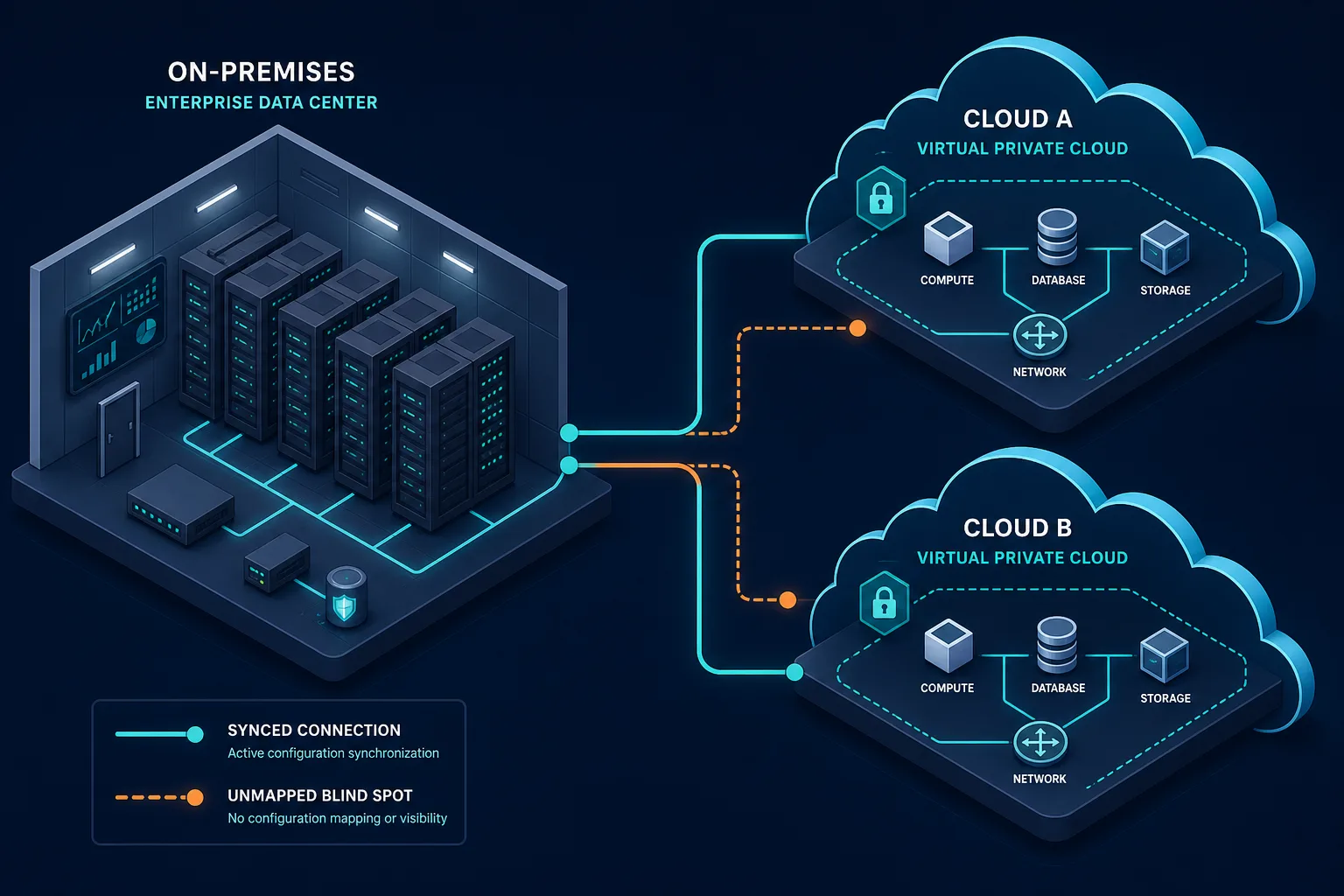
Operating across distributed footprints introduces intricate network architecture variations. Understanding these variations requires evaluating hybrid and multi-cloud network topologies to understand how private and public subnets connect. Hybrid cloud discovery unifies disparate environments by scanning assets across cloud accounts, private hypervisors, physical racks, and software platforms into one coherent data structure.
A mature discovery program relies on high-frequency scheduled discovery cycles rather than sporadic manual reviews. Scheduled scans reconcile configuration drift by collecting live infrastructure attributes, identifying orphaned virtual machines, and mapping operational dependencies.
The hidden problem
Most organizations attempt to track hybrid environments using siloed departmental tools that create operational blind spots.
| Operational Situation | What Happens on the Ground |
|---|---|
| Teams reconcile on-premises inventory quarterly by hand | Cloud virtual machines spin up and terminate between cycles, leaving configuration databases obsolete within days |
| Cloud engineering audits workloads using native provider consoles | Configuration items remain siloed inside isolated dashboards, preventing teams from identifying dependencies that cross between private racks and cloud VPCs |
| Discovery operates as an isolated annual clean-up project | Unapproved software subscriptions, temporary cloud instances, and forgotten test environments quietly accumulate immediately after project closure |
| Configuration managers manually merge disparate discovery spreadsheets | Systems administrators spend ten to fifteen hours every week deduplicating spreadsheet records instead of fixing production dependencies |
When infrastructure teams operate without a central operational baseline, configuration errors go unnoticed until systems fail. Technology leaders often evaluate hybrid cloud asset management frameworks to bridge the gap between static asset ledgers and live cloud infrastructure.
What is hybrid cloud asset discovery?
Hybrid cloud asset discovery is the automated, scheduled process of identifying, cataloging, and mapping hardware, virtual instances, and software dependencies across on-premises data centers, private clouds, and public cloud providers. It consolidates disparate infrastructure data into a normalized configuration baseline.
Why hybrid cloud asset discovery matters for Atlanta enterprises
Operating in the Atlanta metropolitan area presents distinct economic, regulatory, and technical considerations. The IBM Cost of a Data Breach Report 2024 documented that the average data breach expense in the United States climbed to $11.5 million per incident. This represents the highest national average worldwide, driven largely by forensic investigations and prolonged operational downtime.
Cloud security research published by the Cloud Security Alliance evaluating enterprise environments revealed that 29 percent of organizations run workloads possessing a toxic cloud combination. These workloads combine public internet exposure, unpatched critical vulnerabilities, and excessive administrative privileges simultaneously. In unmapped environments, engineering teams rarely recognize these vulnerable configurations until external actors exploit them.
Atlanta represents a major economic hub for transaction processing and healthcare administration. Research from the Technology Association of Georgia shows that Georgia-headquartered fintech firms process more than two-thirds of all annual payment transactions across the United States. This concentrated payments corridor, known as Transaction Alley, requires rigorous compliance with payment card security mandates. When fintech payment switches and healthcare electronic records operate across mixed environments, unmapped digital assets expose organizations to substantial regulatory liabilities.
Reviewing industry benchmarks in IT asset management statistics reveals that unmanaged infrastructure directly correlates with higher operational expenditure and extended incident resolution cycles.
Where hybrid estates quietly drift
- Discovery operates as an episodic milestone rather than a scheduled operational practice. Engineering teams scan environments before annual audits, assuming configuration baselines remain stable. Cloud teams deploy microservices, modify security groups, and decommission virtual storage weekly. Consequently, the configuration database accurately reflects infrastructure on audit day but drifts into obsolescence within weeks.
- Infrastructure teams run separate discovery tools across cloud accounts and on-premises racks. Systems administrators scan physical data centers with legacy network interrogators while cloud engineers monitor workloads inside proprietary cloud dashboards. Discovered records use incompatible naming taxonomies, missing cross-environment identifiers. This divergence prevents configuration items from reconciling into a shared schema, breaking application dependency mapping at the hybrid boundary.
- Product development teams spin up unapproved cloud accounts outside central governance. Engineers provision temporary staging environments using corporate credit cards to bypass service desk procurement queues. Teams frequently abandon these virtual instances without terminating public endpoints or revoking administrative credentials. As a direct consequence, security operations teams encounter unmanaged internet-facing instances during incident investigations rather than finding them beforehand.
- Discovered asset intelligence remains isolated outside daily change management workflows. Network discovery tools capture port numbers and firmware revisions but fail to synchronize updates with central service desk records. Change advisory boards review deployment requests using outdated infrastructure diagrams. This blind spot leads change managers to approve production updates without visibility into hidden software dependencies, triggering major system outages.
Why does hybrid cloud asset discovery matter for Atlanta enterprises?
Atlanta enterprises operate in dense data center clusters and heavily regulated industries like fintech and healthcare. Hybrid cloud asset discovery eliminates unmonitored infrastructure blind spots across on-premises and multi-cloud environments, ensuring regulatory compliance and preventing configuration drift that leads to outages.
Who pays for an unmapped hybrid estate?
When hybrid environments lack automated visibility, different technical and business leaders shoulder significant organizational burdens.
For CTOs and architecture leaders
Chief Technology Officers must balance rapid digital innovation with systemic architecture resilience. When software development teams build distributed applications across hybrid environments, unmapped configuration drift creates operational instability. The toxic cloud combinations identified in industry security research frequently occur when engineers adjust cloud storage permissions without evaluating downstream impacts. Without authoritative discovery, architecture leaders lack visibility into which legacy systems connect to new cloud microservices.
For CMDB owners
Configuration Management Database owners bear direct responsibility for infrastructure data integrity, yet their roles rarely carry executive enforcement mandates. In hybrid architectures, configuration records fragment across VMware clusters, AWS accounts, and on-premises server rooms. When discovery runs irregularly, configuration managers spend significant time reconciling conflicting spreadsheets, only to see records degrade as cloud workloads change. Understanding why a CMDB without discovery turns into a stagnant data repository helps organizations prioritize automated data collection.
For SecOps teams
Information security engineers cannot defend digital assets they do not know exist. Visibility gaps in vulnerability management programs leave security analysts blind to exposed ports and unpatched operating systems. Security Information and Event Management systems trigger alerts containing naked IP addresses, forcing incident responders to search disparate network consoles to identify system owners. Deploying dedicated cybersecurity asset management software enables security teams to correlate asset records with vulnerability intelligence, identifying unmanaged endpoints before threats materialize.
For Atlanta’s regulated industries (fintech and healthcare)
Organizations operating within Atlanta’s fintech corridor and regional healthcare networks navigate stringent compliance mandates. The Flexera State of ITAM Report revealed that 44 percent of enterprises spent more than $1 million defending software vendor audits over three years. The same research documented that complete IT asset visibility dropped to just 36 percent of surveyed organizations.
Atlanta payment processors subject to PCI DSS Requirement 9 and Requirement 12 must maintain detailed inventories of all hardware, virtual machines, and software components touching cardholder data environments. Simultaneously, regional healthcare providers complying with HIPAA Security Rule guidelines must document every electronic protected health information repository. In these regulated sectors, maintaining an accurate healthcare IT asset management program supports compliance baselines across clinical and administrative systems.
Preparing for formal regulatory assessments requires mastering CMDB audit essentials to ensure configuration records satisfy external auditor inquiries. In regulated sectors, the configuration database serves as the operational infrastructure layer supporting technical controls, rather than replacing formal compliance mechanisms.
Establishing governance across complex estates requires modern organizations to establish Trusted Runtime Truth across their digital operations. This operational framework answers what exists, how it is connected, what changed, what will break, and who owns it across both physical and virtual assets.
How hybrid cloud asset discovery fixes this
Resolving enterprise visibility blind spots requires moving beyond fragmented spreadsheets and manual audit exercises. Modern infrastructure governance relies on three core operational pillars:
- Discover with authority across on-premises data centers, AWS, and Azure in one unified model. Hybrid cloud asset discovery replaces isolated scanning scripts with end-to-end coverage. Virima combines agentless network interrogations, lightweight endpoint sensors, and direct cloud API integrations to capture running instances, hardware profiles, and installed software. Discovered assets normalize into a shared data structure, ensuring workloads maintain identical attribute definitions whether running in a private data center or an AWS VPC. Explore full IT discovery capabilities to see how automated scanning bridges hybrid silos.
- Understand in context to keep the configuration database current instead of stale between audits. High-frequency scheduled discovery scans run non-disruptive cycles across subnets and cloud subscriptions. Automated reconciliation rules detect when engineers provision virtual machines, alter network interfaces, or reassign IP addresses. Every discovered configuration item retains an authoritative timestamp and source pedigree, turning the central CMDB into a reliable source of operational truth.
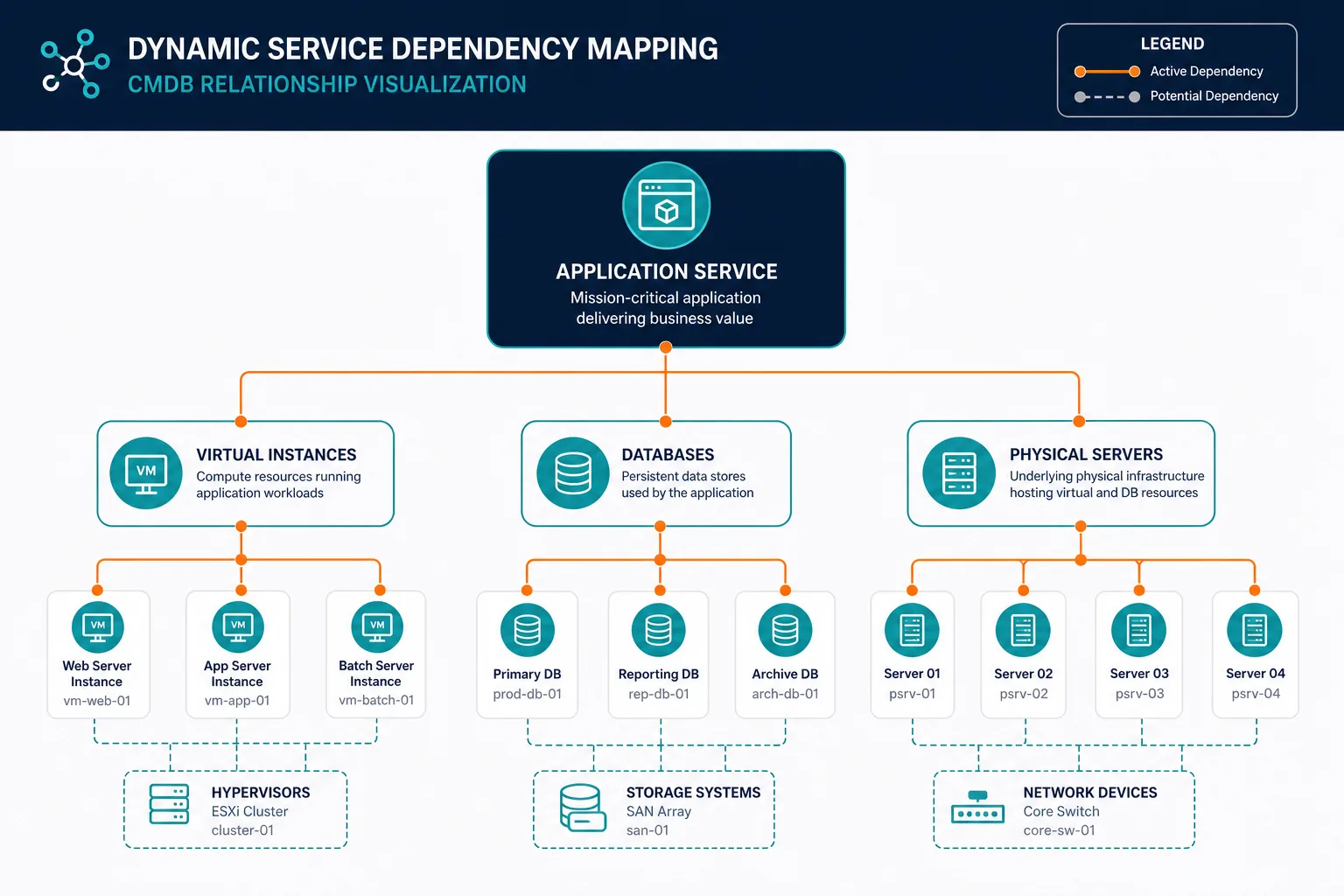
- Govern every action with live dependency and service mapping. Collecting isolated infrastructure inventories does not explain how systems interact during production incidents. Automated relationship mapping links hardware, virtual instances, databases, and application services into dynamic visual topologies. Through ViVID™ service maps, change managers and incident responders immediately see which business services depend on specific infrastructure components, understanding what will break before applying patches.
| Operational Dimension | Manual Spreadsheet Tracking | Scheduled Discovery-Driven Baseline |
|---|---|---|
| Discovery Cadence | Quarterly manual inventories or annual vendor audit reviews | High-frequency scheduled discovery cycles scanning weekly or daily |
| Multi-Cloud Visibility | Disconnected spreadsheets maintained in AWS, Azure, and vCenter | Unified configuration model normalizing attributes across environments |
| Dependency Mapping | Static network diagrams that grow outdated after the next release | Dynamic dependency maps showing live application and hardware connections |
| Audit Preparation | Weeks of emergency data collation and manual spreadsheet cross-referencing | Verified configuration records with authoritative timestamps available on demand |
How is hybrid cloud asset discovery different from a one-time CMDB audit?
A one-time CMDB audit captures a point-in-time snapshot that begins decaying immediately as cloud workloads and network configurations change. Hybrid cloud asset discovery operates on high-frequency scheduled cycles, continuously reconciling asset drift, verifying active endpoints, and updating dependency relationships automatically.
Hybrid cloud asset discovery in practice
Real-world operational scenarios illustrate how automated visibility transforms infrastructure management across enterprise teams.
A CTO catches a risky change before deployment.
An enterprise engineering team prepares to migrate a core customer billing service from an on-premises data center to an Azure cloud instance. Traditional configuration records indicate that the billing application connects solely to a modern cloud database. During pre-deployment change analysis, automated dependency mapping flags an active database query connecting to a legacy mainframe server located in a regional private facility. Recognizing this undocumented dependency allows the architecture team to re-architect the data flow before deployment, preventing an unexpected production outage during business hours.
A SecOps team locates an unregistered cloud workload.
During a scheduled morning vulnerability review, security analysts receive an automated alert detailing an unpatched Linux vulnerability exposing port 22 to the public internet. Instead of spending hours matching the flagged IP address against static server logs, analysts query their discovery console. The system immediately identifies the instance as an unapproved staging server provisioned in an auxiliary AWS region by an external contractor. The security team isolates the network interface and revokes active credentials within fifteen minutes of detection, eliminating exposure before external scanning engines discover the opening.
A CMDB owner eliminates weekly reconciliation cycles.
A configuration manager at a growing enterprise spends two full days every week manually comparing cloud export spreadsheets against on-premises IT service records. After implementing automated discovery across on-premises hypervisors and public cloud subscriptions, the system reconciles duplicate records using automated normalization rules. With high-frequency scheduled discovery verifying active configuration items, the configuration manager reallocates twelve hours weekly toward improving service dependency modeling and supporting change advisory board reviews.
An Atlanta fintech prepares for PCI DSS audits.
An Atlanta-based payment processing enterprise prepares for its annual PCI DSS assessment across hybrid transaction environments. In prior years, compliance officers spent six weeks requesting system exports from server administrators, network teams, and cloud architects to prove cardholder data environment boundaries. By maintaining scheduled hybrid discovery, the compliance team generates an audit-ready inventory of all connected systems, firmware revisions, and network interfaces in minutes. The documented discovery logs demonstrate continuous asset governance, satisfying external auditor scrutiny without disrupting daily development velocity.
How Virima powers hybrid cloud asset discovery for Atlanta enterprises
Enterprise organizations require purpose-built visibility solutions that integrate cleanly into existing operational ecosystems without introducing management friction.
Immediate operational impact
Deploying Virima across hybrid environments delivers thorough visibility from initial scan cycles. The platform combines agentless discovery, lightweight endpoint agents, and native cloud API connectors to scan on-premises server rooms, private virtual clusters, and public cloud environments including AWS and Azure. Because the discovery engine uses non-disruptive communication protocols, organizations identify active endpoints safely without impacting sensitive production workloads. Technology teams evaluate agentless asset discovery to catalog remote offices and cloud instances without software distribution overhead.
Long-term accuracy across distributed infrastructures
Maintaining configuration accuracy over months and years requires sophisticated data hygiene. Virima implements intelligent data normalization rules that resolve inconsistent naming conventions, duplicate IP assignments, and ephemeral cloud addresses into unified configuration records. Discovered attributes retain detailed audit logs showing discovery timestamps and source credibility scores. This continuous data governance allows technology leaders to manage cloud environments effectively, ensuring configuration databases mirror verified runtime reality.
Integration with existing enterprise ITSM frameworks
Large enterprises maintain significant investments in established service management platforms. Rather than requiring teams to abandon existing consoles, Virima functions as an authoritative discovery and data normalization engine that synchronizes bidirectionally with leading ITSM systems. The platform integrates out of the box with ServiceNow, Jira Service Management, Ivanti, HaloITSM, Xurrent, and Hornbill.
For organizations running enterprise service desks, deploying Virima for ServiceNow hybrid discovery enriches standard incident, problem, and change management forms with verified hybrid asset data. Incident responders view live infrastructure context directly inside active tickets, accelerating root-cause analysis without toggling between disconnected administration portals.
How does hybrid cloud asset discovery support compliance for Atlanta fintech and healthcare organizations?
Hybrid cloud asset discovery establishes an authoritative, timestamped baseline of every physical, virtual, and cloud asset processing sensitive data. This provides the verifiable infrastructure documentation required by PCI DSS and HIPAA controls, proving to auditors that cardholder and patient data environments contain no unmapped endpoints.
Moving from spreadsheet-era tracking to discovery-driven visibility
Transitioning from manual inventory tracking to automated discovery establishes sustainable infrastructure hygiene across expanding hybrid enterprises.
| Traditional Manual Practice | Modern Discovery-Driven Operations |
|---|---|
| Disconnected teams maintain separate spreadsheets for private racks and cloud workloads | A single normalized configuration model unifies assets across on-premises, AWS, and Azure |
| Inventories undergo manual reconciliation before scheduled annual audit reviews | High-frequency scheduled discovery scans verify active workloads on recurring schedules |
| Incident investigation teams guess system dependencies using static network diagrams | Dynamic service maps display live application, infrastructure, and change relationships |
Operational benefits across enterprise teams
IT operations teams eliminate manual spreadsheet collation, gaining real-time confidence in infrastructure baselines during maintenance windows. At the same time, security and compliance analysts uncover shadow cloud accounts and unpatched endpoints before vulnerabilities become active enterprise incidents. For enterprise architects, dynamic service dependency topologies make it possible to evaluate cloud migrations thoroughly without disrupting dependent business functions.
Getting started in 5 practical steps
- Establish your current inventory baseline by documenting existing data sources across VMware consoles, cloud subscription portals, and network hardware records.
- Deploy agentless and API-based discovery scans across initial network subnets and cloud accounts to identify uncataloged configuration items safely.
- Configure normalization and reconciliation rules to merge duplicate records, standardize operating system names, and resolve overlapping network addresses.
- Synchronize discovered configuration items with your central ITSM platform to enrich daily change management, incident response, and service desk workflows.
- Establish automated recurring scan schedules to detect configuration drift, unapproved cloud instances, and decommissioned assets systematically.
If your configuration records have not undergone automated verification against your live hybrid estate this quarter, unmonitored infrastructure blind spots are already accumulating. Review how Virima IT Discovery unifies physical, virtual, and cloud workloads into an authoritative, audit-ready operational record.
Frequently Asked Questions
What is hybrid cloud asset discovery?
Hybrid cloud asset discovery is the automated, scheduled process of identifying, cataloging, and mapping hardware, virtual instances, and software dependencies across on-premises data centers, private clouds, and public cloud providers. It consolidates disparate infrastructure data into a normalized configuration baseline.
Why does hybrid cloud asset discovery matter for Atlanta enterprises specifically?
Atlanta enterprises operate in dense data center clusters and heavily regulated industries like fintech and healthcare. Hybrid cloud asset discovery eliminates unmonitored infrastructure blind spots across on-premises and multi-cloud environments, ensuring regulatory compliance and preventing configuration drift that leads to outages.
What is a real-world example of hybrid cloud asset discovery in practice?
A common example occurs when an enterprise prepares a cloud migration. Automated discovery and service mapping uncover an undocumented dependency between a cloud application and an on-premises database, allowing engineers to resolve the connection before deployment and prevent a production outage.
Does Virima’s hybrid discovery integrate with ServiceNow and other ITSM platforms?
Yes. Virima integrates out of the box with ServiceNow, Jira Service Management, Ivanti, HaloITSM, Xurrent, and Hornbill. Discovered configuration items and dependencies synchronize bidirectionally, enriching incident, problem, and change workflows with authoritative hybrid cloud asset discovery data.
How does Virima discover assets without disrupting production workloads?
Virima uses scheduled agentless scanning protocols and direct cloud API integrations across AWS, Azure, and private hypervisors. This non-intrusive approach captures granular configuration details, active ports, and service dependencies without degrading workload performance or requiring custom agents across every endpoint.