Why Your Construction Asset Management Software Doesn’t See Half Your Risk

In April 2024, Chicago general contractor Skender disclosed a ransomware incident that reached employee personal data. ENR, citing Zurich Resilience Solutions, uses that case alongside 2025 sector volume to show how construction remains a prime ransomware target. The pattern is familiar: digital project tools, multi-party access, and connected field gear expand the surface faster than inventory practices keep up.
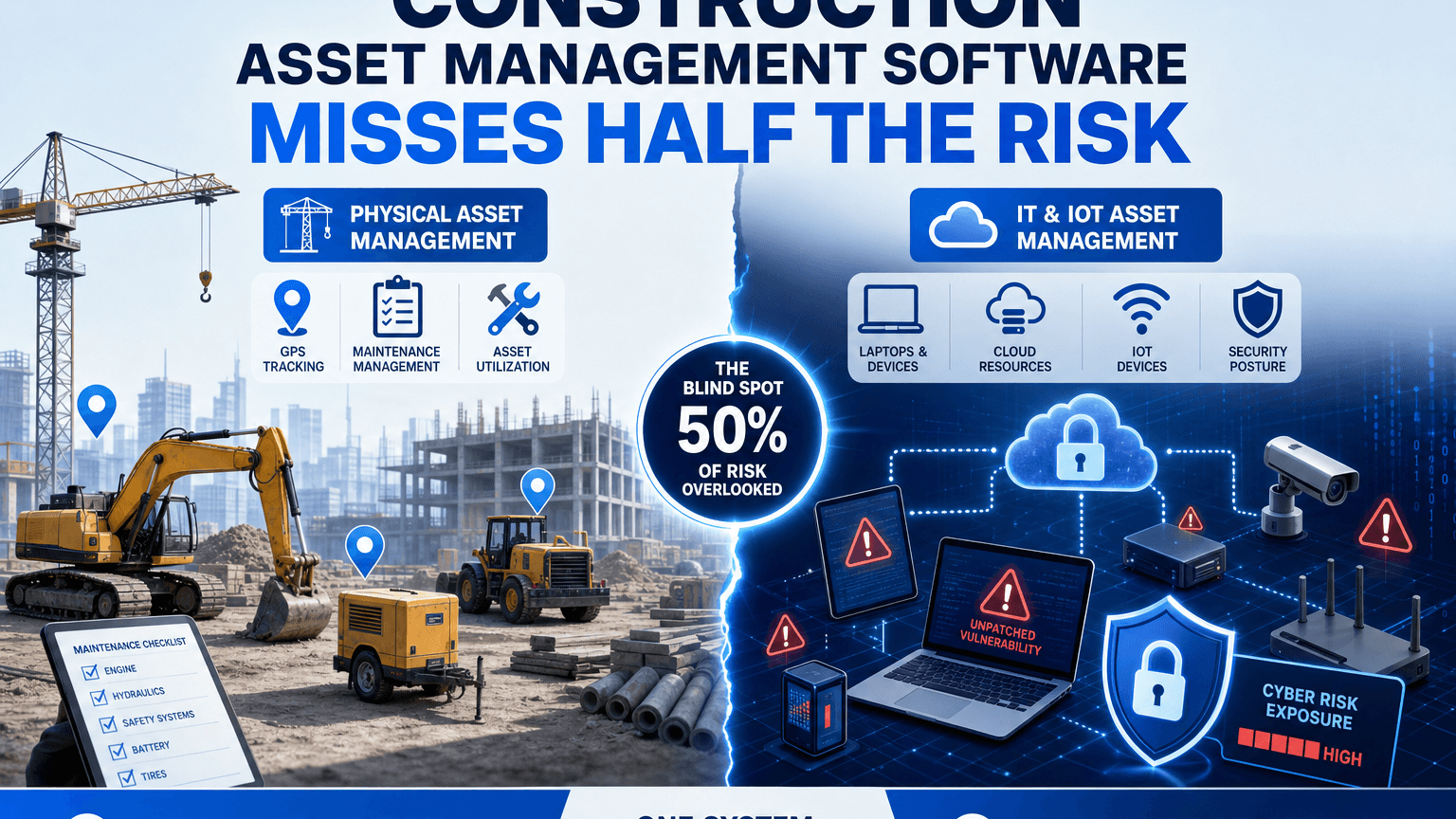
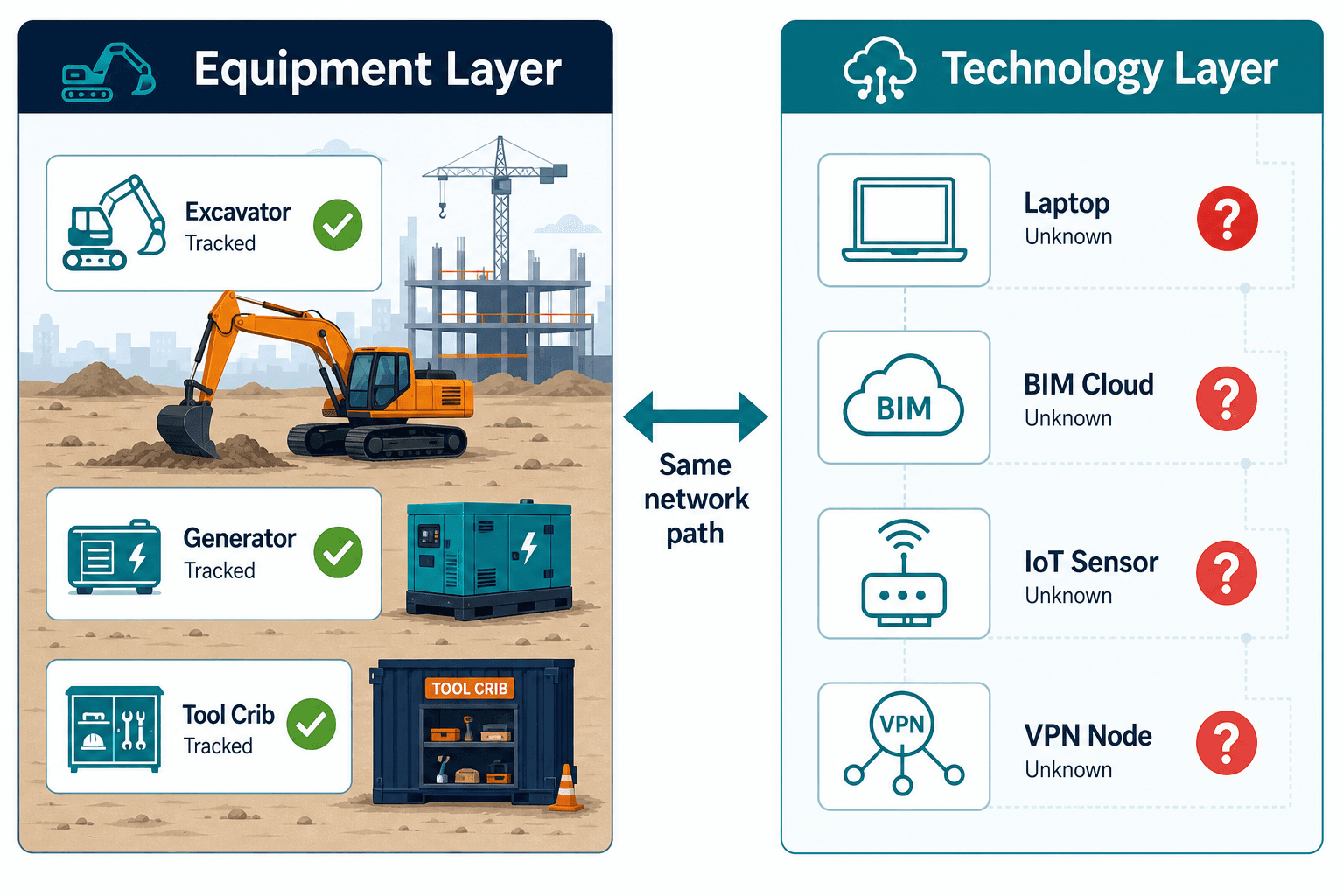
Most construction firms already run construction asset management software for the physical side of the job. Cranes, fleet, tools, and materials sit in equipment systems with GPS, RFID, check-in workflows, utilization dashboards, and maintenance schedules. That stack answers where the excavator is, who checked out the generator, and when the next service is due. Field teams and project controllers trust it every day.
The same jobsites also run on laptops, tablets, BIM and scheduling SaaS, cloud project platforms, VPN identities, cameras, and IoT sensors bolted to the equipment those trackers already log. Ransomware crews and insurer questionnaires hit that technology layer first. The attack path rarely starts on a dozer. It starts on a shared project platform, a subcontractor laptop, a default-password sensor, or a cloud seat nobody owns.
That split is the half of risk construction asset management software still leaves dark. This article separates what the equipment category actually covers from the technology inventory gap underneath it, why the gap shows up in breach cost and offboarding failures, and how discovery-sourced CMDB context closes it without replacing the fleet tools the field already uses.
What is construction asset management software (and what it actually covers)?
Construction asset management software is the category built for physical plant on and between job sites. Its core job is to track heavy equipment, tools, fleet, and materials; schedule maintenance; report utilization; and push cost data into ERP or accounting. Typical capabilities include check-in and check-out, geofencing or GPS location, work-order-style maintenance, barcode or RFID tagging, and offline mobile capture when the trailer has weak signal.
That category is real and valuable. It answers where the excavator is, who checked out the generator, and when the next service is due. It does not answer which laptop joined jobsite Wi-Fi last week, which BIM seat a project manager bought on a card, or which IoT gateway still talks outbound with factory credentials.
The hidden problem
| Situation | What physical asset tools do | What actually happens |
|---|---|---|
| A new IoT sensor ships with a telematics unit | Logs the equipment it is bolted to | The sensor firmware, network credentials, and data path stay off any IT system of record |
| A subcontractor laptop joins jobsite Wi-Fi | Outside category scope | An unmanaged endpoint with no owner of record sits on the same path as project files |
| A PM buys a BIM or scheduling SaaS seat | Not tracked | License sprawl and shadow IT accumulate by project with no central install truth |
IT asset management covers hardware, software, cloud accounts, and life cycle ownership for technology. Equipment asset management covers capital plant and tools. Mixing the labels creates false confidence. A firm can score green on equipment utilization and still fail a basic question from security or insurance: list every connected device and SaaS identity that can reach project data.
Virima does not replace fleet or equipment trackers. Those products own physical plant. Virima owns discovery-sourced inventory and configuration context for the technology layer those tools, and everything else on the network, depend on.
What does construction asset management software cover versus IT asset inventory?
Construction asset management software covers equipment, tools, fleet, and materials with GPS, RFID, check-out, and maintenance. IT asset inventory covers endpoints, servers, cloud accounts, software installs, and IoT or OT-adjacent devices with ownership and dependency context. Both layers are required on a modern jobsite.
Why technology asset visibility matters on a construction job site
Construction digitalized faster than many security programs could follow. Rapid7’s November 2025 sector series places building and construction among the top three most attacked sectors in 2025, with Play, Akira, Qilin, and peer groups active against U.S. firms first. The companion piece on initial access, supply chain, and IoT ties exposure to BIM platforms, cloud project tools, and third-party credentials. It also flags IoT-enabled machinery that often ships with weak authentication and unpatched firmware.
ENR’s March 2026 brief with Zurich Resilience Solutions reports that in a September 2025 ransomware surge, construction and engineering made up 11.4% of victims, the most impacted sector in that window. The same brief pulls IBM Cost of a Data Breach 2025 cost deltas that map cleanly to multi-subcontractor jobsites:
- Roughly $175,010 more when an IoT or operational technology (OT) environment is involved in the breach
- About $200,321 more when shadow AI is in play
- About $227,244 more when the breach originates in the supply chain
IBM’s own Cost of a Data Breach 2025 insights separately flag shadow AI in one in five studied breaches and weak access controls in nearly all AI-related cases studied. None of those cost drivers are fixed by knowing the serial number on a skid steer.
Where equipment-only tracking breaks down
These blind spots follow a pattern:
- a terminated subcontractor’s VPN or RDP credentials that stay live for months because no inventory lists who still has access
- a jobsite IoT sensor or camera that never enters patch or credential hygiene because it sits outside any system of record, the exact OT/IoT asset discovery gap CISA and partners warned about in their August 2025 asset inventory guidance
- two project managers buying the same scheduling SaaS under different cost codes, so finance sees duplicate spend while security sees two unmanaged identity planes.
None of these show up in a check-out log.
Why are construction firms high ransomware targets in 2025?
Rapid7 ranks construction among the top three attacked sectors in 2025. Tight project deadlines, multi-party supply chains, legacy systems, and fast adoption of BIM, cloud tools, and IoT expand the attack surface. Attackers exploit urgency and third-party paths more than any single equipment gap.
What an unmanaged technology layer costs you
For operations leaders
Ransomware against construction is not an abstract cyber story. Rapid7 documents how even short outages halt schedules, trigger penalties, and push firms toward fast payment under deadline pressure. Equipment systems keep logging machine hours while the scheduling platform, file share, or identity path is offline. Ops feels the stoppage in days of crew idle time, not in a CMDB chart.
For IT and ops managers who own the inventory function
Without a single discovery-backed record, staff rebuild spreadsheets per region: which tablets still VPN in, which cameras hang off the trailer switch, which SaaS seats belong to closed jobs. That work repeats after every project closeout. Hours go to hunting, not to hardening.
For finance and procurement
Construction Dive has long documented rising app use with weak integration across contractor stacks. When purchases stay project-local, a pattern of shadow IT in construction procurement emerges — the same category of tool appears three times under three POs. License truth never meets install truth, so renewals renew noise.
Market-scale pressure
Digital tools only pay off when adoption is governed. Ungoverned sprawl means more seats, endpoints, and sensors with the same blind spots: duplicate SaaS, longer incident triage, and weaker answers when cyber insurers ask for asset inventory evidence. Virima’s cybersecurity asset management guide frames inventory as the control other controls assume exists, the same logic behind cybersecurity asset management for construction firms managing multi-subcontractor risk.
Closing the technology asset gap in construction
Three mechanisms close the gap without throwing out the equipment stack the field already trusts.
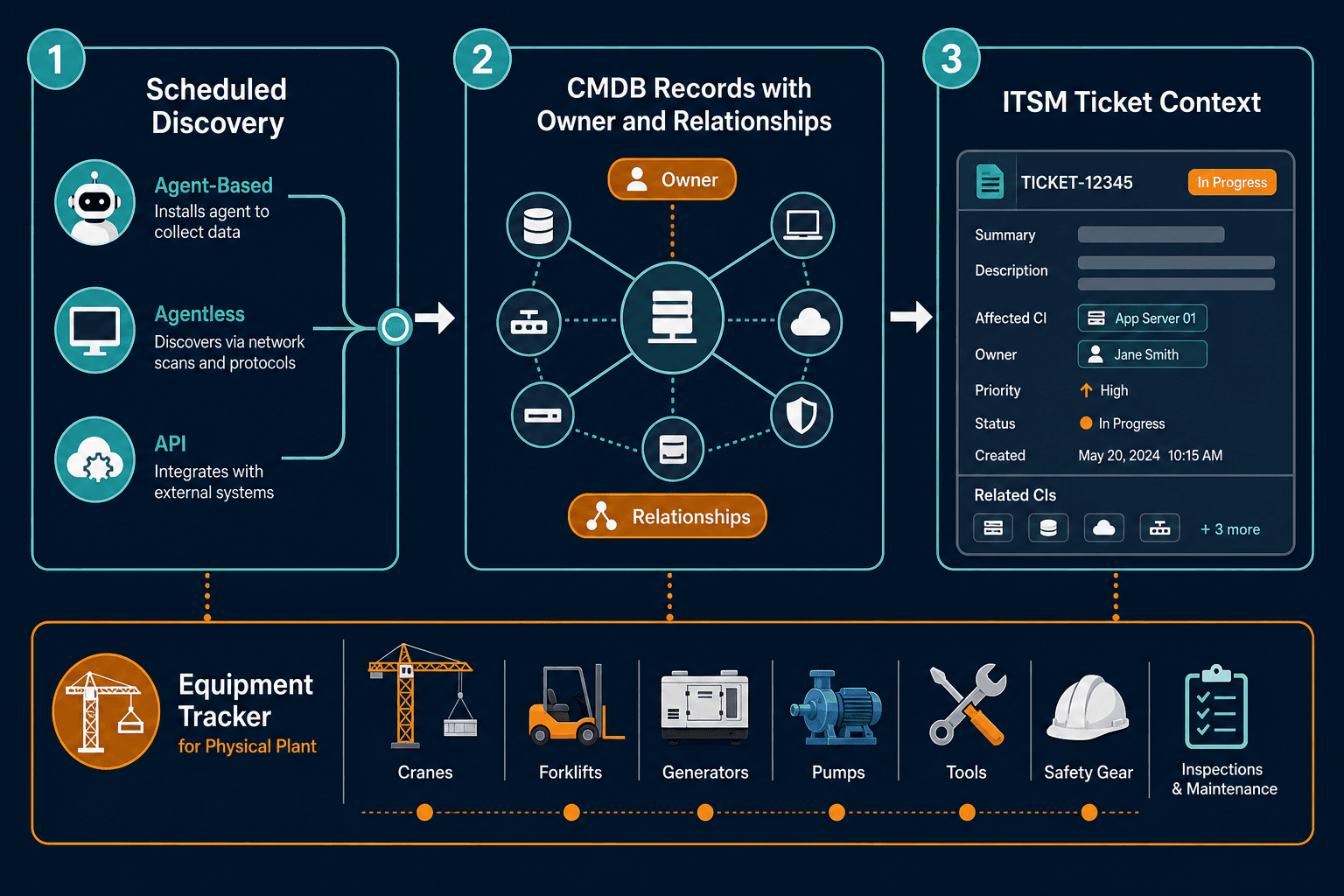
- High-frequency scheduled discovery across hybrid environments. Agent-based, agentless, and API discovery find hardware, software installs, cloud resources on AWS and Azure, and network-visible devices on a defined cadence. Not every jobsite endpoint needs an agent on day one. Agentless and API paths cover what rotating crews will not babysit. See active versus passive discovery for method tradeoffs. Product note: Virima runs scheduled discovery cycles, not passive continuous event streams.
- A CMDB with ViVID™ service maps. Once service definitions are provided (manual, spreadsheet, or architecture import), Virima builds dependency maps so an ops lead can see what a device connects to before anyone yanks it. That is configuration and impact context, not a second fleet GPS.
- ITSM integration. Discovery data should land where tickets already live. Virima integrates with major ITSM platforms including ServiceNow, Jira Service Management, and Ivanti, through one hub for all integrations. Construction IT teams keep their request path; inventory stops living only in a side spreadsheet.
Manual tracking versus automated discovery plus CMDB
| Manual/spreadsheet tracking | Automated discovery + CMDB | |
|---|---|---|
| New device on jobsite Wi-Fi | Found only if someone notices | Surfaced on the next scheduled scan |
| Subcontractor offboarding | Relies on memory to revoke access | Ownership and last-seen fields flag stale accounts |
| Audit prep | Manual reconciliation by region | Exportable, discovery-sourced record |
How should construction firms inventory technology without replacing equipment software?
Keep equipment platforms for fleet, tools, and maintenance. Add high-frequency scheduled discovery and a CMDB for endpoints, cloud accounts, software installs, and IoT or OT-adjacent devices. Feed that record into the existing ITSM tool so offboarding and audit work use one source of truth.
Construction technology asset management in practice
These are composite operating patterns, not named customer claims.
- Unmanaged tablets after closeout. A regional GC finds jobsite tablets still on corporate VPN two months after demobilization. Equipment check-out closed cleanly. Identity and endpoint inventory never did.
- Duplicate scheduling seats. An IT lead reconciles licenses across five active projects and finds two PMs bought the same tool under separate cost codes. Install discovery shows both. Procurement only saw one renewal conversation.
- Ownerless IoT after phishing. A security review after a phishing event turns up a network camera with no listed owner and default admin still enabled. Rapid7’s IoT write-up flags weak authentication and unpatched firmware as common construction device traits.
None of these failures mean the equipment tracker failed. They mean the technology half of the estate never entered a system of record with owners and last-seen dates.
Virima finds the devices nobody else is tracking
Virima’s job on a construction estate is narrow: discover what is connected and installed, hold authoritative configuration records, map dependencies once services are defined, and push that truth into the ITSM stack the firm already runs.
Immediate operational impact. Multi-site footprints stop depending on quarterly spreadsheet campaigns. Scheduled discovery returns a current hardware and software picture for a pilot region, then repeats on cadence so closed projects do not leave ghost endpoints.
Long-term accuracy. Discovery-sourced records age on a known schedule. Audit prep becomes a delta review against the last successful cycle, not a from-scratch rebuild.
Patterns with ServiceNow, Jira Service Management, and Ivanti mean construction IT does not stand up a parallel ticketing world. Practitioners who already live in those queues get configuration context on the same screen, which matters most on the job sites IBM’s 2025 data flags as highest-cost. Supply-chain-originated breaches run roughly $227,244 higher, exactly the multi-subcontractor pattern ITSM-integrated discovery is built to shrink.
For ServiceNow-centered teams, CMDB software patterns for ServiceNow users show how augmentation beats rip-and-replace.
When you need the category frame for trusted operational context, start with Trusted Runtime Truth: what exists, how it connects, what changed, what breaks, and who owns it.
Get the Construction Technology Asset Visibility Checklist: the 5 steps to find every laptop, cloud seat, and sensor your equipment tools never logged. Download the Checklist.
Virima is not a replacement for construction asset management software that tracks equipment and tools. It is the technology inventory and configuration layer those platforms, and the rest of the jobsite network, sit on.
Moving from equipment-only tracking to full asset visibility
Two shifts change the risk picture: equipment tracking alone becomes equipment tracking plus a technology-asset system of record, and reactive audit prep from spreadsheets becomes discovery-sourced inventory refreshed on a known cadence.
Benefits cascade
Fewer orphaned accounts after demobilization lower the chance of long-lived credentials after a sub leaves. Lower breach exposure follows when IoT and endpoints enter patch and access hygiene instead of living as unnamed ports. Cleaner audit and insurance conversations follow when inventory evidence is exportable and dated, not reconstructed under deadline.
Getting started
- List what equipment software already tracks versus what it never will (endpoints, SaaS, cloud, sensors).
- Run a discovery pilot on one region or active project.
- Reconcile software licenses against discovered installs across open jobs.
- Assign ownership for IoT and OT-adjacent devices on the network.
- Connect discovery output into the ticketing system already in use.
Life cycle discipline for technology assets still matters after the first scan. Pair the pilot with a clear asset life cycle management process so procurement, assignment, and retirement stay joined to discovery.
See the technology half of the jobsite before the next closeout
Equipment systems will keep doing their job: utilization, maintenance, and location for physical plant. The open question is whether IT and security can name every laptop, cloud seat, and sensor that can touch project data this quarter. If that list only exists in tribal knowledge, half the risk stays invisible by design.
Request a demo and walk one pilot region through discovery, CMDB records, and ITSM context. Keep the construction asset management software you trust for tools and fleet. Add the technology inventory layer those tools never claimed to own.
Frequently Asked Questions
What is construction asset management software?
Construction asset management software tracks physical assets such as equipment, tools, fleet, and materials across job sites. Core functions include check-in and check-out, GPS or RFID location, maintenance scheduling, utilization reporting, and links to ERP or accounting. It is built for plant and tools, not full IT inventory.
Why does IT asset visibility matter for construction companies?
Construction ranks among the most attacked sectors, with ransomware groups exploiting BIM, cloud tools, subcontractors, and IoT. Without IT asset visibility, firms cannot revoke access after demobilization, patch unnamed sensors, or prove inventory to auditors and insurers. Equipment trackers do not close those gaps.
What construction technology assets typically go untracked?
Common gaps include subcontractor laptops on jobsite Wi-Fi, project-bought SaaS seats, cloud accounts for scheduling and document tools, IoT sensors and cameras, VPN identities after closeout, and BIM platform access shared across partners. None of these appear in a standard equipment check-out log.
How is a CMDB different from an equipment-tracking tool?
An equipment tracker records physical plant location, utilization, and maintenance. A configuration management database (CMDB) holds technology configuration items with relationships, ownership, and change context. Construction teams need both: one for capital plant, one for the systems that carry project data and access.
How does Virima fit alongside existing construction equipment-tracking software?
Virima does not replace equipment or fleet platforms. It discovers and inventories the technology layer: endpoints, software, cloud resources, and network-visible devices, then maps dependencies and feeds ITSM tools such as ServiceNow, Jira Service Management, and Ivanti. Keep the field tool for plant; add Virima for technology truth.