IT Asset Discovery for Hybrid Financial Services in New York

A Sunday change freeze on a Midtown trading stack rarely breaks on the server named in the ticket. It breaks on a cloud instance spun up for a weekend fix, a colocation switch nobody refreshed in the CMDB (configuration management database), or a vendor jump box that still routes to production. New York banks, brokers, and insurers run hybrid estates by design. Core systems stay on-prem or in regulated facilities while analytics, disaster recovery, and newer apps land on AWS and Azure. When discovery only samples one side of that split, IT asset discovery for financial services hybrid environments has to close both gaps at once. Otherwise risk, change, and exam prep all inherit the same blind spot.
This guide frames that hybrid discovery problem with a New York operating lens. It covers why hybrid ownership fragments inventory, how NYDFS-era expectations raise the bar on living asset lists, and how discovery-sourced CMDB records support change impact without inventing service maps from thin air.
Why hybrid financial estates defeat single-source inventory
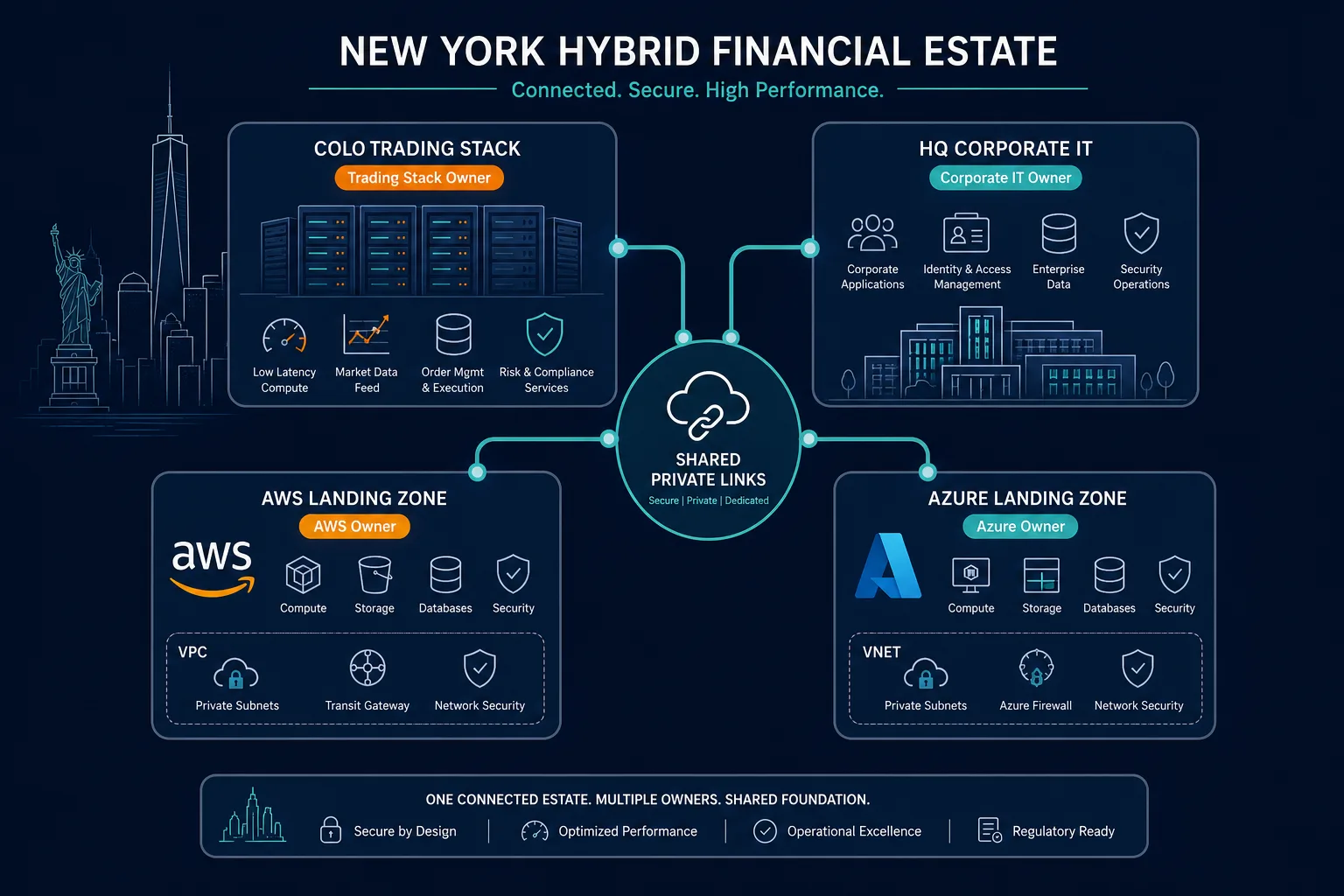
Standard asset programs assume one data center authority and one cloud bill owner. New York financial firms break both assumptions. Markets technology, risk platforms, and core banking often sit under different change boards. Cloud landing zones grow under product squads that never file a hardware request. Colocation cages and private links still carry latency-sensitive traffic while cloud accounts multiply for sandboxes, DR, and vendor-hosted workloads.
Three inventory layers form and rarely reconcile on their own. The first layer is traditional enterprise IT: identity, messaging, branch and HQ networks, and owned data centers. The second layer is markets and payments infrastructure that cannot miss a settlement window.
The third layer is cloud and SaaS-adjacent compute that appears faster than quarterly true-ups can track. When discovery only runs inside known on-prem ranges, the other layers stay as tickets and chat threads until an outage or an examiner forces a scrub.
That gap shows up beyond anecdote. Flexera’s 2025 State of ITAM report found that visibility across the technology stack remains under pressure even as cost scrutiny rises, with hybrid cloud complexity cited as a driving factor. The report is based on a survey of 506 global IT professionals (Flexera, 2025). The operational cost shows up before the exam room, too.
Cascades often start on an unmanaged edge system rather than the named production cluster. Discovery that only refreshes after major projects will miss the next emergency scale-out and the next temporary interface host. High-frequency discovery cycles across on-prem, colo, AWS, and Azure ranges reduce that surprise before the change advisory board meets.
When partial inventories still drive weekend changes, start with Trusted Runtime Truth and pressure-test whether your discovery scope matches the hybrid estate you already run.
What makes IT asset discovery for financial services hybrid environments harder than single-site inventory?
Hybrid financial estates split ownership across core platforms, markets tech, and cloud product teams, so one procurement path and one CMDB owner rarely exist. Emergency cloud instances and colo gear join outside central buying. Discovery must cover on-prem and cloud on a shared schedule or inventory debt compounds until outage or exam forces a manual scrub.
New York regulatory pressure meets multi-cloud reality
IT asset discovery for New York financial services now sits inside a specific compliance timeline, not just good practice. Covered New York financial entities already treat cybersecurity program design as board-level work under 23 NYCRR Part 500. The New York Department of Financial Services cybersecurity resource center remains the public home for Part 500 requirements and related guidance. Covered entities became subject to the asset-inventory maintenance provisions on November 1, 2025, and must first certify compliance in the annual filing due April 15, 2026 — turning a living, hybrid-wide inventory into a certification requirement rather than a best practice. Virima’s breakdown of NYDFS 500 and PCI DSS obligations covers where the same CMDB evidence can satisfy both frameworks for New York payment and financial firms. Even while counsel debates fine print, CIOs and CISOs still need living technology inventories that cover hybrid footprints, not annual spreadsheet exports from one division.
Hybrid design complicates that ask every week. A workload that processes nonpublic information in a private cloud one quarter may move to a new Azure subscription the next after a vendor swap. Temporary jump hosts for market events sit outside standard patch rings. DR runbooks name systems that no longer match last-seen discovery data. Inventory that only covers the mainframe farm or the primary colo cage will not answer leadership questions about the full estate that can affect confidentiality, integrity, or availability of customer and market data.
Discovery programs that support exam readiness produce more than a device count. They produce evidence of coverage: last-seen timestamps, method of discovery, owner, location or account, and relationship to known business services. Those fields turn an inventory into something risk committees can interrogate. They also give SecOps a place to hang vulnerability data from NVD lookups for Windows Server overlays without pretending every operating system is covered by one scanner. Pair discovery output with a CMDB health dashboard that surfaces unknown devices as a tracked backlog with an aging metric, not a silent gap nobody owns.
Teams already deep in financial services asset programs can connect this hybrid discovery scope to broader IT asset management for financial services practices so inventory feeds license, warranty, and control workflows instead of sitting in a silo.
How does IT asset discovery support NYDFS-era inventory work in hybrid banks?
Discovery feeds a living technology asset inventory with last-seen data, ownership, and placement across on-prem and cloud ranges. That inventory supports risk analysis and Part 500 program evidence needs around technology assets. Single-division spreadsheet exports cannot show whether emergency cloud nodes still sit adjacent to systems that handle nonpublic information.
What high-frequency discovery must cover in NY hybrid stacks
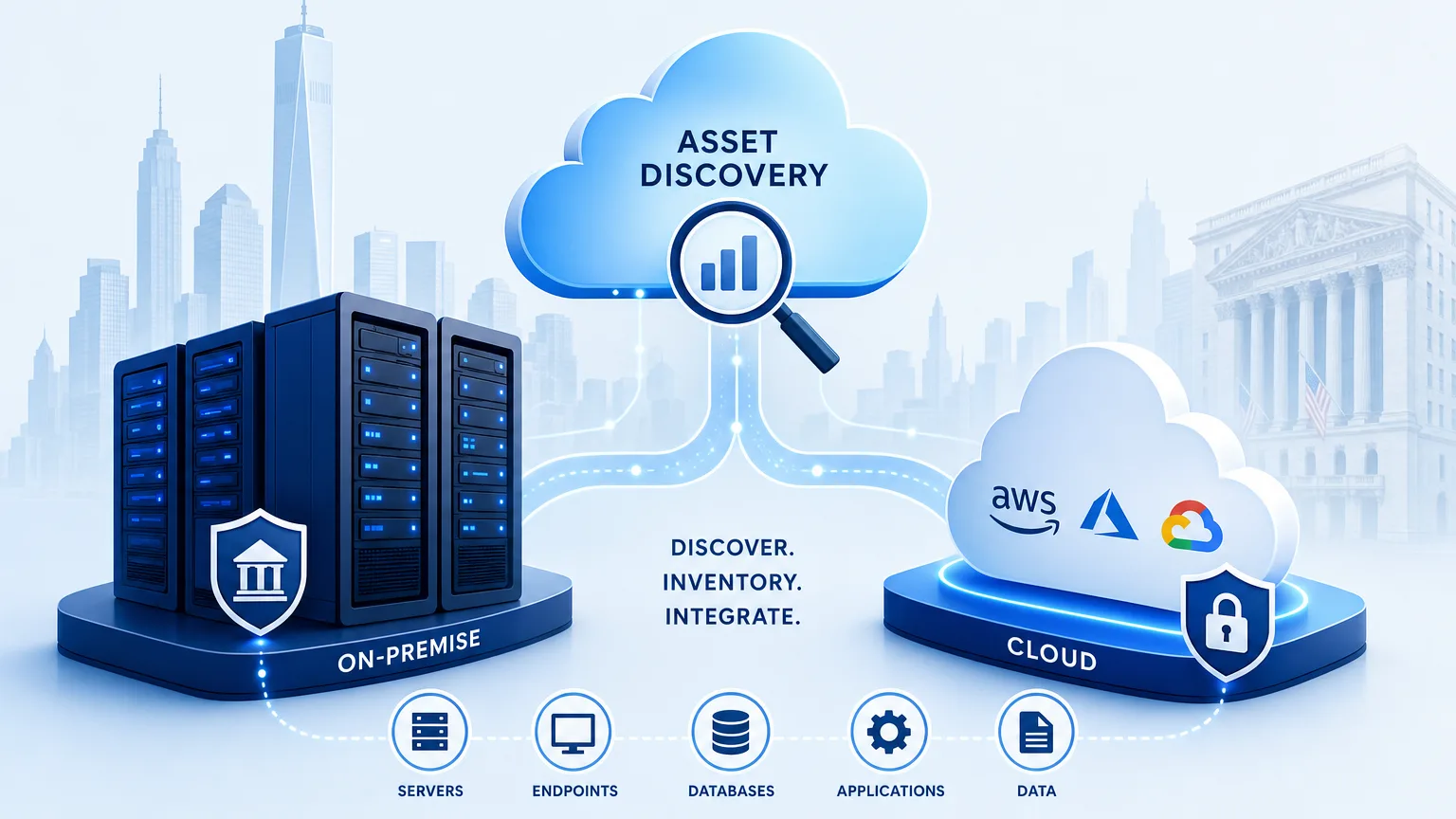
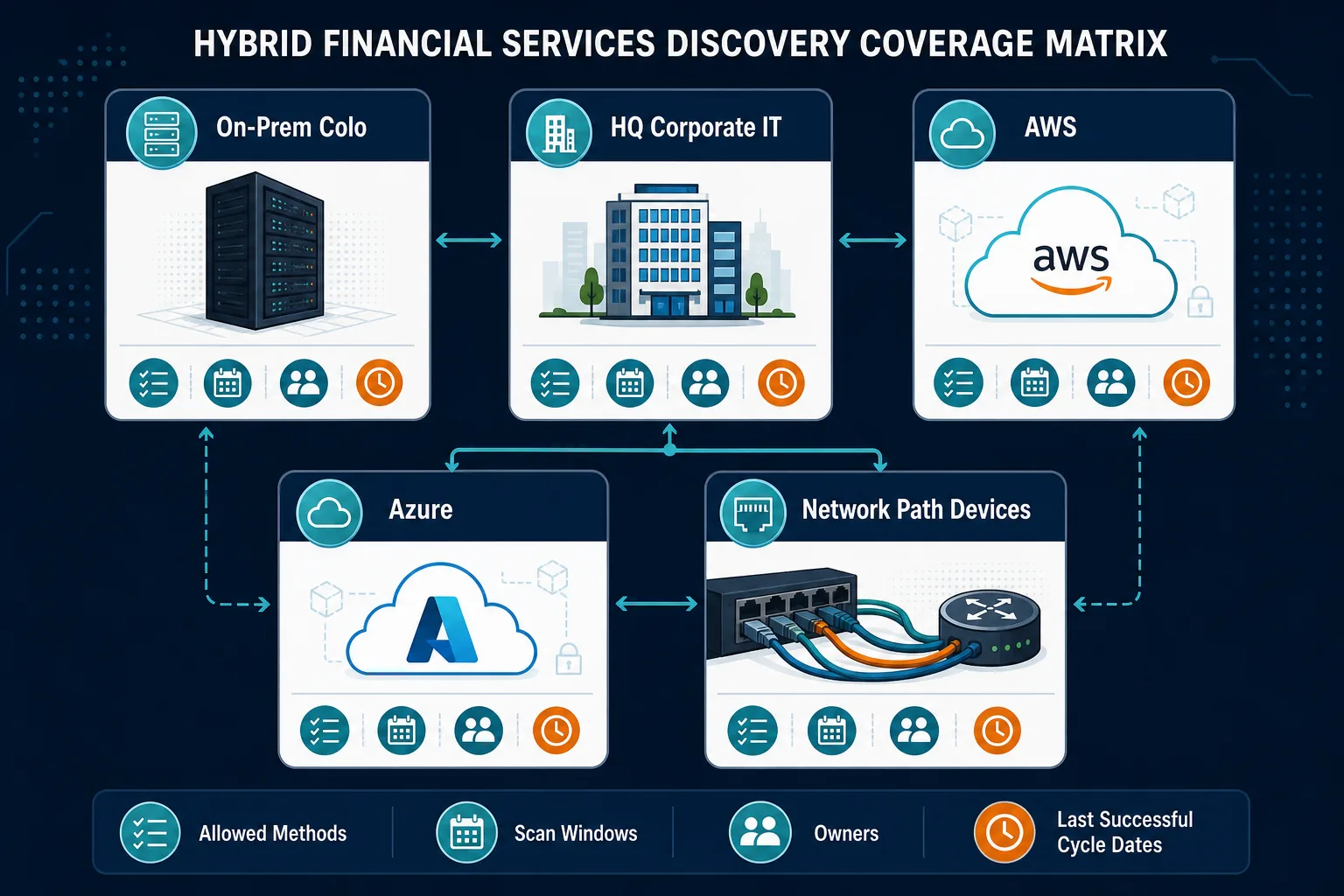
Coverage design beats tool branding for these estates, a point Virima’s own rundown of CMDB discovery tools makes when comparing approaches across the broader market. What hybrid IT discovery for banks and brokers must cover starts with a written scope, mapped to the method that actually reaches each range:
- Primary and DR colos — agent-based discovery for deep software inventory
- HQ and branch ranges that still matter — credentialed agentless discovery where agents are blocked
- AWS and Azure accounts used for production, DR, analytics, and shared services — API pull against each cloud account
- Network devices that define paths between trading floors and cloud endpoints — network device collection along that path
Cadence matters as much as method. Quarterly sweeps fit hardware refresh planning and fail change management. New VMs, weekend fix instances, and vendor demo kits appear weekly. High-frequency discovery cycles keep last-seen data close enough to trust during CAB review and incident bridges. They do not need to mean continuous passive packet collection if that capability is not yet in the stack. They do mean scheduled passes short enough that a month-old blind spot is treated as a defect, not a norm.
Internal teams evaluating platform fit should review how Virima IT discovery combines agent-based and agentless methods so regulated constraints and deep endpoint inventory can coexist without forcing a single technique everywhere.
How often should hybrid financial services discovery run to stay useful for change management?
Quarterly discovery sweeps fit hardware refresh planning but miss the weekly cadence of new VMs, DR nodes, and vendor jump hosts in hybrid financial estates. High-frequency discovery cycles across on-prem, colo, AWS, and Azure ranges keep last-seen data current enough to trust during change advisory board review.
Building a financial services hybrid CMDB that markets and risk leaders can share
When discovery runs on shared scope and cadence, the next failure mode is political, not technical: who owns a financial services hybrid CMDB when four teams feed it. Core banking, markets, cloud platform, and security owners must agree which system is authoritative for a CI class. They also need a rule for how conflicts resolve when two tools report different OS versions or owners. Multi-source reconciliation should prefer discovery evidence with recent last-seen data over static imports that nobody revalidates. Manual overrides stay allowed for business metadata without freezing hardware facts scanners still observe.
Which discovery source should win when two tools disagree on a CI’s owner or OS version?
When two discovery sources disagree on a CI’s OS version or owner, multi-source reconciliation should default to the tool with the most recent last-seen timestamp over static imports nobody revalidates — keeping the CMDB closer to what’s actually running than to the last manual edit.
Relationship data is the third coverage requirement. A flat list of hostnames will not tell a change owner whether a risk calculation node still supports a payments-facing interface. Once service definitions are provided by operations or enterprise architecture, dependency maps can show installed-on and runs-on links that matter for impact analysis. Virima ViVID™ builds those maps from defined services rather than inventing service composition automatically. That boundary keeps maps honest when markets apps share infrastructure with corporate systems in ways org charts never drew.
Virima approaches this as Trusted Runtime Truth for the operational estate: what exists, how it is connected, what changed, and who owns it, sourced from discovery rather than from the last spreadsheet edit. Automated discovery refreshes CIs while the CMDB holds relationships and health signals. Once services are defined, dependency maps give leaders a shared blast-radius view before weekend changes. Virima’s guide to mapping core banking and payment gateway dependencies applies this directly to trading and payments infrastructure. Integrations can push that truth into ServiceNow, Jira Service Management, Ivanti, HaloITSM, Xurrent, and Hornbill workflows so tickets stop inventing separate asset lists. Partner connections sit on the Virima integrations hub.
For New York financial firms, the practical win is fewer Sunday surprises. Cloud instances that joined last month appear beside the colo interfaces they can affect, with owners and last-seen dates before an examiner asks. That is inventory as operational safety for markets and customers.
See how IT asset discovery for financial services hybrid environments covers on-prem, colo, AWS, and Azure so New York firms stop running changes on partial asset lists.
What good looks like before the next market event window
Leaders can score readiness with a short operational checklist. First, every on-prem and cloud range that can reach production or customer data has a named discovery method and a last successful cycle newer than the change freeze policy requires. Second, unknown devices open an ownership workflow instead of remaining unlabeled forever. Third, CMDB health tracks completeness and staleness so executives see inventory debt as a metric, not an anecdote. Fourth, service maps for payments, trading, and customer-facing services exist from defined compositions and stay tied to infrastructure CIs that discovery still confirms.
When those conditions hold, IT asset discovery for financial services hybrid environments becomes a managed control across brands, vendors, and cloud accounts. Discovery-sourced CMDB records and dependency context give a shared runtime picture before the next patch window, DR test, or regulatory review.
If your teams still reconcile colo, HQ, and cloud inventories by hand before major changes, see how Virima IT discovery covers on-prem and cloud together, and decide from there whether a fuller conversation makes sense.
Frequently Asked Questions
Why do emergency cloud instances stay missing from bank asset lists?
Product teams often open cloud accounts and weekend fix instances outside central procurement and enterprise scan policies. Without shared discovery scope across on-prem and cloud, those nodes stay missing until an incident or exam forces a manual hunt.
How often should New York financial firms run hybrid IT asset discovery?
Cadence should beat how fast new VMs, DR nodes, and temporary interface hosts appear. Many teams treat month-old blind spots as defects. High-frequency discovery cycles on agreed ranges beat annual or quarterly-only sweeps for change and exam readiness.
Does Virima’s discovery integrate with the ITSM tools NY financial firms already run, like ServiceNow or Jira Service Management?
Yes. Virima’s discovery-sourced CMDB and ViVID™ service maps integrate with ServiceNow, Jira Service Management, Ivanti, HaloITSM, Xurrent, and Hornbill, so discovery data flows into the ticketing and change workflows teams already use instead of living in a separate asset spreadsheet.
How does Virima help New York financial services with hybrid discovery?
Virima runs agent-based and agentless discovery, populates a CMDB with multi-source reconciliation, and builds ViVID™ dependency maps after services are defined. Teams use that discovery-sourced truth inside ITSM workflows instead of maintaining separate colo and cloud spreadsheets.
Where should first-time buyers start if hybrid inventory is fragmented today?
Write the scope map first: colo, HQ, AWS, Azure, and path devices with allowed methods and owners. Run discovery on that map, reconcile duplicates into one CI authority, then attach service definitions for the few payments and markets services that create the most change risk.