IT Change Management and Configuration Management: How They Work Together

Change management and configuration management get mixed up constantly — and it’s easy to see why. Both involve controlling changes to IT systems. Both appear in ITIL frameworks, and both run alongside major infrastructure projects. But they do very different jobs. Knowing this difference separates teams that ship changes cleanly from teams that spend weekends fixing problems.
IT change management controls every proposed modification to your IT environment. Every addition, deletion, or configuration change gets documented, reviewed, and approved before it reaches production. Configuration management ensures every CI stays at its approved baseline. It also provides the dependency map that change managers need before approving anything. Both processes are distinct but inseparable — change management governs what happens, and configuration management verifies what exists.
Here’s how each process works, where they diverge, and how they reinforce each other when set up properly.
Key Takeaways
- Change management is reactive governance. It controls how proposed modifications get approved, scheduled, and documented before anyone touches production.
- Configuration management is proactive accuracy. It keeps every CI at its approved baseline and tracks how the environment evolves.
- Both processes depend on the same CMDB — change management queries it for impact data, and configuration management keeps it current after every approved change.
- Configuration drift — the gap between a CI’s approved state and its actual state in production — happens when one or both processes break down.
- In 2026, AI agents raise the accuracy bar for both processes. Every CI an agent touches needs source lineage, policy attributes, named ownership, and freshness validation.
What is IT change management?
Change management controls every modification to your IT environment. It covers additions, deletions, and changes to components, attributes, and configuration data. In short, it’s the process that governs what gets changed — and when.
The core idea is governance. Every change gets documented, reviewed, and approved before anyone touches production. This matters more than it sounds. Uptime Institute’s 2025 study found that 58% of human-error outages happened because staff skipped established procedures. That’s up from 48% just a year before — and change management exists to close that gap.
Change management also covers the people side. Everyone affected by a change needs to know what’s happening. They also need to work normally once it goes live. In practice, that means coordinating with software teams, help desk staff, and the managers signing off on timelines.
Note on terminology: ITIL 4 renamed this practice “change enablement” to shift the emphasis from controlling changes to enabling them. Most IT teams still use “change management” day-to-day, and the underlying workflow is the same. This article uses both terms interchangeably.
What does an IT change management process look like?
A standard change management workflow runs through these steps:
- Someone submits a change request and it gets logged.
- The request is assessed for risk, cost, and downstream impact.
- A change advisory board (CAB) or designated approver reviews and approves it — or sends it back.
- The change is scheduled, executed, and tested.
- Baselines and project documentation get updated.
- Stakeholders are notified about the outcome.
The whole point is to cut the risk of surprise outages. When something goes wrong after a deployment, the change record gives you a clear trail. You can trace back to the root cause quickly.
What is configuration management?
IT teams use configuration management software to keep all system components at their approved baseline. This includes servers, network switches, desktops, and cloud instances. For example, deploying an app update across every server in a cluster is configuration management in action. You’re making sure each change lands correctly so production stays consistent.
Configuration data also drives better change decisions. An AWS configuration management database gives you CI-level detail for every cloud resource. Your change advisory board can then see exactly what a proposed change touches — VPCs, subnets, and interconnected services. That’s the same visibility they expect for on-premises assets.
What is configuration drift?
Configuration drift is the gap between a CI’s approved baseline and its actual state in production. It happens when someone makes changes outside the formal process. Think of a patched server, a modified firewall rule, or a cloud instance spun up without an approved change record. Drift builds up silently until an incident exposes it. And the further the actual state drifts from the documented one, the longer recovery takes.
What is a configuration item (CI)?
A configuration item is any object in your IT environment whose value depends on its state and identity. CIs include software packages, hardware components, documents, network devices, and virtual machines. Your CMDB stores these items and tracks their status throughout their lifecycle.
Minor vs. major changes
Minor changes are low-risk, low-effort tasks. One person usually handles them — often the same person who submitted the request. Formal planning is rare.
Major changes are a different story. Moving servers, migrating to the cloud, or deploying a new ITSM platform all require multi-team coordination. These need documented rollback plans, scheduled testing windows, and explicit stakeholder sign-off before anyone starts.
Change management vs. configuration management: key differences
| Dimension | Change management | Configuration management |
|---|---|---|
| Timing | Reactive — manages changes as they happen and handles unexpected fallout | Proactive — validates correct configuration before changes reach production |
| Focus | People, process, and governance around changes | Technical accuracy and consistency of CIs |
| Activities | Planning, budgeting, approving, and communicating changes | Tracking, versioning, validating, and maintaining CI baselines |
| Scope | Changes to requirements, designs, policies, and customer expectations | Managing CI states, specifications, and version control |
| Output | Change records, approvals, stakeholder notifications | Configuration baselines, version histories, audit trails |
How change management and configuration management work together
Configuration management lays the groundwork. Before you propose a change, you need an accurate map of your environment. You need to know what assets exist, how they’re configured, and what depends on what. Without that baseline, change management is just guesswork.
Change management builds on top of that map. When a change request comes in, the change manager needs to answer a few hard questions: What will this touch? Which services depend on this CI? If this goes wrong, how far does the damage spread?
That’s how the two processes lock together:
- Configuration management keeps the CMDB current — one source of truth for every CI and its relationships.
- Change management queries the CMDB to assess impact before approving anything.
- After implementation, configuration management updates the CMDB to reflect the new state.
- When a change causes problems, the CMDB’s history gives incident management teams a trail to trace what changed and when.
This feedback loop is what Trusted Runtime Truth looks like in practice. It gives you a discovery-sourced picture of what exists and how everything connects. You can also see what changed, what might break, and who owns it. Every approved change that flows through both processes keeps that picture current. Every undocumented change widens the gap — until the CMDB becomes too unreliable to trust.
This interdependence becomes even more critical in regulated industries. For example, teams managing medical device configuration cannot approve changes to networked clinical equipment without first checking firmware versions, regulatory certifications, and downstream dependencies. Accurate CMDB data isn’t just useful in these environments — it’s a compliance requirement.
Our guide to how a CMDB supports change management walks through a mature change process step by step.
See the full picture before you approve. Discover what Trusted Runtime Truth means for your change and configuration management practice: virima.com/trusted-runtime-truth
Why agentic IT raises the stakes for both processes
AI agents executing change actions introduce a new requirement. Before an agent acts on a CI, it needs to know not just what the record says. It also needs to know how authoritative that record is. Neither process was originally designed for that.
An agent-ready environment needs both processes working as one governed system. Change management must embed policy attributes in every CI record. This includes the change approval tier, blast radius classification, and maintenance window constraints. Configuration management must also maintain source lineage on every CI attribute. That means named ownership and freshness validation — not just “last updated,” but “last verified by an authoritative scan.”
Siloed processes cause agents to act on stale data, miss dependencies, or execute changes without clear ownership. Gartner predicts over 40% of agentic AI projects will be canceled by end of 2027, citing inadequate risk controls (Gartner, June 2025). In IT operations, the CMDB is where that risk control lives. And the change process is what keeps it governed.
How Virima supports IT change and configuration management
Virima ties change management and configuration management together in one platform. Here’s what that looks like in practice:
- IT discovery — Agentless, agent-based, and API-based scanning finds every asset in your environment. This includes on-premises servers, cloud instances on AWS and Azure, network devices, and installed software. High-frequency discovery feeds your CMDB with current data — not stale spreadsheets. Every CI attribute also carries source lineage for agentic readiness.
- CMDB — Stores every CI and its relationships. Virima’s CMDB is the foundation for both configuration management and change management workflows. It gives change managers and config managers a shared source of truth. Multi-source reconciliation happens at the attribute level.
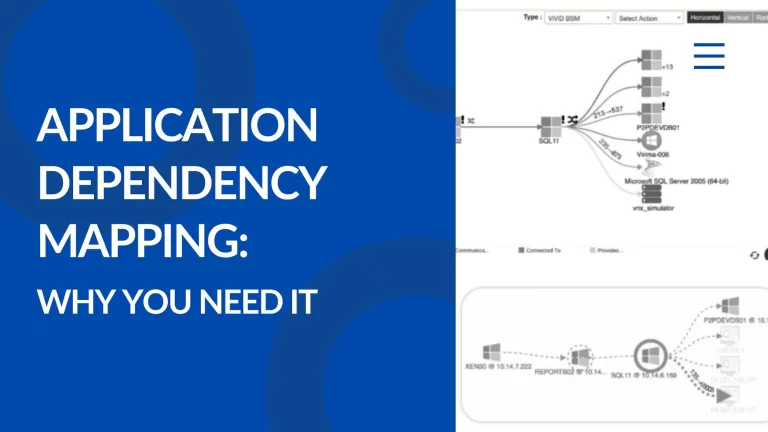
- ViVID™ service maps — Visualize application dependencies and change impact. Before a change is approved, ViVID™ shows which services, users, and infrastructure components sit in the blast zone. It also highlights open incidents, pending changes, and NIST NVD vulnerability context.
- Service dependency mapping — Maps the dependencies between applications, infrastructure, and business services. Change managers can then assess risk with real data instead of assumptions.
- ITAM — Tracks hardware and software inventory across your distributed environment, including lifecycle status and ownership records.
- Change process automation — Automate change workflows, enforce approval gates, and log every change in the CMDB with documentation attached. Virima integrates with ITIL processes like problem management and release management alongside ServiceNow, Jira Service Management, and Ivanti.
See exactly which services a change will touch before you approve it. Request a Virima demo and watch ViVID™ map a real change’s blast radius in minutes using your own discovery-sourced data.
One system, complete control over your IT changes
Change management and configuration management work best as one connected system. One gives you control over change. The other keeps your environment current and consistent. When both align, you reduce risk, improve visibility, and make every change more predictable. You also give any AI agents in your environment the governed foundation they need to act safely.
Getting there is hard without the right data. Teams struggle with incomplete inventories, unclear dependencies, and slow approvals. According to Uptime Institute, 80% of data center operators say better management would have prevented their last outage. High-frequency discovery, an accurate CMDB, and strong dependency mapping give you the context to make confident decisions.
Request a Virima demo and see how smarter change and configuration management transforms your IT operations.
Frequently asked questions
What is change impact analysis in ITIL?
Good impact analysis depends on accurate dependency data. If your CMDB doesn’t capture the relationships between CIs, your risk assessment is incomplete. Virima’s ViVID™ service maps solve this by visualizing CI dependencies. Change managers can then see the full blast radius of any proposed change before they approve it.
What are the three types of changes in ITIL?
ITIL defines three change types: standard, normal, and emergency. Standard changes are pre-approved and low-risk — think password resets or routine patching. Normal changes go through the full workflow, including risk assessment and CAB review. Emergency changes bypass the standard process to address active incidents or critical vulnerabilities. But they still get documented and reviewed after the fact.
What is the role of a change advisory board (CAB)?
A CAB is a group of stakeholders who evaluate proposed changes before approval. The board typically includes people from IT operations, security, application teams, and affected business units. Their job is to assess risk and weigh the impact on live services. They then decide whether the change should proceed, be modified, or be rejected. Not every change goes to the CAB — standard and low-risk changes are usually pre-authorized.
How does service mapping support change management?
Service mapping creates a view of how applications, infrastructure, and services connect. When someone proposes a change, the service map reveals every upstream and downstream dependency. Without that visibility, you might patch a database server without realizing three critical applications depend on it. Virima’s ViVID™ service maps surface those dependencies before a change is scheduled. That way, the right people get notified before the change — not after.
What is ITIL 4 change enablement?
ITIL 4 renamed “change management” to “change enablement” to shift the focus from control to enablement. The idea is that change should be a positive force — not a bottleneck. The practice still covers risk assessment, authorization, and scheduling. But the new framing encourages teams to make changes faster and easier to approve. The underlying workflow stays largely the same — the new name just reflects a shift toward speed and value.