ITIL Change Management and CMDB Accuracy: Why One Depends on the Other

The change that should have gone fine
The CAB approved it. The change window opened on schedule. Forty minutes in, three downstream services started degrading — a customer-facing API, an internal reporting pipeline, and a batch job nobody had touched in two years that turned out to be running on the same middleware tier as the target system.
The post-incident review told the familiar story: the impacted services never appeared in the blast radius assessment because the CMDB relationships connecting them to the change target were fourteen months out of date. The CI records existed. The relationships did not.
This is not a rare edge case. It is one of the most recognizable failure patterns in enterprise IT. The change workflow was followed correctly. The CAB did its job. The problem was the data the entire process ran on.
That is the core issue this article addresses: the relationship between ITIL change management and CMDB accuracy is not optional. Your CMDB is the foundation everything else depends on.
What ITIL change management actually requires from your CMDB
ITIL 4 Change Enablement — what earlier versions of the framework called change management — gives you a structured process for managing risk across the change lifecycle. What it does not give you is accurate CMDB data. That part is assumed.
Every stage of the change process carries a silent dependency on configuration management data being current, complete, and trustworthy. When it is not, each stage degrades in a specific and predictable way. Aligning change management configuration management practices ensures that every approved change is validated against accurate CI data, preventing configuration drift from compounding during high-pressure transformations.
Here is what each stage actually needs from your CMDB:
Change request — The request needs to identify the correct CI, its current owner, and its current state. Stale ownership records mean the wrong team gets notified. An incorrect CI state can cause the request to be miscategorized before anyone reviews it.
Impact assessment — This is where CMDB accuracy matters most. A complete, current picture of every CI related to the change target is required — upstream dependencies, downstream consumers, shared infrastructure, service relationships. If those relationships are missing or outdated, the blast radius assessment is wrong before anyone has a chance to review it.
CAB approval — The Change Advisory Board approves based on the impact analysis it receives. If that analysis was built on stale CMDB data, the CAB is making a risk decision from an incomplete picture. It does not know what it does not know.
Implementation — The change window runs on the assumption that the dependency picture is accurate. When it is not, teams hit unexpected conflicts mid-window and face a bad set of options: push through with unknown risk or roll back.
Post-implementation review — The PIR either confirms success or investigates failure. When failure traces back to missing CI relationships, the review correctly identifies a data problem — but unless the CMDB is fixed before the next change, the same failure mode remains in place.
For a closer look at how change management and configuration management work together at a process level, that breakdown covers the interdependence in more detail.
The CMDB accuracy problem is not theoretical
Research consistently shows that manually maintained CMDBs reach 30–40% data inaccuracy within six months of initial population. That statistic alone should concern anyone running change management on CMDB data — because it means the blast radius assessment for a change approved six months after the last CMDB refresh has roughly a one-in-three chance of being based on incorrect data.
The problem is not carelessness. It is math. A typical enterprise environment processes hundreds of changes per month — patches, deployments, configuration updates, scaling events, infrastructure moves. Each change modifies at least one CI attribute or relationship. If even a fraction of those modifications are not captured in the CMDB, the data starts drifting from reality immediately.
The consequences compound. One missing dependency link might not matter. Fifty missing dependency links across a CMDB with ten thousand CIs means that every impact assessment is running on an incomplete graph. And unlike a traditional database where missing records are obvious, missing CMDB relationships are invisible until an incident exposes them.
This is why organizations that follow ITIL change management to the letter still experience change-related outages. The process is correct. The data underneath it is not.
How CMDB drift breaks each stage of the ITIL change process
Understanding exactly where CMDB inaccuracy introduces risk makes the problem actionable.
Change request: wrong CI, wrong owner
When a change requestor selects a CI from the CMDB, they assume the record reflects the current state. If the CI was migrated to a new server six months ago and the CMDB still points to the old one, the entire change is scoped against the wrong target. Similarly, stale ownership means the approval notification goes to someone who no longer manages that asset — and the actual owner may never learn the change is happening.
Impact assessment: invisible dependencies
This is the stage with the highest exposure to CMDB drift. Impact assessment maps every CI that could be affected by the change. It relies on relationship data between CIs — application-to-server connections, service-to-infrastructure mappings, upstream and downstream consumers.
Relationships are the first thing to go stale in a CMDB. A new API integration gets deployed, creating a dependency that never gets logged. A load balancer configuration changes, shifting traffic across server pools that the CMDB does not reflect. The impact assessment maps the old relationships, declares the blast radius contained, and the change proceeds into a minefield it cannot see.
CAB approval: false confidence
The CAB approves changes based on the impact analysis presented to them. If that analysis was built on stale dependency data, the approval carries false confidence. The board believes the risk is manageable because the data says it is. The data is wrong.
This is one of the more frustrating aspects of CMDB drift: it does not produce ambiguity. It produces false clarity. A stale CMDB still answers questions. It just answers them incorrectly.
Implementation: mid-window surprises
When the change goes into the production environment, reality overrides what the CMDB said. Unexpected conflicts surface. Services that were not in the blast radius start throwing errors. The team faces a decision: push forward without understanding the full impact, or roll back and investigate. Both options cost time, and in production environments, time is SLA exposure.
Post-implementation review: the right diagnosis, no fix
The PIR correctly identifies that missing CMDB data caused the incident. A remediation task is created to update the CMDB. But remediation that updates one set of records does not address the systemic problem — the CMDB will drift again before the next change cycle unless the underlying discovery and update process changes.
What accurate CMDB data makes possible in change management
When the CMDB is current, every stage of the ITIL change process runs on trustworthy inputs.
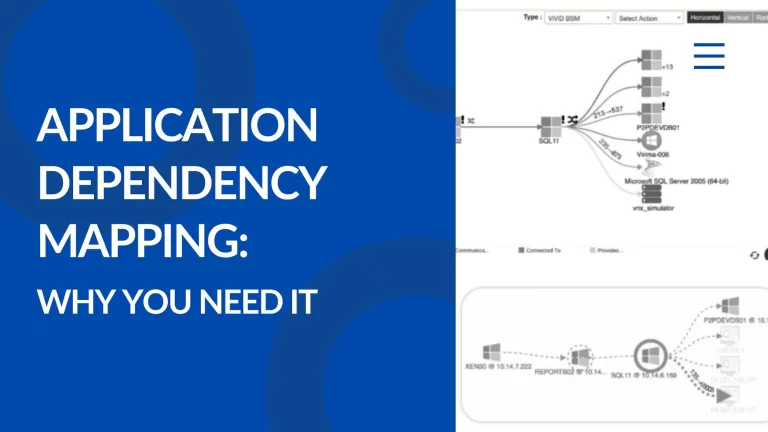
Confident impact assessments. When dependency data reflects the live environment, blast radius analysis shows the actual footprint of a proposed change. ViVID™ renders this as an interactive topology view — CAB members can see every CI in the blast radius, trace upstream and downstream relationships, and identify service boundaries the change crosses.
Faster CAB reviews. When the CAB trusts the data, reviews move faster. The meeting shifts from debating whether the impact analysis is complete to evaluating whether the risk is acceptable. That is a fundamentally different conversation.
Fewer change-related outages. When the blast radius is accurate, changes that carry hidden risk get caught before approval. Changes that are genuinely low-risk move through faster because there is data to prove it. The change failure rate drops because the decision-making inputs improve.
Reliable post-implementation validation. After a change, the next discovery cycle validates the new state of the environment. If something changed that was not in the change plan, discovery flags the discrepancy. The PIR runs on data, not interviews.
Better emergency change decisions. Emergency changes skip the full CAB process because speed matters. But blast radius analysis is arguably more important here, not less. An emergency fix applied without understanding dependencies can turn one outage into two.
The difference is that the analysis needs to happen in minutes, not days, which is only possible if your CMDB and dependency data are already accurate and accessible. The same applies to any AI agent or automated remediation workflow executing in your environment — trusted runtime truth is what lets them act fast without acting blind.
How to fix the CMDB accuracy problem undermining your change process
The fix is not a CMDB cleanup project. Cleanup projects restore accuracy temporarily and then drift reasserts itself within weeks. The fix is structural — a trusted runtime truth foundation that keeps the CMDB accurate as a default state, not as the result of periodic remediation. Virima delivers that foundation: live, explainable, discovery-sourced ground truth that feeds change management with data your CAB can actually trust
Run discovery on a recurring schedule, not on demand
One-time discovery sweeps create snapshots. Recurring scheduled scans create a continuous feed of environmental data into the CMDB. IT Discovery that runs across every protocol and environment — on-prem, AWS, Azure, using both agentless and agent-based methods — closes the gap between what is running and what the CMDB records.
Every scan cycle detects new CIs, identifies changed attributes, maps updated relationships, and flags assets that have disappeared. The CMDB stays current not because someone updated it manually, but because discovery keeps writing accurate data back into it.
Build bi-directional links between change management and the CMDB
Every approved change should generate an expected modification in the CMDB. After implementation, discovery validates whether the actual change matches the expected one. If it does not — if discovery finds modifications that were not in the change plan, or if planned modifications did not take effect — that discrepancy gets flagged.
This creates a closed-loop change management process. Changes update the CMDB, and discovery validates the updates. Neither process runs blind.
Give the CAB visual dependency data
Text-based impact assessments are hard to verify and easy to under-scope. When CAB members can see the blast radius as a visual topology — tracing dependencies from the change target through every connected CI and service — the review is grounded in observable data rather than written summaries.
ViVID™ provides this capability as an overlay on top of the dependency and relationship data that IT Discovery and Service Mapping produce. The CAB sees the blast radius, not a description of it.
Address the non-discoverable data gap
Some CI attributes — business context, application ownership, compliance classification, cost center assignment — cannot be discovered through network scans. These attributes still drift, and their inaccuracy still undermines change management.
Autonomic Social Discovery (ASD) automates the process of gathering these non-discoverable attributes from the people who actually know them. Rather than sending spreadsheets to CI owners once a year, ASD runs structured queries on a schedule, feeding organizational and contextual data back into the CMDB alongside the technical data that IT Discovery captures.
Monitor CMDB accuracy as a KPI
CMDB accuracy should be tracked as a metric, not assumed as a state. Compare discovery findings against CMDB records on a regular basis. Measure the percentage of CIs where discovered attributes match the CMDB. Measure the percentage of relationships that discovery confirms. When accuracy drops below a threshold, investigate before the next change cycle — not after the next change-related outage.
Accurate CMDB data is the change management prerequisite nobody wants to own
ITIL change management gets plenty of attention. Process design, CAB governance, approval workflows, change types and authorization models — these are well-documented and widely practiced. What gets less attention is the data quality prerequisite that determines whether any of it actually works.
CMDB accuracy is the unglamorous foundation of effective change management. It does not generate its own business case. It does not have a direct stakeholder demanding it. But every change-related outage that traces back to missing dependencies or stale CI records is evidence that the foundation was neglected.
The organizations that run change management well are not the ones with the most sophisticated approval workflows. They are the ones that keep their CMDB current through continuous discovery, validate change impact through visual dependency analysis, and treat CMDB accuracy as a metric that gets measured — not a state that gets assumed.
See how Virima delivers trusted runtime truth for ITIL change management at virima.com. Schedule a demo. Move faster. Act safely.
FAQs
Why does CMDB accuracy matter for ITIL change management?
Every stage of the ITIL change process — from the initial request through impact assessment, CAB approval, implementation, and post-implementation review — depends on CMDB data being current and complete. When it is not, the change process runs on incorrect inputs and produces decisions that carry hidden risk.
How fast does CMDB data become unreliable?
In manually maintained environments, CMDB data typically reaches 30–40% inaccuracy within six months. The rate depends on the pace of change in your environment, but any organization running frequent patches, deployments, and infrastructure changes will see significant drift within a single quarter.
Can you have good change management with a bad CMDB?
Not sustainably. Individual changes may succeed despite inaccurate data, but the change failure rate will remain elevated because impact assessments are running on incomplete dependency maps. Over time, the CAB loses confidence in its own reviews, and the change process becomes a compliance exercise rather than a risk management tool.
What is the relationship between configuration management and change management in ITIL?
ITIL treats configuration management and change management as interdependent practices. Configuration management maintains the CMDB and keeps CI data accurate. Change management uses that data to assess, approve, and validate changes. When configuration management fails — when the CMDB drifts — change management loses its primary input.
How does automated discovery improve change management outcomes?
Automated IT discovery keeps the CMDB current by detecting new CIs, updated attributes, and changed relationships on a recurring schedule. This means the data available for impact assessment, CAB review, and post-implementation validation reflects the live environment rather than a months-old snapshot.