Why Dublin’s Big Tech HQs Need a GDPR Compliant CMDB Before the Next Audit

In September 2024, the Data Protection Commission (DPC) fined Meta Platforms Ireland Limited €91 million for storing user passwords in plaintext, citing GDPR Article 5(1)(f) and Article 32(1), both of which require appropriate technical and organisational security measures. The decision was issued from Dublin, and it carries binding authority across the entire European Economic Area under the one-stop-shop mechanism. It is not an isolated data point: the DPC’s enforcement record shows fines against Dublin-headquartered Big Tech entities escalating in scale and frequency, and every one of those decisions raises the same underlying question for every other company headquartered in the city: does the organisation run a GDPR compliant CMDB in Dublin that can prove what it knew, and when?
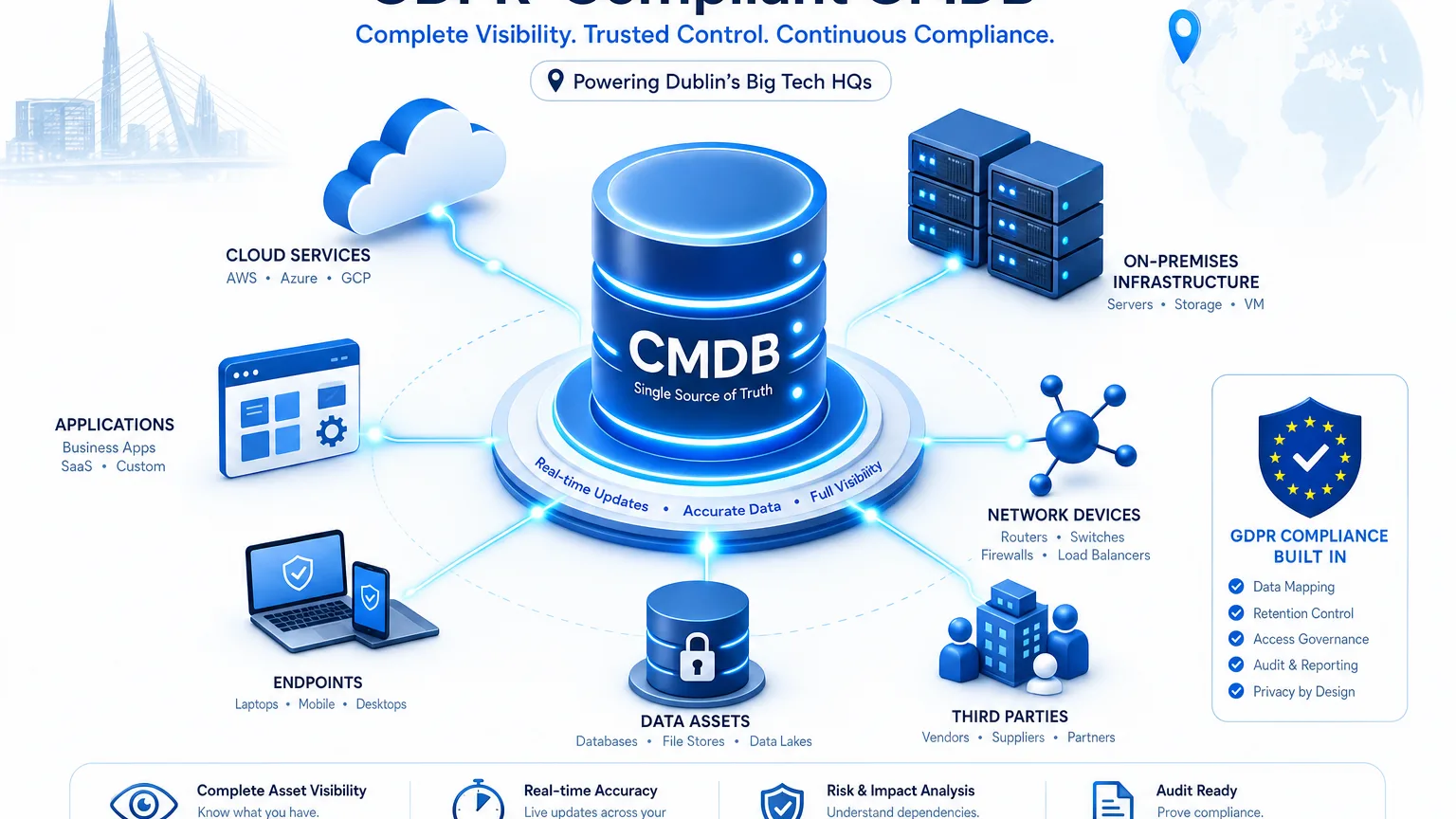
The Meta penalty arose from a security-measure failure. But a quieter, equally disqualifying question runs underneath many DPC inquiries: can the organisation produce an accurate, current account of what systems exist in its environment, who owns them, where personal data resides, and whether that inventory was actively maintained? The DPC’s periodic compliance checks on Records of Processing Activities (RoPA) have made that question explicit. Regulators are checking, and the infrastructure layer that answers it is the configuration management database. A GDPR-compliant CMDB is a configuration management database maintained with the accuracy and freshness needed to support Article 5(2) accountability and Article 30 RoPA obligations.
Dublin concentrates the EU headquarters of Meta, Google, TikTok, Microsoft, Apple, LinkedIn, and X within a few square kilometres. A DPC decision issued against one Dublin entity sets precedent for every other organisation in the same jurisdiction. The next inquiry is not a hypothetical risk on a heat map. It is a scheduled certainty for the organisations that choose Dublin as their European base.
What Is a GDPR-Compliant CMDB?
A configuration management database (CMDB) is a structured record of an IT estate’s configuration items (CIs), their attributes, and the relationships between them. Under ITIL 4’s Service Configuration Management practice, a CMDB’s function is to ensure accurate, reliable configuration data is available to every process that depends on it, from change management and incident response to security review and audit preparation.
GDPR layers two specific obligations on top of that operational function. Article 30 of the GDPR requires every controller to maintain a Record of Processing Activities (RoPA) that documents categories of data processed, the purposes for processing, the recipients, and the retention periods in force. Article 5(2) establishes the accountability principle, which requires controllers to demonstrate compliance, not merely assert it. A RoPA entry with no corresponding CI in the CMDB is an unverifiable claim. A CI with no RoPA entry is a governance gap that no auditor will overlook.
A GDPR-compliant CMDB is the infrastructure and visibility layer that supports these accountability requirements. It does not perform Data Protection Impact Assessments (DPIAs), manage consent records, or function as the compliance mechanism itself. What it supplies is the foundational asset truth that makes every downstream compliance process legible, traceable, and auditable.
The Hidden Problem: Three Recurring Patterns
| Situation | What happens |
|---|---|
| A SaaS analytics tool connects to production customer data mid-quarter | No CI exists for it, no RoPA entry is created, and no one notices until an access review flags the connection months later |
| A contractor provisions a temporary cloud instance for a proof-of-concept | The instance continues running past the contract end date, still holding real user records, with no owner recorded in the CMDB |
| An acquired subsidiary carries undocumented infrastructure into the estate | Discovery has never run in that environment, which is precisely where a DPC inquiry looks first |
The pattern in each case is identical: a system holding personal data carries no authoritative CMDB record and no corresponding RoPA entry. When an auditor requests evidence of what was running and who was accountable, the answer is a gap. For a detailed foundation on what a CMDB tracks and manages, and on how ITIL 4 frames configuration management, both references provide grounding before this section’s implications reach the operational level.
What makes a CMDB GDPR-compliant?
A GDPR-compliant CMDB is a configuration management database maintained with sufficient accuracy and freshness to support Article 5(2) accountability and Article 30 Records of Processing Activities obligations. It records what systems exist, who owns them, and what data they hold. It is the infrastructure evidence layer, not the compliance mechanism itself, and does not replace a RoPA, DPIA process, or consent management framework.
Why Does IT Asset Governance Matter for GDPR in Dublin?
Dublin’s Outsized Regulatory Exposure
Dublin is not a generic compliance jurisdiction. The one-stop-shop mechanism under GDPR designates the DPC as lead supervisory authority for companies headquartered in Ireland. Decisions issued from Dublin carry EU-wide legal force, which means a compliance failure in a Dublin IT estate has consequences across every member state where the company processes personal data. The DPC’s enforcement record confirms that its cumulative GDPR fines run into the billions of euros since the regulation took effect, with the majority directed at the Big Tech companies that have chosen Dublin for their European operations.
The IBM Cost of a Data Breach Report 2026 puts the global average breach cost at $4.99 million, a 12% increase year-on-year and a record high. Asset visibility sits at the root of that figure. Breaches involving unknown or unmanaged assets take longer to detect, longer to contain, and cost more to remediate than breaches involving assets the security team already had in scope. A 2025 Trend Micro study of 2,250 security and IT leaders across 21 countries found that 74% had experienced security incidents attributable to unknown or unmanaged assets. That finding maps directly onto GDPR’s Article 5(2) accountability requirement and its Article 32 security-measure obligations, because a system the IT team does not know exists is a system no one governs under GDPR.
For Dublin’s Big Tech HQs, the concentration of EU operations in one DPC jurisdiction amplifies the exposure. A single overlooked asset in a Dublin IT estate can trigger a DPC inquiry that covers every EU processing activity the organisation conducts.
Five Failure Modes That Create GDPR Exposure
- Shadow SaaS connected to production data with no CI or RoPA entry. A business unit deploys a SaaS analytics tool and connects it to a customer data export. IT leadership discovers the connection during a periodic access review, six months after the connection was first established.
- Legacy systems running past their intended retirement date. An IT Director schedules a server for decommission at year-end, but the decommission stalls because no team has confirmed which services depend on it. The server keeps running, holding personal data for a user category the team believed was already migrated.
- M&A-inherited infrastructure sitting entirely outside discovery scope. An acquired entity brings cloud tenancies and on-premises systems the acquiring organisation’s CMDB has never catalogued. The DPC’s first question in any post-acquisition inquiry is whether the parent organisation knew what it inherited.
- Contractor-provisioned cloud instances never reconciled after contract end. A solutions architect provisions a cloud virtual machine for integration testing and loads it with a dataset copied from production. The contract ends. The VM keeps running for nine months because no decommission request was raised and no CI for the VM exists in the CMDB.
- Multi-region EMEA cloud sprawl invisible to the Dublin parent. A Dublin-based parent runs cloud workloads across three EU regions, none of which report into the central IT asset inventory. The CMDB reflects only what the Dublin team provisioned directly.
For context on how these gaps compound over time, Virima’s IT asset management statistics and the complete guide to IT asset management address the drift that accumulates when discovery is manual or infrequent.
What an Unaudited CMDB Actually Costs Dublin’s Big Tech HQs
For CIOs and boards, Article 5(2)’s accountability principle attaches direct consequence to the CIO’s role. DPC inquiry decisions name the data controller, not the IT function, in their formal findings. Board-level accountability for GDPR compliance rests on demonstrating that technical and organisational measures were in place and operating correctly at the time of any alleged breach or non-compliance. A CMDB last updated six months ago, or one that has never included cloud workloads provisioned outside the central IT team’s direct control, cannot support that demonstration.
For CMDB owners and operations teams, the cost is different and less visible in executive reporting. Teams responsible for keeping a CMDB accurate without automated discovery spend significant time chasing asset owners, reconciling spreadsheets between departments, and resolving discrepancies that accumulate in the gaps between quarterly audits. When a DPC inquiry or internal GDPR audit generates a request to confirm what systems were running on a specific date, who owned them, and what data they held, a manually maintained CMDB rarely produces a clean answer. Teams fill the gap with institutional knowledge, which DPC auditors treat as unsubstantiated.
For Dublin’s Big Tech EU HQs specifically, the one-stop-shop exposure means that a CMDB accuracy problem does not stay contained to a single country. A DPC decision issued against a Dublin entity applies across every EU member state in which that entity processes personal data. A CMDB gap in Dublin is not a local operational shortfall. It is a continent-wide governance gap.
At market scale, Ireland hosts a large concentration of global technology firms’ EU operations, many of which fall under the DPC’s direct enforcement record. A DPC inquiry that results in a fine for a fellow Dublin-headquartered company raises the audit-readiness bar for every other entity operating under the same supervisory authority.
The CMDB compliance and IT security risk pillar reference covers how CMDB accuracy connects to compliance posture across the full range of technical and governance dimensions.
How a Discovery-Driven CMDB Fixes This
A CMDB that relies on manual input or quarterly spreadsheet imports cannot maintain the freshness that GDPR accountability requires. Three mechanisms close the specific gaps the preceding sections identified.
1. High-Frequency Scheduled Discovery Closes the Shadow-IT Gap
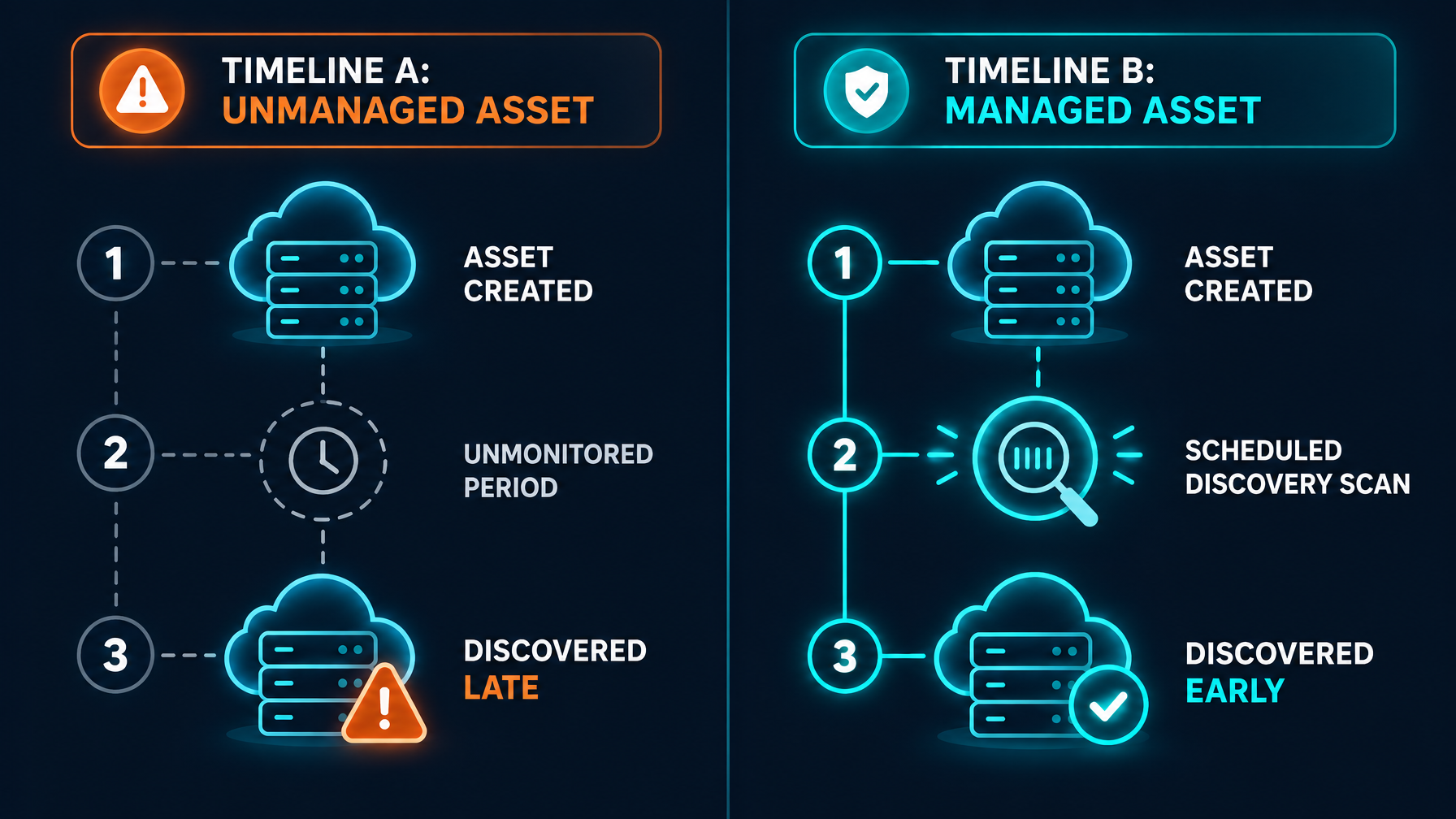
Virima’s IT discovery capability runs scheduled discovery cycles across agent-based, agentless, and API-driven protocols, covering on-premises infrastructure, cloud workloads across AWS and Azure, and endpoints regardless of whether a device sits inside the corporate network perimeter. Each cycle produces an updated inventory of what exists in the environment, what it is running, and what it connects to. Systems provisioned outside the central IT team’s direct control appear in the CMDB after the next scheduled discovery cycle, not after a manual audit finds them.
The practical difference for GDPR accountability is the time between when an asset appears in the environment and when the CMDB reflects it. A CMDB without authoritative discovery decays at the rate infrastructure changes, which in a Dublin Big Tech HQ running multiple cloud providers and a hybrid on-premises estate is rapid and continuous.
2. ViVID™ Service Mapping Provides RoPA Dependency Context
Once an IT team defines the services that make up its environment, ViVID™ builds dependency maps from the CI data that discovery produces, showing which infrastructure components underpin each service, what connects to what, and where data flows between systems. That dependency context does not replace a RoPA, and Virima’s service mapping capability is not itself a GDPR-compliance tool. What it supplies is the factual infrastructure record that a compliance officer or Data Protection Officer (DPO) needs to verify whether a RoPA entry accurately reflects the actual processing environment.
3. CI Ownership Tagging Creates the Audit Trail
The Virima CMDB records each CI with an owner, a last-discovered timestamp, and a history of configuration changes. When a DPC inquiry asks which team was responsible for a specific server on a specific date, a CMDB with ownership records and discovery history provides a verifiable, structured answer. A spreadsheet provides the best recollection.
Manual audit vs. discovery-driven governance:
| Governance approach | Shadow-asset detection | Ownership documentation | Audit response |
|---|---|---|---|
| Manual quarterly audit | Finds assets only at audit time; gaps accumulate between cycles | Depends on human recall and ticketing history | Reconstruction from memory, email, and access logs |
| High-frequency scheduled discovery | CI surfaces after the next scheduled cycle, typically hours after provisioning | Owner tagged at CI creation and updated on each configuration change | Timestamped discovery history available on demand from the CMDB |
How does high-frequency scheduled discovery support GDPR accountability?
High-frequency scheduled discovery closes the shadow-asset gap by adding new configuration items (CIs) to the CMDB within hours of provisioning, rather than waiting for a quarterly audit cycle. CI ownership tagging and freshness timestamps provide the timestamped, attributed audit trail that GDPR Article 5(2) accountability requires when regulators ask which systems existed, who owned them, and what personal data they held on a specific date.
GDPR-First CMDB in Practice: Examples
The following scenarios are illustrative composites drawn from recurring asset-governance patterns in large, multi-cloud IT environments. They are not claims about what caused the DPC fines referenced in the opening section of this article.
- A newly acquired subsidiary’s cloud tenancy, sitting outside discovery scope for months. A Dublin-headquartered technology company acquires a mid-size SaaS vendor and adds the vendor’s three cloud tenancies to the parent’s network inventory on paper at close. Discovery has never run in those tenancies, and the parent’s CMDB contains no CIs from the acquired environment. Six months after the acquisition closes, a routine internal GDPR audit requests the RoPA for all processing activities in the acquired estate. The compliance team cannot produce one because the CMDB records nothing about what is running there.
- A contractor’s temporary VM, never decommissioned, still holding real user records. A contractor provisions a cloud virtual machine for integration testing and loads it with a dataset copied from production, containing real user records. The contractor’s engagement ends. A Head of Infrastructure reviews the billing tag list ninety days later, identifies the VM as a no-longer-needed resource, and raises a decommission ticket. The ticket reveals the VM never existed in the CMDB, which explains why no decommission was triggered when the contract closed.
- A shadow analytics tool connected to production customer data, absent from the RoPA. A marketing team connects a third-party analytics platform to a customer data export covering tens of thousands of EU users. Because no change request was raised and no IT provisioning was involved, no CI exists for the tool in the CMDB. No one has added it to the organisation’s RoPA. An access review eighteen months later is the first time IT leadership sees the integration.
Virima’s Cybersecurity Asset Management (CSAM) capability surfaces unknown and unmanaged assets across the full estate as part of its discovery scope. The CSAM overview covers in detail how asset visibility connects to risk reduction and compliance readiness.
How Virima Closes the Asset-Visibility Gap Behind GDPR Risk
- Immediate operational impact. When a compliance officer, DPO, or external auditor asks what systems were processing personal data for a specific user category on a specific date, a discovery-driven CMDB with ownership records and freshness timestamps answers the question from structured data. A CMDB maintained by spreadsheet or manual imports answers it from a combination of best-available records and team recollection, which auditors evaluate differently.
- Long-term accuracy. Each discovery cycle updates CI attributes, records configuration changes, and flags assets that have changed ownership or gone out of contact since the previous cycle. That running history transforms the CMDB from a point-in-time snapshot into an asset of record that reflects the environment as it has actually operated over time.
- Integration with existing workflows. Virima integrates bi-directionally with ServiceNow, Jira Service Management, and Ivanti, so discovery data flows directly into the ITSM workflows where change requests, incident records, and decommission tickets are managed. When a DPC inquiry requires evidence that a system was actively managed throughout a given period, the integration record between the CMDB and the ITSM platform provides that evidence chain. Virima’s full integrations catalogue and the ITSM integration detail cover the specific data flows.
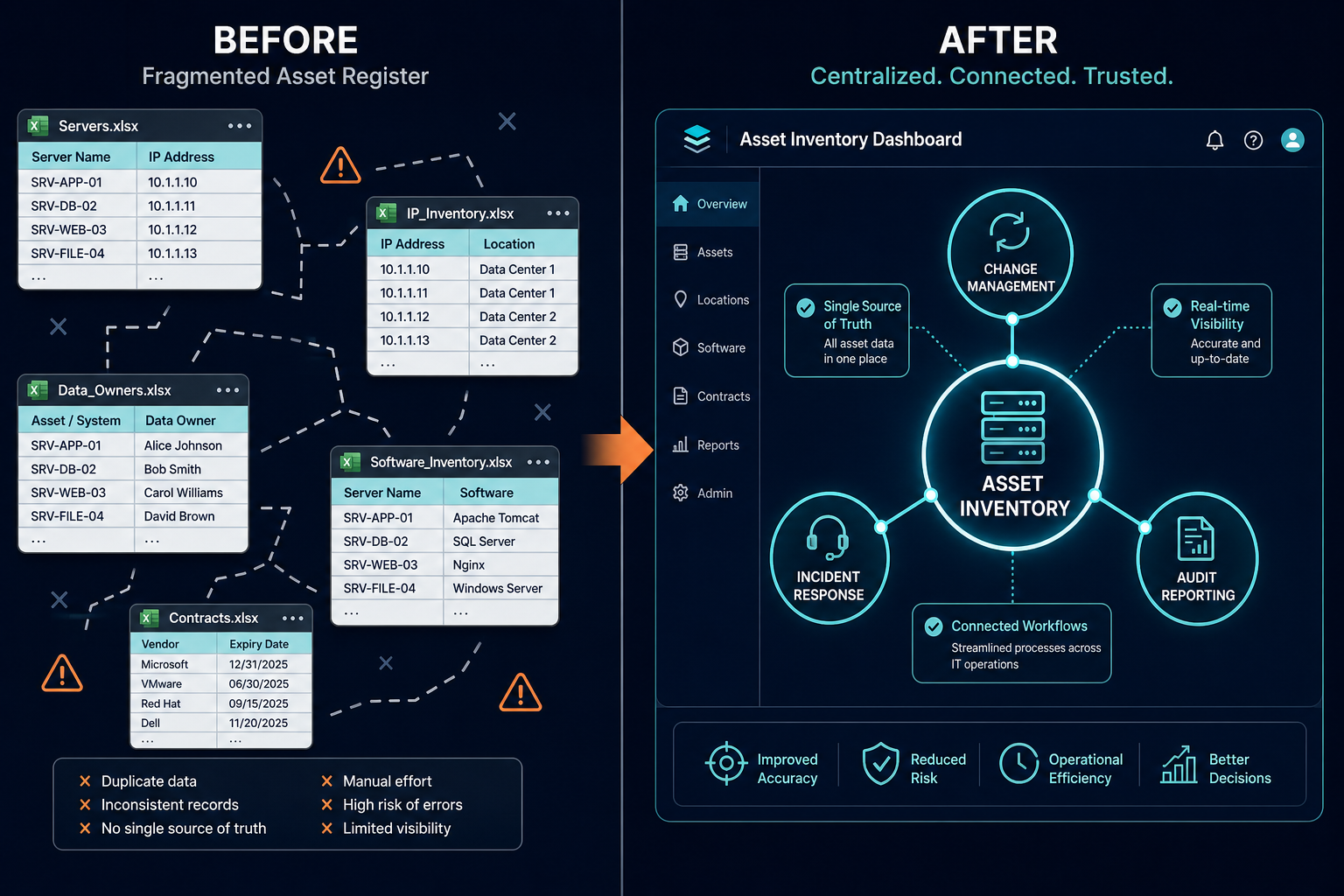
The practical outcome is that every function depending on knowing what exists in the environment, from change management through DPC audit response, draws from a single authoritative source rather than from parallel, diverging records. That convergence on a single source is precisely what GDPR’s accountability principle requires when it asks controllers to demonstrate compliance rather than assert it.

Moving From Spreadsheet Governance to Map-Driven Governance
The shift from manual to discovery-driven CMDB governance involves two concrete changes, each with a cascade of downstream benefits.
| Change | From | To |
|---|---|---|
| Asset detection | Finds what auditors actively look for on audit day | Surfaces what no one asked about, after each scheduled cycle |
| CI ownership | Recorded in a spreadsheet last updated at the prior audit | Updated at CI creation and on each subsequent configuration change |
| Audit response timeline | Days to weeks of cross-team reconstruction | Hours, from timestamped CMDB records |
| RoPA accuracy | Reflects the environment as it existed at the last manual review | Reflects the environment as it currently operates |
Downstream Benefits for GDPR Posture
The downstream benefits reach across three areas that directly affect GDPR posture:
- Faster audit response. A DPC inquiry requesting system records, ownership evidence, and processing scope documentation receives a structured CMDB export rather than a cross-team reconciliation effort that itself becomes a subject of inquiry.
- Reduced breach notification risk from unknown assets. GDPR Article 33 requires breach notification within 72 hours of the controller becoming aware of a breach. A system the IT team does not know exists is a system no one monitors for breach indicators, and awareness of a breach involving an unknown asset will almost always come late.
- Board-level reporting confidence. A CIO presenting GDPR compliance posture to a board references a timestamped, discovery-sourced asset inventory rather than a manually maintained register whose accuracy depends on when someone last updated it.
Getting Started: Five Practical Steps
- Run an initial discovery sweep across on-premises infrastructure, cloud environments, and remote endpoints to establish a current CI inventory baseline.
- Assign CI owners to every discovered asset, using ITSM team structure and cost-centre assignments as the ownership backbone.
- Define your services in Virima so ViVID™ can build dependency maps from the CI inventory that discovery produces.
- Integrate with your existing ITSM platform so change requests and decommission tickets update the CMDB automatically rather than through a separate manual step.
- Set a scheduled discovery cadence that fits your environment’s change velocity, keeping the gap between infrastructure reality and CMDB record within your audit response requirements.
For organisations evaluating where ITAM and CSAM overlap in this governance process, Virima’s ITAM vs CSAM comparison covers the boundary between the two disciplines clearly.
What are the first steps to implementing a GDPR-compliant CMDB?
The foundation is a discovery sweep that establishes a current CI inventory across on-premises, cloud, and endpoint environments. CI owners are assigned to each discovered asset. Services are defined so dependency maps can be built from the inventory. The CMDB then integrates with existing ITSM workflows so that change requests and decommission tickets update asset records automatically, without a separate manual step.
The Audit-Ready CMDB Starts With Discovery
Dublin’s Big Tech HQs operate under the DPC’s direct supervisory authority, and the regulator’s enforcement record confirms that the volume and scale of GDPR inquiries is increasing, not contracting. A discovery-driven, ownership-tagged CMDB is the infrastructure layer that makes GDPR accountability demonstrable rather than asserted. See what Virima’s CMDB capability includes, then schedule a demo to assess how high-frequency scheduled discovery would keep your asset inventory current before the next audit arrives.
Frequently Asked Questions
What is a GDPR-compliant CMDB?
A GDPR-compliant configuration management database (CMDB) is a structured IT asset record maintained with sufficient accuracy and freshness to support Article 5(2) accountability and Article 30 Records of Processing Activities obligations. It documents what systems exist, who owns them, and what data they hold, supplying auditable evidence rather than asserted compliance.
Why does IT asset governance matter for GDPR compliance in Dublin?
GDPR’s accountability principle requires controllers to demonstrate compliance, not merely claim it. Dublin entities operate under the DPC as lead supervisory authority, so every DPC decision carries EU-wide legal force. A discovery-sourced CMDB ensures every system processing personal data appears in the asset inventory, carries an identified owner, and maps to a corresponding RoPA entry.
Does Virima’s CMDB integrate with ServiceNow or Jira Service Management for GDPR audit evidence?
Yes. Virima integrates bi-directionally with ServiceNow, Jira Service Management, and Ivanti, so discovery-sourced CI records, ownership data, and configuration history flow directly into the ITSM workflows where change requests, incidents, and decommission tickets are managed. That integration record is what supplies audit evidence linking a system’s configuration history to the team that managed it.
What are examples of CMDB gaps that create GDPR exposure?
Four recurring patterns account for most CMDB-related GDPR exposure: shadow SaaS tools connected to production data with no CI or RoPA entry; contractor-provisioned cloud instances never decommissioned after contract end; M&A-inherited infrastructure sitting outside discovery scope; and multi-region cloud workloads invisible to the Dublin parent’s central IT asset inventory.
How does Virima’s discovery frequency compare to a manually maintained CMDB for audit readiness?
A manually maintained CMDB reflects the environment as it existed at the last audit or spreadsheet update, with gaps accumulating between review cycles. Virima’s scheduled discovery runs across agent-based, agentless, and API-driven protocols, adding new configuration items to the CMDB within hours of provisioning rather than at the next quarterly review, which shortens the gap between infrastructure reality and the record regulators will ask to see.