GxP Compliance and CMDB Accuracy for Dublin’s Pharmaceutical Manufacturing Cluster

On June 22, 2026, the FDA issued a warning letter to Genzyme Ireland Limited, a Sanofi subsidiary running a biologics manufacturing site in Waterford. The inspection, conducted between January 12 and 20, 2026, produced several findings. Review Checklists were discarded rather than retained, configuration and quality records were updated without traceable attribution to a specific person, and 74 canceled deviations were logged, 36 of which the FDA determined required re-investigation.
Those findings covered laboratory and quality control records, not IT infrastructure. No CMDB failure caused the Genzyme inspection outcome. What the inspection does reveal is the standard regulators apply when they walk into any GxP manufacturing site in Ireland: attribution must be complete, traceability must hold under scrutiny, and every record must connect to the configuration state that existed when a batch was released, or a deviation was logged.
That standard applies to Dublin’s pharmaceutical cluster as directly as it applies to Waterford. Dublin is Ireland’s regulatory nerve center for life sciences. The Health Products Regulatory Authority (HPRA), Ireland’s competent authority for GMP oversight, operates from Kevin O’Malley House on Earlsfort Terrace. The National Standards Authority of Ireland (NSAI), Ireland’s sole designated Notified Body under Regulation (EU) 2017/745, is headquartered in Santry, Dublin 9.
Dublin is also a significant GxP manufacturing hub in its own right. Pfizer’s Grange Castle site, Amgen’s Dún Laoghaire facility, and other multinational biologics operations run validated production systems whose configuration records are examined during HPRA and FDA inspections. When those records are maintained manually or updated only after an inspection cycle forces a reconciliation, the gap becomes visible at exactly the wrong moment.
What is a GxP-compliant CMDB in Dublin’s manufacturing cluster?
GxP is shorthand for the family of Good Practice regulations that govern pharmaceutical manufacturing in the EU: Good Manufacturing Practice (GMP), Good Laboratory Practice (GLP), Good Clinical Practice (GCP), Good Distribution Practice (GDP), and Good Pharmacovigilance Practice (GVP). For a Dublin biologics manufacturing site, GxP compliance primarily means GMP compliance, governed by EudraLex Volume 4, Annex 11, the EU’s binding requirements for computerized systems in a GMP environment. Those requirements cover system validation, audit trails, access controls, and the traceability of any change to a validated computerized system.
EU MDR refers to Regulation (EU) 2017/745, which sets the conformity framework for medical devices entering the EU market. The HPRA is the competent authority under both frameworks in Ireland. NSAI is the country’s sole MDR-designated Notified Body and issues the conformity assessments that allow devices to carry the CE mark.
The two frameworks have different structures, but both make demands on infrastructure evidence:
| Requirement area | GxP / GMP (EudraLex Vol. 4, Annex 11) | EU MDR (Regulation 2017/745) |
|---|---|---|
| Regulatory oversight | HPRA (competent authority) | HPRA (competent authority) + NSAI (Notified Body) |
| Computerized system requirement | Annex 11: validated state, audit trail, access controls, change records | Annex I General Safety and Performance Requirements (GSPRs) |
| Configuration record expectation | Evidence of validated state at time of batch release | Technical file demonstrating device constituent conformity |
The hidden problem sits in how most Dublin manufacturing sites maintain those records:
| Situation | What happens at inspection time |
|---|---|
| Configuration records held in spreadsheets | Inspector cross-checks the spreadsheet against the deployed system and finds a discrepancy |
| No dependency map across validated systems | A deviation investigation closes before the full scope of affected systems is identified |
| No change-record linkage to CI state | The configuration state at time of batch release cannot be reconstructed from the records produced |
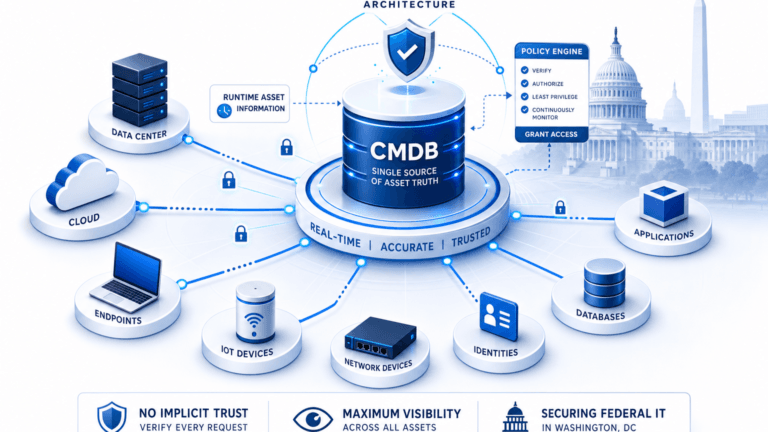
A CMDB that is kept current through scheduled discovery addresses each of these gaps directly. It records what is deployed, links changes to configuration items (CIs), and provides the dependency context that deviation investigations require.
Where GxP and MDR stop being separate problems
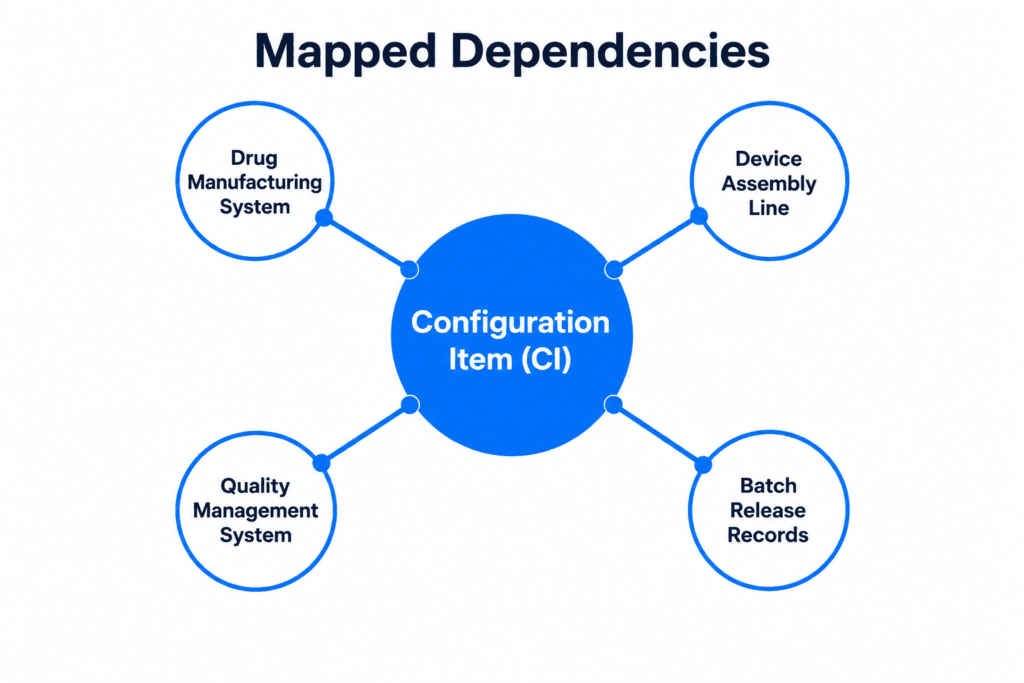
Under Article 117 of Regulation (EU) 2017/745, when a biologic is packaged as an integral drug-device combination- a pre-filled syringe, an auto-injector, a pen device- the device constituent requires a Notified Body Opinion against MDR Annex I General Safety and Performance Requirements before the medicinal product’s marketing authorization clears. Pfizer’s Grange Castle site runs a pre-filled syringe operation. Amgen’s Dún Laoghaire facility, expanded as part of a $300M investment, added a dedicated syringe-filling line. Both sites must produce evidence for two separate regulatory reviews from the same set of equipment and configuration records: an HPRA GMP inspection covering drug manufacturing, and a Notified Body Opinion under MDR covering the device constituent.
A CMDB that cannot distinguish which CIs belong to the drug-manufacturing process and which belong to device assembly cannot fully support either review.
Three points where configuration records let Dublin sites down
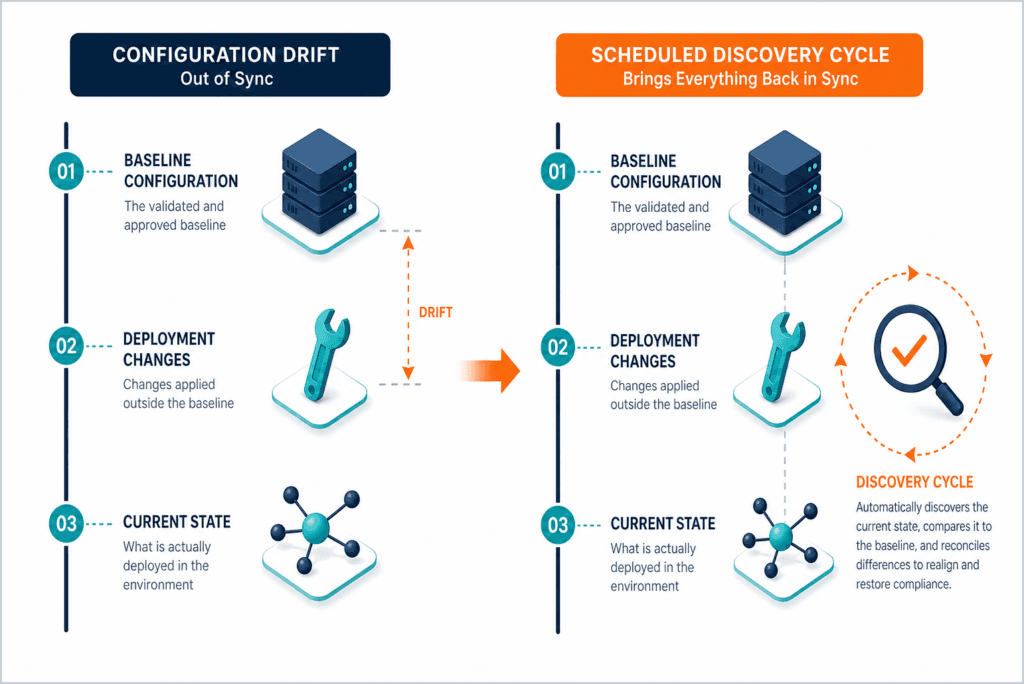
- Configuration drift from the validated state: Validated systems in a GMP environment have an approved configuration baseline. When equipment is patched, software is updated, or network parameters change without those changes flowing through to the CMDB, the record no longer matches what is physically deployed. An HPRA or FDA inspector reviewing a system’s validated state checks the configuration record against the actual deployed system. When those two pictures diverge, the site has a formal finding.
- Narrow investigations from missing dependency data: The Genzyme warning letter cited 74 canceled deviations, with 36 requiring re-investigation. That pattern reflects what happens when no dependency map exists: the configuration team cannot trace which other validated systems a change or deviation touched, so an investigation closes before the full scope of impact is established. The same condition that triggered the original deviation persists in systems that were never examined. Applying agent-based or agentless discovery across the validated system estate provides a live dependency record, so investigation scope is defined by the infrastructure rather than reconstructed from memory.
- Split regulatory records on combination-product lines: A Dublin site running a syringe-filling operation logs changes and deviations under its GMP quality management system. Those same records are what a Notified Body examines when issuing an Article 117 opinion on the device constituent. When the CMDB does not track which CIs relate to the device-assembly portion of the line, the technical file produced for the Notified Body and the batch-release record produced for HPRA draw from different, incomplete pictures of the same equipment. Neither regulator completes its review from records that answer only half of its questions.
Discovery-backed CMDBs close exactly this kind of gap: see how Virima’s CMDB keeps configuration records current between audit cycles instead of reconstructed under deadline pressure.
What does GxP compliance require from a CMDB in a pharmaceutical manufacturing site?
GxP compliance under EudraLex Volume 4 Annex 11 requires computerized systems to maintain a validated, traceable configuration baseline. A CMDB must record which configuration state was applied at the time of batch release, deviation investigation, or regulatory audit, and every record must support attribution to a specific person and decision without reconstruction from memory.
How CMDB gaps surface across five stakeholder groups
For plant and IT leaders
An FDA warning letter carries consequences beyond a written response. The Genzyme letter references the risk of import alerts and injunctions when manufacturing deficiencies remain unresolved. A site under a warning letter also absorbs the operational burden of remediation: re-investigation of closed deviations, audit readiness work across multiple systems, and sustained regulatory correspondence. Those costs typically run across months before a follow-up inspection resolves the letter.
For quality and configuration teams
The CMDB Owner’s daily work in a GMP environment involves reconciling what the validated-system inventory shows against what is actually deployed. When that reconciliation runs on spreadsheets, it consumes hours per change control cycle and still leaves gaps that inspectors find. That is a data-currency problem, not a staffing problem. Thin mandates and manual workloads are not unique to any one site. They are the default condition of a configuration function that has not been given discovery tooling.
For IT and OT security
The IBM Cost of a Data Breach Report 2025 places pharmaceutical sector breach costs among the highest recorded across regulated industries. Those figures represent cybersecurity incidents, not GMP findings. The two risk categories are distinct, but both require the same underlying foundation: a complete, current inventory of what is deployed, where it is, and how it connects to other systems. An incomplete CMDB creates exposure across both risk categories simultaneously.
For combination-product and device teams
EFPIA has documented the real-world experience of pharmaceutical companies navigating the Article 117 Notified Body Opinion process. Notified Body capacity is a demonstrated constraint across the EU. Technical files that arrive incomplete or that require supplementary configuration evidence to support review slow the queue. A site that cannot quickly produce a traceable equipment and configuration record for its device-constituent assembly process waits longer for its Opinion than one that can.
At national scale
Ireland is home to nine of the world’s top ten pharmaceutical companies, according to IDA Ireland. A single site-level warning letter or compliance finding carries reputational weight that extends beyond the individual company. The country’s manufacturing cluster is interdependent: regulators, Notified Bodies, and multinational operations in Dublin, Cork, and Galway operate in shared regulatory territory, where one site’s findings shape inspection priorities across others.
How a GxP-compliant CMDB addresses the gap
Three mechanisms move a Dublin manufacturing site from point-in-time inventory toward configuration records that support both HPRA and FDA audit readiness.
1. High-frequency scheduled discovery replaces point-in-time inventory
High-frequency scheduled discovery runs against deployed assets on a defined cycle, updating the CMDB with the current configuration state without waiting for a manual survey. When a patch is applied, a hardware component is replaced, or a network parameter changes, the next discovery cycle captures that change and updates the CI record. Annex 11 requires that any modification to a computerized system in a GMP environment goes through a controlled process and that the record of the validated state remains accessible. High-frequency scheduled discovery provides the currency layer that keeps those records aligned with the deployed environment between formal change control events.
2. ViVID™ dependency mapping gives investigations a defined scope from the outset
ViVID™ builds a dependency map from discovered configuration data, showing which systems connect to which. When a deviation or change is logged against a specific CI, the dependency map shows which other CIs sit downstream or share a dependency. Investigators work from the map rather than reconstructing scope from memory or from a spreadsheet compiled during a previous audit cycle.
On a combination-product line, ViVID™ shows which CIs support the drug-manufacturing process and which support device assembly. An HPRA inspector reviewing GMP batch-release records and a Notified Body reviewer examining Article 117 technical-file evidence each see the boundary clearly. The same underlying map answers both questions without requiring two separate record-reconstruction exercises.
3. ITSM integration turns inspection evidence into a query
When the CMDB integrates with existing ITSM and quality management workflows, change records and deviation logs reference live CI data from the point they are opened. Producing the configuration state that applied at a specific moment becomes a database query rather than an archival exercise. Virima integrates with ServiceNow, Jira, Ivanti, and other platforms, so the configuration record an inspector requests is the same record that change managers and quality teams work from every day.
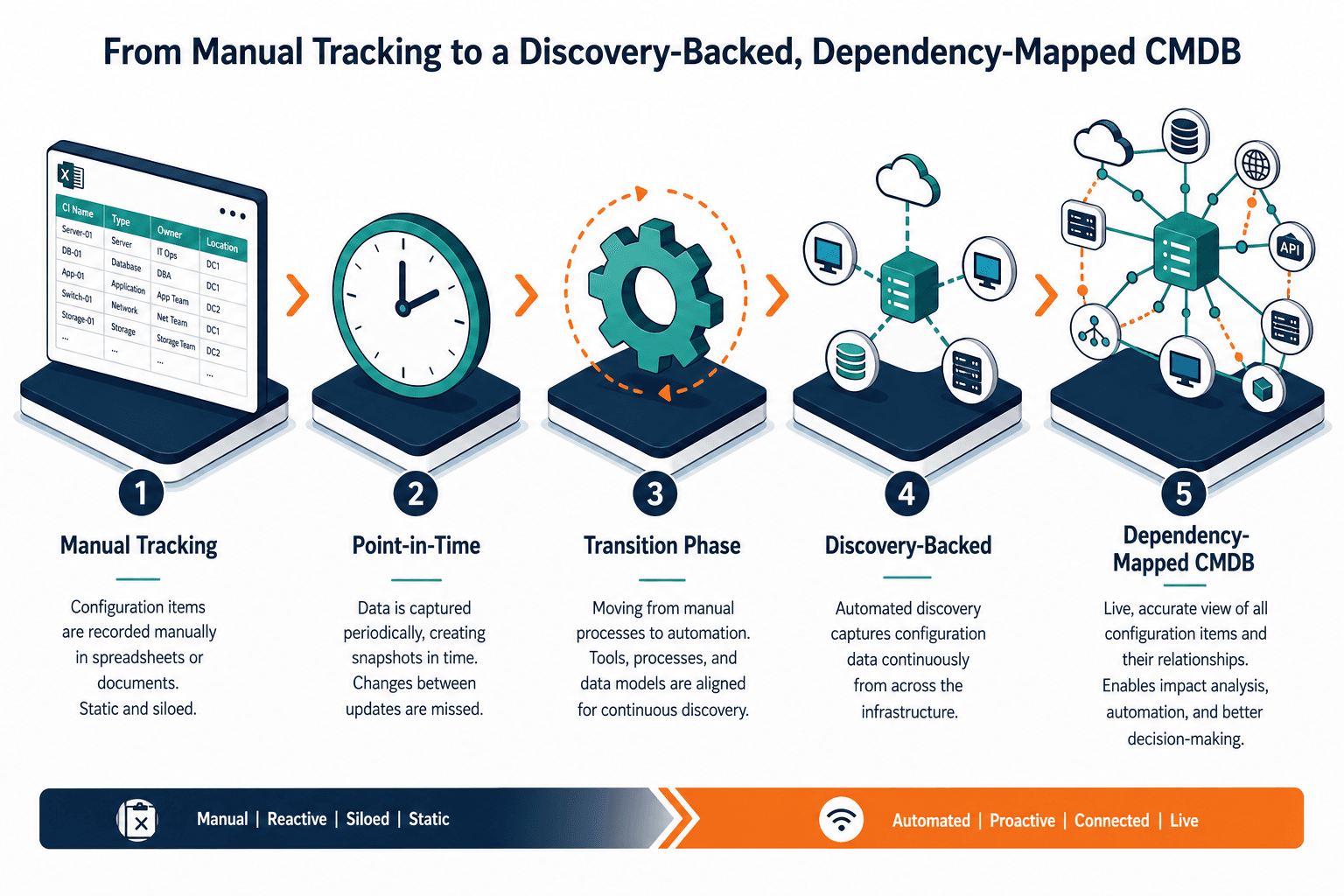
Manual tracking versus a discovery-backed CMDB:
| Criterion | Manual tracking | Discovery-backed CMDB |
|---|---|---|
| Update frequency | Point-in-time, dependent on staff input | High-frequency scheduled cycles |
| Attribution | Dependent on who last updated the spreadsheet | Tied to discovery cycle timestamp and change record |
| Change-impact visibility | Requires manual cross-reference at investigation time | Dependency map shows affected CIs at query time |
| Inspection readiness | Reconstruction from records under deadline pressure | Current record accessible on demand |
When do GxP and EU MDR compliance overlap for a Dublin pharmaceutical manufacturer?
The overlap is most direct on combination-product lines. Under EU MDR Article 117, when a biologic ships as an integral drug-device combination such as a pre-filled syringe, the device constituent needs a Notified Body Opinion before marketing authorization clears. The same equipment and configuration records support both the HPRA GMP inspection and the NSAI Notified Body review.
GxP-compliant CMDB in practice
Two confirmed Dublin manufacturing contexts illustrate what a discovery-backed CMDB needs to support in practice.
- Batch-release investigation. A regulatory inspector requests the configuration state applied to a bioreactor control system at the time of a specific batch release three months prior. The CMDB record, kept current by high-frequency scheduled discovery, provides a timestamped snapshot with attributable change history. The site produces it in hours rather than days.
- Syringe-fill line, dual conformity review. A Dublin biologics site runs a syringe-filling operation. The CMDB distinguishes CIs that belong to the drug-manufacturing portion of the line from CIs that support device assembly. An HPRA GMP inspection and a Notified Body Article 117 review each draw the configuration evidence relevant to their question from the same system, without requesting overlapping clarifications or waiting for separate reconstruction exercises.
How Virima powers a GxP-compliant CMDB in Dublin
- Immediate operational impact: Scheduled discovery replaces the manual surveys that currently drive configuration reconciliation between change control cycles. The hours that configuration teams spend cross-checking spreadsheets against physical deployments shift toward change management and deviation investigation work. The CMDB reflects the deployed environment rather than what was recorded during the last scheduled review.
- Long-term accuracy: A discovery-backed CMDB does not decay between inventory cycles the way a manually maintained spreadsheet does. Each discovery run updates CI records, logs changes with timestamps, and flags discrepancies for review. Over time, the CMDB becomes a reliable source of infrastructure evidence rather than a record of what was deployed at the last audit cycle.
- Integration with existing workflows: Virima’s discovery engine feeds CI data into ITSM and quality management workflows. Change records reference live CI data from the moment they are opened. Deviation investigations begin with a dependency map already populated from the current state of the environment. The configuration evidence an inspector requests is the same record that change managers and quality teams work from every day.
- A broader look at how CMDB compliance supports audit readiness across regulated environments is available for teams mapping this to existing governance frameworks.
- A boundary that matters: Virima’s CMDB is the infrastructure and evidence layer that supports GxP audit readiness and GAMP 5 computerized system validation. It records configuration states, change histories, and system dependencies. It does not perform computer system validation, does not replace the site’s quality unit or validation program, and is not GxP certified; no such certification exists for infrastructure, which is a point even major cloud platform providers explicitly acknowledge about their own environments.
The same boundary applies to MDR: ViVID™ dependency mapping shows which systems and equipment sit on a combination-product line and which regulatory pathway each CI supports. It does not produce the technical file or the Notified Body Opinion itself. Those remain the responsibility of the site’s device regulatory function. Virima supports the evidence layer. The quality unit owns the validation program. Both are necessary, and neither substitutes for the other.
Moving from point-in-time inventory to a discovery-backed CMDB
The transition from a manual-survey baseline to a discovery-backed CMDB involves two changes in how configuration data flows through the organization.
| Current state | Discovery-backed state |
|---|---|
| Configuration records updated manually after change events | Configuration records updated by scheduled discovery cycle with timestamps |
| Deviation investigations reconstruct scope from prior inventories | Dependency map defines investigation scope when the deviation is logged |
| Combination-product records mixed across GMP and device technical files | CI classification separates drug-manufacturing and device-assembly CIs from the outset |
Three operational benefits follow from that transition. Configuration currency removes the gap between what is deployed and what the CMDB records. Dependency visibility changes how investigations and change assessments open: scope is set by the infrastructure map, not reconstructed from memory. Attribution becomes tied to the discovery cycle and the formal change record, rather than to whoever last updated the spreadsheet.
Getting started in five steps:
- Map current state: inventory all validated systems, equipment, and configuration records against what is actually deployed across the facility.
- Establish high-frequency scheduled discovery across on-premises, cloud, and OT-adjacent assets.
- Build the ViVID™ dependency map around GxP-critical systems and combination-product lines, separating CIs by regulatory pathway.
- Integrate with existing ITSM and quality workflows so change and deviation records reference live CI data from the outset.
- Define CI-class ownership before the next HPRA or FDA inspection cycle, or before an NSAI Notified Body review under MDR Article 117.
The CMDB audit essentials checklist is a practical starting point for step one.
What should a Dublin pharma or medtech site look for in a GxP-ready CMDB?
A GxP-ready CMDB should provide high-frequency scheduled discovery that keeps configuration records current between audit cycles, dependency mapping that shows which systems are connected to a validated process or combination-product line, ITSM integration so change and deviation records reference live CI data, and CI classification that can distinguish drug-manufacturing assets from device-assembly assets when both regulatory frameworks apply.
Start with the infrastructure evidence layer
Dublin’s pharmaceutical cluster operates under two overlapping regulatory frameworks, inspected by two authorities from the same sites. The HPRA reviews GMP compliance. The NSAI issues Notified Body Opinions under MDR. Both draw from the same underlying configuration records.
When those records are maintained manually and updated only when an inspection forces a reconciliation, the gap is predictable and findable. A discovery-backed CMDB closes it by providing trusted runtime truth across every validated system, every combination-product line, and every inspection cycle, without replacing the quality program that sits above it.
If your Dublin site is preparing for an HPRA inspection, an MDR Article 117 review, or a change in your configuration management approach, schedule a conversation with Virima to walk through what a discovery-backed CMDB looks like for a GxP manufacturing environment.
Frequently Asked Questions
What is GxP compliance, and how does it apply to Dublin’s pharmaceutical manufacturers?
GxP is the collective term for Good Practice regulations in the pharmaceutical sector: GMP, GLP, GCP, GDP, and GVP. For a Dublin biologics manufacturing site, GxP compliance primarily means GMP compliance under EudraLex Volume 4, including Annex 11 for computerized systems. The HPRA conducts GMP inspections and has authority to issue formal findings when configuration records, audit trails, or validated-system documentation fall short of the required standard.
When do GxP and EU MDR compliance overlap for a Dublin manufacturer?
The clearest overlap occurs on combination-product lines. Under EU MDR Article 117, when a medicinal product incorporates a device constituent, such as a pre-filled syringe or auto-injector, the device component requires a Notified Body Opinion from NSAI before the marketing authorization is approved. The same manufacturing equipment and configuration records must support an HPRA GMP inspection and a Notified Body technical-file review, which means the configuration evidence layer has to answer two regulatory questions from one set of records.
Why does a GxP-compliant CMDB matter for HPRA and FDA audit readiness?
Annex 11 requires that any change to a validated computerized system is controlled and that the validated state at the time of any batch release or deviation investigation remains traceable. The FDA’s 2026 warning letter to Genzyme Ireland cited the failure to maintain attributable and traceable records. A CMDB updated by high-frequency scheduled discovery provides that traceable baseline without relying on manual entry, which means the configuration state an inspector asks about is already recorded, not reconstructed under deadline pressure.
Can a CMDB make a computerized system GxP compliant on its own?
No. A CMDB is the infrastructure and evidence layer – it records configuration states, change histories, and system dependencies. Computer system validation under GAMP 5 methodology is a separate process owned by the site’s quality unit and requires validation protocols, test documentation, and regulatory review. A discovery-backed CMDB supports the evidence that validation relies on, but it does not perform validation or replace the quality program. No infrastructure tool is GxP certified, because no such certification exists for infrastructure.
Does Virima’s CMDB integrate with the ITSM and quality management systems already used at a Dublin GxP site?
Yes. Virima integrates with ServiceNow, Jira Service Management, Ivanti, and other ITSM and quality management platforms already in use at most Dublin manufacturing sites. Change records and deviation logs reference live CI data from the point they are opened, so the configuration evidence an HPRA inspector or Notified Body reviewer requests is the same record that change managers and quality teams already work from; not a separate export built for the inspection.