Hybrid Cloud Discovery for Paris Enterprises: The Sovereignty Gap Nobody’s Mapping

On March 20, 2026, France’s Conseil d’État closed years of argument over where the Health Data Hub should run. The country’s highest administrative court upheld the Commission Nationale de l’Informatique et des Libertés (CNIL) authorization for Microsoft Azure hosting. It judged the Cloud Act risk acceptable under the safeguards in place. Coverage in Le Monde Informatique made the legal outcome plain.
The operational lesson sits one layer deeper. The court spent years determining jurisdiction, access paths, and hosting location because those facts were not sitting in a single queryable infrastructure record.
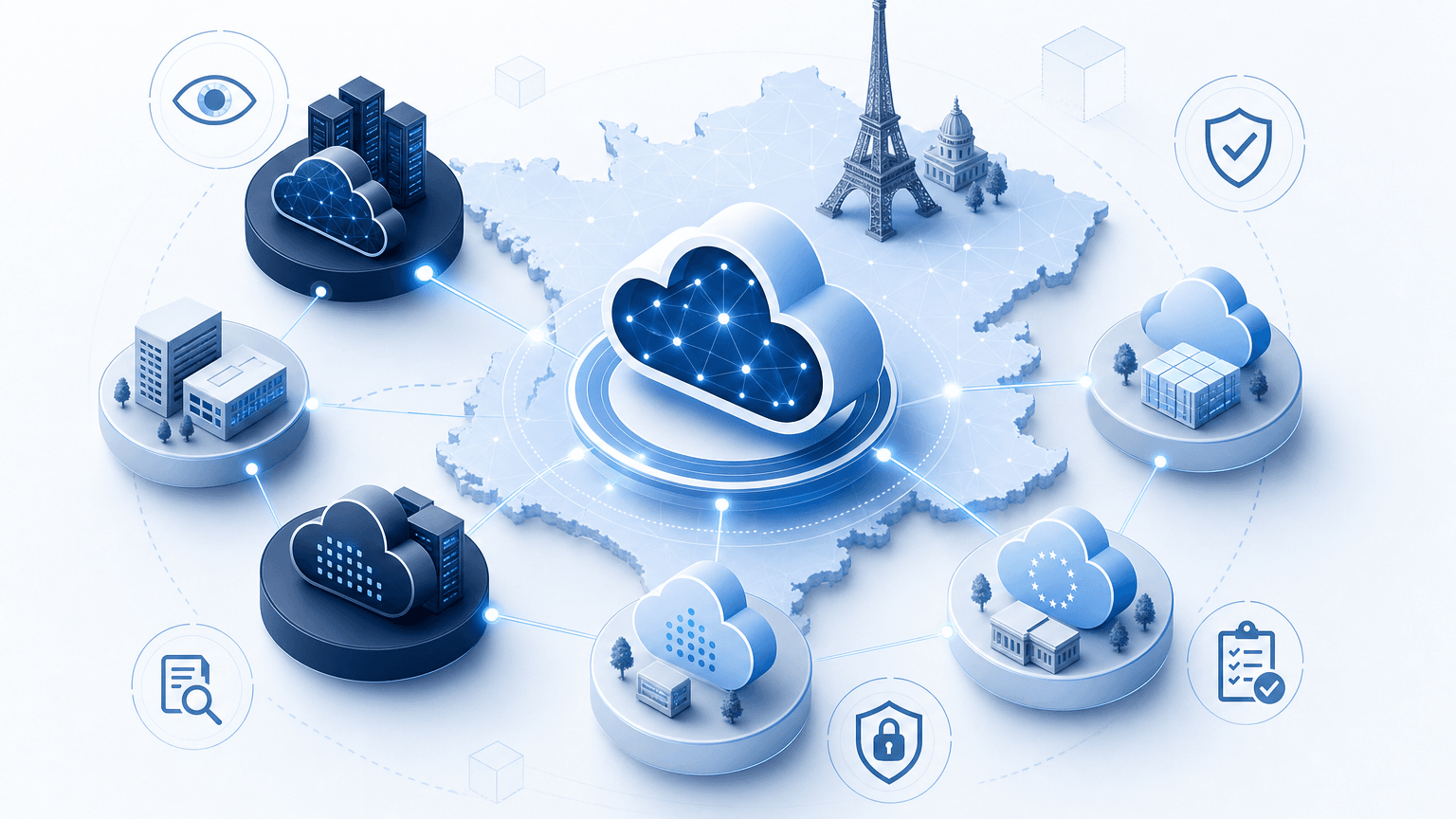
That is the sovereignty gap hybrid cloud discovery for data sovereignty in Paris is meant to close. Paris enterprises already run mixed estates: on-premises rooms in and around the capital, EU-region hyperscaler accounts, and a growing set of SecNumCloud-qualified or “Cloud de Confiance” options. Scale is not theoretical.
JLL’s EMEA data centre reporting put Paris ahead of its full-year forecast in the Frankfurt, London, Amsterdam, Paris, and Dublin (FLAP-D) market. The region delivered 72.5 MW in the first half of 2026 alone. More capacity means more places a workload can land. Without scheduled discovery across a mixed estate, residency and provider claims stay assertions, not timestamped evidence.
What is hybrid cloud discovery under data sovereignty rules in France?
NIST SP 800-145 defines hybrid cloud as a composition of two or more distinct cloud infrastructures that remain unique entities. Those infrastructures are bound together by technology that enables data and application portability. In enterprise practice, that includes on-premises compute and storage. ITIL 4 Service Configuration Management expects those components as configuration items with relationships, ownership, and change history.
Hybrid cloud discovery is the scheduled practice that finds those components across on-premises networks, virtualization layers, and cloud APIs, then normalizes them into one configuration model. Region, provider, account, and relationship become queryable fields. It answers a narrower question every French sovereignty program needs: which infrastructure exists, which provider runs it, and which region it sits in, as of the last successful discovery cycle.
In France, that question is loaded. ANSSI’s cloud guidance frames SecNumCloud as the security qualification path for cloud services, including protection against extraterritorial law exposure. SecNumCloud underpins the political “Cloud de Confiance” label buyers hear in procurement. Data sovereignty rules France enterprises live under stack up: RGPD obligations, sector rules for health and finance, NIS2 duties, and contractual pressure toward qualified providers. Discovery supplies the infrastructure inventory those regimes assume you can produce.
Sovereignty vs. data compliance in France
The two terms are related but describe different things, and the distinction shapes what discovery actually delivers.
Data sovereignty is a legal concept: data is subject to the laws of the country where it is collected, processed, or where the data subject resides. For French enterprises, that means infrastructure location is a jurisdictional fact, not just an operational preference. When a workload runs on a provider whose parent company is subject to the US Cloud Act, sovereignty is affected whether or not any regulatory body has yet acted on it.
Data compliance is the operational and procedural work of adhering to those and other regulatory rules: registering with ANSSI, producing evidence for a NIS2 audit, meeting RGPD controller obligations, passing a SecNumCloud qualification review.
Discovery’s direct output is a sovereignty fact: which provider, which region, which jurisdiction each workload runs in. Compliance programs consume that fact. Good compliance documentation does not substitute for a current infrastructure record.
The hidden problem
| Situation | What happens on the ground |
|---|---|
| Compliance asks for proof of EU data residency ahead of an audit | IT stitches exports from three cloud consoles and on-prem records over several days, with no single verified answer |
| A SecNumCloud-qualified project shares an estate with legacy hyperscaler workloads | Nobody has a current map of which configuration items sit on which provider, so “sovereign by design” is asserted, not proven |
| A new analytics workload gets provisioned fast | It lands in whichever region spun up first, not the region compliance assumed, and nobody notices until the next review |
| DSI and RSSI teams keep separate inventories | On-prem records and cloud or security records use different naming and never reconcile into one sovereignty answer |
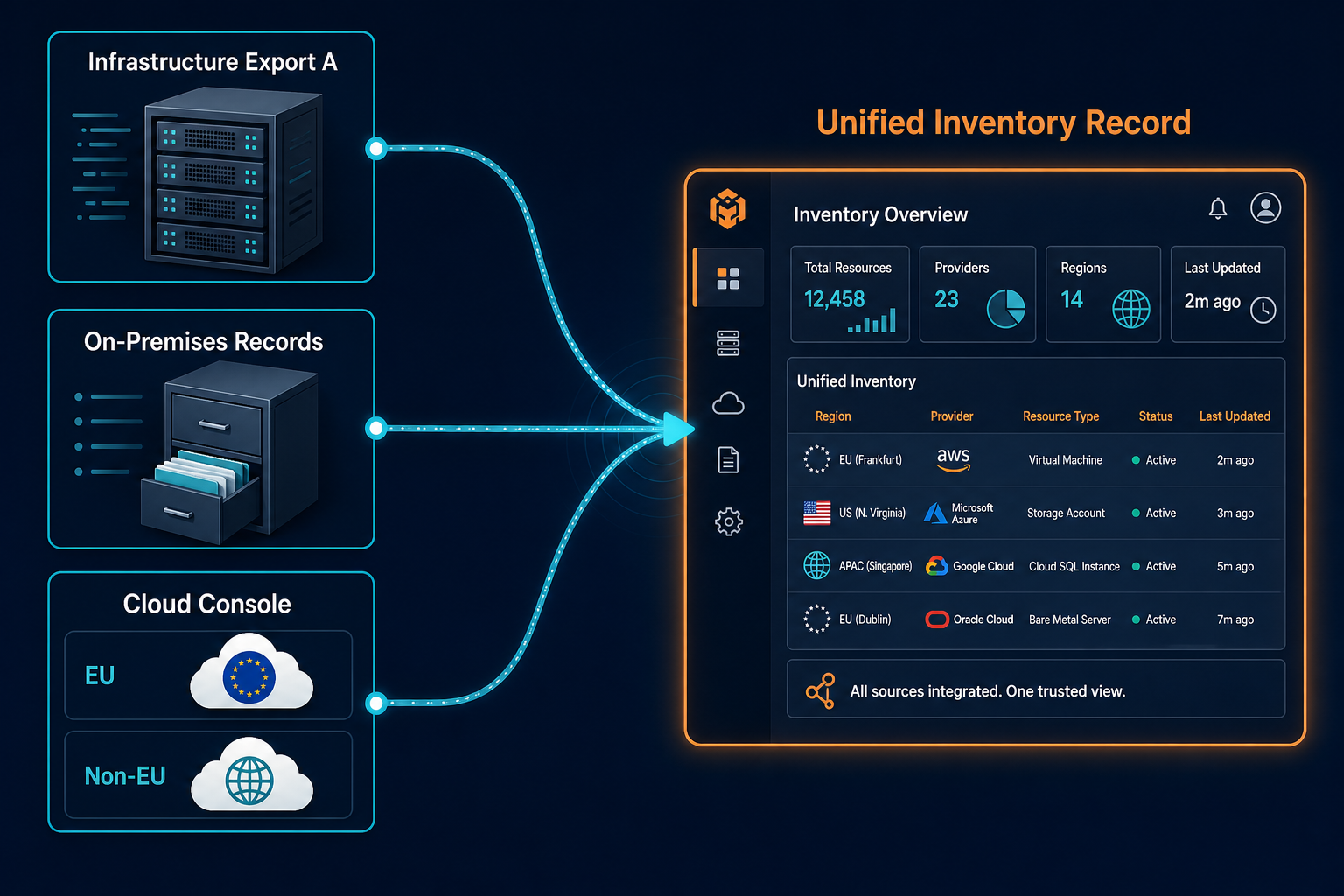
Paris hybrid estates also fail for structural reasons that look familiar once you map hybrid and multi-cloud network topologies. Paths cross providers. Naming diverges. Ownership sits in different tools. Sovereignty proof needs the joined view, not three partial ones.
Why hybrid cloud discovery matters for Paris enterprises and SecNumCloud compliance
French buyers are no longer treating sovereignty as a slide in a vendor deck. The ISG Provider Lens 2026 France release reports that firms in France put sovereignty at the core of hybrid cloud plans. Regulated-workload procurement now weighs jurisdictional control and audit readiness alongside SecNumCloud. The same release ties that selectivity to the €109 billion AI infrastructure investment announced at the 2025 Paris AI Action Summit. More AI capacity on French soil multiplies the accounts, regions, and GPU estates that must still prove where they run.
Breach economics add pressure from the other direction. IBM’s 2026 Cost of a Data Breach study put the global average breach cost at a record $4.99 million, up 12% year over year. The same IBM report details how asset context gaps stretch detection and containment. When you cannot name the CI, the owner, and the region during an incident, cost follows.
SecNumCloud compliance is often framed as a provider problem: pick a qualified cloud and move on. Estates that mix qualified sovereign capacity with legacy hyperscaler and on-prem systems break that framing. Qualification sits on a service, and your CMDB has to show which workloads use it. Without discovery covering both sides of the mix, SecNumCloud becomes a contract line, not an estate fact.
Where Paris estates quietly drift
- Discovery runs as an annual audit-cycle event, not a scheduled practice. Result: the inventory reflects reality on audit day only, and sovereignty claims cannot be verified the other 364 days of the year.
- Cloud and on-prem teams run separate consoles with incompatible taxonomies. Result: nobody can answer which workloads sit outside the EU without a multi-day manual pull.
- Shadow cloud accounts get provisioned outside central governance to save time. Result: a workload touching regulated data ends up on hyperscaler infrastructure instead of a sovereign option such as Bleu, S3NS, OVHcloud, or Outscale, without anyone deciding that trade-off on purpose.
- Discovered infrastructure data stays isolated from change management. Result: a change advisory board approves a migration to a new cloud region before legal can flag a residency conflict.
| NIS2 Article 21 requirement | CMDB field it maps to |
|---|---|
| Asset classification | Asset/CI class |
| Criticality assessment | Criticality tier |
| Accountable owner | CI owner |
| Physical/logical location | Region and provider |
| Evidence of current state | Last-verified discovery timestamp |
An IT risk register that lists “cloud residency” as a control still fails when the underlying asset list is stale.
Who pays for an unmapped hybrid estate in Paris?
Different roles absorb different costs when hybrid cloud visibility fails.
- For CIOs and DSI leadership, NIS2 pushed cybersecurity deeper into director accountability, and board questions about regulated infrastructure location are no longer optional. Vendor sprawl across sovereign and hyperscaler contracts makes the answer harder without a consolidated view.
- For CTOs, hybrid sovereign-plus-hyperscaler design creates configuration drift by default, and incomplete dependency maps raise the cost of any future move to SecNumCloud-qualified capacity. Nobody can prove what breaks in the cutover.
- For CMDB owners, records fragment across on-premises, EU-region cloud, and sovereign providers such as Bleu, S3NS, OVHcloud, and Outscale, and without automated refresh the CMDB becomes a reconciliation project that never finishes. A CMDB without discovery stagnates for the same reason in any market; Paris just adds residency and qualification fields that spreadsheets rarely keep current.
- For SecOps leads and RSSI teams, asset inventory gaps block NIS2 registration packets and slow incident evidence. You cannot produce a clean scope for an ANSSI-facing review from three naming schemes. Cybersecurity asset management only helps when discovery feeds it current infrastructure, not last quarter’s export.
- For regulated Paris sectors, the stakes are concrete: financial services around La Défense, healthcare organizations still living with Health Data Hub lessons, and OIV or OSE entities under NIS2 already face contractual and supervisory pressure. France was one of four member states the European Commission referred to the Court of Justice on July 8, 2026, for failing to notify complete NIS2 transposition. The Commission requested financial penalties (IP/26/1499). That referral is not a free pass: ANSSI’s interim ReCyF referential and supply-chain clauses already apply in practice, and transposition delay does not pause inventory expectations.
CNIL enforcement remains visible. The 2026 Free/Free Mobile sanction confirms French regulators act on data protection failures with public decisions. Discovery does not “ensure compliance” with RGPD or NIS2, but the CMDB is the infrastructure visibility layer compliance programs query. Without current CIs, those programs work from stories instead of records.
See how Virima IT Discovery maps your mixed sovereign/hyperscaler estate before your next attestation.
How hybrid cloud discovery fixes CMDB data residency blind spots
Three mechanisms close the gap when they run together.
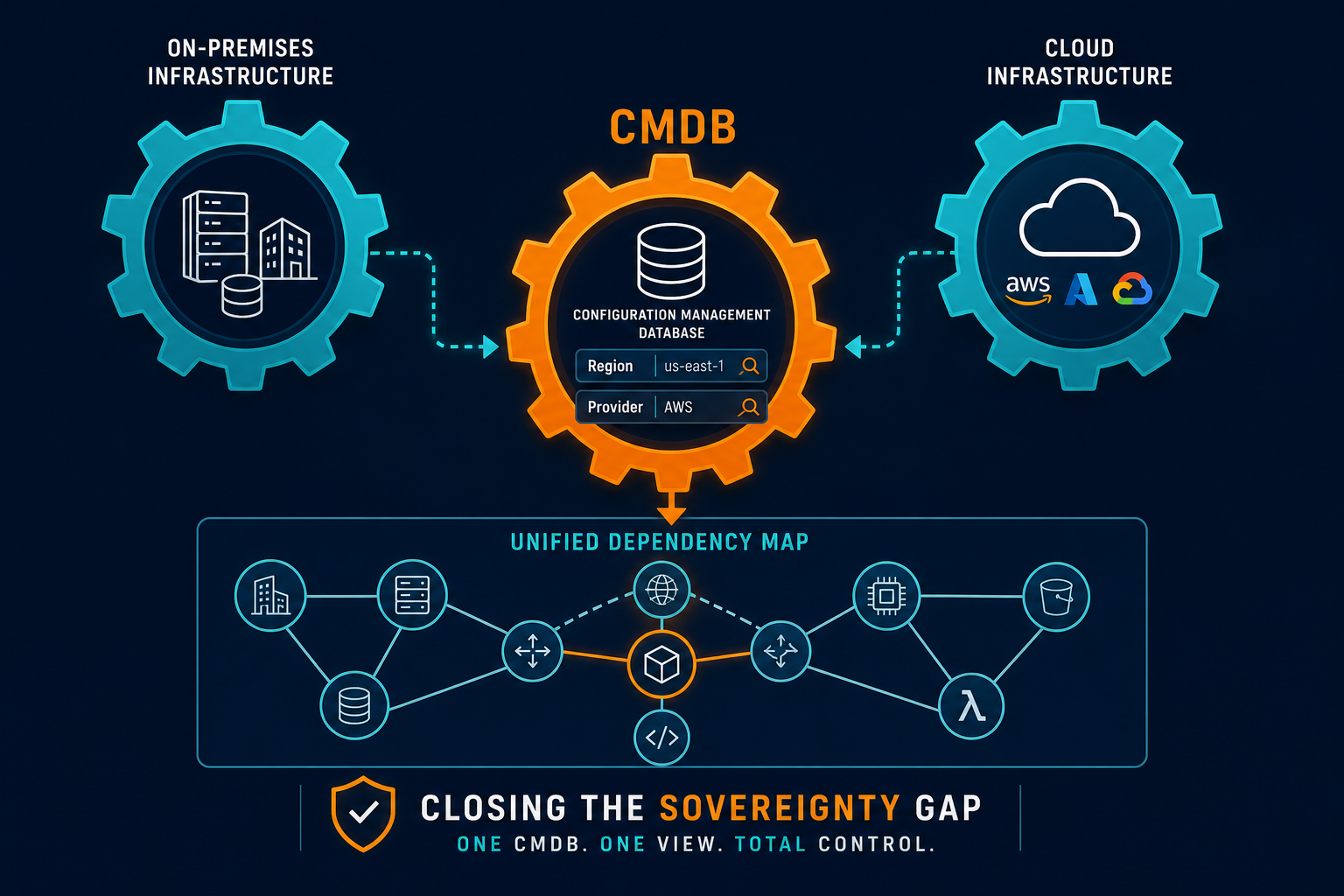
- Discover across on-premises French facilities, EU cloud regions, and non-EU cloud accounts in one model. Agent-based, agentless, and API discovery cover different slices of the estate. Virima IT Discovery is the entry point for that multi-method coverage, with the full integration surface available on the integrations hub.
- Keep the CMDB current with region and provider as queryable attributes. Compliance should ask where a workload runs and receive a timestamped answer. A CMDB fed by automated discovery treats residency metadata as first-class fields instead of comments in a ticket.
- Map dependencies so a region migration does not silently drag a regulated workload across a sovereignty boundary. Once service definitions are supplied, ViVID™ service maps build the dependency graph that change and architecture teams need. They don’t invent service composition — they make the infrastructure path visible after the business names what the service is.
| Dimension | Manual spreadsheet tracking | Scheduled discovery-driven baseline |
|---|---|---|
| Discovery cadence | Annual audit-cycle reviews | High-frequency scheduled discovery cycles |
| Jurisdiction visibility | Disconnected exports per cloud console | Unified model with region and provider as first-class fields |
| Dependency mapping | Static diagrams, outdated within weeks | Dependency maps that flag cross-jurisdiction links |
| Audit preparation | Weeks of manual collation per request | Verified, timestamped records available on demand |
Hybrid cloud discovery in practice
- A CTO catches a sovereignty violation before go-live. Pre-migration dependency mapping flags a workload labeled “sovereign” that still reaches a shadow non-EU dependency, and the team re-architects before deployment instead of explaining the path after cutover.
- An RSSI finds an unregistered storage bucket outside the approved region. A contractor spun it up for speed, and the next scheduled discovery cycle surfaces it before an auditor, or CNIL does.
- A DSI closes a gap before a board-level NIS2 attestation. The missing CI class appears in the discovery delta while there is still time to remediate ownership and placement, not during the board packet review itself.
How Virima powers hybrid cloud discovery for Paris enterprises
- For DSI and CIO leadership
Pain point: A board-level NIS2 or SecNumCloud attestation needs proof of where regulated infrastructure runs, and that proof currently takes weeks to assemble by hand.
Solution: Trusted Runtime Truth is the live operational context layer across assets, services, dependencies, ownership, and change history, so a board question becomes a query instead of a project. - For CTOs and architecture leads
Pain point: A migration can move a regulated workload into the wrong cloud region, and nobody notices until the next review.
Solution: ViVID™ service maps show what a planned change actually touches, so a sovereignty-boundary crossing is visible before deployment. - For CMDB owners
Pain point: Reconciling on-premises, hyperscaler, and sovereign-cloud records by hand, then watching the result go stale within days.
Solution: Discovery-fed CMDB workflows normalize those records into one estate instead of three spreadsheets, with region and provider as first-class queryable fields. - For RSSI and SecOps teams
Pain point: Shadow cloud accounts and unregistered instances surface during an incident or an ANSSI-facing review, not before one.
Solution: IT Discovery extends agentless and API-based scanning across on-premises, EU-region, and non-EU accounts, catching unapproved infrastructure on the next scheduled cycle.
Moving from spreadsheet-era tracking to discovery-driven sovereignty proof
IT operators stop rebuilding the same export pack for every request, and change windows start from current CI relationships instead of last quarter’s diagram. Compliance and legal teams get residency questions answered against timestamped infrastructure instead of email threads, with evidence packets for NIS2, RGPD, and sector reviews starting from the same baseline. Architecture teams can test hybrid designs against real cross-region links before go-live, and moves toward SecNumCloud-qualified capacity start from a known dependency set.
Getting started in five steps
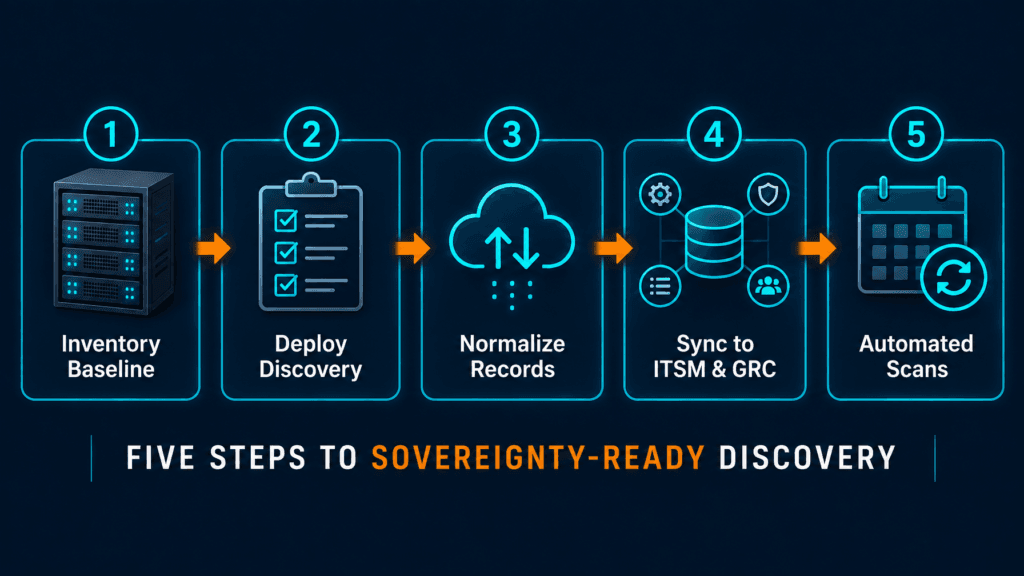
- Establish a current inventory baseline across on-premises records, cloud consoles, and network sources.
- Deploy agentless and API-based discovery across initial subnets and cloud accounts.
- Configure normalization rules to merge duplicate records and standardize naming, including region and provider.
- Sync discovered configuration items into ITSM and GRC workflows that already own tickets and controls.
- Establish automated recurring scan schedules so drift and unapproved cloud instances appear on the next cycle, not the next annual project.
Close the sovereignty gap before the next attestation
If your infrastructure records cannot currently answer where a workload runs and whether you can prove it, that gap does not close itself before the next audit. See how Virima IT Discovery turns hybrid infrastructure into a verified, audit-ready record, built on the same discovery cycle and CMDB fields covered above.
Frequently Asked Questions
What is hybrid cloud discovery for data sovereignty?
Hybrid cloud discovery is the automated, scheduled process of identifying and cataloging infrastructure across on-premises and cloud providers. For data sovereignty, its output is a location fact: which provider and jurisdiction each workload actually runs in.
What’s the difference between data sovereignty and data compliance in Paris?
Data sovereignty is a legal concept: data is subject to the laws of the country where it is collected or processed. Data compliance is the operational process of meeting those and other regulatory rules. Discovery establishes the sovereignty fact; compliance programs consume it.
What is SecNumCloud and how does it relate to hybrid cloud discovery?
SecNumCloud is ANSSI’s security qualification for cloud providers, protecting against extraterritorial law exposure. Hybrid cloud discovery supports it by identifying which infrastructure runs on qualified versus non-qualified providers across an estate.
How does Virima keep NIS2 asset inventory current between audits?
Scheduled agentless and API-based discovery cycles refresh region, provider, and ownership fields automatically, so the inventory reflects the estate as it exists today rather than as it existed at the last annual audit.
Does Virima’s discovery cover SecNumCloud-qualified providers like OVHcloud or Outscale alongside hyperscalers?
Yes. Virima’s API-based and agentless discovery extend across sovereign and non-sovereign providers in one model, so qualified and non-qualified infrastructure show up as queryable fields on the same CI record instead of in separate systems.