CMDB Statistics: 15 Facts & Figures Every IT Leader Should Know

What CMDB Statistics Say About Visibility and Inventory Accuracy
| Only 43% of IT organizations have complete technology stack visibility according to the Flexera 2025 State of ITAM Report — a figure that fell from 47% the prior year. CMDB statistics on visibility consistently show that expanding infrastructure outpaces many teams’ ability to track it through manual methods alone. |
IT organizations have complete technology stack visibility.
According to the Flexera 2025 State of ITAM Report, just 43% of organizations have complete visibility across their technology stack — down from 47% the prior year. That declining trend reflects a widening gap between infrastructure growth and inventory management capability. For IT leaders, this CMDB statistic is a practical benchmark: if your CMDB does not cover every cloud region, every remote site, and every SaaS application in active use, you are likely in the majority — not the exception.
Understanding your current discovery coverage is the starting point for any CMDB improvement effort. Organizations that run a multi-source discovery scan for the first time often find assets in unexpected places — cloud accounts provisioned outside standard processes, applications still running past their decommission date, and devices on network segments that agentless scanning did not reach. CMDB best practices consistently recommend mapping your discovery scope before assessing inventory completeness.
ITAM teams rank accurate IT inventory as their top SAM priority.
The Flexera 2026 State of ITAM Report found that 78% of ITAM teams identify maintaining an accurate IT inventory as their highest software asset management priority. That ranking has held across multiple years of Flexera’s research. It reflects a persistent challenge: the inventory is never fully accurate, so teams keep prioritizing it. The goal is to shift from reactive inventory correction to discovery-driven inventory maintenance. When high-frequency discovery cycles keep CI records current automatically, your team’s energy moves from data cleanup to data use.
CMDB data in hybrid environments ages faster than most teams account for.
In a hybrid environment — on-premises infrastructure plus cloud providers plus SaaS applications — CI data can become outdated within days of any infrastructure change. Cloud instances are provisioned and terminated on demand. Containers spin up and down on scheduling logic that may not align with your discovery cycle. SaaS applications are added and removed with procurement cycles that often bypass IT. Without scheduled discovery cycles covering all of these environments, your CMDB may reflect the infrastructure as it was at your last scan, not as it is today. Understanding how CMDB asset management differs from traditional IT asset tracking helps clarify why hybrid environments create unique accuracy challenges.
Change Management CMDB Statistics
| DORA 2024 data shows that high-performing software delivery organizations maintain change fail rates between 5% and 15%, while low performers regularly exceed 30%. Accurate CI relationship data — knowing what depends on what — is a consistent differentiator between organizations that catch change risk early and those that discover it during the outage. |
High performers maintain change fail rates between 5% and 15%; low performers often exceed 30%.
The DORA 2024 State of DevOps Report documents a clear performance gap on change failure rate. High performers — teams with mature change governance and accurate configuration data — maintain significantly lower failure rates. Low performers, who often lack pre-change impact analysis grounded in reliable CMDB data, see failure rates that are two to six times higher. Change impact analysis that draws on accurate CI relationships is a consistent factor in that performance difference. When your CMDB relationships are current, you can identify affected services before a change window opens. When they are not, your team is making risk decisions without the full picture.
The connection between ITIL change management and CMDB accuracy is well-documented in ITIL 4 guidance, which positions the CMDB as the foundational data source for change enablement decisions.
Change impact analysis is only as reliable as the CI relationship data it draws from.
ITIL 4 treats the CMDB as the primary input to change enablement. Before any change, your team needs to know which CIs are directly affected, which services depend on those CIs, and who owns each affected component. The CMDB provides this data — but only if the CI relationship layer is maintained alongside the CI inventory. Organizations that populate their CMDB with CI records but do not invest in relationship mapping often find that their change impact analysis surfaces the wrong services or misses critical dependencies.
This is one of the most consequential CMDB statistics gaps: high CI inventory completeness combined with low CI relationship accuracy produces a false sense of confidence going into a change window. You know what exists — you just do not know what depends on what.
Post-change CI verification closes the loop that most CMDB cycles miss.
Most organizations run scheduled discovery cycles on a weekly or bi-weekly basis. But changes happen continuously inside those cycles. When a change window closes and the CMDB update does not happen until the next scan, the database reflects the old environment for several days. That lag creates a window during which incident response teams may use stale relationship data to troubleshoot issues introduced by the recent change. High-performing organizations address this by scheduling discovery cycles in close proximity to significant change windows, validating the post-change state against the pre-change CMDB baseline.
Why do most CMDB implementations fail to deliver accurate change impact analysis? Most CMDB implementations fail at change impact analysis because CI relationship data is not maintained through high-frequency discovery cycles. When CIs are added, modified, or decommissioned without triggering a CMDB update, the relationship map becomes outdated. Impact analysis built on stale data often misses affected services or flags irrelevant ones, reducing trust in the process over time. |
The Cost of CMDB Inaccuracy: What the Data Shows
| The IBM Cost of a Data Breach Report 2024 found the global average breach cost reached $4.88 million — the highest IBM has documented. Ungoverned and untracked assets are a consistent factor in breach risk. CMDB statistics on the cost of poor data quality underscore why inventory visibility is a security priority, not just an operational one. |
The average cost of a data breach reached $4.88 million in 2024.
According to the IBM Cost of a Data Breach Report 2024, the global average cost of a data breach reached $4.88 million — a 10% increase over 2023 and the highest figure IBM has recorded. The report highlights that organizations with stronger asset visibility and faster threat detection typically experience lower breach costs. Assets not tracked in the CMDB are assets your security tooling cannot easily reach. They will not appear in vulnerability prioritization workflows, will not trigger alerts when their configuration drifts, and will not appear in blast radius analysis when a related service is at risk.
This CMDB statistic connects directly to the CMDB audit essentials every security-conscious IT team should maintain: asset discovery coverage, CI ownership attribution, and integration with vulnerability data from NVD lookups.
Untracked assets represent a disproportionate share of security risk.
Assets outside your CMDB are typically also outside your patch management cycle, your change management process, and your vulnerability response workflow. Shadow IT, personally provisioned cloud accounts, and legacy systems that were never formally decommissioned continue to run, accumulate vulnerabilities, and process data without the oversight controls applied to CMDB-tracked systems. Security teams that integrate discovery data into their asset inventory can identify these gaps and bring them into managed lifecycle processes.
This is one of the most actionable CMDB statistics contexts: discovery-driven CI population is not only an operational hygiene measure. It is a security control. Every asset brought into the CMDB and given a formal lifecycle is an asset that can be patched, monitored, and governed.
Compliance frameworks depend on CMDB completeness, ownership accuracy, and configuration history.
Audits under SOX, HIPAA, PCI-DSS, and ISO 27001 require organizations to demonstrate control over their IT assets. Auditors ask for evidence of who owns each asset, what its current configuration is, how its configuration has changed over time, and what access controls are in place. Organizations that maintain discovery-driven CMDB records can answer these questions with documented evidence. Organizations relying on manually maintained records often face extended audit cycles when gaps are identified. IT regulatory compliance has a direct dependency on the quality and completeness of your CMDB data.
| How does CMDB accuracy affect audit outcomes for enterprise IT teams? CMDB accuracy directly affects audit outcomes because compliance frameworks require documented evidence of asset ownership, configuration history, and access controls. When a CMDB is incomplete or relies on manual updates, it typically cannot provide auditors with a reliable, timestamped record of asset state. Discovery-driven CMDB data is more defensible because every CI record traces back to a discovery source and timestamp. |
Discovery Coverage and CI Relationship Statistics
Multi-source discovery consistently uncovers assets that single-method approaches miss.
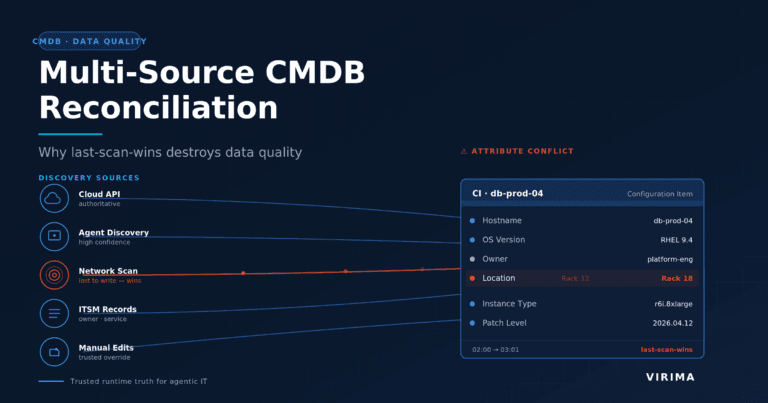
Agentless discovery — using WMI, SSH, and SNMP — reaches network-accessible devices quickly and without requiring software installation. Agent-based discovery captures detailed configuration data from enrolled endpoints, including assets behind firewalls or in network segments inaccessible to agentless scans. API-based discovery pulls cloud resource inventories directly from AWS and Azure, capturing provisioned instances that may not be visible from on-premises scan points. Each method has blind spots. Organizations that combine all three methods through high-frequency discovery cycles consistently find assets that any single method would have missed.
When evaluating your current discovery approach, the IT discovery tool best practices most often cited include: running multi-source discovery from the start, establishing CI normalization rules that merge records from different sources, and scheduling discovery cycles against cloud APIs separately from network-based scans.
CI relationships are the most underinvested part of most CMDB implementations.
Most CMDB projects begin with CI inventory. Servers, workstations, network devices, and applications are imported or discovered, and CI records are populated. The CI relationship layer — mapping which application runs on which server, which service depends on which application, which infrastructure component underpins which business capability — typically receives less investment. Yet it is the relationship layer that enables service impact analysis, ViVID service maps, and blast radius visibility before changes. A CMDB with accurate CI records but sparse relationships can tell you what exists. It typically cannot tell you what breaks when one component fails.
Understanding how CIs and relationships work together in a CMDB is foundational to getting sustained operational value from CMDB investment.
Source attribution on CI records is what makes CMDB data defensible.
When a CI record is populated and updated through a scheduled discovery cycle, every attribute carries a source and a timestamp. You know which discovery method confirmed the record and when it was last verified. When a CI record is entered manually — or not updated since the last major infrastructure project — the data has no clear timestamp or source attribution. In change management contexts, where you need to know whether CI data is current enough to trust, source attribution is the difference between a confident decision and an assumption.
This is the foundation of trusted runtime truth: not just that data exists in the CMDB, but that you can trace every CI attribute back to the discovery source that confirmed it. CMDB automation is what makes source attribution practical at scale.
| What is the difference between CI inventory and CI relationships in a CMDB? CI inventory refers to the set of individual configuration items — servers, applications, network devices — tracked in the CMDB. CI relationships map how those items connect and depend on each other. Inventory without relationships tells you what exists. Relationships tell you what breaks when something changes. Both are necessary for effective change management and incident response. |
CMDB Statistics That Matter for Agentic IT and AI Operations
| As AI agents begin handling IT decisions autonomously, CMDB data accuracy becomes a direct safety and reliability concern. Freshness signals, source attribution, and CI confidence scores are moving from operational nice-to-haves to requirements for any team building AI-assisted IT workflows. |
AI agents acting on CI data need freshness signals, source attribution, and confidence scores.
An AI agent that queries the CMDB before making a change decision needs to know three things: that the CI was recently confirmed by discovery (freshness), that the data came from a reliable source rather than a manual entry (attribution), and that if the record is older than expected, the system flags it before acting (confidence threshold). Without these properties, AI-driven workflows can initiate changes based on infrastructure that has already been decommissioned, reconfigured, or moved. These are the core properties of Virima’s Trusted Runtime Truth approach — giving both human teams and AI agents the information needed to assess whether CMDB data is reliable enough to act on.
CI confidence scoring is becoming a key CMDB health metric for AI-ready organizations.
Traditional CMDB health metrics focus on completeness — how many CI types are covered, what percentage of known assets have CI records. Forward-looking organizations are beginning to track CI confidence: a composite measure of how recently each CI was confirmed by discovery, how many discovery sources agree on its current state, and whether its relationships have been validated against the current environment. CI confidence turns CMDB health from a static count into an actionable signal. For AI agents, a low confidence score on a CI can trigger a re-scan request before the agent proceeds — a form of built-in data governance that protects against automated decisions based on stale records.
The lag between discovery cycles and CI age is where agentic IT risk tends to concentrate.
If your organization runs weekly discovery cycles and an AI agent makes a change decision on day six of the cycle, the CI data it references may be up to six days old. In stable environments, this lag is typically acceptable. In active environments — ongoing cloud deployments, frequent change windows, migration projects — a six-day-old CI record may not reflect the current infrastructure. Agentic IT readiness means accounting for this gap: either shortening discovery cycles in high-change environments, prioritizing high-frequency discovery for the most change-sensitive CI types, or implementing CI confidence scoring that surfaces stale records before AI agents rely on them.
| Why does agentic IT increase the demand for CMDB accuracy? Agentic IT increases CMDB accuracy demands because AI agents act autonomously on the data they receive. A human engineer can recognize that a CI record looks out of date and pause before acting. An AI agent following a workflow typically cannot make that judgment unless the CMDB provides explicit freshness signals, source attribution, and confidence scores that indicate whether the data is reliable enough to act on. |
What These CMDB Statistics Mean for Your IT Strategy
- The 15 facts in this article point toward a consistent conclusion: CMDB accuracy is a foundational condition for effective IT operations, not a background task. The Flexera visibility data, the DORA change failure patterns, and the IBM breach cost figures all describe consequences of operating with CMDB data that teams cannot fully trust.
- For IT directors and asset managers, the most actionable response is a structured assessment of your current CMDB health. Start with discovery coverage: which asset types, network segments, and cloud environments are currently in a scheduled discovery scope? Then evaluate your CI relationship layer: are your service dependencies mapped accurately enough to support change impact analysis? Finally, consider CI freshness: how old is the average CI record in your CMDB, and would you trust that data to make a change decision today?
- The goal is not a perfect CMDB. It is a CMDB that is accurate enough to trust when it counts: during an incident, before a change window, at the start of an audit, or when an AI agent is about to make an autonomous decision.
- Virima supports this through high-frequency discovery cycles across agentless, agent-based, and API-based methods for AWS and Azure environments. ViVID service maps build dynamic dependency maps from discovery-sourced CI data, giving your team visual blast radius context before every change. And bi-directional integration with ServiceNow, Ivanti, Halo, Jira Service Management, and Xurrent means your CMDB data reaches the teams and tools that depend on it.
| To see how Virima delivers trusted runtime truth across your environment, explore the Trusted Runtime Truth approach |
Turning CMDB Statistics Into Trusted Runtime Truth
The 15 facts in this article share a common thread: CMDB data is only valuable when it is accurate, current, and traceable to a reliable source. The visibility gaps Flexera documents, the change failure patterns DORA tracks, and the breach costs IBM reports are all, in part, consequences of CMDB data that teams are not confident enough to act on.
Virima’s discovery-driven CMDB gives your team the trusted runtime truth it needs: live, explainable, source-attributed CI data that supports faster incident response, safer change decisions, and audit-ready configuration records — all without replacing your existing ITSM stack.
| Ready to close the visibility gap? Schedule a demo. |
Frequently Asked Questions About CMDB Statistics
How often should IT organizations update their CMDB data?
Update frequency depends on how actively your environment changes. Most ITIL practitioners recommend scheduling discovery cycles so that no CI record goes unverified for more than two weeks in a stable environment. In high-change environments — active cloud deployments, frequent patching cycles, ongoing migration projects — more frequent cycles are warranted. The target is not the most frequent update possible, but frequent enough that your teams can trust the data when they need to act on it.
What is the most common reason CMDB projects fail to deliver long-term value?
CMDB projects often underdeliver because organizations rely on manual data entry rather than discovery-driven CI population. Manual CMDB maintenance does not scale. As infrastructure grows and changes, the effort required to keep records current outpaces team capacity. The result is a CMDB that was reasonably accurate at go-live and progressively less reliable over time. Discovery-driven CI population shifts maintenance from individual effort to scheduled processes, which makes long-term accuracy more sustainable.
How does CMDB accuracy affect mean time to restore (MTTR) during incidents?
During an incident, the first operational priority is understanding which services are affected and identifying the most likely failure point. Accurate CI relationships allow teams to quickly identify the blast radius of a failed CI and route the incident to the correct owners. When relationships are outdated or missing, teams typically spend the early part of an incident reconstructing the dependency picture manually. That reconstruction time directly extends MTTR. Accurate CI relationship data is one of the most consistently cited factors in faster incident resolution.
What is CI confidence, and why is it important for AI-driven IT operations?
CI confidence is a measure of how reliably a CI record reflects the current state of the actual configuration item. It accounts for how recently the CI was last confirmed by discovery, how many sources agree on its attributes, and whether its relationships have been validated. As AI agents begin to use CMDB data for automated decisions, CI confidence provides a signal that the data is trustworthy enough to act on — without requiring a human to verify each record before every automation step. CI confidence is emerging as the bridge between CMDB health monitoring and agentic IT readiness.
| What CMDB statistics matter most for IT leaders assessing CMDB health? The CMDB statistics most useful for IT leaders are discovery coverage rate (what percentage of your environment is in an active scan scope), CI relationship completeness (how many CIs have mapped dependencies), CI freshness (average age of CI records), and change fail rate (from DORA 2024 benchmarks). These four metrics map directly to the operational risks that poor CMDB data creates. |