CMDB Automation: Why It Drives CMDB Accuracy

| What is CMDB automation? CMDB automation uses discovery scans, business rules, and ITSM integrations to keep configuration item (CI) data current without manual intervention. It detects new assets, updates changed attributes, flags stale records, and synchronizes with downstream platforms so IT workflows operate from accurate, discovery-sourced data. |
Understanding CMDB Automation
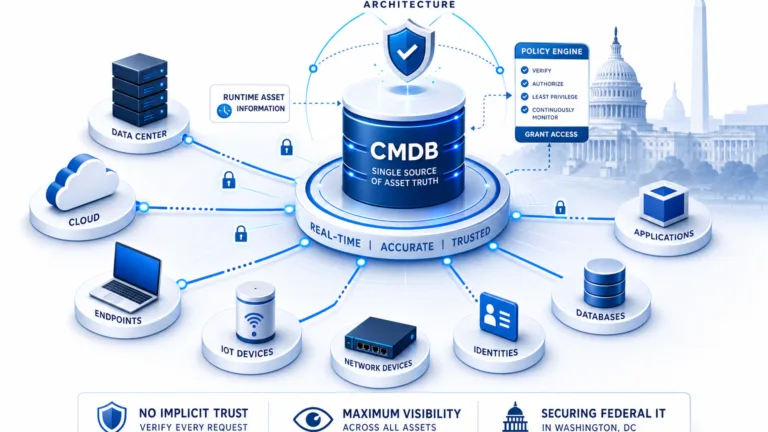
A configuration management database (CMDB) is a centralized repository that tracks IT assets, their attributes, and their relationships. CMDB automation uses high-frequency discovery cycles, business rules, and integrations to keep that data current without relying on manual updates.
In modern IT environments, manual CMDB maintenance fails by design. Infrastructure changes too fast for human-driven processes to keep pace. Cloud resources spin up and decommission within hours. Devices move between network segments. Software versions change. Each of those events creates a gap between what the CMDB says and what is actually running.
CMDB automation addresses this by building a discovery-driven process that detects changes and updates CI records consistently, regardless of how often the environment shifts. When paired with Virima IT Discovery, it identifies assets across on-premises, cloud, and remote environments and keeps the CMDB populated from authoritative sources.
Key Components of CMDB Automation
- Configuration items (CIs): Core records representing physical devices, software, virtual entities, and services, each with verified attributes like ownership, specifications, and dependencies.
- High-frequency discovery cycles: Scheduled scans that identify new and changed CIs, normalize data, and push updates to the CMDB. More reliable than manual entry at any scale.
- Business rule automation: Configurable logic that determines which CI changes get auto-promoted, which trigger alerts, and which require human review. Governance happens at the data level.
- ITSM integration: Bidirectional sync with platforms like ServiceNow, Ivanti, Halo, Jira Service Management, and Xurrent so incident and change workflows draw from current CI data.
- Reporting and analytics: Dashboards and trend data that give IT leaders visibility into asset inventory, compliance gaps, and infrastructure risk.
| What are the benefits of CMDB automation? CMDB automation reduces manual effort, improves data accuracy, cuts incident response time, and gives IT leaders a reliable picture of the environment for planning and compliance. When discovery cycles run on schedule, your teams spend less time reconciling data and more time on work that matters. |
Benefits of CMDB Automation
Improved Data Accuracy
Discovery-driven CMDB automation detects changes in your environment and updates CI records based on what it finds. Your teams get an accurate view of assets and their dependencies. That accuracy feeds into better ITSM workflows, faster incident resolution, and more confident change planning.
Time Savings
Cloud environments and remote devices change faster than any team can track manually. When discovery handles CI updates, your teams focus on managing and monitoring the environment rather than reconciling data. That shift reduces escalations during incidents and frees capacity for work that drives outcomes.
Risk Reduction
When your CMDB reflects what is actually running, you can manage device lifecycles more accurately, identify gaps before they become failures, and reduce the frequency of configuration drift causing unplanned outages. See how CMDB inaccuracy compounds into measurable business cost to understand the financial case.
Better Service Management
Accurate CI data gives ITSM workflows a trustworthy foundation. Your teams can prioritize incidents, track resolutions, and identify recurring issues faster when they are not questioning the reliability of the underlying records.
Better Planning Decisions
A discovery-driven CMDB gives IT leaders a consistent view of assets across teams and locations. That foundation supports capacity planning, maintenance scheduling, and audit readiness. The change management process in particular, depends on this view.
Challenges in Implementing CMDB Automation
CMDB automation works when the data feeding it is clean and the processes governing it are consistent. Common failure points include:
- Data quality and normalization: Discovery-driven updates are only as reliable as the data they produce. Duplicate records, inconsistent naming conventions, and gaps in source data require governance rules to resolve before they propagate into the CMDB.
- Integration complexity: Connecting CMDB automation to legacy systems and multiple data sources introduces configuration work upfront. Without clear mapping rules, CI data from different sources can conflict rather than reconcile.
- Ongoing governance: Discovery schedules, business rules, and promotion logic need regular review. A CMDB that was well-governed six months ago can drift if nobody maintains the rules that keep it current.
- Common failure patterns: Reliance on manual updates as a fallback, incomplete data from limited discovery coverage, absence of CMDB governance policies, and missing ownership for key CI records.
- Cloud and off-network visibility: Devices that move off-network or exist only in cloud environments require agent-based or API-based discovery to stay visible. Agentless scanning alone does not cover them.
| See how Virima’s discovery-driven CMDB handles these challenges. Schedule a demo to see CMDB automation in action across on-premises, cloud, and hybrid environments. |
| How does Virima automate the CMDB? Virima populates and maintains its CMDB through high-frequency discovery cycles. Every CI carries a verified source attribution, a freshness indicator, and an ownership tag. Granular business rules govern which CI changes get auto-promoted, which trigger downstream actions, and which require human review, so governance happens at the data level rather than through manual oversight. |
Virima CMDB: Discovery-Sourced, Governed, and Built for Complex IT Environments
The success of CMDB automation depends on how data gets in, how it is governed, and how it connects to the workflows that rely on it. Virima CMDB approaches all three through a discovery-driven architecture. Every CI carries a verified source, a freshness indicator, and an ownership tag. When discovery runs, it populates or updates CI records based on what it actually finds in the environment, not what was last manually entered.
Discovery-Driven CI Population
Virima’s IT discovery identifies configuration items and their relationships across your IT infrastructure. It covers on-premises devices, cloud assets via AWS and Azure API integrations, and remote endpoints via optional agents for Windows, macOS, and Linux. Once discovery runs, Virima builds CI records and maps the relationships between them.
Business Rule Automation
Routine CI governance decisions, including which changes get promoted, which trigger downstream sync actions, and which generate alerts, can be configured as business rules. This reduces manual review of routine updates and keeps your teams focused on exceptions that need human judgment.
Data Consolidation and Import
Virima integrates with IT management tools and consolidates CI data into one view. Reusable import templates bring in data from CSV files and link asset records consistently. That consolidated view supports accurate reporting and steady decision-making.
NIST NVD Integration for Vulnerability Context
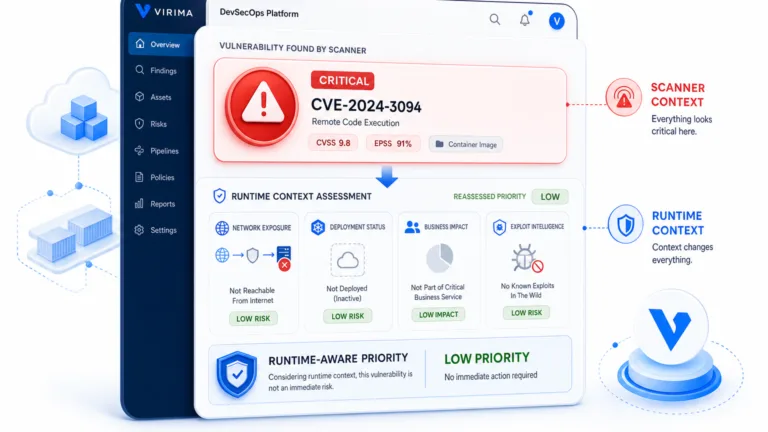
Virima CMDB integrates with the NIST National Vulnerability Database (NVD) at no additional cost. It cross-references discovery data, including CPEs and CVEs, to help your teams identify and prioritize vulnerabilities based on what is actually present in your environment. This is part of Virima’s broader cybersecurity asset management approach.
Bidirectional ITSM Sync
Two-way synchronization between Virima CMDB and ITSM platforms reduces data errors and keeps CI records consistent across incident, change, and problem workflows. Supported platforms include ServiceNow, Ivanti, Halo, Jira Service Management, and Xurrent.
ViVID™ Service Mapping and Vulnerability Prioritization
Virima’s ViVID™ Service Mapping builds dynamic service dependency maps from your discovery data. Those maps show how applications and services connect and what would break if a specific CI changed. Your teams can assess blast radius before making changes and reduce the risk of unplanned outages.
With NIST NVD data layered onto your service maps, ViVID™ helps you prioritize remediation by asset importance and service criticality. You address the most impactful vulnerabilities first, rather than working through a flat list. Learn more about how CMDB automation supports broader ITOM workflows.
| What are common CMDB automation failures? Common CMDB automation failures include reliance on manual fallback updates, poor data normalization at source, absent CI ownership assignments, lack of ongoing business rule governance, and limited discovery coverage for cloud and off-network assets. Each gap leaves stale or missing CI records that manual processes will not reliably close. |
| Can CMDB automation support AI agents? Yes. AI agents that execute IT actions need accurate CI data to know what they are allowed to touch, what depends on it, and what the blast radius of a given action would be. Discovery-sourced CMDB data with verified ownership and relationship mapping gives those agents the trusted runtime truth they need to act safely. See how a CMDB built for AI agents differs from a traditional configuration store. |
FAQ: CMDB Automation
What is the difference between CMDB automation and manual CMDB maintenance?
Manual CMDB maintenance requires IT teams to update CI records by hand as the environment changes. CMDB automation uses discovery scans, business rules, and integrations to update records based on what is actually in the environment. Manual processes create lag and introduce errors at scale. Automation creates a discovery-sourced foundation that reflects current reality.
How does CMDB automation support change management?
When a CMDB reflects accurate, up-to-date CI relationships, change managers can assess the potential impact of a change before it is approved. Discovery-sourced CI data lets you see which services depend on the CI being changed, who owns it, and what else might break. That context reduces failed changes and limits unplanned outages.
What IT environments benefit most from CMDB automation?
Environments with high asset velocity, cloud workloads, distributed endpoints, or multiple ITSM platforms benefit most. The faster your environment changes, the faster manual CMDB maintenance falls behind. Discovery-driven automation is built for environments where change is constant, not occasional.
Does CMDB automation replace IT discovery?
No. CMDB automation depends on IT discovery. Discovery identifies what is in the environment. Automation governs how that data flows into and through the CMDB. Without high-frequency discovery cycles, a CMDB automation framework has no reliable data source to work from.
Can CMDB automation support AI agents in IT operations?
AI agents that execute IT actions need accurate CI data to know what they are allowed to touch, what depends on it, and what the blast radius of a given action would be. Discovery-sourced CMDB data with verified ownership and relationship mapping gives those agents the trusted runtime truth they need to act safely.
A Discovery-Driven CMDB Is the Foundation Your IT Operations Need
CMDB automation works when discovery does. High-frequency discovery cycles, clean business rules, and bidirectional ITSM sync keep your CI data current. Your teams, your workflows, and your AI agents all operate from the same authoritative record.
If your CMDB is drifting, that is not a data problem in isolation. It is a process problem. The right CMDB automation framework fixes it at the source, before drift compounds into failed changes, extended outages, or bad data feeding automated decisions.
| Ready to build a discovery-driven CMDB? Schedule a demo today to see how Virima’s CMDB automation keeps your IT data accurate, governed, and ready for whatever your environment throws at it. |