Managing IT Assets Across Multiple Clients: Virima for MSPs

The Multi-Client Asset Problem Most MSPs Know Too Well
- MSPs operate in an environment where client sprawl is the baseline condition. You might support a healthcare provider, a regional bank, a law firm, and a mid-market retailer, all under the same team and the same platform. Each client brings different infrastructure, different compliance obligations, and a different risk tolerance.
- Managing this complexity with generic ITAM tools forces your team into constant context-switching, manual data segregation, and reporting workarounds. Tools built for internal IT teams assume one organization, one policy set, and one shared view of every asset. For MSPs, that assumption breaks at the first client boundary.
- The global managed services market reached $430.56 billion in 2026 and is on track to grow to $704.2 billion by 2031, according to Mordor Intelligence. As client portfolios expand, the operational demand on MSP teams scales with them. Platforms that served you well at ten clients stop working reliably at twenty-five.
Why Standard ITAM Tools Break Down for MSPs
- Most asset management tools are designed for a single internal IT team. When MSPs try to adapt that model for multi-client operations, three failure patterns appear quickly.
- First, data isolation becomes a manual effort. Client A’s assets sit in the same database as Client B’s, separated only by field-level tagging. A misconfigured export, a misrouted alert, or a careless query can expose one client’s data to another’s view. The risk is real, and the mitigation is tedious.
- Second, discovery configuration needs rebuilding from scratch for every new client. There is no concept of a client template. Each engagement requires re-entering credentials, re-scoping network ranges, and re-mapping CI relationships manually.
- Third, reporting becomes patchwork. One client’s executives want a monthly asset health summary. Another client’s compliance team wants a quarterly software audit. Without client-level separation at the data layer, generating clean, scoped reports takes hours of manual filtering rather than minutes of configuration.
| What does multi-tenant IT asset management mean for MSPs? Multi-tenant IT asset management gives each MSP client a logically isolated data environment within a shared platform. Each client has its own CMDB records, discovery configurations, access roles, and reports. The MSP manages all clients from one centralized portal, with no data from one client appearing in another client’s views or exports. |
How Virima Solves Multi-Client Asset Management
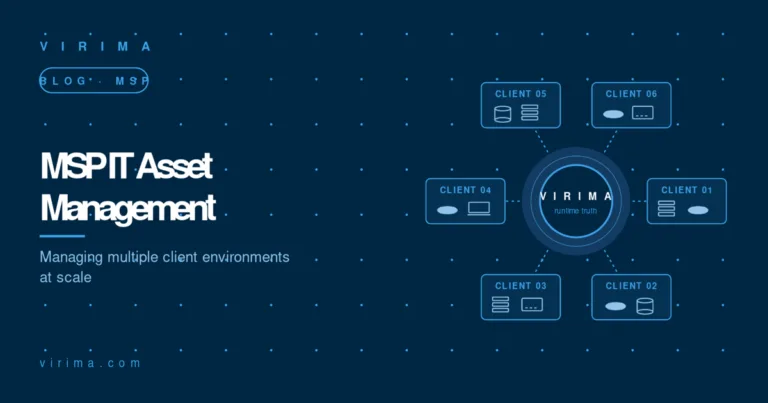
The Virima MSP platform is built from the ground up for multi-client delivery. Rather than adapting a single-tenant ITAM tool into an approximation of multi-tenancy, Virima provides native architecture that separates client environments at the data layer while giving MSP teams a centralized management portal for every client they support.
You get full visibility across every client from one place. Your technicians switch between client environments, run discovery scans, review CMDB health, and generate reports without leaving the platform. Each client’s data stays cleanly isolated, with no crossover risk between instances.
Virima also supports white-labeling, so you can deliver the platform under your own brand. This matters when you are selling CMDB-as-a-Service or Discovery-as-a-Service to clients who expect a branded experience.
If your team is ready to explore how trusted runtime truth delivers the data foundation that MSP operations require, the Trusted Runtime Truth resource center is a strong starting point.

Discovery That Works Across Every Client Environment
- One of the most operationally intensive parts of managing multiple clients is running discovery reliably across all of them. Different clients bring different network topologies, different credential policies, and different expectations about scan frequency and scope.
- Virima supports both agent-based and agentless discovery, giving you flexibility for clients who will accept lightweight deployed agents and clients who require credential-based network scanning only. Virima’s guide to agent-based and agentless discovery can help you match the right method to each client’s environment and access model.
- For each client, you configure separate discovery zones, credentials, and scan schedules. High-frequency discovery cycles keep CMDB records current without requiring manual intervention between runs. Discovery covers physical hardware, virtual machines, network devices, software inventory, and cloud assets across AWS and Azure environments.
- When a new client onboards, you provision their instance from a standard template using the MSP portal. This cuts the time from contract signature to first discovery scan and removes the setup inconsistency that comes from building each client environment by hand.
| How do MSPs run IT discovery for multiple clients without data crossover? MSPs using Virima configure separate discovery zones and credentials for each client environment. Scanned assets populate only that client’s isolated CMDB instance. There is no shared asset pool between clients. The MSP portal provides a unified technician view across all client instances, with role-based access controlling exactly what each user can see and modify. |
CMDB Accuracy Across Client Boundaries
A CMDB that is accurate for one client but stale for another creates uneven service quality, which erodes client trust. Virima’s CMDB health scoring gives you a consistent accuracy metric across every client environment. You can see at a glance which client’s CMDB is drifting, prioritize remediation efforts, and bring CMDB health data into client business reviews.
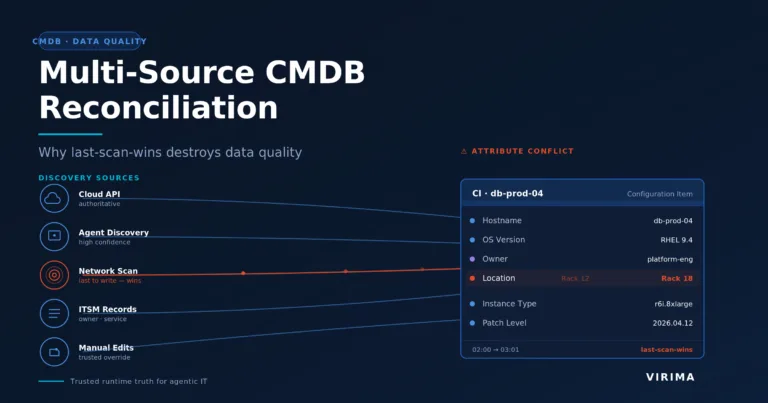
Following CMDB best practices at scale is simpler when the platform enforces consistency by design. Virima’s multi-source data reconciliation merges CI data from multiple discovery sources into a single authoritative record for each client. Change impact analysis lets your team model what will break before a change window opens, whether that change sits in your infrastructure or a client’s.
Virima also tracks the full CI lifecycle from deployment through decommission for every client instance. This matters for clients in regulated industries where complete asset history is a compliance requirement, not an optional capability.
| How does Virima maintain CMDB accuracy across multiple MSP client environments? Virima uses CMDB health scoring to track accuracy, completeness, and staleness per client instance. High-frequency discovery cycles refresh CI records on configurable schedules. Multi-source data reconciliation merges inputs from multiple discovery methods into a single authoritative CI record, and the MSP portal surfaces health metrics across all clients from one view |
ViVID Service Mapping: Understanding Client Services, Not Just Assets
Knowing every asset a client has is necessary but not sufficient for MSP-level service delivery. You also need to know how those assets connect into services. Which application servers back the client’s ERP system? Which network devices sit in the path of their cloud storage integration? When an incident fires at 2 AM, your team needs to trace the impact path in seconds, not minutes.
Virima’s ViVID Service Mapping builds dynamic dependency maps once service definitions are provided. You supply the service definitions for each client, either manually, via spreadsheet import, or through integrations such as Lean IX. Virima then builds and maintains the dependency map as infrastructure changes are detected, without requiring manual rebuilds.
This gives your team an explainable, current service map for each client, structured around the services that client actually runs. Incident triage becomes faster. Change risk conversations become concrete and evidence-based. Clients gain a view of their IT environment that most of them have never had before.
Software License Management Across Your Entire Client Portfolio
Software license sprawl is expensive at the single-tenant level. At the MSP level, with dozens of clients running hundreds of applications each, it becomes a material financial and compliance risk. Clients get audited. Licenses expire without notice. Applications install outside procurement processes. You find out at the worst possible moment.
Virima tracks software inventory across every client environment and compares actual installs against licensed entitlements. You can identify over-licensed applications wasting budget and under-licensed applications creating audit exposure. Virima’s software license management capabilities cover the full tracking and compliance reporting workflow if you want to explore how this works in practice.
Integrations That Fit Your Clients’ Existing Ecosystems
Most MSPs manage clients who already run an ITSM platform. Virima integrates with the tools your clients are already using, including ServiceNow, Ivanti, Halo, Jira Service Management, and Xurrent. Asset and CI data flows into the client’s ITSM, so tickets, changes, and incidents are always backed by accurate configuration data.
This removes the friction of parallel systems. Your technicians do not maintain the CMDB separately from the service desk platform. The platforms stay synchronized through Virima’s integration layer, and every ticket carries the configuration context it needs for faster resolution.
Flexible Delivery Models That Match How MSPs Actually Bill
Virima MSP supports the way managed service providers actually structure and price their services. You can offer clients any of the following as standalone or bundled managed offerings:
- Discovery-as-a-Service: You run and maintain discovery on the client’s behalf, on a schedule the client approves.
- CMDB-as-a-Service: You manage CI accuracy, health scoring, and relationship mapping as an ongoing managed service.
- IT Asset Management-as-a-Service: You handle hardware lifecycle tracking, software license compliance, and audit-ready reporting.
Project-based engagements are equally well-supported. Cloud migrations, data center consolidations, and mergers and acquisitions work all benefit from Virima’s dependency mapping and discovery data. You have the asset-level detail to scope, plan, and execute infrastructure projects with confidence.
Licensing is flexible. You pay only for the features each client needs, with monthly billing for hosted services and no large upfront investment required. Low startup costs make it viable to onboard new clients quickly and grow the engagement scope over time.
| What services can MSPs deliver using Virima? MSPs can use Virima to offer Discovery-as-a-Service, CMDB-as-a-Service, and IT Asset Management-as-a-Service. Project-based engagements including cloud migrations, data center consolidations, and M&A due diligence are also supported. Virima’s per-feature licensing and MSP portal let providers scope each client independently without large upfront platform costs. |
IT Risk and Compliance Across Regulated Client Environments
Clients in regulated industries have compliance reporting requirements that do not pause between audits. Virima’s audit trail and history logging capture every change to CI records across each client’s environment. This gives you a defensible record of what existed, when it changed, and who made the change, without manual documentation overhead.
For clients managing structured IT risk registers, Virima’s change impact analysis and CI relationship data provide the evidence base that formal risk management requires. You can surface risk signals before changes are approved, which means fewer incidents traced back to undisclosed dependencies.
For clients running hybrid environments, Virima’s guide to CMDB in cloud environments covers the key considerations for MSP-managed cloud estates.
Frequently Asked Questions
Can Virima support fully isolated CMDB environments for each MSP client?
Yes. Virima’s multi-tenant architecture separates each client’s CMDB, discovery data, and service maps at the data layer. There is no shared asset pool between clients. The MSP portal gives technicians a unified management view across all client instances, with role-based access preventing any data crossover between environments.
What types of assets does Virima discover in client environments?
Virima discovers physical hardware, virtual machines, network devices, software inventory, and cloud assets across AWS and Azure environments. Discovery runs on configurable schedules using both agent-based and agentless methods, depending on the access model each client environment supports.
How does Virima help MSPs with client software license compliance?
Virima tracks software inventory per client and compares actual installations against licensed entitlements. MSPs can identify over-licensed applications wasting client budget and under-licensed applications creating audit risk, then surface that data in client-ready compliance reports.
Can MSPs white-label the Virima platform for their clients?
Yes. Virima MSP supports white-labeling so managed service providers can deliver the platform under their own brand. This is particularly useful for MSPs offering CMDB-as-a-Service or Discovery-as-a-Service as branded managed offerings to clients who prefer a consistent vendor experience.
How does Virima reduce time-to-value when onboarding a new MSP client?
MSPs use the Virima MSP portal to provision new client instances from a standard template. This pre-built configuration structure reduces the manual setup that typically comes with onboarding a new client and shortens the time from contract signature to first discovery run.
From Asset Sprawl to Client-Ready Operational Clarity
Managing IT assets across multiple clients does not have to mean managing chaos. With Virima’s native multi-tenant architecture, high-frequency discovery cycles, CMDB health scoring, and ViVID Service Mapping, your team gets the operational structure to deliver consistent, accurate, client-isolated IT asset management at scale.
| When you are ready to see how Virima supports MSP delivery in practice, schedule a demo, and we can walk through your specific client portfolio requirements. |