CAB Change Management Still Approves Risk the Estate No Longer Matches

The Change Advisory Board packet looks complete. Risk is medium. Rollback is documented. Business sponsor signed. The meeting ends on time. Sunday night the same change still trips a shared identity path that never appeared on the CI list the board trusted.
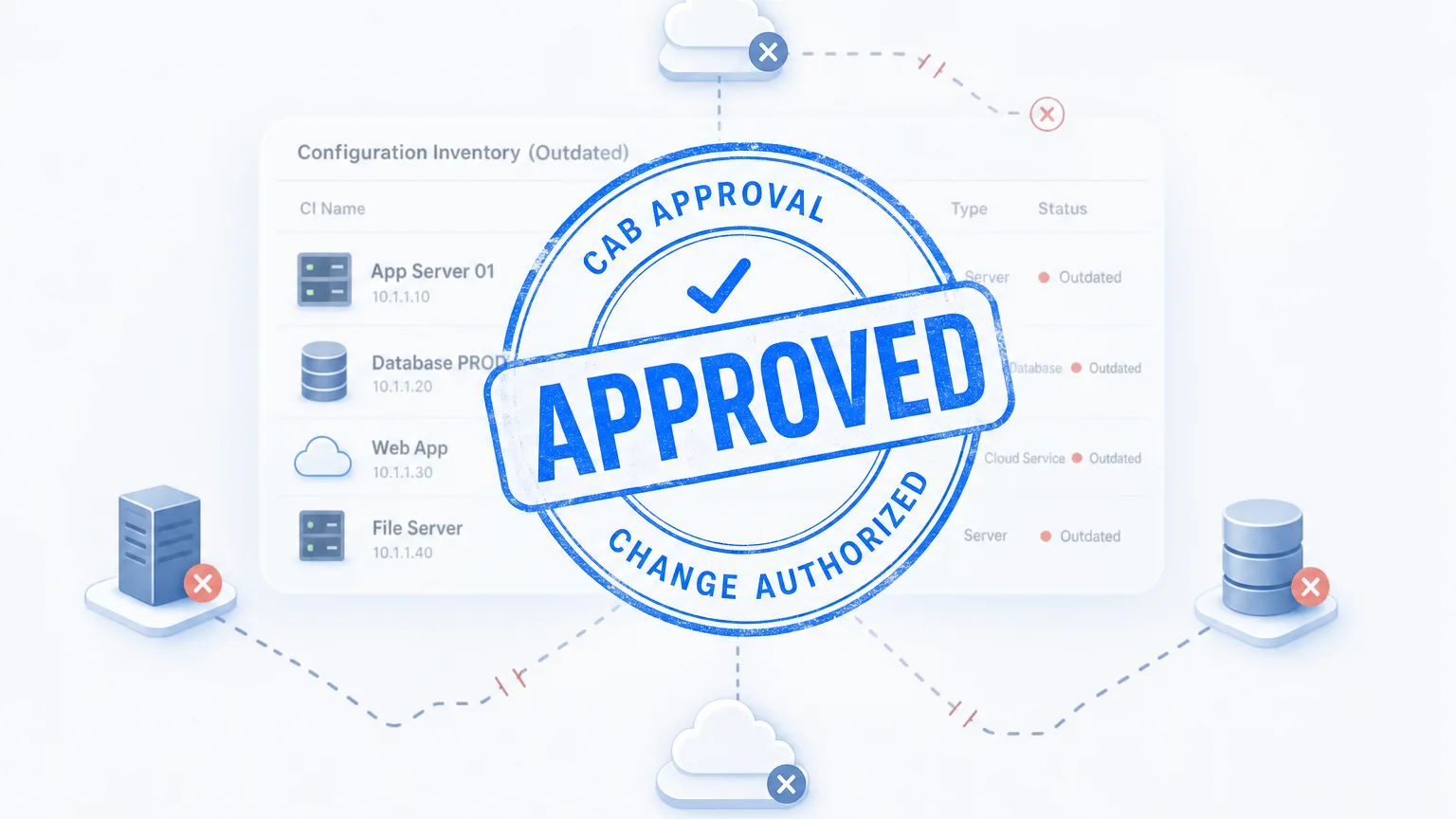
That is the everyday failure mode of CAB change management. The practice still works as a calendar, a quorum, and a decision log. The inputs under the ticket do not match the estate that will absorb the change. Boards keep approving risk scores the inventory stopped matching weeks earlier.
What CAB change management is supposed to control
In ITIL language, change enablement decides whether work should proceed under risk policy. Many enterprises still run that decision through a Change Advisory Board or a delegated change authority that inherited the same habits. PeopleCert’s ITIL portfolio frames change enablement as a core service management practice. Axelos publishes dedicated ITIL 4 change enablement practice guidance on how organizations assess, authorize, and schedule changes without treating every request as a blank-check meeting.
CAB change management in practice still has four control surfaces operators recognize:
- Scope: which configuration items (CIs), services, and environments the change touches.
- Risk and impact: what fails if the change fails, and how wide the damage spreads.
- Authority: who can approve standard, normal, and emergency paths.
- Evidence: what the board can show auditors after the window closes.
Those surfaces only hold when the CMDB rows behind the ticket still describe what exists, who owns it, and how it connects. A polished agenda cannot invent missing hosts.
What is CAB change management?
CAB change management is the operating model where a Change Advisory Board or delegated change authority reviews, authorizes, and schedules IT changes under risk policy. It only protects production when each ticket carries current CI scope, owners, and dependency context from discovery-sourced inventory, not self-declared risk alone.
Why CAB meetings still green-light the wrong risk
Commodity guides teach RACI, standard change catalogs, and shorter meetings. Those matter. They do not fix the data problem that shows up after the vote.
Self-declared risk is not measured impact
Most tickets ask the submitter to pick impact and risk from dropdowns. The engineer files what they know. Shared message brokers, forgotten DNS aliases, and shadow load balancers stay off the form. The board debates the narrative, not the topology.
CI scope freezes at intake
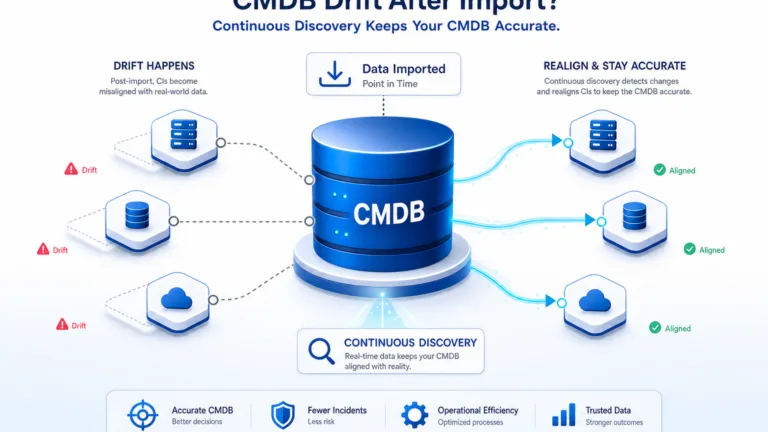
Discovery may have already recorded a new cluster node, a rehomed database replica, or a certificate on a different host. If the change record still points at last quarter’s CI list, CAB change management reviews a historical snapshot. The vote is real. The inventory is not.
Owners drift faster than the board cycle
The named technical owner left, moved squads, or no longer holds the on-call path. The ticket still shows their name. Escalation after failure burns the first hour of the incident on people search.
Emergency paths inherit the same blind spots
Emergency changes skip the long meeting. They don’t skip dependency truth just because the meeting did. Fast approval on incomplete CIs is still incomplete approval.
DORA’s software delivery metrics treat change fail rate and related stability measures as core delivery health. Google’s 2025 DORA report keeps that research centered on how organizations ship and recover. Heavyweight boards without current estate context still feed failed changes into those metrics.
CAB change management vs blast radius mapping vs release packaging
Related Virima coverage already owns adjacent jobs. Keep the lanes clear.
| Discipline | Primary question | Companion on virima.com |
|---|---|---|
| CAB change management (operating model) | Does the board’s decision packet still match current CIs, owners, and risk inputs? | Operating model and ticket truth |
| CAB blast radius | What else breaks if this CI fails? | CAB blast radius without tribal knowledge |
| ITIL release management | Is the deployment unit package complete for the environments that receive it? | ITIL release management and runtime truth |
| Change enablement + CMDB accuracy | Why process maturity collapses without accurate configuration data | ITIL change management and CMDB accuracy |
Service maps answer blast radius. Release practice answers packaging. CAB change management answers whether the authorization meeting is voting on current truth or on a tidy fiction.
Why does CAB change management fail even when the meeting process is mature?
Mature CAB agendas still fail when risk scores, CI lists, and owners on the ticket no longer match discovery-verified inventory. The board authorizes a narrative. Production absorbs the real topology. Process compliance cannot invent missing relationships or stale ownership.
What the board should require before the vote
Treat the packet as evidence, not theater.
Minimum evidence for normal and high-risk changes
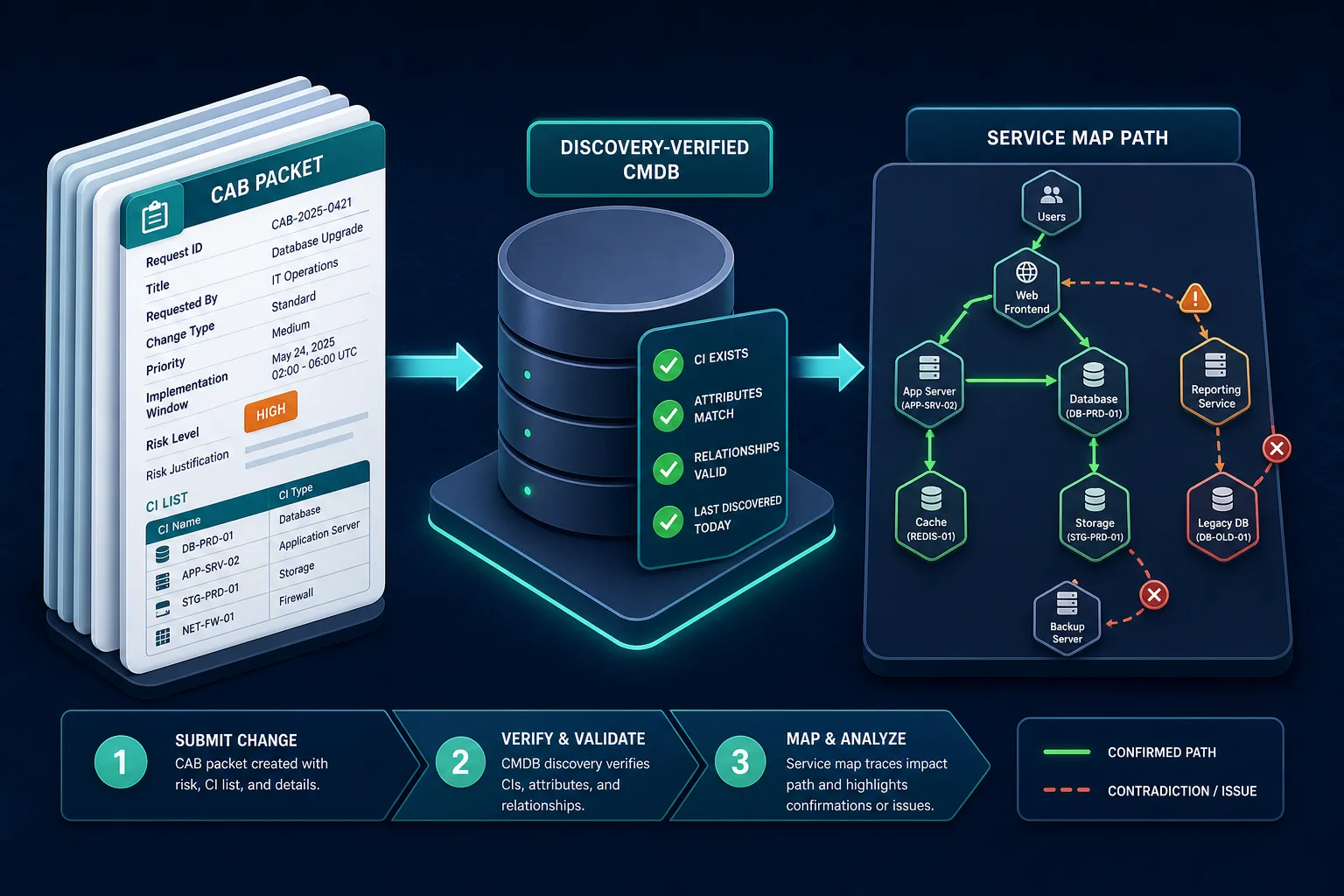
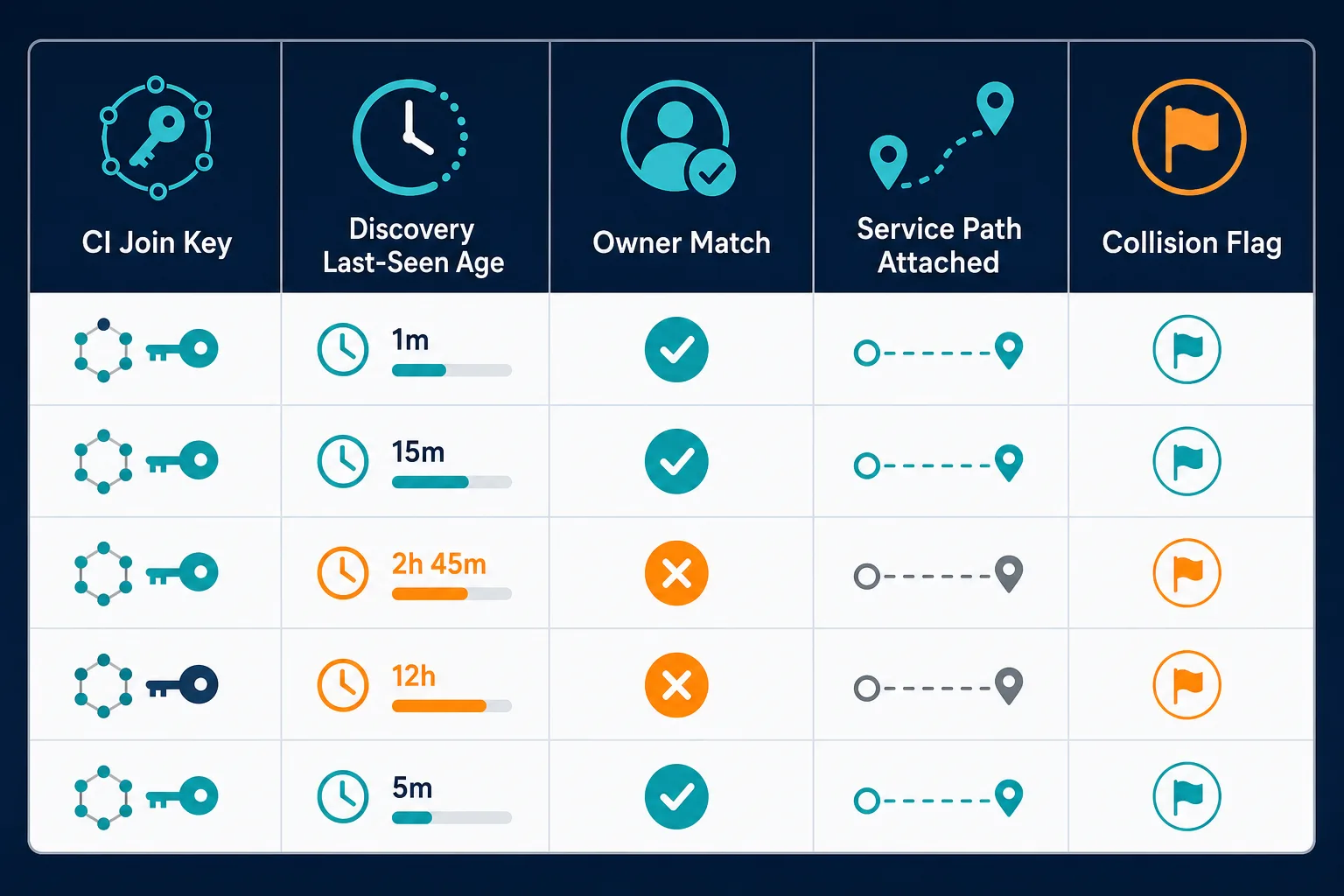
- CI join keys that discovery can re-verify: serial, hostname, cloud resource ID, or equivalent primary keys, not free-text nicknames only.
- Last-seen freshness: a discovery timestamp recent enough for the risk class (hours or days, not “last quarter inventory”).
- Owner and backup owner that still match the CMDB and on-call roster.
- Service context when service definitions exist: which business path depends on the target CIs.
- Collision check: overlapping windows on shared tiers already booked in the same period.
- Post-change verification plan that checks the service path, not only the package heartbeat.
How fresh should CMDB data be before a CAB approves a change?
A CAB packet is only as current as its last-seen timestamp. Discovery-verified CI data that is hours or days old lets a board trust the topology it is voting on. A CI list with no discovery hit since last quarter means the board is approving a historical snapshot, not the environment the change will actually hit.
CISA Binding Operational Directive 23-01 pushed federal civilian agencies toward complete asset visibility on a defined cadence. Commercial CAB programs that authorize production without comparable visibility inherit the same class of blind spot.
What Virima supplies under the CAB
Virima is not a replacement Change Advisory Board and not a full ITSM suite. The lane is Trusted Runtime Truth under the change record: what exists, how it connects, what changed, and who owns it. See Trusted Runtime Truth.
High-frequency scheduled discovery with agent, agentless, and API methods refreshes presence and attributes in the CMDB. Those cycles keep CI scope and owners from rotting between board meetings. Event-driven streaming discovery remains roadmap territory rather than the current product surface.
When service definitions exist, ViVID™ service maps bind defined services to discovery-sourced edges so impact talk moves from memory to a path the board can inspect. Maps do not invent service composition. They require definitions first, then automate the dependency view.
Virima integrates with ServiceNow, Jira, Ivanti, and many more through the Virima integrations hub. Change authorities keep working in the ITSM tool they already use while discovery-sourced fields and maps feed the ticket. For workflow context beyond the board meeting, see IT workflow management and change windows. Use-case framing sits on Virima change management.
Start with the CAB packet checklist below at your next board cycle. When you want to see how discovery-sourced CMDB truth lands inside the change records your board already reviews, walk through it with the team.
A practical CAB packet checklist
- Separate process maturity from data maturity. Short meetings and clear RACI do not fix stale CIs.
- Ban free-text-only scope for moderate and high risk. Require join keys discovery can re-read.
- Show last-seen age on the packet. Reject tickets whose critical CIs have no recent discovery hit without an explicit exception.
- Reconcile owners weekly against HR and on-call sources before the board cycle.
- Attach map or dependency evidence for high-risk paths when service definitions exist.
- Log collisions when two teams share a hypervisor, VIP, or database window.
- Measure change fail rate against inventory freshness, not only against meeting attendance.
Make CAB change management vote on the estate you actually run
CAB change management earns its seat when authorization is evidence-based. It fails when the board confuses a complete agenda with a complete inventory.
Keep the meeting. Raise the bar on what the packet must prove. Bind every material change to discovery-verified CIs, current owners, and service context where definitions exist. That is how Change Advisory Boards stop approving risk scores the estate no longer matches.
If your calendar is green and your post-change incidents still start with “what else touched this host,” start with the checklist above, then the inventory and ownership layer under the ticket. When you’re ready to see it in the tools your board already uses, schedule a demo.
Frequently Asked Questions
What is CAB change management in ITIL terms?
It is the operating model where a Change Advisory Board or delegated change authority reviews and authorizes changes under ITIL-style change enablement. ITIL 4 emphasizes risk-based enablement. Many enterprises still use CAB language for that review function.
How is CAB change management different from blast radius analysis?
CAB change management covers the authorization operating model: scope, risk inputs, owners, and evidence on the ticket. Blast radius analysis answers what else fails if a CI fails. Boards need both. Maps alone do not fix stale owners or missing CI join keys on the packet.
What data should a CAB require before approving a normal change?
Require discovery-verifiable CI keys, recent last-seen timestamps, current owners, service context when definitions exist, collision checks on shared tiers, and a post-change verification plan that watches the service path.
Does better CAB process reduce change fail rate by itself?
Process helps coordination. DORA research still ties delivery health to how organizations ship and recover. Boards that authorize incomplete inventory keep feeding failed changes regardless of meeting polish.
Does Virima replace the Change Advisory Board?
No. Virima supplies discovery-sourced CMDB and service mapping that feed change records in ITSM platforms. The CAB or change authority remains the governance body. Virima improves the truth those bodies review.
Does Virima integrate with ServiceNow and Jira for CAB change records?
Yes. Virima feeds discovery-sourced CI data and ViVID™ service maps into change records inside ServiceNow, Jira Service Management, Ivanti, and other ITSM platforms through the integrations hub, so the CAB reviews current data in the tool it already uses. Virima does not require a platform switch.