ITIL Release Management Still Fails When Deployment Units Lack Runtime Truth

The CAB approved the window. The package cleared testing. The release calendar still shows green. Ninety minutes after promote, two services that never appeared on the deployment plan start timing out because a shared message broker and a forgotten staging DNS alias still point at the old build.
That is the everyday failure mode of ITIL release management. The practice documents build, package, and deploy. The ticket history looks complete. The gap is not another approval form. The gap is that the deployment unit was never joined to current configuration items (CIs), owners, and dependency paths in the environments that will actually receive the release.
What ITIL release management is supposed to control
PeopleCert’s ITIL portfolio treats release management as the practice that makes new or changed services and components available for use. Axelos publishes dedicated ITIL 4 guidance for the release management practice, covering how releases are planned, built, tested, packaged, and deployed so the live environment stays coherent.
In plain terms, ITIL release management covers four control surfaces that auditors and operators both recognize. First, the release must declare what is inside the package: deployment units, versions, and configuration baselines that match the approved change. Second, it must declare where the package will land: target environments, progressive rings, and documented rollback points. Third, it must name who owns build, test, deploy, and post-release verification so handoffs do not dissolve into chat threads. Fourth, it must leave evidence that the deployed package matches the approved package.
Change enablement decides whether a change should proceed under risk policy. Release management decides how approved work becomes a controlled package in production. When those practices share a stale configuration management database (CMDB), both look mature on paper and both inherit the same blind spots. The CAB stamp cannot invent missing relationships. The release calendar cannot invent missing hosts.
What is ITIL release management?
ITIL release management is the ITIL 4 practice that plans, builds, tests, packages, and deploys new or changed services and components so they become available for use under controlled conditions. It only holds up in production when the deployment unit carries clear scope, current owners, and a defined rollback path.
Why release calendars still ship unknown risk
Most release failures that land on the operations floor are not missing RACI charts. They are missing estate truth at the moment of promote. ITIL release management training teaches packaging discipline. Production outages still track unknown topology, shared tiers, and environment drift that never entered the deployment unit plan.
The package is accurate. The estate map is not.
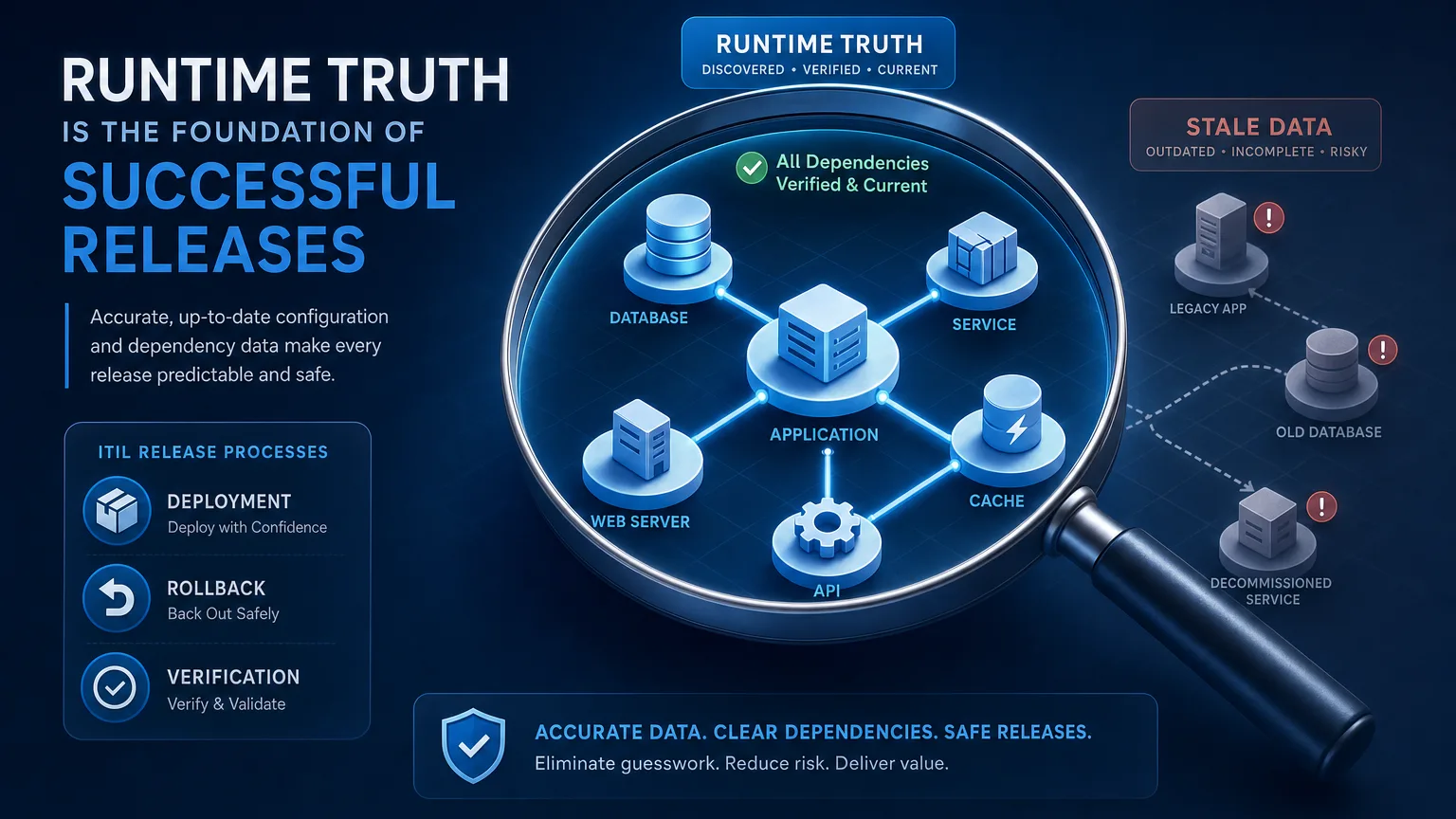
Release engineers version the artifact carefully. They still promote against host lists, cluster membership, and service dependencies that were true last quarter. A new Kubernetes worker, a migrated database replica, or a shadow load balancer never enters the deployment unit plan. The release succeeds against the wrong topology. Postmortems then debate process compliance while the inventory gap remains.
Test environments lie by omission
UAT may pass because the test ring never included the shared identity provider path production uses after hours. ITIL release management asks for adequate testing. It cannot invent the missing CI relationships that discovery never fed into the CMDB. Green test gates on an incomplete estate still produce red customer outcomes.
Post-release verification checks the wrong signal
Teams confirm agent heartbeat or pipeline green status. They do not walk the business service path that depends on the released component. The ticket closes. Customer impact opens twenty minutes later on a different queue. Verification that only watches the package, not the service map, is incomplete verification.
DORA’s software delivery metrics treat change fail rate and related stability measures as core delivery health. Google’s announcement of the 2024 DORA report keeps that research program centered on how organizations ship and recover. Release process maturity without current dependency context still feeds failed changes into those metrics, no matter how polished the calendar looks.
Release management vs change enablement vs deployment tooling
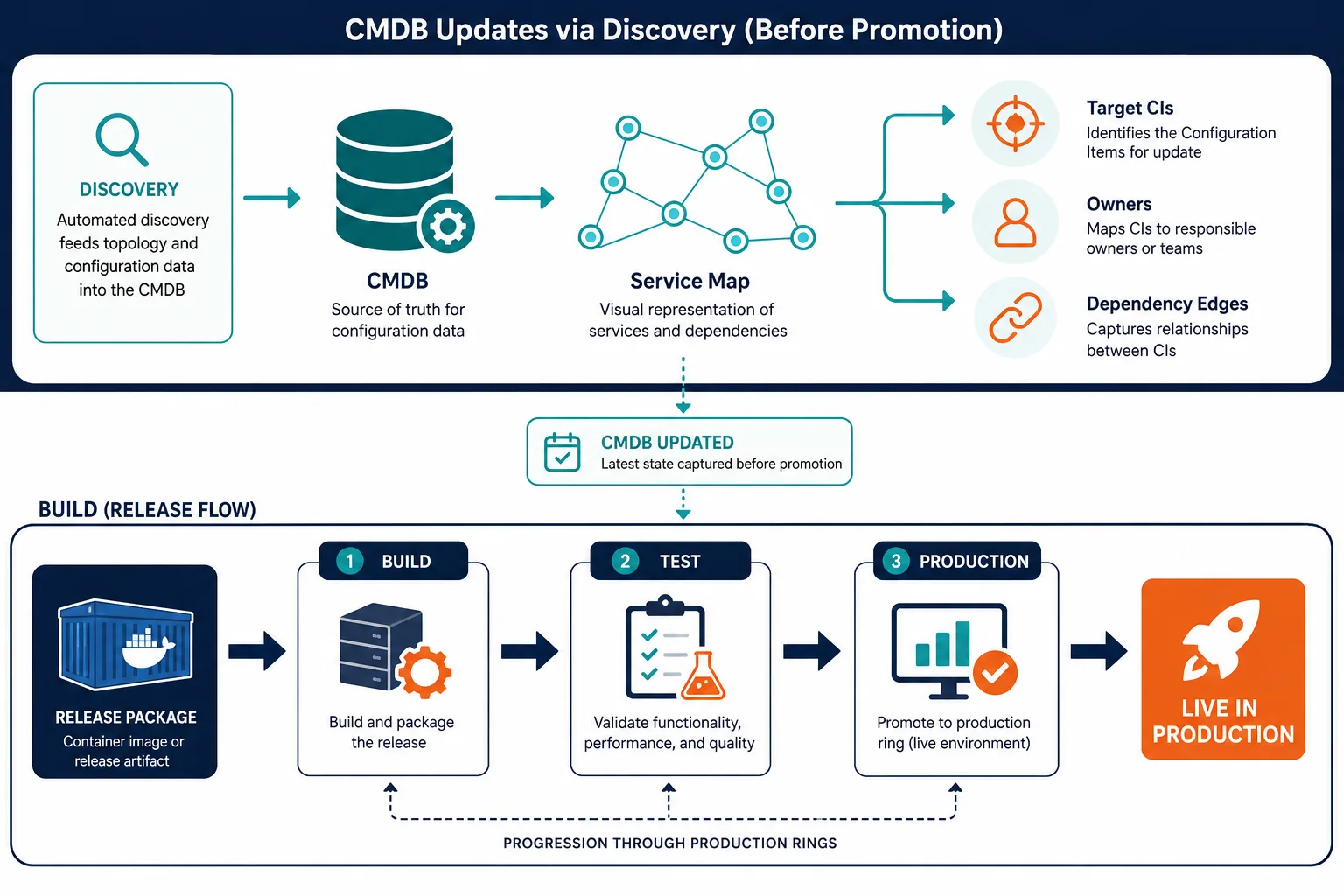
Teams collapse three different jobs into one word: “release.” Separating them clarifies where discovery-sourced data must sit. A deployment unit is the versioned set of CIs — services, containers, certificates, and configuration objects — packaged and promoted together as a single release. It only stays accurate when every CI inside it carries a current, discovery-verified last-seen timestamp, not a manually maintained list.
| Discipline | Primary question | Breaks when |
|---|---|---|
| Change enablement | Should this work proceed, and under what risk controls? | Risk scores use stale owners and incomplete CI scope |
| ITIL release management | How do we package and introduce approved work as a controlled release unit? | Deployment units omit shared dependencies and environment drift |
| CI/CD / deployment tooling | How do we automate build, test gates, and promote steps? | Pipelines target inventory that no longer matches production |
Automation accelerates all three. It does not replace discovery-sourced configuration authority. A fast pipeline that deploys to yesterday’s node list is a faster path to the same outage class. Tooling vendors will happily sell more gates. Gates still need truthful inputs. Platforms that bundle release management with their own CMDB, such as ServiceNow or BMC Helix, face the same exposure the moment that bundled CMDB runs on manual updates instead of scheduled discovery — the fix is data currency, not which product owns the release record.
Ownership follows the same three-way split. The release manager owns packaging and the go/no-go call for the release unit. The change manager owns risk approval under change enablement. The service owner confirms post-release verification against the business service the release touches. The CMDB owner is accountable for the CI and dependency data all three roles depend on — when that role doesn’t exist, accountability defaults to whoever last edited the CI, which is how ownership drifts.
For more on how stale CMDB data skews change risk scoring, see ITIL Change Management and CMDB Accuracy: Why One Depends on the Other.
The data ITIL release management needs before promote
A defensible release plan needs more than a version number and a CAB stamp. The morning-of checklist should force estate questions, not only process questions.
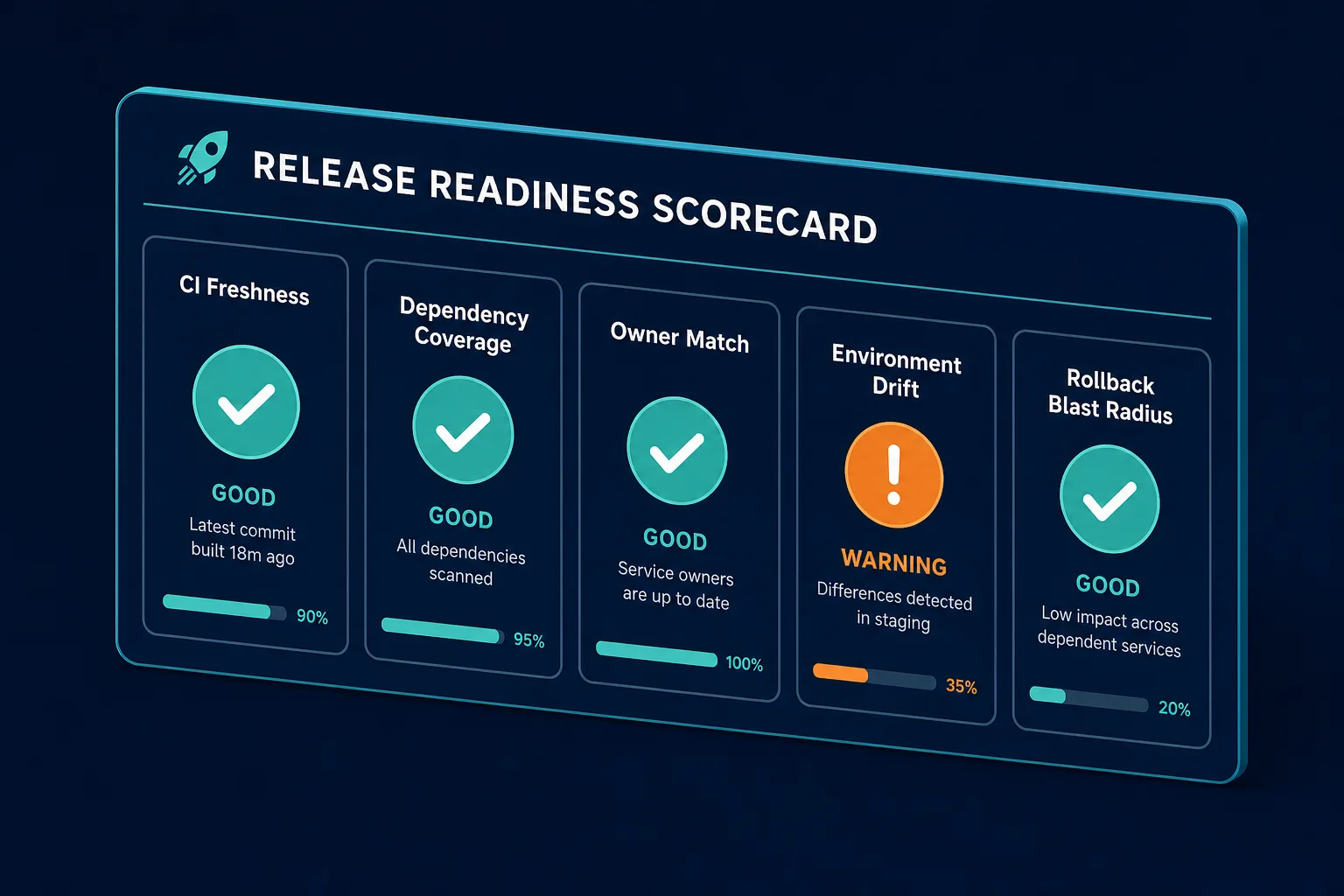
- Authoritative CI list for the deployment unit. Every host, container node, service account, certificate, and config object in scope needs last-seen evidence from scheduled discovery, not a spreadsheet export from last planning cycle.
- Upstream and downstream dependencies. Document what the unit calls, and what calls it, across on-prem, VMware, AWS, and Azure paths the release will touch. Shared message buses and identity tiers belong on the plan when the package can stress them.
- Ownership and support group currency. Name who gets paged when post-release checks fail on a shared tier. Stale assignment groups recreate the wrong-queue pattern after every bad promote.
- Environment parity signals. Capture drift between build, test, and production that would invalidate the test evidence. If production still routes through a legacy alias the test ring never hit, the green UAT report is incomplete.
- Rollback blast radius. List which services and customers sit on the same failure domain if the package is reversed. Rollback without a map is hope dressed as a runbook.
CISA Binding Operational Directive 23-01 pushed federal civilian agencies toward complete asset visibility and vulnerability detection on a defined cadence. Enterprise release programs face the same logic without the federal letterhead: you cannot govern what you cannot inventory, and you cannot safely promote what you cannot place on a current map.
What data does ITIL release management need before promote?
Before promote, ITIL release management needs current CIs in the deployment unit, upstream and downstream dependencies, verified owners, environment drift signals, and rollback blast radius so test evidence and production risk match the same estate.
How discovery-sourced runtime truth stabilizes release windows
Virima’s lane is not to replace your ITSM release module or your pipeline. The lane is Trusted Runtime Truth under the release plan: what exists, how it is connected, what changed, what will break, and who owns it. That proof clause matters for release managers who already own process maturity and still inherit unknown risk.
High-frequency discovery into the CMDB
Virima discovers across hybrid estates on high-frequency scheduled cycles using agent, agentless, and API methods. Those cycles refresh CI presence, attributes, and relationships in the CMDB so release planners are not working from a one-time import. Event-driven streaming discovery remains roadmap territory rather than the current product surface. The operational claim is scheduled authority that stays current enough for release windows and audit sampling.
Service maps after service definitions exist
Once service definitions are provided through manual entry, spreadsheet import, or integration feeds, ViVID™ service maps turn those definitions into dependency maps built from discovery-sourced relationships. Release managers can see whether a deployment unit sits under a customer-facing service path before the window opens, not after the page storm starts. Maps do not invent service composition. They bind defined services to discovered infrastructure edges.
ITSM as system of engagement
Virima integrates with ServiceNow, Jira, Ivanti, and many more through the Virima integrations hub. Release and change records stay in the platform teams already use. The CMDB and maps feed scope, impact, and ownership instead of competing as a second ticket system. That keeps ITIL release management workflows where practitioners live while fixing the data those workflows consume.
See how Trusted Runtime Truth turns release scope into explainable estate context before the promote step.
If your next ITIL release management window still depends on host lists nobody trusts, see how discovery-sourced CMDB and ViVID™ maps put current CIs, owners, and blast radius under the deployment unit before promote.
A practical release readiness checklist
Use this before the next major or standard release that touches shared infrastructure. Treat it as a gate on data quality, not as theater for the audit folder.
Scope and inventory
- Every CI in the deployment unit has a discovery last-seen within the agreed freshness window
- Decommissioned or quarantined assets are excluded from promote targets
- Certificates, service accounts, and load-balancer members in path are named, not assumed
Dependencies and services
- Upstream and downstream edges for the unit are reviewed on the current map
- Shared platforms (message bus, identity, DNS, storage) appear explicitly when the package can stress them
- Customer-facing services on the same failure domain are listed for communications
Ownership and verification
- Support groups match the live CMDB, not the onboarding spreadsheet
- Post-release checks walk service paths, not only pipeline status
- Rollback owners and timeboxes are assigned before the window starts
For more on blast-radius planning before a rollback decision, see Virima blog post on blast radius mapping for change and release risk.
How do you reduce failed releases under ITIL release management?
Reduce failed releases by joining each deployment unit to discovery-fresh CIs, dependency maps, verified owners, and environment drift checks before promote, then verifying business service paths after deploy instead of pipeline status alone.
What good looks like after the next three releases
Teams that fix the data layer under ITIL release management usually see operational tells before the dashboards fully rebrand. Emergency CAB revisits caused by unknown shared dependency decline because the dependency was visible before promote. Mean time to identify the wrong-tier owner after a bad promote shortens because ownership already lived on the CI. Audit evidence improves because package contents, target CIs, and map snapshots can be shown together. Release calendars can still move quickly because risk review stops debating imaginary inventory and starts debating real blast radius.
Process training still matters. So do pipeline gates. Neither substitutes for estate authority that can answer, under time pressure, what the package will touch. For more on shortening MTTR when ownership data lives on the CI, see Virima blog post on reducing MTTR with accurate CMDB ownership data.
Close the gap between the release package and the live estate
ITIL release management is a packaging and introduction practice. It only protects the business when the package is bound to current runtime truth. Discovery-fed CMDB records, dependency maps after service definitions, and ITSM integration keep release windows honest without asking teams to abandon ServiceNow, Jira, or Ivanti workflows.
If your release process is mature and your failed-change rate still tracks unknown topology, start with the inventory and map under the deployment unit. Schedule a demo to see how Virima supplies that layer for hybrid estates.
Frequently Asked Questions
Why do ITIL-aligned release processes still cause outages?
Because the practice controls package and deploy steps while production risk lives in CI relationships and environment drift. When the CMDB and maps are stale, approvals and pipelines both operate on incomplete scope.
Is ITIL release management the same as change management?
No. Change enablement decides whether work should proceed under risk controls. ITIL release management plans, builds, tests, packages, and deploys approved work as controlled release units. Both need current configuration data to work.
Can CI/CD replace ITIL release management?
CI/CD automates build and promote mechanics. It does not define business release scope, stakeholder communication, or rollback ownership by itself. Automation without discovery-sourced targets still deploys into unknown blast radius.
How does Virima support ITIL release management without replacing ITSM?
Virima supplies discovery-sourced CMDB and ViVID™ service maps that feed release and change records in platforms such as ServiceNow, Jira, and Ivanti. Teams keep ITSM as the system of engagement while estate truth stays current under each deployment unit.
What should release managers check the morning of a major window?
Confirm CI freshness for every target, review dependency edges for shared tiers, verify owners match the live CMDB, note environment drift versus test evidence, and assign rollback owners with an explicit blast-radius list.
How often does Virima’s discovery refresh CMDB data before a release window?
Virima runs agent, agentless, and API discovery on high-frequency scheduled cycles rather than a one-time import, so CI presence, attributes, and relationships in the CMDB stay current enough to check against a deployment unit before promote.