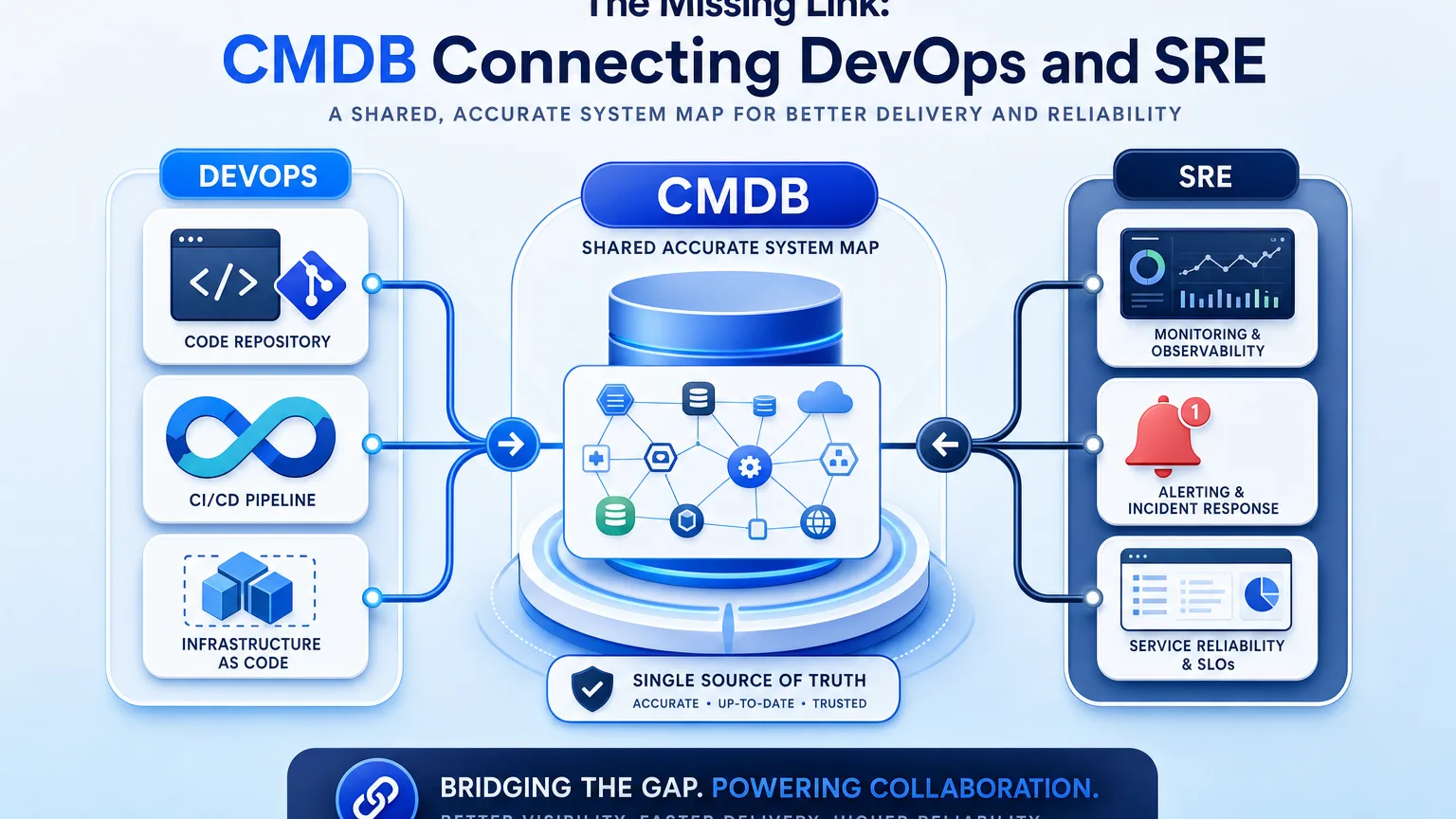
DevOps vs SRE: Both Practices Fail Without the Same Missing Piece

On January 14, 2026, Verizon customers across the United States hit an hourslong disruption that put phones into limited service and blocked normal calls and data for a large share of the base. CNET reported the outage affected more than two million customers and tracked the carrier’s follow-up credits and FCC attention. Verizon described a software issue in the core network path, not a cyberattack. The debate that followed asked who should have caught the change — the harder question is whether the people who shipped and the people who own reliability shared an accurate picture of what the change would touch before it landed.
That is the real DevOps vs SRE fight inside most enterprises. Org charts and title wars recycle every year, but the shared assumption under both practices is quieter: someone already holds a current inventory of systems, ownership, and dependencies. When that assumption is wrong, delivery speed and reliability work fail for the same reason.
What is DevOps? What is SRE?
DevOps is the set of practices that shorten the path from commit to production while keeping quality visible through automation and shared ownership of outcomes, measured through DORA’s delivery performance research: deployment frequency, lead time, change failure rate, and recovery time.
SRE is Google’s engineering answer to running large systems with software instead of manual ops — teams set service level indicators and objectives, spend error budget deliberately, and automate toil so humans stop repeating the same recovery steps by hand. The Site Reliability Engineering book frames reliability as a product feature with explicit risk tradeoffs; Google Cloud’s SLI, SLO, and SLA primer is the cleanest shared vocabulary for those contracts.
The DevOps vs SRE comparison charts online usually stop at focus: ship faster versus stay up. That split is real. It is not the full failure story.
The hidden problem
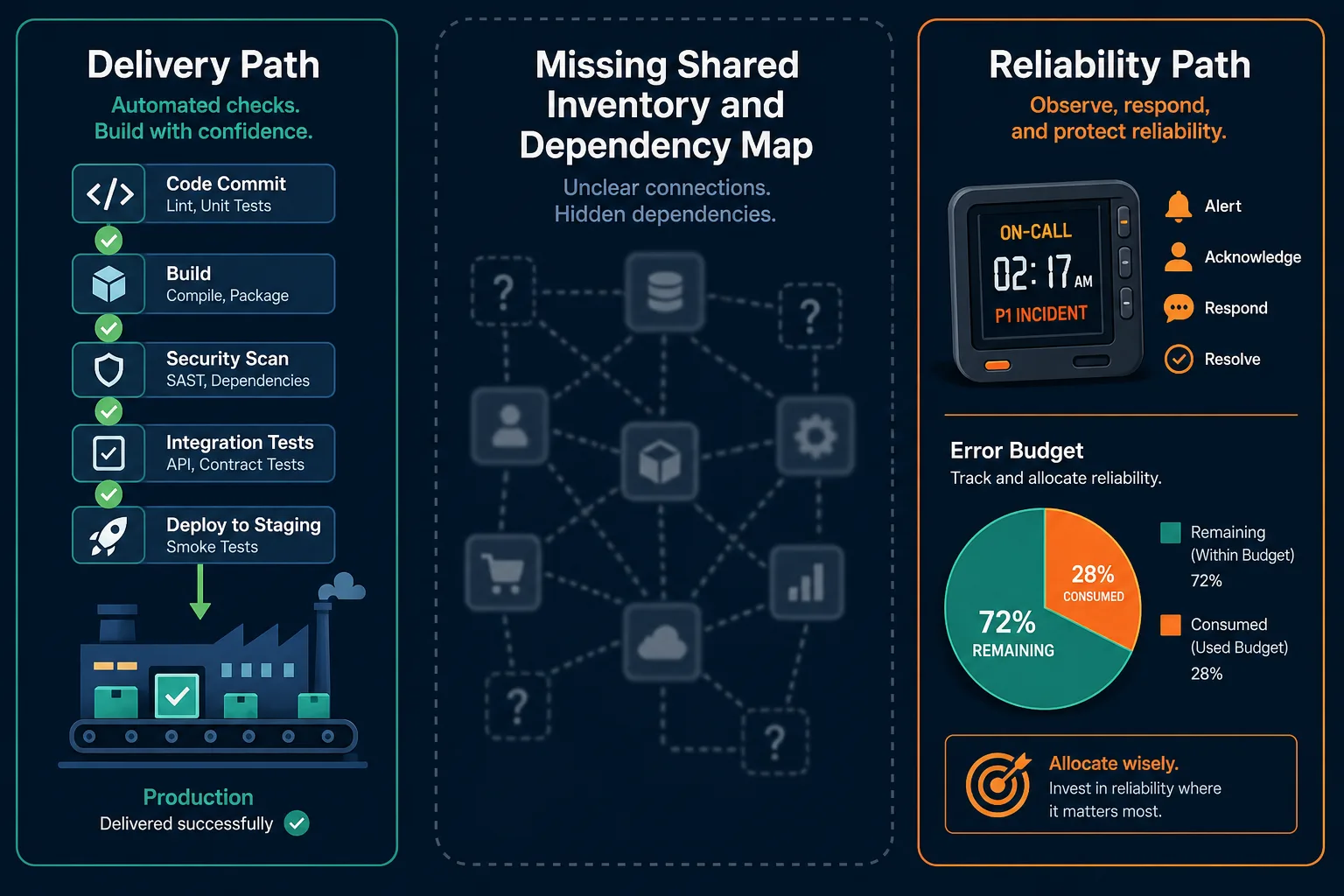
| Situation | What the practice assumes | What often happens |
|---|---|---|
| DevOps ships a change with a green CI/CD run | Tests cover the blast radius that matters in production | Downstream services and shared infrastructure sit outside the test graph |
| SRE holds an error budget and on-call rotation | The dependency map used in triage matches live topology | The first half hour of a P1 is spent learning what is still connected |
| Leadership funds both teams | Hand-offs work because both sides see the same estate | Each team defends a different spreadsheet of truth |
Delivery teams often improve throughput while infrastructure visibility lags the pipeline. DORA’s data shows elite performance depends on stability: fewer failed changes, faster recovery as much as on speed, which requires knowing which configuration items sit in a release’s path. See how infrastructure visibility stays relevant in a DevOps world.
Why Does This Debate Keep Resurfacing?
Every few years the same org redesign arrives: merge platform and SRE, split them again, rename ops as DevOps, hire a reliability pod, then argue about who owns production. The cycle returns because titles change faster than the data layer those titles depend on.
3 assumptions that quietly undercut both practices
- A clean CI/CD pass equals production accuracy. Tests validate what the suite can see; shared databases, identity planes, and third-party SaaS often sit outside that view, so a low-risk release still lands on an untested dependency.
- The CMDB already reflects what is running. Many configuration databases are rebuilt after audits, then drift until the next cleanup, leaving change tickets and postmortems arguing from stale owners and missing relationships.
- SRE will catch it without current dependency data. Error budgets and on-call pages need a map of what the failing symptom connects to. Without it, triage burns minutes on inventory before engineering work begins.
McKinsey’s June 2025 piece on operational excellence through SRE opens with a blunt industry finding: only about 10 percent of cloud transformations achieve their full value. Under its operating-model and automation recommendations sits a quieter requirement: teams need trustworthy measurement and topology data before SRE metrics and platform self-service can hold. Without that foundation, DevOps vs SRE becomes a staffing argument about symptoms.
Leaders who treat the debate as pure headcount miss the measurement problem. SRE ratios, platform golden paths, and error budgets all need a current estate picture, or every redesign restarts the same fight under a new title.
What This Gap Costs Each Team
For DevOps and ops-level teams
Change failure and rework show up as failed deploys, hotfixes, and frozen release trains. CMDB accuracy research consistently cites poor data quality as the leading reason configuration investments fail to return value, and that failure mode undercuts pipeline confidence the same way it undercuts incident response. Teams that want a practical method should start with how to determine CMDB accuracy before adding another CI stage.
For SRE practitioners
Toil and mean time to restore rise when the first action in an incident is reconstructing the estate. SRE literature treats toil as the enemy of engineering time, but that discipline breaks down when ownership and dependency fields are empty — practical recovery always returns to identifying what failed and what it sits under. ITIC’s 2024 Hourly Cost of Downtime research found that for more than 90 percent of mid-size and large enterprises, one hour of downtime now exceeds $300,000, excluding litigation and penalties (ITIC 2024 Hourly Cost of Downtime Report). SRE pages sit on that clock; minutes spent hunting configuration items are not abstract process waste.
For leadership
Leadership pays twice: once in delayed product throughput, once in unplanned risk. McKinsey’s cloud-value work ties SRE adoption to resilience and efficiency gains, but also flags partial adoptions that keep teams reactive. The DevOps vs SRE budget fight often hides a simpler board question: can either practice prove what a change will affect before it ships?
The Missing Layer: What Both Practices Assume You Already Have
Both practices need the same shared picture. DevOps needs it to size risk before promote; SRE needs it to protect error budgets and route incidents to the right owners; platform teams need it to know which golden paths still match live topology.
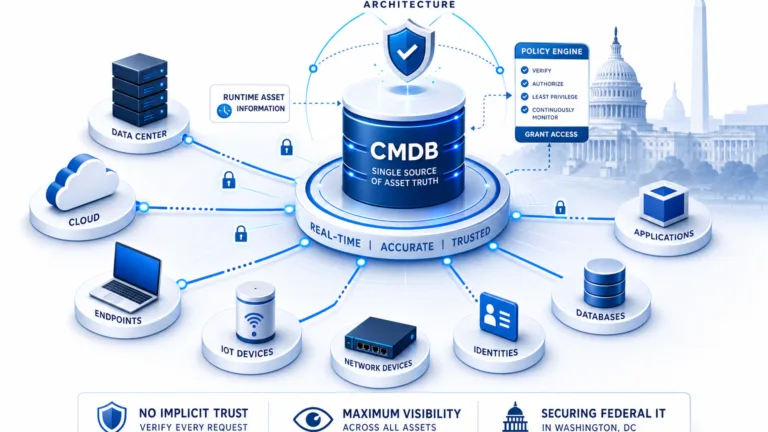
That picture is not a wiki page updated after the last outage. It is a discovery-sourced configuration record with relationships, owners, and freshness that both sides can open from the tools they already use. This replaces scattered asset spreadsheets, architecture diagrams frozen at the last review, and change tickets carrying only free-text impact notes.
If the shared layer is missing, hiring more DevOps engineers or more SREs multiplies the same blind spot. If it is present, the classic DevOps vs SRE handoff becomes a design choice about roles, not a permanent argument about reality.
DevOps and SRE in Practice
These are composite patterns, not named customer claims.
- A canary that looked small on paper. A load-balancer change passes pipeline checks between a payment service and its primary database path; the ticket called it low risk because the service name was familiar. Without a current dependency view, nobody saw the shared identity hop that also served internal admin tools. Rollback recovered the app, but the postmortem still spent hours reconstructing a path that should have been visible at approval.
- A P1 with a stale map. On-call opens dashboards showing latency, but the first twenty minutes go to asking which clusters still front the customer journey and which change window touched shared caches. Reliability engineering cannot start until inventory questions close, the opposite of error-budget discipline.
Change confidence improves when impact context is current. Teams that manage risk at approval time, not only in the postmortem, need configuration and service relationships available inside the change path. See Virima’s change management use case for how discovery-backed context supports that workflow.
What DevOps and SRE Need to Operate Without Friction
This is a short list of conditions that have to be true before ship-it and keep-it-up stop fighting over facts, not a request to add another console for its own sake.
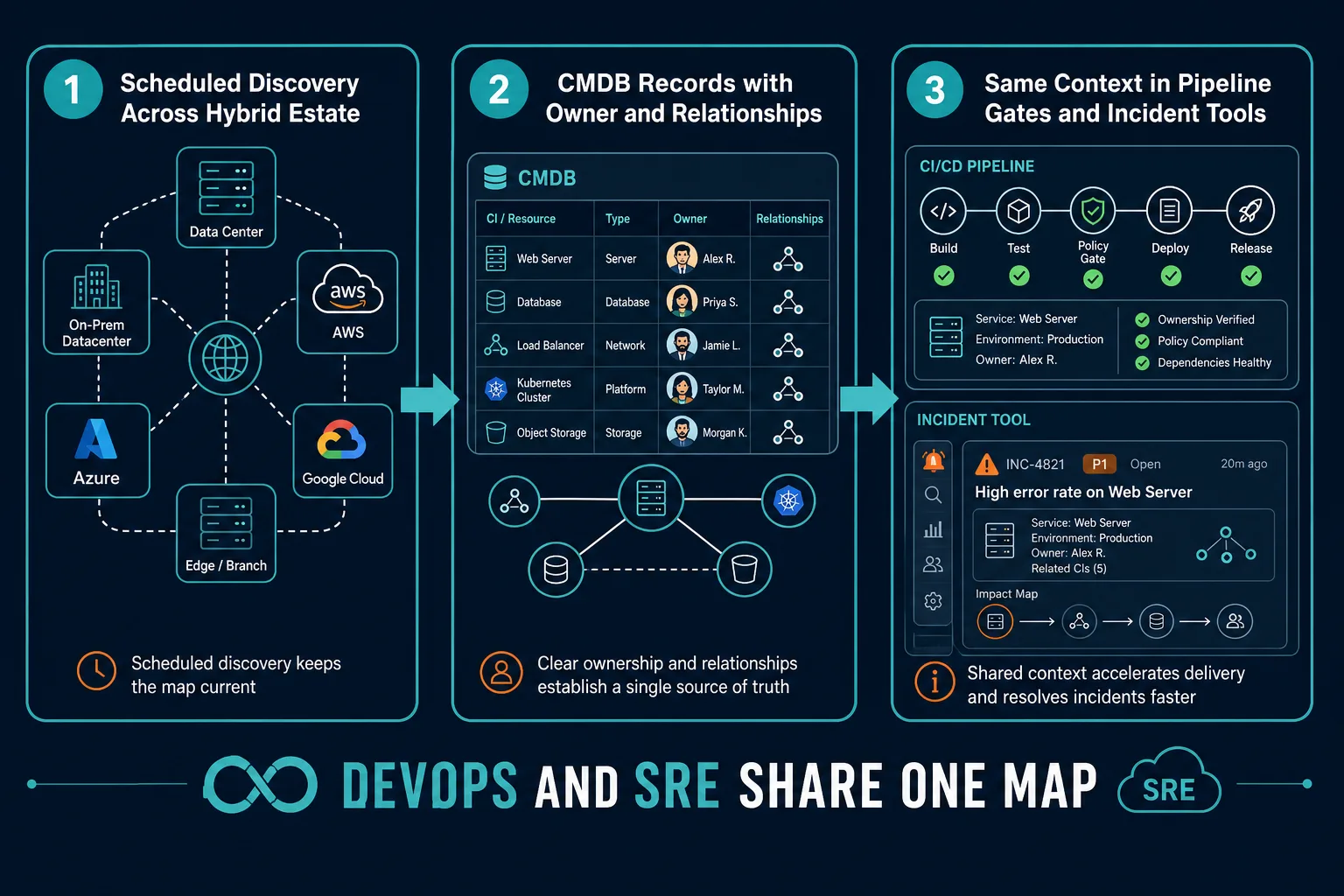
- One accurate picture both teams work from. Scheduled discovery, including agent, agentless, and API-based, across on-prem, cloud, and hybrid estates should feed a CMDB with source and freshness on every record. Virima’s IT discovery covers that path, so delivery and reliability open the same inventory.
- Blast radius before a change reaches CAB, not after payments fail. Once service definitions are provided, Virima’s service mapping builds dependency maps so approvers see what a configuration item connects to.
- The same context where tickets already live. Bi-directional integration with ServiceNow, Jira Service Management, Ivanti, HaloITSM, Xurrent, and peer ITSM platforms keeps pipeline and incident work on identical inventory, through one integrations hub. Partner names stay plain text.
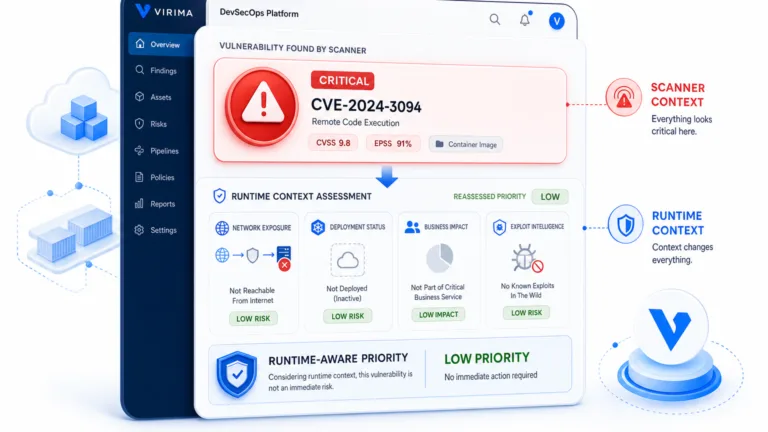
- Vulnerability priority is tied to what a CVE touches, and a governance trail leadership can inspect. CVSS alone does not rank business impact. Overlaying NIST NVD data on the same service map, weighted by the services an asset supports, is the practical join. Exportable, dated inventory beats reconstructed tribal knowledge when auditors ask for proof.
- Safe ground for AI-assisted operations. As copilots and agents suggest or execute runbook steps, they inherit the same map humans need without authoritative configuration items and relationships; automation multiplies bad context.
Virima’s role here is centered on discovery-sourced inventory, configuration records, service maps once definitions are supplied, and ITSM context; not a replacement for the CI/CD platform or the pager rotation.
When that map has to be trusted under agentic load, start from Trusted Runtime Truth: what exists, how it connects, what changed, what breaks, and who owns it.
Moving From Tribal Knowledge to a Shared Source of Truth
The handoff between delivery and reliability improves when both sides stop maintaining private inventories: spreadsheets and chat lore may feel faster for one ticket, but they fail when the next change window or P1 needs the same facts under pressure. Discovery feeding configuration records on a known cadence, with service maps rebuilt after definitions are set, lets both pipeline gates and incident tools read the same estate.
Getting started
- Compare what the CMDB claims against what discovery finds on one critical service path.
- Map the highest-traffic change route and list real dependencies, not ticket free text.
- Connect discovery output into the ITSM tool already in use rather than standing up a parallel queue.
- Set a drift review cadence after the first cleanup, not a one-time project end date.
- Give DevOps and SRE the same map in the tools they already open.
When discovery feeds the service desk, keep ServiceNow, Jira Service Management, Ivanti, HaloITSM, Xurrent, and peers as plain text and use one entry point at all integrations.
Close the DevOps vs SRE Handoff on Shared Runtime Truth
DevOps vs SRE will keep producing comparison posts that end on the idea that they are complementary. That line is incomplete without shared runtime data; complementarity only holds when both sides work from the same picture of what is running, who owns it, and what a change will touch. Integrations that copy tickets without refreshing configuration items will not close that gap, and neither will an org redesign that renames ops without fixing inventory.
The missing piece is not another title on the org chart. It is current configuration data with owners and relationships both practices can trust under change and under incident pressure. If your estate still runs on tribal knowledge, start with discovery-backed configuration truth before the next reorganization: one map, one freshness cadence, one place to open relationships, and revisit titles only after that layer exists. For the configuration layer that fails without discovery authority, read why a CMDB without discovery is only a database.
See how Virima’s discovery-sourced CMDB and ViVID™ service maps give DevOps and SRE one shared inventory to work from, in the tools each team already runs. EMA Identifies Virima as a Foundational Platform for Operational IT Efficiency.
Frequently Asked Questions
What is the difference between DevOps and SRE?
DevOps optimizes the path from change to production with automation and shared delivery metrics. SRE applies software engineering to reliability with SLIs, SLOs, error budgets, and toil reduction. Both need current inventory and dependency context to work as designed.
Do you need both DevOps and SRE?
Many organizations run both when delivery velocity and production reliability are both board-level goals. Some combine roles in smaller teams. The decision is secondary to whether either side can see the same live estate when they ship or respond.
What is a real example of DevOps and SRE working together?
A release team ships behind an error budget that SRE owns. Promote gates use shared service maps so blast radius is visible before CAB. Incidents open with the same CI ownership the pipeline used at change time.
Can one team handle both DevOps and SRE responsibilities?
Smaller orgs often combine delivery and reliability work in one platform group. That model still fails when inventory and dependencies are tribal. Role merge does not replace a shared configuration system of record.
How does Virima help DevOps and SRE teams share the same dependency data?
Virima’s agentless, agent-based, and API-based discovery feeds configuration items into a CMDB with owners and relationships, and ViVID™ service maps build the dependency context on top once services are defined. Both delivery pipelines and incident tools can read that same record, so DevOps and SRE stop working from separate estimates of what is running.