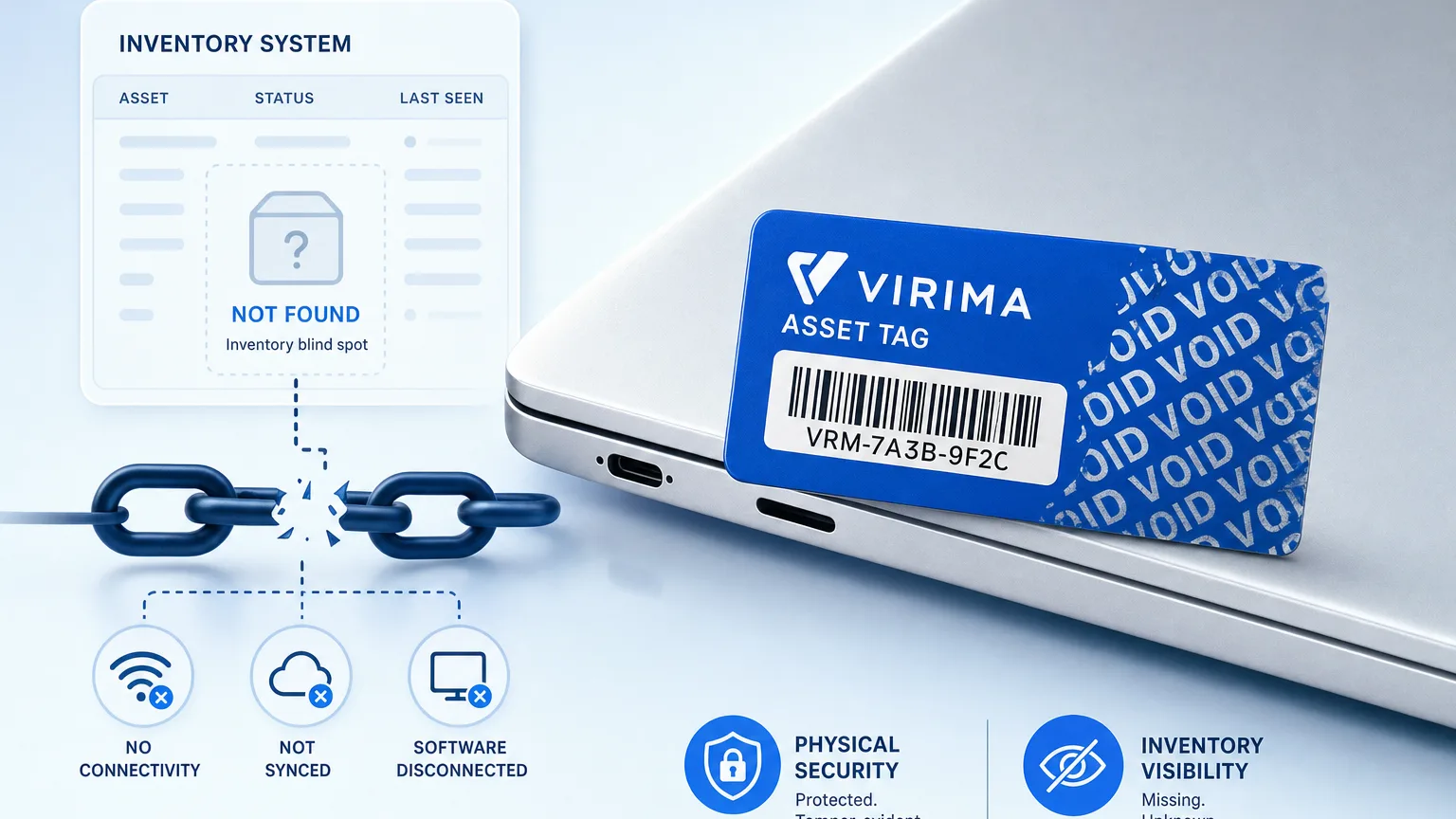
Anti-Theft Asset Tags Still Leave Inventory Blind

Security orders a fresh batch of anti-theft asset tags after three laptops walk out of a contractor bay. Facilities wants VOID foil that shreds if peeled. Finance wants a scannable ID that survives an insurance claim. IT prints the labels, sticks them under chassis lips, and closes the ticket. Six months later the same tag IDs still sit on devices that never check in, or on chassis that were wiped and reassigned without a rescan.
That is the quiet failure mode behind most anti-theft tagging programs. The label did its physical job. The inventory job kept running without a matching refresh of who holds the asset, what software sits on it, and whether it still exists on the network. Anti-theft asset tags are tamper-evident labels that deter removal and prove tampering; they don’t refresh who holds the device or what’s running on it.
What anti-theft asset tags are designed to do
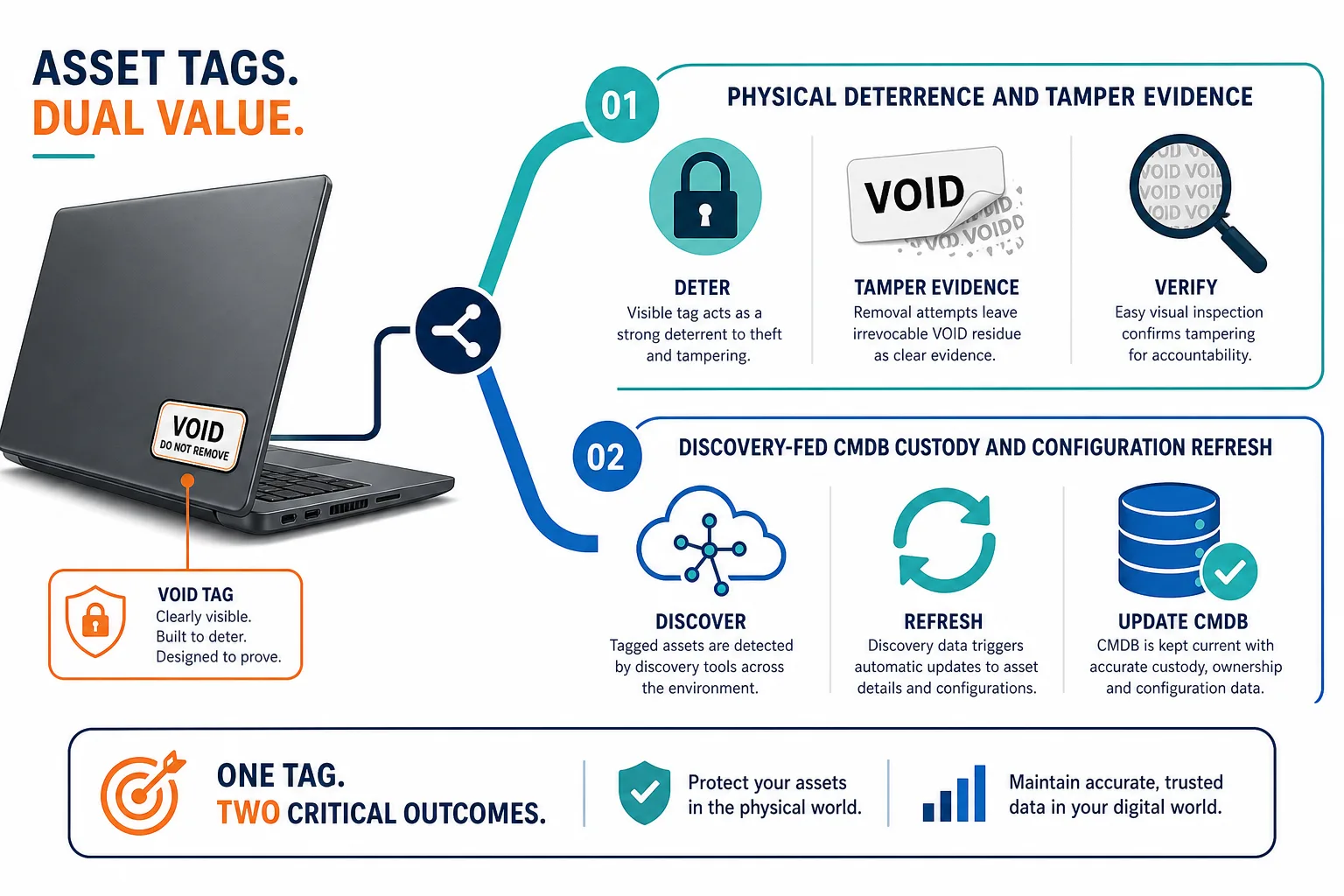
Anti-theft asset tags are physical labels built to raise the cost of unauthorized removal and to leave evidence when someone tries. Vendors package that job as destructible vinyl, VOID patterns that print residue when peeled, metallic on-metal stock, RFID inlays for portal reads, and stronger adhesives.
Camcode’s overview of asset tags frames tags as the link between equipment and digital records through barcode, QR, or RFID. Anti-theft variants add deterrence and tamper evidence on top of that identity job. They are not GPS trackers. They are engineered stickers and inlays that make theft messier and audits cleaner when a human can still see or scan the chassis.
Physical jobs the tags actually win
- Deterrence at the door: Visible company marks and hard-to-clean residue discourage opportunistic walk-offs.
- Tamper evidence: VOID and destructible stock show that a tag was moved or replaced.
- Offline identity: A powered-down device in a cage or courier bag still has a scannable ID.
- Insurance and recovery paperwork: A durable ID ties chassis to purchase order, serial, and claim files.
- Portal and bulk reads (RFID variants): Depots can count tagged stock without line-of-sight barcode guns when readers and on-metal tags are designed correctly.
Jobs the tags never owned
- Continuous custody after checkout: A sticker does not rewrite the assigned user when a manager hands a laptop to a contractor.
- Configuration and software truth: Labels cannot detect unapproved apps, missing agents, or patch debt.
- Network presence: Anti-theft foil does not report last-seen status on VPN, domain, or cloud endpoints.
- Cloud and virtual estates: There is no chassis tag for an ephemeral instance that never sat in a cage.
- Duplicate CI prevention after repair: Motherboard swaps can change BIOS serial while the anti-theft tag stays on the old shell.
What do anti-theft asset tags actually prevent?
Anti-theft asset tags raise the cost of physical removal and leave tamper evidence when labels are peeled or swapped. They support offline ID, insurance, and cage audits. They do not keep custody, software, or network presence current after a device leaves intake without discovery-backed inventory refresh.
Why anti-theft programs still fail audits
Procurement treats the tag buy as the control. Auditors sample the system of record. Those two layers diverge the moment tagged hardware enters daily life.
The cage is not the estate
Most theft risk stories start in receiving, staging, or a shared lab. Anti-theft tags help there. Enterprise loss also happens after legitimate checkout: home offices, partner sites, overnight courier loops, and quiet reassignment between tickets. Without a required rescan or a discovery join on serial and hostname, the anti-theft tag becomes a historical sticker on a living asset.
Tamper evidence is not inventory evidence
Tamper evident asset tags prove someone touched the label when a VOID pattern shreds. They do not prove the CMDB row is wrong, right, or missing. Teams still need a join key from physical tag ID and manufacturer serial into the configuration item that discovery and MDM keep current.
CISA Binding Operational Directive 23-01 pushed federal civilian agencies toward complete asset visibility on a defined cadence. The same logic applies to commercial ITAM: you cannot govern theft, write-off, or residual risk against inventory you only trust at print time.
NIST SP 800-53 Revision 5 catalogs media and system inventory related controls that assume organizations know what they hold. Anti-theft labels support physical control narratives. They do not replace the inventory accuracy those controls imply. For the operational side of passing that sample, see Closing the gaps: How Virima strengthens Xurrent’s CMDB with a robust discovery.
VOID, RFID, and tamper-evident asset tags: where each fits
Match stock to the threat and the workflow, not to the loudest vendor brochure. VOID asset labels and RFID anti-theft asset tags dominate the higher end of that spectrum; destructible vinyl covers the low-cost baseline.
| Tag style | Strength | Limit | Best fit |
|---|---|---|---|
| Destructible vinyl / paper composite | Cheap visible mark; tears on peel | Weak outdoor durability | Low-cost bulk endpoints |
| VOID / tamper-evident polyester | Leaves residue message when removed | Higher unit cost; still line-of-sight for barcodes | Regulated and high-loss fleets |
| Metallic / foil on-metal | Survives heat, solvents, metal chassis | Needs correct adhesive and print method | Laptops, servers, industrial gear |
| Passive RFID (UHF) anti-theft asset tags | Bulk portal reads without aiming a gun | Reader design, metal interference, higher cost | Depots, cages, warehouse exits |
| Combined QR + RFID + VOID | Human scan plus portal plus tamper mark | Most expensive; process discipline still required | High-value mobile and shared labs |
RFID gates are not a CMDB
Portal readers can flag a tagged chassis crossing a doorway. That event is useful, but it is still a physical sensor event. Without a trusted asset record and a discovery path for devices that never pass that door again, the gate log becomes another silo next to the sticker program.
Related Virima work on asset tags for laptops covers general identification and reconciliation for notebook fleets. This article stays on the anti-theft and tamper layer: deterrence, VOID evidence, and the inventory gap that remains after the security label is perfect.
Are anti-theft asset tags enough for IT asset management?
No. Anti-theft asset tags handle physical deterrence, tamper evidence, and offline identity. IT asset management still needs ticketed custody changes and discovery-sourced CMDB updates so tagged devices stay accurate after checkout, repair, and reassignment.
The division of labor: tag, process, discovery
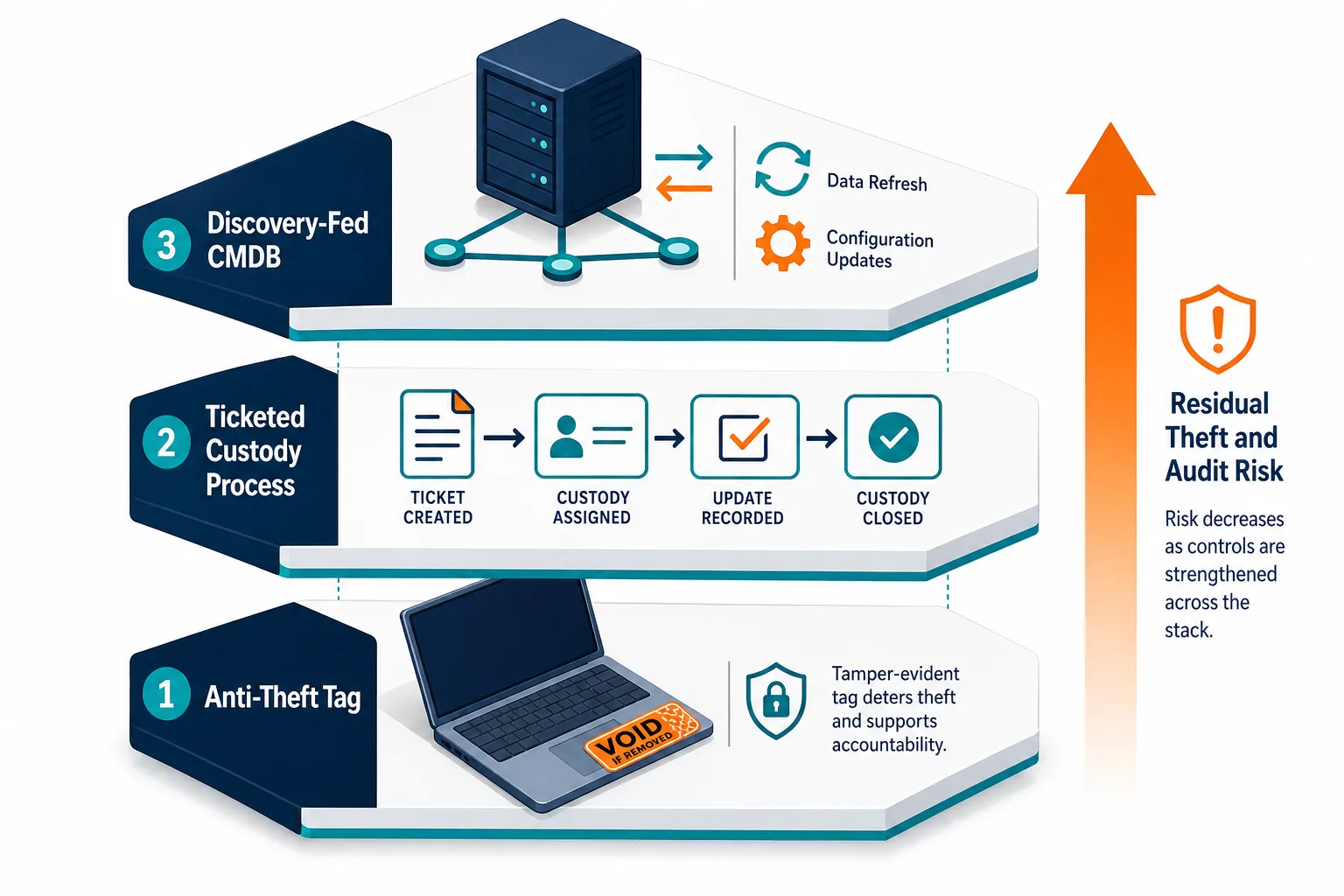
Treat anti-theft asset tags as one control in a three-part stack.
1. Physical control layer
- Standardize VOID or metallic stock for high-loss classes.
- Place tags on a documented chassis location that survives docks and sleeves.
- Capture tag ID, manufacturer serial, PO, and cost center at intake before the device leaves receiving.
- Require outbound and return scans on repair, loaner, and offboarding tickets.
2. Process control layer
- Ban freehand reassignment without a ticket that updates custody fields.
- Train facilities and security that a shredded tag is an incident signal, not a closed inventory event.
- Align insurance and write-off workflows to the same asset ID the CMDB stores.
3. Discovery and CMDB layer
Virima’s lane is not printing foil or installing RFID portals. The lane is Trusted Runtime Truth under the tagged asset: what still exists, who owns it, how it connects, and what changed after checkout. See how Trusted Runtime Truth frames that proof clause for operators and auditors.
High-frequency scheduled discovery with agent, agentless, and API methods refreshes presence, attributes, and relationships in the CMDB. Those cycles do not replace the anti-theft label. They keep the digital twin of the labeled chassis from rotting into a ghost row. Event-driven streaming discovery remains roadmap territory rather than the current product surface.
When service definitions exist, ViVID™ service maps can show whether a tagged host still sits under a business path that matters for residual risk. Maps do not invent service composition. They bind defined services to discovery-sourced edges.
Virima integrates with ServiceNow, Jira Service Management, Ivanti, Cherwell, Hornbill, Xurrent, HaloITSM, and TeamDynamix through the Virima integrations hub. Physical tag IDs and discovered serials can feed the same system of engagement teams already run for ITAM and change. For broader tracking method context, see IT asset tracking.
Turn the checklist below into a working audit: How to Build an AI-Ready CMDB Checklist for 2026 and score your own fleet before the next physical inventory.
Prefer to see it live instead? Schedule a demo.
A practical checklist before the next tag order
- Name the threat you are buying for — cage walk-off, contractor bay loss, courier theft, or quiet internal reassignment each need different process hooks.
- Pick stock for tamper and chassis material — VOID metallic for high-value mobiles; RFID only where portals and on-metal tags are funded end to end.
- Define the join keys on day one — tag ID plus manufacturer serial on one CI, not two spreadsheets.
- Wire tickets to scans — repair, loaner, offboarding, and write-off must update custody fields.
- Fund discovery cadence — schedule estate refresh so last-seen and hostname do not depend on the next wall-to-wall count.
- Queue exceptions — serial conflicts, missing agents, and tags without a live host need ITAM owners, not year-end panic.
- Measure residual risk, not label count — track percent of high-value assets with both a valid tag record and a fresh discovery timestamp.
Close the gap between deterrence and inventory truth
Anti-theft asset tags earn their place. They deter casual removal, document tamper, and keep offline identity alive when power and network are gone. They fail when leaders treat the print run as the full asset control system.
Buy the right VOID or RFID stock for the physical threat. Bind tag ID to serial on a real CI. Keep that CI current with high-frequency discovery and ticketed custody changes. That is how anti-theft labeling stops being a one-time security purchase and starts supporting audits, write-offs, and residual risk decisions.
If your labels look correct and your ghost count still rises, start with the inventory and ownership layer under the tag, not another sticker redesign. Schedule a demo to see how Virima keeps tagged hybrid estates honest after the cage door closes.
Frequently Asked Questions
Do anti-theft asset tags stop laptop theft?
They raise the cost of opportunistic removal and leave tamper evidence. Determined theft, insider reassignment, and post-checkout loss still happen. Pair tags with custody process and discovery-backed inventory for residual risk, not labels alone.
What is the difference between standard asset tags and anti-theft asset tags?
Standard tags mainly identify equipment. Anti-theft designs add deterrence and tamper evidence through VOID patterns, destructible stock, stronger adhesives, or RFID portal use. Both still need a digital record that stays current after intake.
Are RFID anti-theft tags enough for IT asset management?
RFID helps bulk counts and doorway reads when readers and on-metal tags are designed correctly. ITAM still needs custody fields, configuration truth, and discovery for devices that never pass the portal again.
How does Virima keep tagged assets accurate in the CMDB after checkout?
Virima’s discovery layer (agent, agentless, API) refreshes presence, ownership, and configuration on tagged devices after intake, matching each chassis to its tag ID and serial without requiring a manual rescan.
Does Virima sell anti-theft asset tags?
No. Virima provides discovery-sourced CMDB and service mapping that keep tagged assets current in ITSM and ITAM workflows. Physical tags and RFID gates remain separate controls that feed those records.