Why AIOps Incident Triage Hallucinates Without Service Topology Context

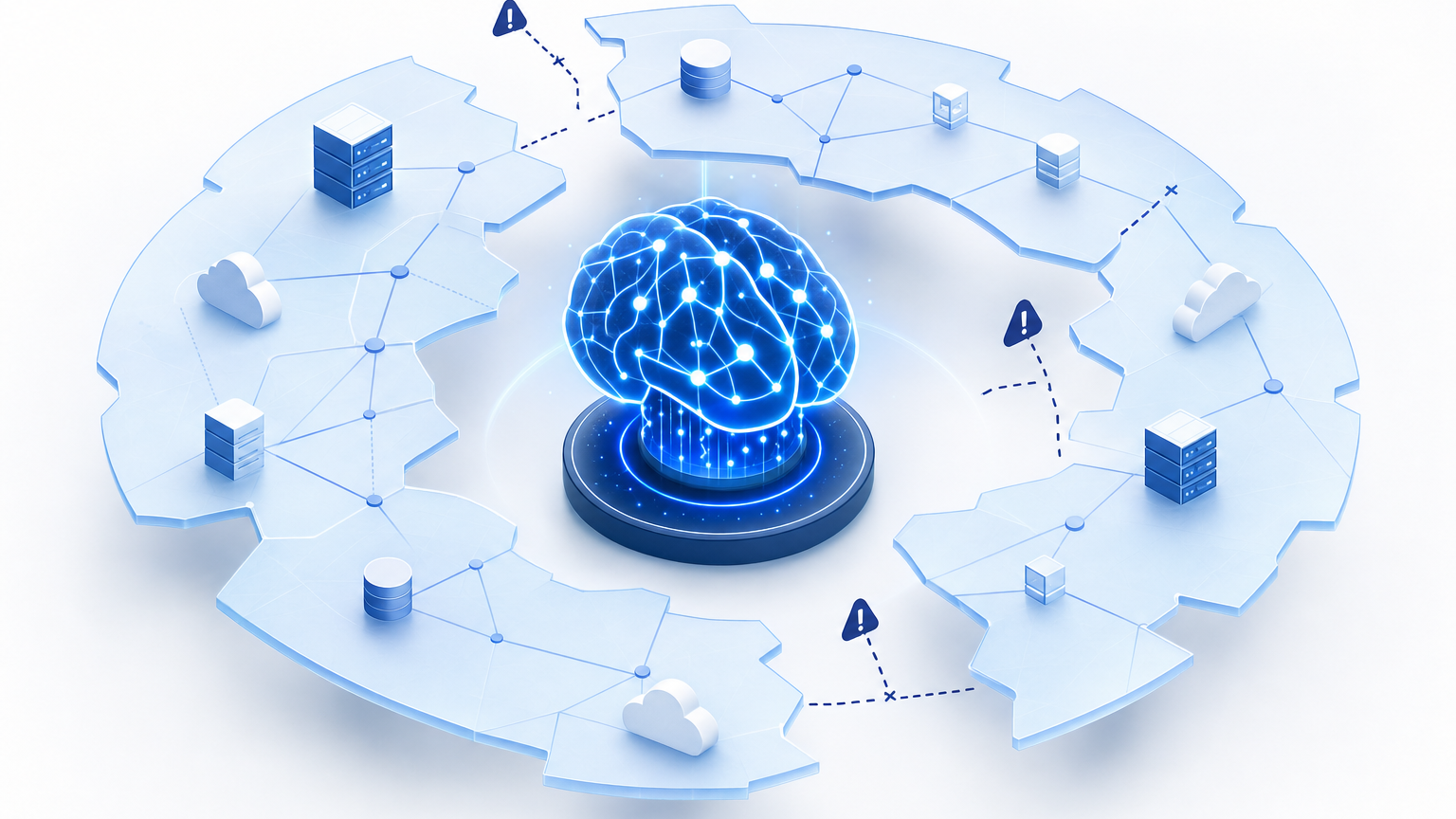
A ticket lands at 2 a.m.: “checkout is slow.” The AI triage step matches that phrase to old ticket text and pages the database team. The ticket then bounces to network and the application team, because nothing in it named the service that was actually down. AIOps incident triage context is what decides whether an artificial intelligence (AI) model names the right team in a moment like that, or the wrong one. A model asked to assign a team from symptom text will assign one whether or not any record supports that assignment. The record in question is the configuration management database (CMDB), which holds configuration items (CIs), their relationships, and their owners.
Atlassian and Procore will present at the Gartner IT Infrastructure, Operations & Cloud Strategies Conference (IOCS) on 8 December 2026 in Las Vegas. The session will cover how replacing fragmented tools with Jira Service Management (JSM) and Rovo streamlined incident triage. The session abstract does not mention a CMDB or topology, so the context angle in this post is Virima’s own reading of the problem.
One ServiceNow Community post describes AIOps without a service model as “correlation without comprehension”. The model is rarely the weak part of a triage stack. The CMDB behind it often is. AI triage is only as good as the CMDB feeding it.
What AI triage decides at the ticket stage
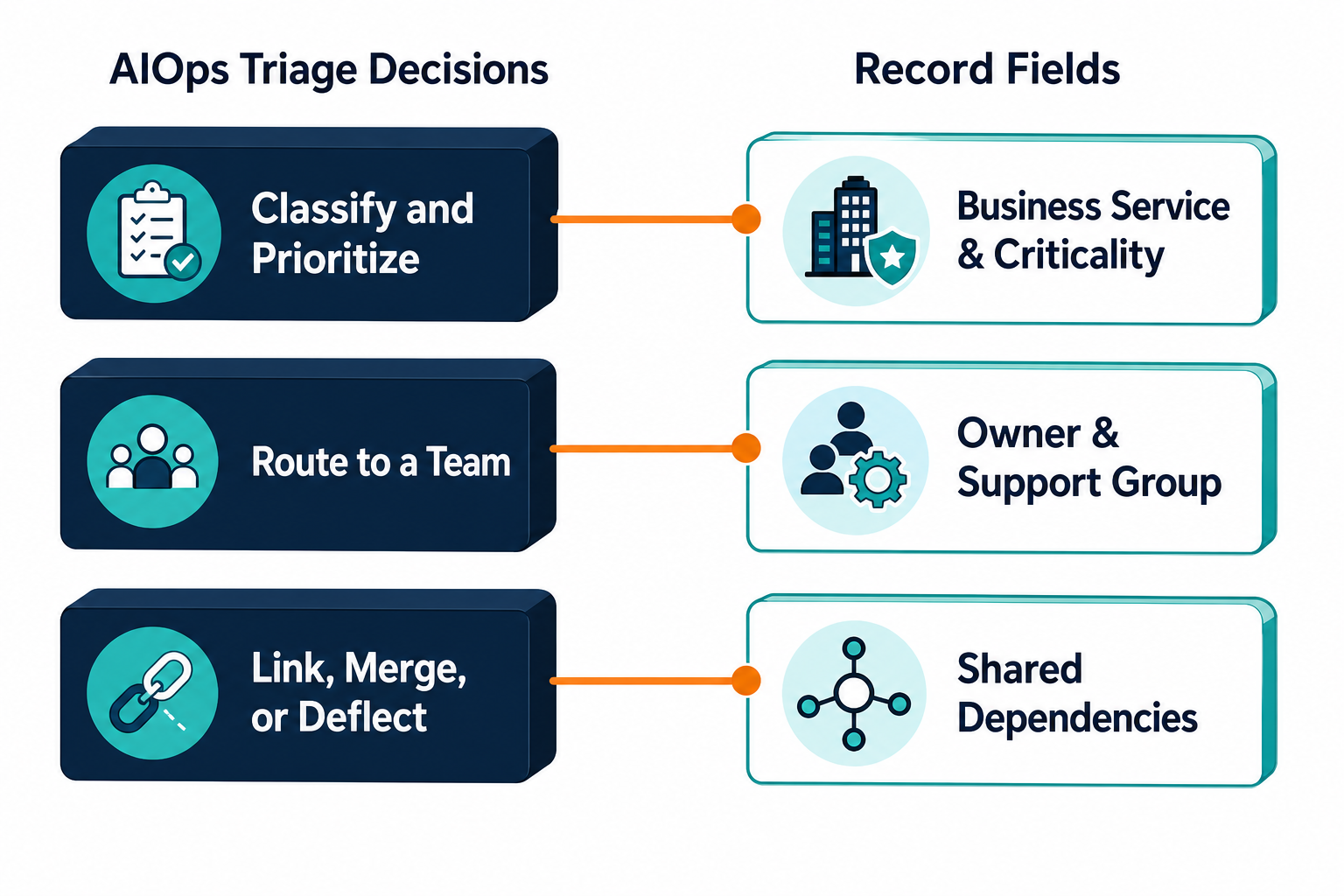
Every AI triage step makes some version of three decisions. Each decision reads a different field from the record, so a gap in one field breaks one decision and leaves the others intact. Mapping service topology for automated triage onto each of those decisions shows exactly where a gap breaks routing.
| Decision | What the model sees in the ticket | What it needs from the record | What goes wrong without it |
|---|---|---|---|
| Classify and prioritize | Summary and description text | The business service the CI supports and the criticality the team has recorded | A slow payment service gets the same priority as a slow test server |
| Route to a team | Reporter, keywords, and past ticket text | The owner and support group of the CI | The wrong team is paged and the ticket bounces between queues |
| Link, merge, or deflect | Similar tickets and knowledge articles | Shared dependencies between the affected CIs | One fault becomes many tickets, or a ticket on a shared service is deflected as a duplicate |
Why does my AI triage tool keep paging the wrong team?
AI incident triage misroutes tickets when no record names the support group for the failing component. The model infers a team from keywords instead. A database mention routes to the database team even when a network path owned by another group caused the failure.
Classification needs a service and a criticality, routing needs an owner, and merging needs the dependency path two tickets share. A single “AI-ready” label on a CMDB hides these differences, so each field deserves its own check. The gap shows up most in AI ticket routing: one Virima customer saw 31% of auto-routed incidents land with the wrong assignment group after a reorg left CI ownership pointing at teams that no longer existed, and unassigned tickets sat 47 minutes before a human escalated them.
Why triage models hallucinate without topology
In triage, an AI triage hallucination is a confident answer that the record does not support. One vendor, Mezmo, argues that messy context turns into confident wrong advice, with missing ownership and stale dependency links as typical causes. That is one vendor’s view, and it matches what service desks report when a model names a team that never owned the service.
Why does AI incident triage give wrong answers?
AI incident triage gives wrong answers when the ticket names a symptom and no record links that symptom to a service, a dependency path, or an owner. The model fills the gap with a plausible guess from ticket text, and the guess reads as confident.
The ticket names a symptom, not a service
A requester writes “VPN is down” or “orders are failing”. Neither phrase identifies a CI. The model matches words to past tickets, and past tickets carry the same vague wording. A ticket bound to a CI gives the model a service, a path, and an owner to read instead of a phrase to match.
Alert storms turn one fault into many tickets
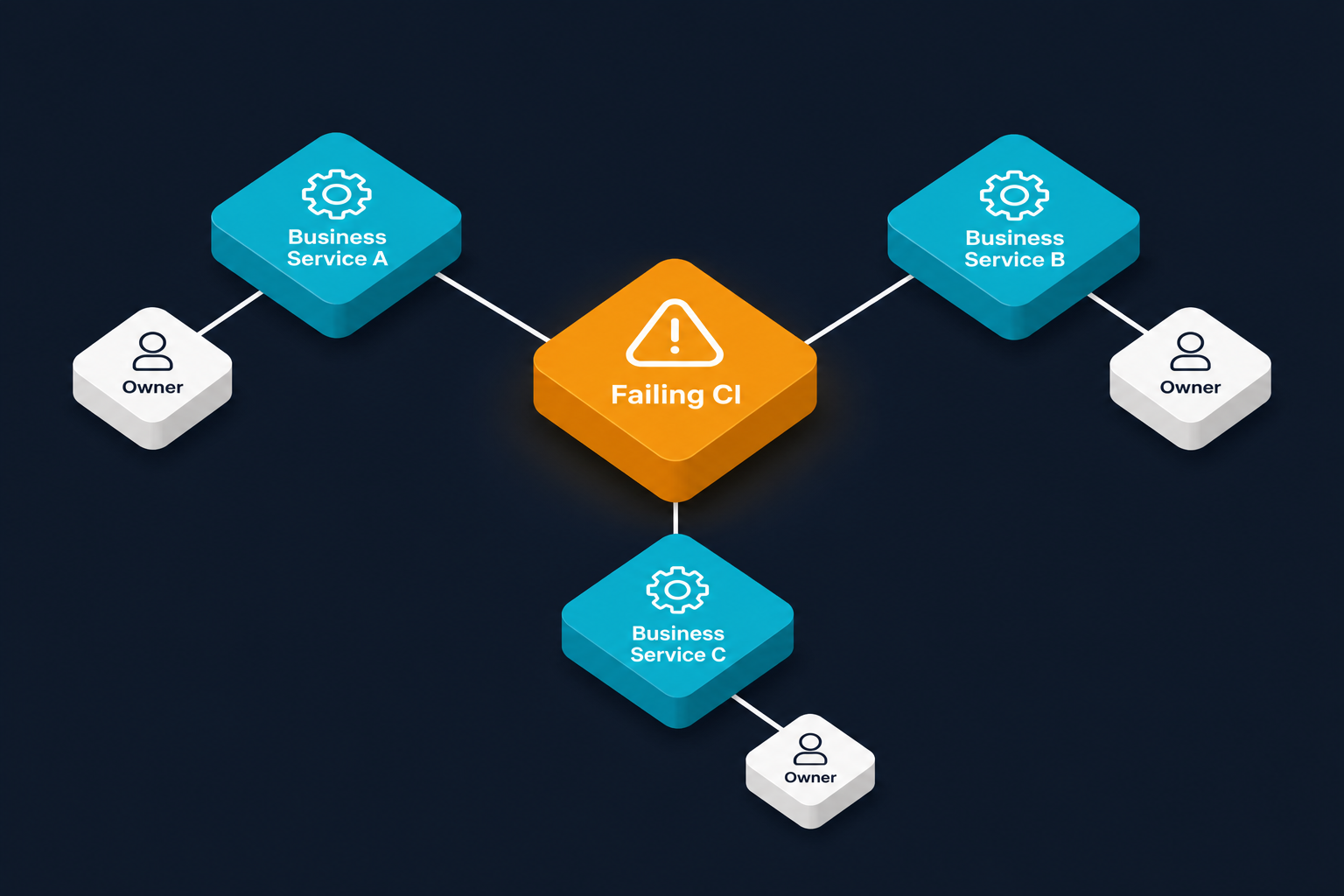
When a shared database slows down, every application that depends on it raises alerts. Each alert can become a ticket, and each ticket looks unrelated to the others. This pattern is alert storm misrouting: one fault multiplies into tickets that all look unrelated unless something ties them to the same dependency. The shared dependency is the only link between them. This post picks up after the alert, and the earlier guide on correlating alerts to a service covers how an alert binds to a CI before a ticket exists.
Ownership becomes a guess
When no record names the support group for a CI, the model infers a team from keywords. A keyword such as “Oracle” sends the ticket to the database team even when the failing component is a network path owned by someone else. The inference reads as routing, but it only repeats the ticket wording.
If misrouted tickets are already stacking up in your queue, the readiness test later in this article shows where to look first, or review how service mapping surfaces the dependency data a team would need to run it.
The context a ticket should carry
The CMDB holds a record for each CI. For a ticket, that record shows what the CI is, what it touches, and who owns it. A triage step can use only what the record shows, and a ticket with no CI attached gives it nothing to read. One Virima customer linked CI records to Jira tickets and cut MTTR from 4.7 hours to 3.1 across 94 incidents. CI identification time fell from 47 minutes to 8, and CI context on incidents rose from 22% to 89%.
| Ticket context field | Where it comes from in Virima | What a triage step does with it |
|---|---|---|
| CI identity | CMDB record built from scheduled discovery | Binds the ticket to one component instead of a hostname guess |
| Business service and dependent services | ViVID™ service map built from discovery data and team-defined services | Sets priority and finds the other services on the same path |
| Owner and support group | IT asset management (ITAM) ownership fields | Routes the ticket to the team that answers for the CI |
| Recent and scheduled changes | Change history on the CI record | Flags a change as a likely cause |
| Source and last-seen date | Discovery source and last-seen timestamp on the record | Tells a human when the record is too old to trust |
| Related open tickets on the same chain | Service dependency links | Groups tickets that share a root cause |
Identity first
Every other field hangs from the CI. A hostname can be reused after a rebuild, so a ticket bound to a serial number or cloud instance ID stays attached to the right component. The triage step then reads one record instead of matching strings.
Dependents next
Priority depends on what else shares the path. A CI that supports one internal report differs from a CI that supports payroll, checkout, and a customer portal. The same dependency view lets a change advisory board see its blast radius without tribal knowledge, and a triage step reads the same fields.
Owner and recent change
Two fields shorten the first ten minutes of an incident. The owner field names who answers, and the change field shows what moved in the past day or week. People confirm ownership, and the CMDB stores and shows the answer they gave. A triage step can then route on a recorded owner instead of a keyword.
Show how old the record is
Discovery runs on a cadence the team sets, so each CI carries a last-seen date. That date lets a human step in when the record is stale. A ticket that shows “last seen 41 days ago” tells the responder to verify before acting. The service mapping view shows the same dates beside each dependency.
Where the record cannot help
A triage step reads a record, and every record has limits. Teams that name those limits early avoid surprises in week three.
- A scheduled record is a snapshot, so a change made after the last discovery run will not show until the next one.
- Services are defined by the team, so a service nobody defined will not appear on a map.
- Software-as-a-service platforms and vendor-managed systems expose limited detail to discovery.
- Whether an AI feature reads CI fields depends on how the ITSM platform is configured, and Virima describes the fields appearing beside the ticket.
- Virima does not run, tune, or check the AI model, and it does not route tickets.
- Naming drift between monitoring tools and the record breaks the join until someone corrects it.
When the record and the responder disagree, the responder is asked. The answer goes into the record with a date, so the next ticket on that CI starts from the corrected entry.
A triage readiness test you can run this month
This test uses closed tickets, so it needs no live incident and no change to the model.
- Pick a sample of closed tickets from each queue, such as 30 per queue.
- Check each ticket for a valid CI, a business service, and an owner.
- Replay the sample through the AI triage step and compare its team and priority with what finally happened.
- Ask the step about a decommissioned or non-existent service and note whether it invents an answer.
- Record every answer that cites no CI.
The incident.io accuracy guide describes the backtest and the non-existent-service check as one published method, and both fit a service desk sample. Track one measure of your own: the share of tickets that arrive with a valid CI and service attached. This measure belongs to your team and does not describe a Virima result.
How can a service desk test AI triage readiness?
Replay a sample of closed tickets from each queue through the AI triage step, then compare its team and priority with the real outcome. Add one question about a decommissioned service. Every answer that cites no configuration item marks a gap in the record.
Failures from the backtest point to missing fields, and the fix sits in the record. The guide on CMDB record trust with JSM covers how teams keep those records accurate over time.
Virima gives AI triage a service record to read
Virima supplies the CMDB service record for AI triage to read. The triage model, routing rules, and ticket workflow stay in the platforms that run them. Virima pairs with Jira Service Management and the other ITSM platforms on its integrations page and does not replace them.
| What Virima supplies | What stays in other systems |
|---|---|
| CMDB records (CIs) from scheduled discovery, with source and last-seen date | The AI triage model and its configuration |
| ViVID™ service maps built from discovery data and team-defined services | Routing rules and queue design |
| ITAM ownership and lifecycle fields | Ticket workflow and approvals |
| Two-way ITSM sync with JSM and other platforms, plus a Representational State Transfer application programming interface (REST API) | Alert and monitoring tools |
The record shows what exists, how it connects, and who owns it. For a Service Desk Manager, that means each ticket can arrive with a service and an owner attached. For a Director of IT Operations, it means a readiness test has fields to measure before AI triage reaches more queues.
Questions to ask before you switch on AI triage
These questions work in a vendor review and in an internal readiness meeting. A good answer names a field, an owner, or a date.
| Question | What a good answer looks like |
|---|---|
| Which fields does the model read for each decision? | A named list per decision: service, owner, and dependencies |
| How old can a record be before a human steps in? | A last-seen threshold the team has agreed |
| Who owns the service when the record has no owner? | A named fallback group with an escalation path |
| How are duplicate tickets tied to one dependency? | A shared CI or service link that groups them |
| Where is a wrong answer recorded and fixed? | A feedback step that updates the record with a date |
Meet Virima at Gartner IOCS 2026
Virima will be at booth 645 at Gartner IOCS 2026 in Las Vegas, where the team will talk through service context for incident triage. See the details on the Gartner IOCS 2026 event page.
Frequently Asked Questions
What is AIOps incident triage context?
AIOps (artificial intelligence for IT operations) incident triage context is the service, dependency, owner, and change data a triage step reads beyond ticket text. Without it, the model classifies and routes from keywords alone.
Why does AI triage give wrong answers?
Artificial intelligence (AI) triage gives wrong answers when a ticket names a symptom and no record links it to a service or owner. Stale entries make this worse, because the model reads an old dependency as current.
Does Virima’s CMDB feed AI triage models directly?
Virima’s CMDB and ViVID™ service maps expose CI, ownership, and dependency fields through a two-way ITSM sync and REST API. Whether a specific AI triage feature reads those fields depends on how the ITSM platform is configured; Virima supplies the fields, not the triage model.
Do alert storms affect AI triage?
Alert storms create many tickets from one shared fault. Without a dependency link between those tickets, AI triage handles each one separately, which raises duplicates and spreads the same incident across several queues.
Does Virima work with Jira Service Management?
Yes. Virima syncs with Jira Service Management (JSM) in both directions, and ViVID™ shows dependency context, ownership, and change history beside the ticket. The post on ViVID for JSM incidents has the details.