Our Jira Team Had Zero CI Context in Every Ticket. Here’s What That Cost Us.

| The jira no ci context incident cost carries two price tags: direct downtime and engineering hours lost to manual CI identification. When Jira tickets carry no configuration item, no service owner, and no dependency map, every response stalls before diagnosis even starts. This article breaks down the exact cost of that gap and shows what changed when a discovery-sourced CMDB was connected to Jira. |
The jira no ci context incident cost has two components. One is direct downtime. The other is the engineering hours lost to manual CI identification before any diagnosis can begin. When Jira tickets carry no affected configuration item, no service owner, and no dependency map, responses stall before diagnosis starts. Connecting a discovery-sourced CMDB to Jira can significantly reduce that delay. It also closes the data gap that allows the same root cause to produce repeat incidents months apart.
ITIC’s 2024 survey found that 41% of large enterprises face hourly downtime costs between $1 million and $5 million. That figure comes from the ITIC 2024 Hourly Cost of Downtime Survey. As a result, every minute of unnecessary investigation is directly material to the business.
A Six-Month Pattern We Failed to Notice
Between August 2024 and January 2025, we experienced three production incidents. Each took between 2.9 and 3.2 hours to resolve. Each was caused by the same misconfigured load balancer routing rule. However, not one of our engineers connected them. Our Jira tickets contained zero CI context, with no shared data anchor pointing to the same component across three separate events.
(The details below are drawn from a customer engagement, with identifying details anonymized.)
What “Zero CI Context” Actually Means
Zero CI context means a Jira incident ticket carries no affected configuration item, no service association, no upstream dependency map, no CI owner, and no change history. Without this data, every incident response starts from scratch. Responders spend the first 30 to 60 minutes on asset identification rather than problem resolution.
The Five Data Points Missing from Every Ticket
Zero CI context means no affected configuration item in the ticket. It also means no service association, no upstream dependency map, no CI owner, and no change history. A CI is any IT asset or component tracked in the CMDB. So every ITSM incident ticket our team of 22 engineers opened in Jira was a blank slate.
Each ticket contained just a written description of what seemed broken, a priority label, and a reporter name. That was it.
How the Gap Compounds Across 1,400 Tickets a Month
Our team processed over 1,400 Jira tickets per month during this period. Across every one, the same pattern held: responders began by asking around. Which server was this? Who owned that service? What changed this week? The answers came through Slack, Teams calls, and direct messages. In other words, colleagues became a human CI lookup layer. That is the investigation tax that most teams undercount.
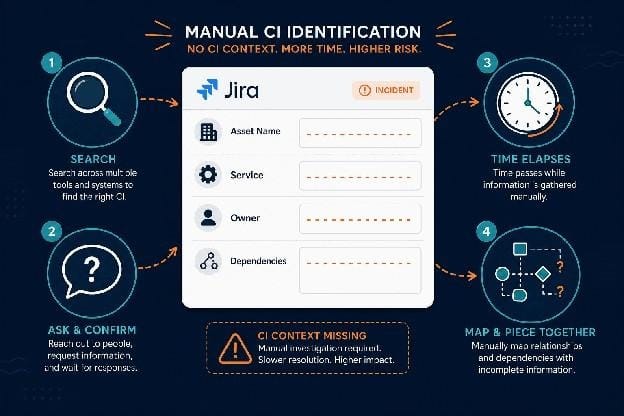
Conceptual diagram showing a Jira incident ticket with all CI-related fields blank: no asset name, no service, no owner.
What does zero CI context in a Jira ticket mean?
Zero CI context means a Jira incident ticket carries no affected configuration item, no service association, no dependency map, no ownership data, and no change history. Without these five data points, every responder must identify the affected asset manually. That process typically consumes 30 to 60 minutes per incident.
If your incident tickets are missing this context today, the fastest path to fixing it starts with understanding what discovery-sourced runtime truth looks like in practice.
| Explore Virima’s Trusted Runtime Truth the discovery layer that feeds CI context into every ticket |
Three Incidents. One Root Cause. Zero Connection.
The First Two Incidents We Treated as Separate Events
In August 2024, our payments service degraded for 3.2 hours on a Thursday afternoon. The root cause traced to a misconfigured routing rule on a load balancer in our primary data center. The rule was corrected and the service restored. Ticket closed.
That November, the same payments service degraded for 2.9 hours on a Tuesday morning. Same load balancer, same routing rule, reintroduced by a change that never referenced the August incident. No shared CI record meant no link between the two events.
Why the Third Incident Cost $46,500
By January 2025, the pattern repeated. The service went down for 3.2 hours — same component, same failure mode. Total downtime across all three incidents: 9.3 hours. At our organization’s estimated $5,000-per-hour impact figure (a conservative internal benchmark), the total came to $46,500 in measurable cost. Industry estimates for critical enterprise services run significantly higher, per ITIC’s 2024 research. Every dollar was preventable.
Without a CI record in each ticket, there is no shared reference point. So separate incidents cannot be linked to the same infrastructure component. Responders treat each ticket as a new problem. The root cause gets fixed in isolation each time. However, the structural conditions that let the misconfiguration recur stay invisible until someone runs a manual keyword search.
How CI-to-Ticket Mapping Closes the Gap
To see how CI-to-ticket mapping prevents this pattern from accumulating, explore Virima’s Jira integration and the discovery-sourced approach that keeps CI data current between incidents.
The broader impact of missing CI context also shows up in root cause analysis. When the same component fails repeatedly without a traceable data anchor, post-mortems address symptoms rather than structure. For a deeper look at how CI data enables effective root cause analysis, see Root Cause Analysis in IT Incident Management.
The Investigation Tax We Paid on Every Ticket
We tracked investigation time across a sample of 80 tickets from Q3 2024. The average time from ticket open to first confirmed CI identification was 58 minutes. For P1 incidents, that number rose to 71 minutes (based on internal analysis, 2024 to 2025).
What That Investigation Tax Actually Cost
At a blended hourly rate of $95 per engineer, the numbers add up fast. We had 40 incident tickets per month where investigation time exceeded 30 minutes. That came to over $29,000 per month in engineering hours on manual CI lookup. However, that money wasn’t spent on solving problems. Instead, it went to finding out what the problem was touching.
| How much does the absence of CI context cost in engineering time? At $95 per engineer-hour and 40 incidents per month requiring manual CI lookup, the monthly cost reaches over $29,000 in engineering hours alone. That totals more than $348,000 annually before factoring in any direct downtime impact from delayed diagnosis. |
Five CI Fields That Eliminate the Investigation Phase
Effective CI context in a Jira incident ticket requires five fields. Together, these fields can eliminate the manual investigation phase. That phase typically consumes the first 30 to 60 minutes of most incident responses.
- The affected CI name and type
- Its current owner
- The services that depend on it
- Open incidents or changes in the prior 72 hours
- A discovery timestamp confirming last-verified state
The Jira and CMDB integration that connected our CMDB to tickets reduced CI identification time from 58 minutes to 11 minutes. That improvement came within 45 days of deployment. For context on what a well-structured CMDB integration looks like, see how Jira CMDB and Virima integration ensures data trust.
What the Data Environment Looked Like
Our IT discovery covered approximately 6,800 CIs at the time of the November incident. The load balancer at the center of all three incidents was in the CMDB. Its routing configuration, service associations, and last-modified date were all recorded.
However, none of that data was ever connected to a Jira ticket. The data existed. The problem was a missing bridge between our asset management environment and our ticketing workflow. So two systems ran in parallel, with no integration, while the team adapted by treating colleagues as a human CI lookup layer.
Why Manual Enrichment Rarely Happens Under Pressure
Discovering a configuration item in a war room conversation is not a discovery process. In fact, it is a guessing game with deadlines.
Under incident pressure, responders default to speed. Looking up a CI in a separate CMDB interface takes time. Copying the record identifier and attaching it to the ticket adds more minutes. The whole process already feels too slow. So without automatic CI attachment at ticket creation, manual enrichment rarely happens. As a result, the ticket record is permanently incomplete.
The Structural Problem Behind the Symptom
A pre-integration audit we ran in February 2025 found 1,140 CIs with blank ownership fields. It also found 427 CIs linked to services renamed or restructured in 2024, but never updated in the CMDB. On top of that, 89 CIs still referenced hardware decommissioned more than 8 months earlier.
The Sequence That Matters
This sequence matters: build a CMDB on accurate, discovery-sourced data, then connect it to ticketing. Connecting first amplifies whatever quality level your CMDB is at, good or bad. For example, poor-quality CI data flowing into Jira tickets trains responders to distrust the suggestions. They stop using them. That outcome is worse than no integration at all.
Start with Your Highest-Risk Service Clusters
For a structured approach to CMDB accuracy before integration, see our CMDB best practices guide. You can also review three ways Virima offers Jira Service Management customers a true CMDB to understand what a production-ready integration looks like.
Once your CMDB is accurate, the path to connecting it is straightforward. The build a CMDB guide walks through each phase, from discovery coverage to CI ownership assignment.
| What should you fix first: CMDB data quality or the Jira integration? Fix CMDB data quality first. Connecting a low-quality CMDB to Jira surfaces inaccurate CI suggestions, which trains responders to distrust and ignore the integration. A targeted audit of CI ownership completeness, service association accuracy, and discovery timestamps for your highest-incident services should precede the integration deployment. |
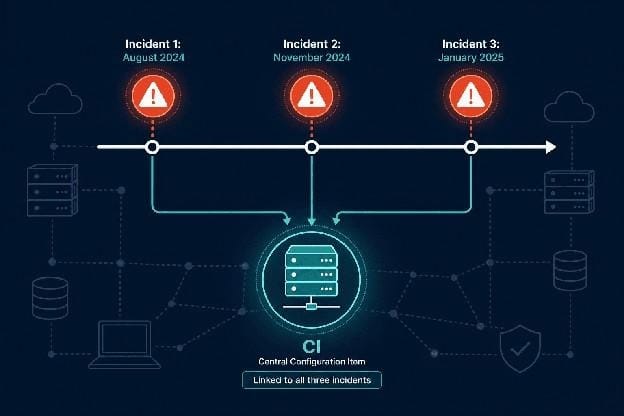
Conceptual diagram showing a timeline of three incidents spanning August 2024 to January 2025, linked to a single unresolved CI record.
What Changed After the Integration
After connecting a discovery-sourced CMDB to Jira, CI identification time fell from 58 minutes to 11 minutes. Tickets with CI context rose from 6% to 84% within 45 days. Engineering hours on manual CI lookup dropped from 326 to 61 per month, and repeat incidents were automatically linked to prior CI appearances.
Four Measurable Results in 45 Days
We deployed our Jira and CMDB integration in February 2025, following a three-week data quality project. The results within 45 days were measurable across four dimensions.
- CI identification time dropped from 58 minutes to 11 minutes
- Tickets with CI context attached rose from 6% to 84%
- Engineering hours on manual CI lookup fell from 326 to 61 per month
- Every repeat incident was linked to its prior CI appearance, making pattern detection part of the workflow
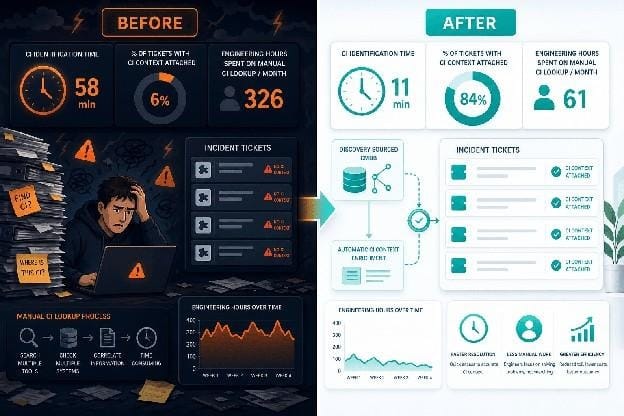
Conceptual before-and-after comparison: CI identification time (58 min vs. 11 min) and CI context coverage (6% vs. 84%).
That is what Trusted Runtime Truth looks like applied to incident management. Not a reporting layer. Instead, it is a live data connection that makes each ticket smarter from the moment it opens.
For teams operating ViVID service maps alongside their ticketing workflow, the integration extends further. Responders can pull up the full impact radius of an affected CI from inside the ticket. They can identify services at risk before they fail, not after.
The Hidden Cost Most Organizations Undercount
The cost of missing CI context in Jira has two components. The first is direct downtime, calculated per hour of service impact. The second is indirect engineering waste, meaning hours spent on manual CI identification. Organizations typically undercount the second component. At $95 per engineer-hour and 40 or more incidents per month, the annual waste frequently exceeds $300,000. That figure does not include any direct P1 downtime impact.
For a broader view on how resolution time improves with discovery-sourced data, see ITSM incident management and resolution time.
What the Post-Mortem Should Have Surfaced
After our January 2025 incident, we found our post-mortem template had no CI field. It asked what process failed. It did not ask which CI was involved.
The Simplest Fix We Made
Adding a required CI field to the post-mortem template was the cheapest intervention we made. It took 15 minutes. Yet it would have caught the pattern after the second incident. In other words, one field change could have prevented $46,500 in repeat downtime.
If your team runs Jira Service Management without CI context in tickets, this pattern is likely accumulating. Check your ticket history for repeated incidents on the same component. And if your team still spends 30 to 60 minutes identifying the CI before diagnosis begins, connecting a discovery-sourced CMDB changes that dynamic.
See the before-and-after in your own environment.
| What is the fastest fix to improve CI context in Jira post-mortems? Adding a required CI field to the Jira incident post-mortem template is often the lowest-cost intervention with immediate impact. It takes minutes to implement and ensures every closed incident leaves a traceable CI record, making it possible to detect repeat failures before they become a third or fourth incident. |
Stop Paying the Investigation Tax on Every Ticket
The jira no ci context incident cost is predictable, measurable, and preventable. It shows up as investigation time on every incident ticket. It also appears as repeat failures that seem new because they lack a shared CI anchor. And it surfaces in post-mortems that identify process failures while missing the infrastructure root cause.
Connecting a discovery-sourced CMDB to Jira does not require a perfect dataset. Instead, it requires a targeted audit, a deployment sequence that prioritizes your highest-incident service clusters, and a post-mortem template that captures the CI field. Together, those three steps typically deliver the majority of the benefit.
| What is the Virima Jira integration and how does it reduce incident cost? Virima’s Jira integration connects a discovery-sourced CMDB to Jira incident tickets at creation, surfacing the affected CI, its owners, service dependencies, and recent change history. Teams using this integration typically see CI identification time fall from 58 minutes to under 15 minutes, reducing both investigation waste and repeat incident risk. |
Frequently Asked Questions
How does the absence of CI context affect incident triage speed?
Without a CI record, responders must identify the affected asset manually before any diagnosis begins. This investigation phase typically runs 30 to 60 minutes. As a result, environments processing 40 or more incidents per month lose more than 300 engineering hours per month to asset identification rather than problem resolution. ServiceNow, Ivanti, Halo, Jira service management, Xurrent.
Why does the same incident recur when the root cause was already fixed?
A root cause fix applied without a CI record does not leave a traceable data anchor. So when conditions change and the same component produces a second incident, there is no automated mechanism to surface the earlier fix. As a result, every incident can appear new regardless of infrastructure history.
What is the first step to adding CI context to Jira incident tickets?
The first step is auditing your CMDB for data quality. CI ownership completeness, service association accuracy, and discovery currency should all be verified before connecting the CMDB to Jira. For example, connecting poor-quality data to ticketing produces inaccurate CI suggestions, which trains responders to distrust the integration and stop using it.
How does Virima automatically attach CI context to Jira tickets?
Virima’s Jira integration uses discovery-sourced CI data to match tickets to CIs based on service name, hostname, and IP address. When a ticket opens, the matching CI record is surfaced with ownership, service associations, open incidents, and a change history. So responders get the full CI picture without ever leaving the ticket.
Does our entire CMDB need to be accurate before we connect it to Jira?
The CMDB does not need to be perfect. However, the CIs most relevant to incident-prone services should be accurate. A targeted audit of your highest-incident service clusters typically delivers most of the benefit before you extend coverage to the full estate.
What discovery methods does Virima use to keep CI data current for Jira ticket matching?
Virima uses agentless network scanning, agent-based discovery (Windows, macOS, Linux), and API-based discovery (AWS and Azure) to run high-frequency discovery cycles that refresh CI records. The Jira integration matches tickets against this dataset, not a point-in-time snapshot. So CI suggestions reflect the current state of the environment when the ticket opens.
What is the jira no ci context incident cost in engineering hours?
The jira no ci context incident cost in engineering time typically runs 30 to 71 minutes per incident for CI identification alone. At a blended rate of $95 per engineer-hour and 40 incidents per month, that amounts to over $29,000 monthly in wasted investigation time. This figure excludes the direct downtime cost of delayed diagnosis.
| See what the before-and-after looks like in your environment. Schedule a demo. |