Data integrity redefined: Jira service management CMDB and Virima integration in action

Picture an IT infrastructure where every component is accounted for, accurately documented, and connected to the services it supports. That’s the promise of a Configuration Management Database (CMDB). Databases like the Jira Service Management CMDB act as the central repository for all IT asset information, including data from multiple sources, from hardware and software to virtual resources and cloud instances.
But here’s the problem: most CMDB tools don’t deliver on that promise. Industry benchmarks suggest that CMDB accuracy typically sits between 50% and 75%, with studies showing the average CMDB is only about 60% accurate in practice, well below the 97% threshold needed for reliable incident response, change management, and compliance reporting.
Why does accuracy matter this much?
Because 56% of IT leaders still lack full visibility into their technology estate, leading to significant operational risk and downtime costs. Clean CMDB data, especially accurate configuration data, drives consistency, completeness, and trust across IT operations. When the data is wrong, IT teams waste hours diagnosing incidents, change advisory boards approve requests based on stale dependency maps, and compliance audits surface gaps that should have been caught months earlier, putting compliance requirements at risk.
This is where Jira Service Management and Virima work together. JSM provides the ITSM platform; Virima provides the IT discovery, service mapping, and CMDB population engine that JSM lacks out of the box. Together, they give IT operations teams the tools to build, populate, and maintain an accurate Jira service management CMDB without manual data entry or stale records.
This blog walks through exactly how the JSM-Virima integration works, what it solves, and why it matters for teams that depend on their CMDB for daily operations.
What benefits does a configuration management database bring to your organization?
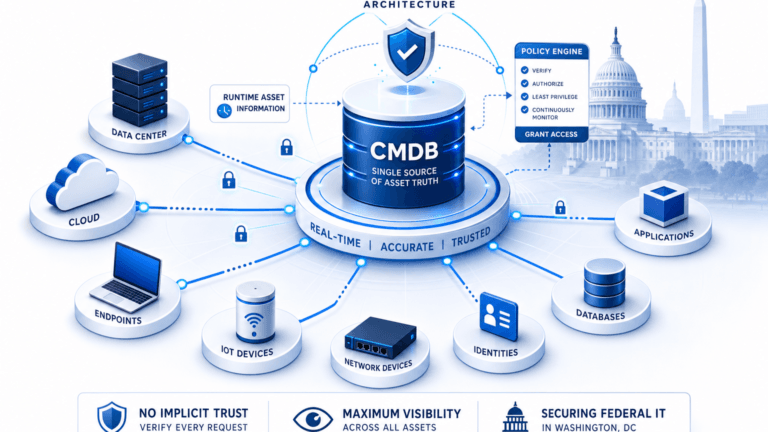
ACMDB gives IT teams a single source of truth for all configuration items (CIs), even when managing federated data across distributed systems. That visibility supports faster incident management, safer change management, better compliance posture, and more accurate IT asset management. It also feeds into IT operations management workflows, where understanding dependencies between CIs directly affects service availability. For organisations managing assets across hybrid environments, on-premises data centres, AWS, Azure, and remote endpoints, this single source of truth is what prevents IT teams from making decisions based on incomplete or outdated data.
What makes a CMDB trustworthy?
A trustworthy CMDB reflects the actual, current state of every CI record. It covers hardware, software, infrastructure, virtual resources, and associated facilities. Each CI carries attributes like status, ownership, relationships, and dependencies. When those records match reality, IT teams can trust the CMDB as their decision-making foundation. When they don’t, for platforms like Virima, trustworthiness is backed by independent validation — Virima is PinkVERIFY ITIL 4 certified across six ITSM processes, including Service Asset and Configuration Management (SACM), and holds SOC 2 Type II certification for data security controls. Both represent third-party confirmation that the platform handling your CMDB data meets recognized standards for ITIL compliance and enterprise data management.
Why CMDB accuracy is non-negotiable
An inaccurate CMDB in Jira creates cascading problems. IT teams spend extra time diagnosing incidents because the dependency data is wrong. Change requests get approved without a full impact analysis. Compliance reporting gaps surface during audits because asset records are incomplete or outdated. For teams running IT service management workflows through JSM, CMDB accuracy isn’t optional; it’s the foundation on which everything else depends.
Does Jira Service Management offer a true CMDB?
JSM includes CMDB functionality, but it lacks out-of-the-box CMDB schemas that make the database usable from day one. Without predefined schemas and well-defined data structures, organizations face a blank canvas—they need to define CI types, attributes, and relationships manually before the CMDB can hold meaningful data.
This is the exact gap the Virima integration fills. Virima provides the schemas, the automated discovery to populate them, and the ongoing synchronization to keep them current. The result is a Jira service management CMDB that reflects your actual IT environment, not a half-populated database that no one trusts.
| Can you use Jira Service Management CMDB without a third-party discovery tool? Technically, yes. Practically, it’s a struggle. JSM’s native CMDB has no built-in discovery engine, which means every CI must be entered or imported manually. Manual entry goes stale fast—within weeks, the database drifts from reality as assets change, move, or get decommissioned. Third-party discovery tools like Virima solve this by running recurring scheduled scans that automatically detect assets, map their relationships, and sync the asset data to JSM. Without this automation, maintaining CMDB accuracy at scale becomes a full-time job that most IT teams can’t sustain. |
How the JSM and Virima integration ensures CMDB accuracy
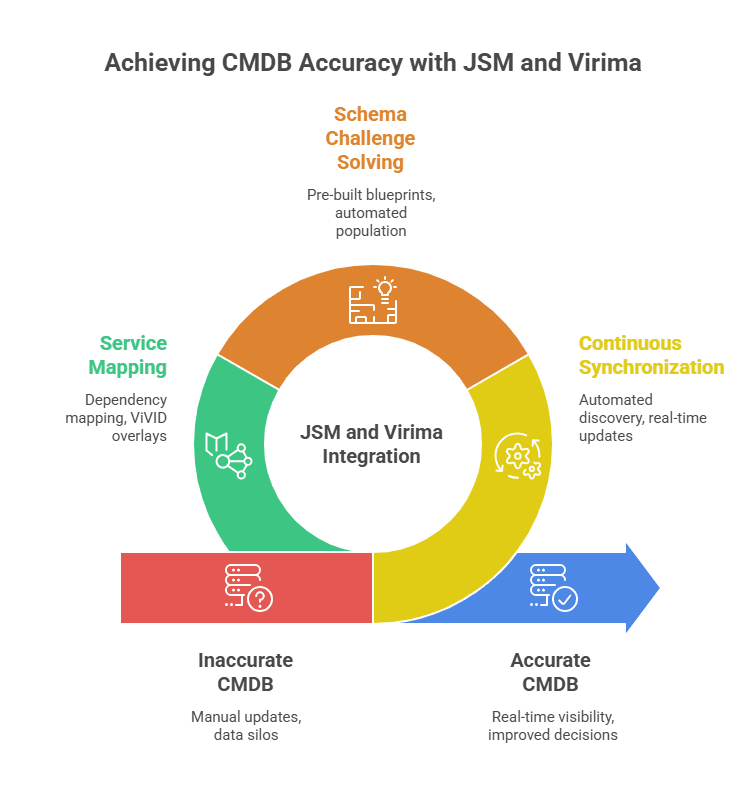
Here’s how each layer of the integration contributes to a reliable, up-to-date Jira service management CMDB.
1. Continuous synchronization keeps the CMDB current
Virima uses agentless, agent-based, and API-based discovery to cover hybrid environments. Agentless scanning handles network devices, servers, and cloud resources via IP-based scans.
Accurate IP address management CMDB tracking is a key part of what makes this agentless scanning reliable — knowing which IP addresses are assigned, active, or available ensures discovery maps the right assets to the right records from the start.
API integrations extend coverage to cloud services like AWS and Azure, hypervisors, containers, and monitoring platforms. The discovery agent covers Windows, macOS, and Linux endpoints for deeper attribute collection, software licenses, and usage tracking.
Discovery runs on recurring scheduled scans, not a one-time import. Each scan cycle captures changes across your infrastructure and syncs them to the Jira service management CMDB automatically. This means the CMDB stays current without manual intervention, giving IT teams confidence that what they see in JSM matches what’s actually running in production.
How asset synchronization works in practice
The automatic sync between Virima and JSM maintains a consistently current view of the IT landscape. When Virima’s discovery finds a new asset, updates an existing CI’s attributes, or detects that a device has gone offline, those changes flow into the JSM CMDB. The integration is a codeless configuration that happens entirely through Virima’s web admin portal and JSM’s user-friendly interfaces, with no development work required.
For an IT ops team, this means the CMDB you check during a 2 AM incident already reflects the change your colleague made yesterday afternoon. No lag, no manual update required.
How often should you update your CMDB?
The short answer: as often as your environment changes. For most organizations, that means running discovery scans on a recurring schedule, daily or weekly, depending on how dynamic your infrastructure is.
Virima’s discovery schedules are configurable; you select which subnets and IP ranges to scan and set automated schedules that run unattended. A fast-changing data center segment might run daily scans, while a stable branch office network might scan weekly. The key is that updates happen automatically on a schedule rather than relying on someone to remember to run a manual refresh.
Data validation for CMDB integrity
Keeping the CMDB accurate isn’t just about discovery; it also requires validation. Organizations can set up validation processes within JSM that cross-reference Virima’s discovery data against existing CMDB records. When discrepancies surface, a CI attribute that doesn’t match, a relationship that’s missing, or a device that discovery can’t reach, the validation process flags it for review.
This approach ensures that only verified information stays in the CMDB, and suspect data gets investigated rather than ignored.
2. Solving the Jira CMDB schema challenge
One of JSM’s biggest CMDB gaps is the lack of predefined schemas. Virima addresses this directly.
Pre-built CMDB blueprints eliminate manual schema work
Virima provides over 120 blueprints, pre-built CMDB schemas covering CI types like Windows desktops, Linux servers, virtual machines, AWS EC2 instances, applications, network switches, and more. These blueprints can be automatically recreated in the Jira CMDB through the Virima UI, with no limits on creating custom blueprints for CI types unique to your environment.
Instead of spending weeks defining CI types, attributes, and relationships from scratch, your team selects the relevant blueprints and pushes them to JSM. The integration is designed to work whether you’re starting fresh or already have some schemas in place. Virima’s flexible UI and deep API integration with the JSM CMDB give you control over how blueprints map to your existing setup. The result is a structured, populated CMDB that provides a high-level view in a fraction of the time, regardless of where you are in your JSM CMDB journey.
Automated discovery populates the CMDB at scale
Once schemas are in place, Virima’s discovery engine populates them. Using agentless IP-based scans and API integrations, discovery automatically and repeatedly identifies data center, network, edge, and cloud resources. Each discovered asset maps to the appropriate CI blueprint, and the data syncs to the Jira service management CMDB based on your configured parameters.
This covers the full discovery scope, on-premises infrastructure, AWS, and Azure cloud environments. Remote endpoints are handled through the discovery agent for Windows, macOS, and Linux.
CMDB maintenance without the manual overhead
Keeping the CMDB accurate over time is where most organizations struggle. Virima makes this manageable through several mechanisms:
- CI ownership assignment: Each CI type gets an assigned owner responsible for data accuracy and investigating discrepancies. Owners can reassign tasks to other users, and the system adapts to determine the best resource for future intelligence gathering.
- Autonomic Social Discovery (ASD): Automates the gathering of human-dependent CI attributes, ownership, lifecycle status, business criticality, policies, and SLAs that scanners can’t detect on their own. When the system identifies a missing piece of human intelligence, it notifies the listed owner to provide the data.
- Integrity checking: Any CI attribute can be tagged for ASD integrity checking. When flagged attributes are missing or unverified, ASD notifies assigned owners, so your team focuses review effort where it matters most. Business rule automation: Granular business rules and automation rules automate CMDB maintenance tasks like promoting certain types of CI updates automatically, while requiring others to go through manual review, keeping the CMDB current without removing human oversight.
- Business rule automation: Hands-free CMDB maintenance rules run in the background while your team retains oversight and control
This combination of automated discovery, social intelligence gathering, and business rules means your Jira service management CMDB stays accurate without becoming a full-time maintenance burden.
| What’s the difference between Jira Service Management and Jira Service Desk? Jira Service Desk was the original product name. Atlassian rebranded it to Jira Service Management (JSM) in 2020, expanding the platform beyond IT service desk functionality to include change management, incident management, and asset/configuration management capabilities. If you see both names in documentation or blog posts, they refer to the same platform. JSM is the current name, and the one Atlassian actively develops. |
3. Service mapping and ViVID™ strengthen CMDB reliability
Service mapping and ViVID™ enhance CMDB reliability by providing real-time dependency insights and operational context.
How service mapping improves CMDB accuracy
Service mapping discovers the dependencies and relationships between CIs — which applications depend on which servers, which databases support which business services, and how network topology connects them all. This relationship data is what turns a flat asset inventory into a true CMDB.
For JSM users, accurate dependency data means that when a CI changes or fails, the CMDB shows exactly which services are affected. Beyond impact analysis, CMDB service maps change management workflows by making it clear which CI owners and service stakeholders need to be looped in before a change is approved — eliminating the guesswork that slows down change advisory boards.
That’s the difference between a 15-minute incident triage and a two-hour guessing game.
Virima’s service mapping uses machine learning techniques to discover these dependencies automatically. The relationships feed directly into the JSM CMDB, keeping the dependency layer current alongside the asset layer.
ViVID™ adds operational context to service maps
Virima Visual Impact Display (ViVID™) enhances service maps by overlaying JSM records directly onto the dependency maps. These overlays include incident tickets, change records, NIST NVD vulnerability data, and event management alerts.
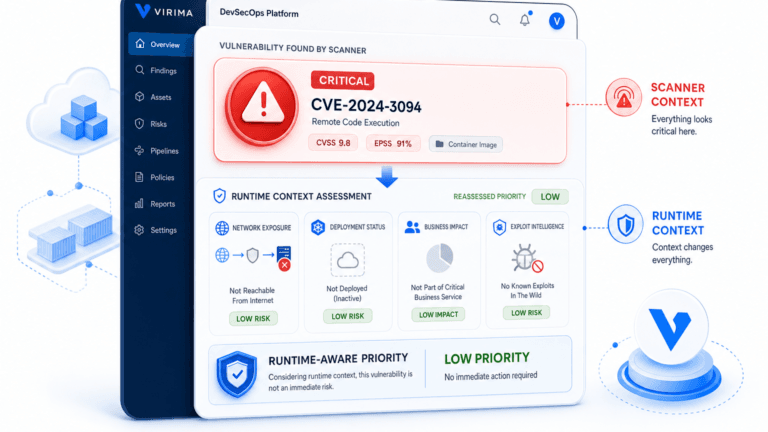
For teams that want a deeper understanding of how this works, Virima’s approach to CMDB vulnerability management — including how CVEs are correlated to specific CIs and how ViVID™ helps teams prioritize remediation by business impact — is covered in detail in Virima’s NIST NVD integration FAQ.
This means your team can see, on a single visual map, not just what depends on what, but which CIs currently have open incidents, pending changes, or known vulnerabilities. That context turns the CMDB from a static data store into an operational decision-making tool that accelerates impact analysis for proposed changes and root cause identification for service disruptions.
When a change request comes in for a database server, ViVID™ shows you every application that depends on it, every open incident tied to those applications, and any vulnerabilities flagged by the NIST NVD integration. That’s the kind of attribute authority that separates a trustworthy CMDB from a fancy spreadsheet.
When a change request comes in for a database server, ViVID™ shows you every application that depends on it, every open incident tied to those applications, and any vulnerabilities flagged by the NIST NVD integration—which is included at no additional cost. That’s the kind of operational context that separates a trustworthy CMDB from a fancy spreadsheet.
How Virima turns your Jira service management CMDB into an operational asset
The integration between Virima and JSM addresses every layer of CMDB accuracy: discovery populates and refreshes CI data on recurring schedules across on-premises, cloud, and remote environments; over 120 pre-built blueprints give the CMDB meaningful structure from day one; ASD and business rules catch discrepancies and keep CI data complete without manual overhead; service mapping and ViVID™ add the relationship and context layers that make the CMDB operationally useful.
For IT operations teams that rely on their Jira service management CMDB for incident response, change management, and compliance reporting, this integration removes the manual burden that causes most CMDBs to go stale.
The same principle applies beyond JSM — teams running Xurrent as their service management platform can take advantage of CMDB enriched ITSM through Virima’s native Xurrent integration, which brings the same real-time discovery and ViVID™ service mapping into a different ITSM environment
The result is a CMDB you can actually trust, one that reflects your real infrastructure, updated automatically, and enriched with the dependency and vulnerability context your team needs to make confident decisions.
And because Virima is purpose-built on AWS with SOC 2 Type II certification, the platform handling your CMDB data meets the same enterprise security standards your organization requires. Schedule a demo today with our team to see the integration in action.