Enhanced Jira incident management: Virima’s ViVID™ for Jira Service Management

No matter what incident management workflow your organization follows, three needs stay constant: a clear view of the infrastructure, effective team coordination, and fast root cause identification. These needs are becoming more critical as incident complexity grows. In fact, 30% of engineering time is now spent on operational toil, much of it tied to incident response inefficiencies.
When you’re running Jira incident management, those needs don’t change. Jira Service Management offers a solid set of incident management features on its own. But integrating ViVID™ (Virima Visual Impact Display) takes your incident workflow further by putting dependency context, ownership details, and change history right alongside the ticket.
In this blog, we’ll walk through how ViVID™ enhances Jira incident management for JSM customers.
Jira ITSM platform: What’s in there for Jira incident management?
Incident management in Jira starts with logging. Users create and log incidents directly in the Jira Service Management platform. Monitoring tools can also generate incidents automatically when parameters cross set thresholds.
To reduce alert fatigue, JSM uses alert enrichment to group and contextualize alerts so teams aren’t buried in noise. This is critical because 73% of organizations have experienced outages caused by ignored alerts, highlighting how alert fatigue directly impacts incident outcomes.
Dynamic forms ensure every incident captures the right information upfront.
Ease of collaboration
Jira Service Management helps teams respond, resolve, and learn from incidents together. Chat channels (Slack, Microsoft Teams) and video conferencing let teams share context and record every action taken during resolution, all within the incident timeline.
Efficient alert handling
JSM supports customizable on-call schedules and routing rules. Alerts are prioritized by origin and urgency, so the right team gets notified at the right time. That means fewer missed alerts and faster first response.
Incident escalation
When an incident escalates, JSM assembles the right DevOps teams quickly. Built-in chat and video conferencing integration speeds up collaboration, and every step is documented automatically to build a detailed incident timeline.
With ViVID™ integrated, teams can also investigate affected dependencies and remediate faster, which cuts the time between escalation and resolution. This matters because AI-driven incident automation can reduce MTTR by up to 40%, proving how better context and automation directly improve resolution speed.
Reporting and analytics
JSM provides reporting and analytics tools for tracking incident response activities. These insights show what’s working and where gaps exist. Teams can export post-mortem reports, incident timelines, and follow-up actions to Confluence so stakeholders stay aligned and repeat incidents are less likely.
ViVID™ (Virima Visual Impact Display) for Jira incident management: Its role in enhancing incident resolution
When teams respond to incidents in JSM, ticket data alone isn’t enough. They need a visual display showing what’s connected, what’s changed, and who owns what.
That’s what Virima’s ViVID™ provides. It overlays ITSM incidents, changes, vulnerability data (via NIST NVD cross-referencing), and alerts from event management tools like SolarWinds, Nagios, and LogicMonitor onto service and application dependency maps.
The result is a visual layer that turns static CMDB records into an incident context your team can actually act on.
Virima’s IT discovery capabilities, using both agentless and agent-based methods, feed accurate and current CI data into these maps. That discovery depth is what makes the ViVID overlays trustworthy.
When your CMDB reflects what’s actually in your environment with accurate, up-to-date configuration data, the dependency maps ViVID renders are reliable enough to drive incident decisions.
How does ViVID improve incident response time in Jira?
ViVID reduces incident response time by putting visual context in front of responders immediately. Instead of querying CMDB tables, cross-referencing change records, and chasing down service owners through Slack, responders open a ViVID map and see the affected service, its upstream and downstream dependencies, recent changes, and ownership all in one view.
For operations teams tracking MTTR, this changes where the time goes. The investigation phase, where responders try to understand what’s affected and why, is often the longest part of incident resolution. ViVID compresses that phase by showing the dependency and change context responders need before they even start troubleshooting.
How the ViVID™ feature enhances Jira incident management for JSM customers
Handling change-born incidents
Many incidents trace back to a recent change. The first question any incident responder asks is: “What changed?”
Teams can check CI updates through the ITSM CMDB to see recent changes. But raw CMDB data, rows of CI attributes and timestamps, don’t show how components relate to each other. A change to a load balancer might have cascading effects on three downstream services, and that’s invisible in a table view.
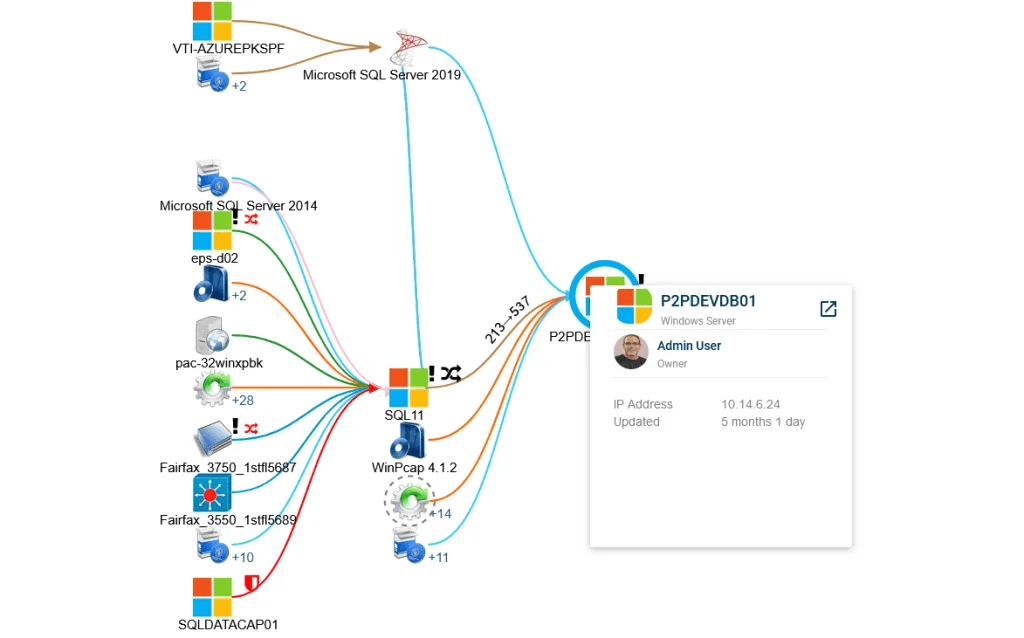
ViVID solves this by overlaying change status (both recently completed and planned) on Virima’s service maps. Incident teams see which infrastructure components near the disrupted service have recent changes and can identify the responsible change without manually tracing dependencies.
More effective stakeholder collaboration with ViVID
When a major incident hits, say a complex software bug affecting multiple applications, multiple teams need to coordinate fast. Each team needs to understand what’s impacted and who owns which components.
ViVID maps affected infrastructure and displays ownership data on each CI, with ownership details populated by Virima’s Autonomic Social Discovery (ASD). ASD automates the gathering of ownership information, business criticality, and SLA assignments that discovery alone can’t capture.
A server, a network switch, a software instance: each one displays its logged incidents and responsible owner directly on the dependency map.
Every team gets a shared visual view of dependencies and relationships. Ownership details are pulled up automatically, so incident coordinators don’t waste time figuring out who manages which component.
Root cause identification for the incident
Whether it’s a major software failure or a VPN outage, incident responders need to trace the problem to its root cause. That means understanding the affected components, their dependencies, and where the failure actually originated.
ViVID turns the CI data sitting in your ITSM CMDB into a visual investigation tool. Follow the dependency chain on the map, and you can spot a recent incident on a dependent CI. A specific firewall, for example, might be the root cause of broader network difficulties. The visual format makes those connections visible in ways that CMDB table queries alone cannot.
What is a service dependency map, and why does it matter for incidents?
A service dependency map is a visual representation of how IT components (servers, applications, databases, network devices) connect to and depend on each other to deliver a business service. When one component fails, the map shows which other components and services are affected.
For incident management, dependency maps are critical. Without them, responders guess at blast radius and waste time investigating components that aren’t related to the outage. With an accurate map, the investigation starts at the right place. Virima builds these maps through discovery and service mapping, feeding the dependency data directly into ViVID for visual incident analysis.
How do you reduce MTTR in Jira Service Management?
Reducing MTTR in JSM starts with faster triage. The longer responders spend figuring out what’s broken and what depends on it, the longer the outage lasts.
Three things move the needle. First, accurate dependency data. Responders need to know what’s connected to the failing component. Stale or incomplete CMDB data forces manual investigation, which adds minutes to every incident. Second, visual context.
A map of affected services and their dependencies is faster to parse than a list of CI records. ViVID overlays incident, change, and ownership data directly onto these maps. Third, ownership clarity. Knowing who manages each affected component eliminates the back-and-forth of finding the right team. ViVID displays ownership data from the CMDB, where it’s kept current by Virima’s discovery and Autonomic Social Discovery.
The combination of Virima’s discovery-fed CMDB accuracy and ViVID’s visual overlays addresses all three, which is why teams integrating Virima with JSM typically see measurable MTTR improvement.
Can Jira Service Management integrate with third-party discovery tools?
Yes. JSM is designed to work with external asset and configuration management tools. Virima integrates with Jira Service Management out of the box, syncing discovered CI data and dependency relationships directly into JSM’s CMDB.
That means your JSM incident workflows benefit from Virima’s discovery depth (agentless and agent-based scanning across on-prem and cloud environments) without the manual data entry that makes other CMDB integrations so painful. The integration is managed through user-friendly interfaces in just a few steps and supports bi-directional CMDB sync, so data stays consistent between Virima and JSM.
Choose ViVID™ integration for Jira incident management
Virima’s ViVID feature helps teams resolve incidents faster across major ITSM platforms: ServiceNow, Ivanti, HaloITSM, and others, including Cherwell. The same capability is available for Jira Service Management.
Virima provides out-of-the-box integration with JSM. Your IT teams gain faster stakeholder identification, coordinated collaboration, and quicker root cause identification, all backed by discovery-fed dependency maps and visual overlays that make Jira incident management data work for your responders, not against them.
Book a demo today to learn more about ViVID™ integration into Jira Service Management.