What Is ITSM? IT Service Management Explained (2026)

What is ITSM? IT service management (ITSM) is the practice of designing, delivering, and managing IT services through structured, repeatable processes aligned to business needs. Most IT teams assume their ITSM quality comes down to having the right workflows in place. The real bottleneck is usually the data those workflows run on. An incident ticket routes to the correct team. The CI record it draws from is six months out of date. Resolution runs slower than it should. That gap, between well-designed processes and accurate underlying data, is where most ITSM programs lose real-world performance.
What ITSM actually covers
ITSM is not a ticketing system. A help desk handles user requests and routes incidents. ITSM is the broader discipline of how IT services are defined, delivered, supported, and improved across their entire life cycle.
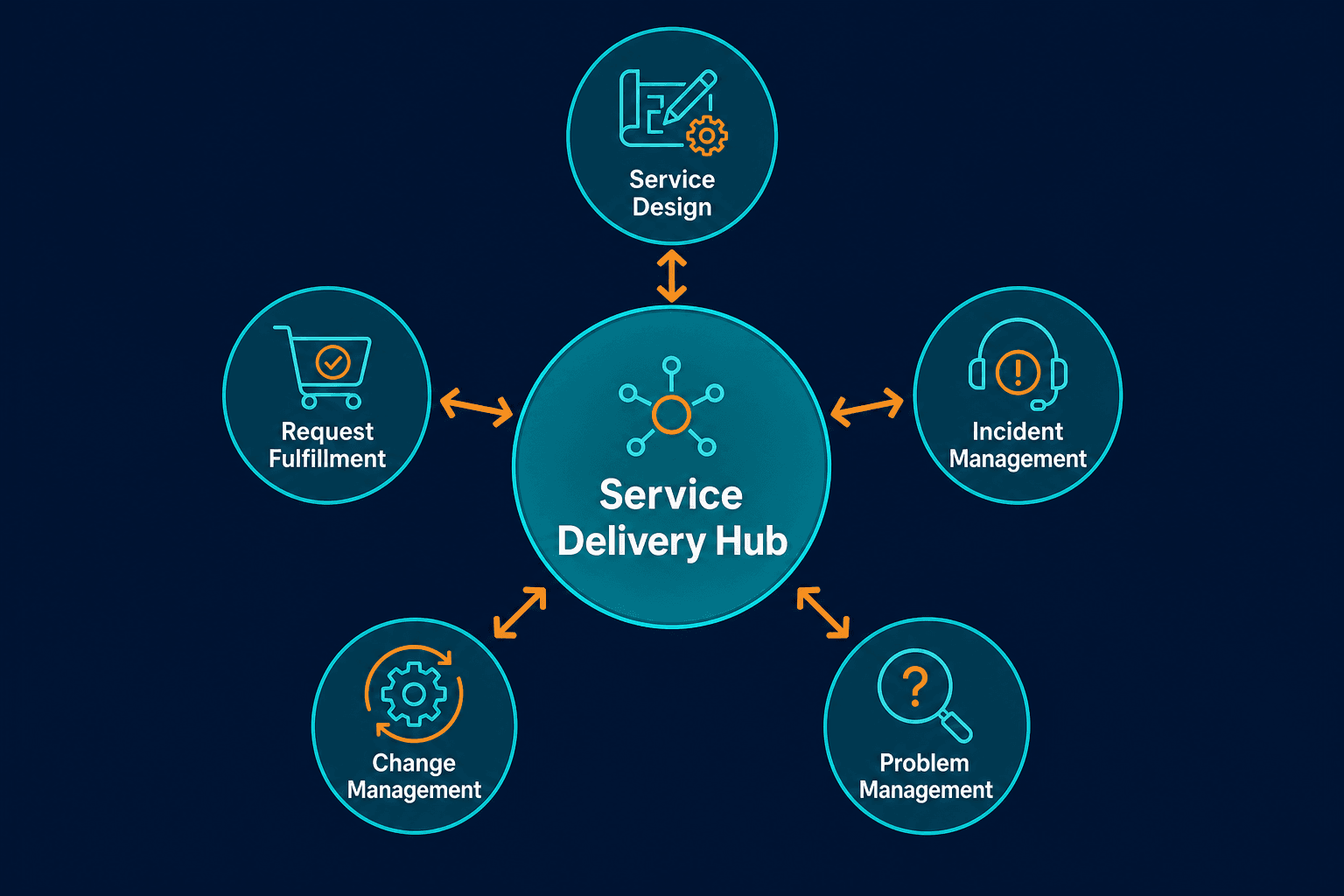
That scope includes how services are designed before they launch, how requests are fulfilled consistently, how incidents are resolved with minimum disruption, how changes are assessed before deployment, and how problems are traced back to root cause. Each of those areas is a distinct practice with its own process logic and its own data dependencies. Done well, this reduces mean time to resolution, lowers change-related outage risk, and keeps audit prep from becoming a fire drill — the business outcomes ITSM investment is ultimately judged on.
What is IT service management? IT service management is the discipline of designing, delivering, managing, and improving IT services through defined, repeatable processes. It covers the full service life cycle, from initial design through active delivery, incident response, change control, and continuous improvement. Structured to align IT output with business need.
The four core ITSM processes
ITSM practice spans many areas, but four processes form the operational core that most enterprise IT teams run daily.
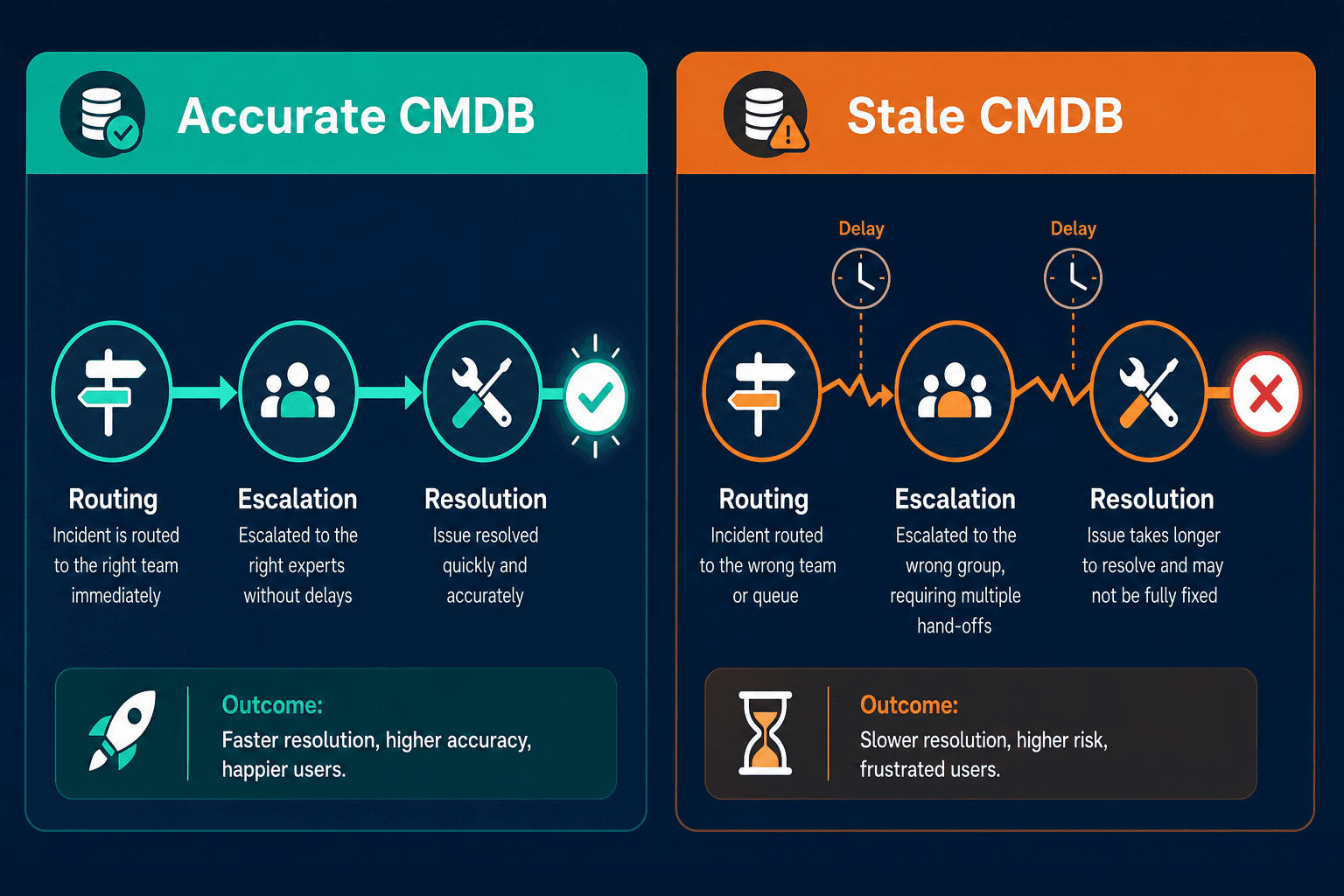
Incident management restores normal service operation after an unplanned disruption, as quickly as possible. Speed and accuracy depend on knowing what the affected CI is, what it connects to, and who owns it. Stale CMDB records slow every step of this process.
Problem management investigates the root cause of recurring incidents. It requires understanding the relationships between CIs in the environment. A service desk that cannot map an application to its dependent infrastructure chases symptoms rather than causes.
Change management evaluates the risk and impact of a proposed change before it enters production. Impact analysis only works when the CMDB reflects current reality. An accurate dependency map is what prevents changes from causing unplanned outages — Uptime Institute’s 2025 Annual Outage Analysis points to change and configuration management failures as a persistent driver of outages industry-wide. For a deeper look at how enterprise teams cut that risk, see Top 10 ITSM change management best practices.
Service request management handles routine requests outside the incident path. New software provisioning, access grants, equipment setup. Fulfillment accuracy depends on knowing current asset status and available inventory.
| ITSM process | What it does | Key data dependency |
|---|---|---|
| Incident management | Restores service after unplanned disruption | CI ownership and service relationships |
| Problem management | Identifies root cause of recurring incidents | CI dependency mapping |
| Change management | Assesses risk before production changes | Current dependency and impact data |
| Service request management | Fulfills routine IT requests | Asset status and inventory accuracy |
How ITIL 4 frames ITSM
ITIL 4 is the current edition of the IT Infrastructure Library. It is the framework that most enterprise ITSM programs align to. ITIL 4 reframes ITSM around a service value system rather than a rigid set of sequential processes. The service value system describes how an organization’s activities and components work together to create value through IT services.
The practical difference from earlier ITIL versions is flexibility. ITIL 4 treats its 34 management practices as guidance, not prescriptive steps. Teams adopt the practices that match their environment. Incident management and change enablement are near-universal. Others, like service catalogue management or deployment management, are adopted based on organizational maturity.
ITIL 4 also organizes its improvement guidance around seven guiding principles. Four show up constantly in day-to-day ITSM work: progress iteratively with feedback, collaborate and promote visibility, think and work holistically, and optimize and automate. The other three, focus on value, start where you are, and keep it simple and practical, round out the full set. None of the seven work as a standalone checklist. Together they form a consistent decision-making framework across every practice area.
For a broader look at how ITSM and IT operations management differ and where they overlap, see ITSM vs. ITOM: a complete guide. ITIL 4 practices also reach outside the IT organization. See how ITIL processes integrate with HR, finance, and security for a closer look at that handoff.
What is the difference between ITSM and ITIL? Think of ITSM as the destination and ITIL as one route for getting there. ITSM defines what an organization needs to accomplish: designing, delivering, and continuously improving IT services. ITIL 4 supplies the specific practices, guiding principles, and service-value-system structure for doing that work systematically rather than ad hoc. COBIT and ISO/IEC 20000 offer alternative routes to the same destination; ITIL 4 remains the most widely adopted in enterprise environments.
The CMDB dependency most ITSM teams underestimate
Every core ITSM process depends on one thing: knowing what exists in the environment, what it connects to, who owns it, and what its current state is. That information lives in the CMDB.
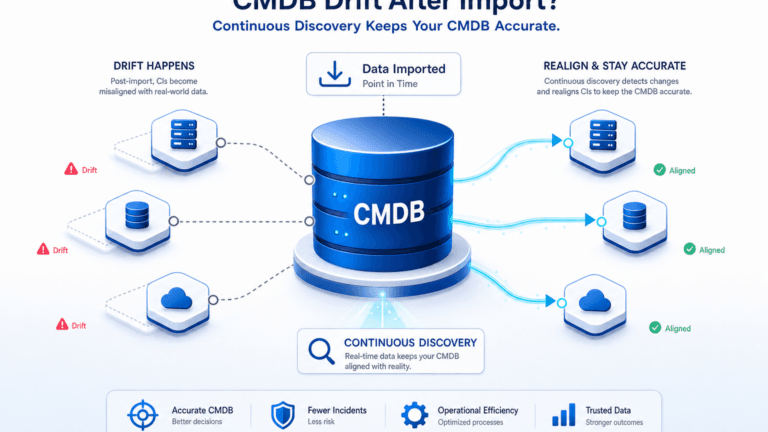
When the CMDB is accurate, ITSM processes run as designed. Incident tickets reach the right team with the right context. Change impact analysis reflects actual dependencies. Problem investigations trace to real root causes. When the CMDB is stale, every process that draws from it degrades. Regardless of how well the workflow itself is built.
Flexera’s 2025 State of ITAM report found that only 43% of organizations report complete visibility across their technology stack. According to itsm.tools’ 2026 ITSM community trends poll, 28% of practitioners cite ITAM as a top-three challenge for the year, alongside AI governance and value demonstration. The connection between asset data accuracy and ITSM performance is one the community recognizes. It rarely gets addressed at the process design level.
The question is how to keep CI records current without building a separate data maintenance team. Manual CMDB updates do not scale. Agent-based approaches require rollout across every managed host. Virima’s agentless IT discovery runs high-frequency discovery scans across on-premises environments and reconciles results directly against CMDB records. New devices create CI records automatically. Existing CIs update when their state changes. The ITSM processes drawing from that data get accurate input without requiring the service desk to maintain it. For a closer look at how that discovery-sourced data flows into daily ITSM workflows, see ITSM automation with Virima.
To see how discovery-sourced data connects to governed IT operations, explore Virima’s Trusted Runtime Truth approach.
How does CMDB accuracy affect ITSM performance? Every core ITSM process. Incident management, change management, and problem management. Draws from CI records in the CMDB. When those records are stale, routing slows, impact analysis misses dependencies, and root cause investigations follow outdated data. CMDB accuracy is the foundation that ITSM processes run on.
If you want to see where your own CMDB stands before the next incident or change window, CMDB Audit Essentials: Ensuring Data Accuracy and Compliance to audit the gap yourself.
ITSM platforms and what they share
ITSM is delivered through platforms that manage workflows, tickets, approvals, and service catalogues — the operational layer beneath any ITSM framework a team adopts. The most widely deployed platforms in enterprise IT are ServiceNow, Jira Service Management, Ivanti, HaloITSM, Xurrent, and Hornbill. Each handles the workflow layer differently. All share the same underlying dependency: the accuracy of the asset and configuration data feeding into their processes.
A change advisory board using ServiceNow runs on the CI data ServiceNow can access. A Jira Service Management incident ticket is only as accurate as the service relationship data behind it. The platform does not create the accuracy. It consumes it. Keeping that data current is a discipline that sits upstream of any ITSM tool selection. Choosing a better platform without fixing the data layer solves the wrong problem.
That is also why swapping platforms rarely fixes the underlying problem on its own. A team that migrates from Ivanti to ServiceNow, or from Hornbill to Jira Service Management, still needs accurate CI and dependency data on day one in the new tool. Virima’s CMDB reconciles discovery-sourced CI records against whichever ITSM platform a team already runs, so the data layer stays current whether or not the platform underneath it changes. That keeps the platform decision and the data accuracy decision separate, which is closer to how most enterprise IT teams actually want to make both calls. Enhanced Jira incident management: Virima’s ViVID™ for Jira Service Management then turn those reconciled dependencies into a continuously refreshed visual view instead of a diagram redrawn after every audit — the recurring discovery cadence, not just the platform-agnostic claim, is what keeps the data trustworthy over time.
Discovery surfaces the assets in an environment and how they connect; teams still define which CIs roll up into a given business service. That mapping step is a one-time setup exercise, not an ongoing manual burden, but it is worth naming honestly rather than implying full automation end to end.
Structured processes. Accurate data. Better IT.
ITSM frameworks define how IT services should be delivered. Platforms automate the workflows. But neither the framework nor the platform compensates for configuration data that does not reflect current reality. The teams that get the most from ITSM investment treat CMDB accuracy as a first-class operational discipline. Not a secondary concern addressed after the tool is in place.
Frequently Asked Questions
What is the difference between ITSM and a help desk?
What is the difference between ITSM and ITIL?
What are the most important ITSM processes for an enterprise IT team?
Why do ITSM programs underperform even with a modern platform?
How does Virima support ITSM teams?
Does Virima replace ServiceNow, Jira Service Management, or other ITSM platforms?
No. Virima’s discovery and CMDB reconcile CI data against whichever ITSM platform a team already runs — ServiceNow, Jira Service Management, Ivanti, HaloITSM, Xurrent, or Hornbill — without requiring a platform switch. Virima integrates with these platforms; it does not replace them.
Accurate ITSM outcomes start with accurate CI data, not a new platform. Download the ITSM Data Accuracy Checklist to audit whether your CMDB is holding your incident, change, and problem management processes back. CMDB Audit Essentials: Ensuring Data Accuracy and Compliance