Hospital Asset Management: Best Practices & Software

Asset management in hospitals is the practice of tracking, maintaining, and securing every clinical, biomedical, facilities, and IT asset a health system depends on — from infusion pumps to network servers. It directly affects patient safety, HIPAA compliance, and cybersecurity, because an asset that isn’t tracked can’t be maintained, patched, or accounted for in a risk analysis. This guide covers the best practices and software categories that keep all three asset types current.
Reviewed by Virima’s IT discovery and security team.
What asset management in hospitals covers
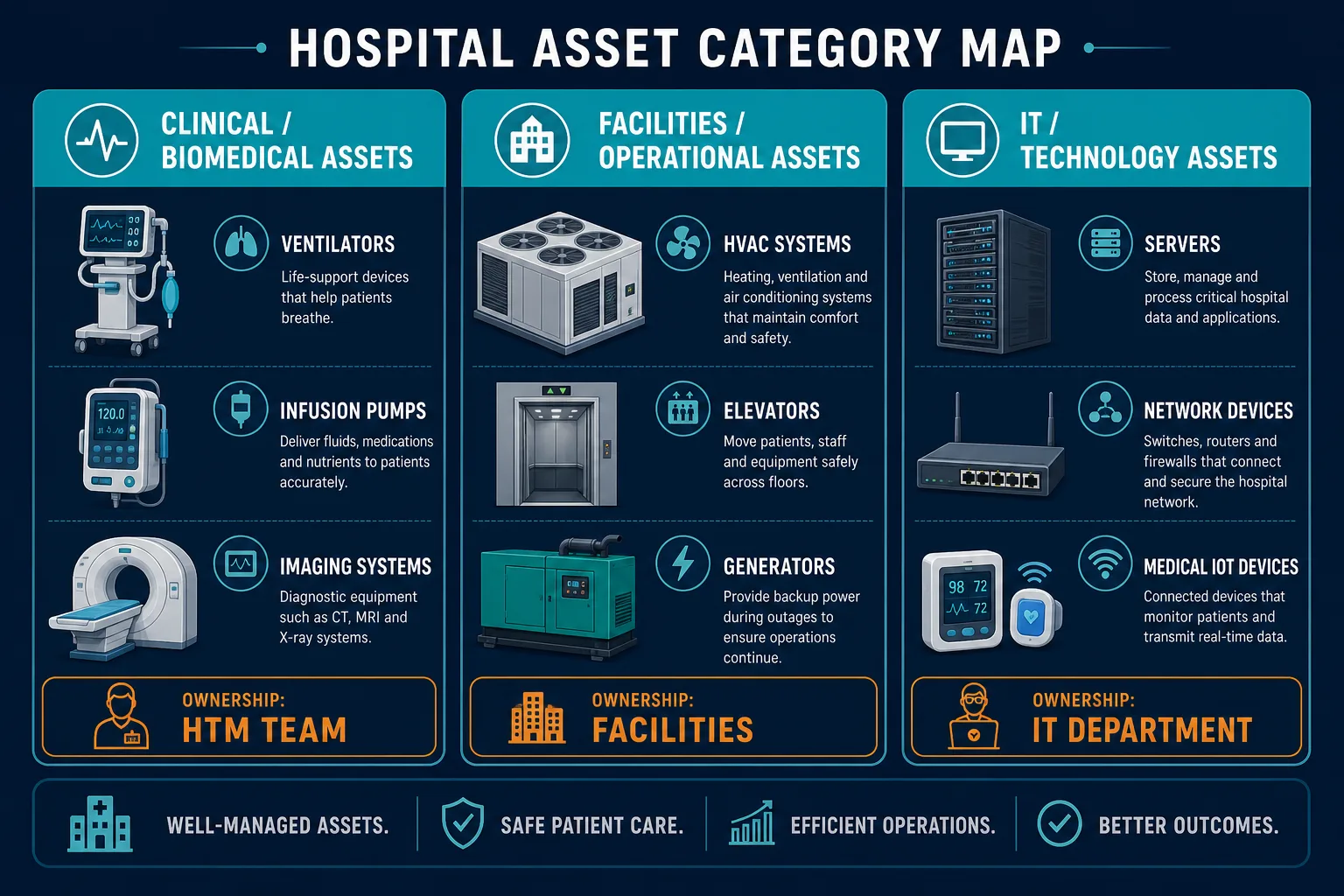
Asset management in hospitals applies to three distinct categories. Most organizations manage all three, but few manage them under a single coordinated framework.
Clinical and biomedical assets include patient-facing medical equipment: ventilators, infusion pumps, imaging systems, patient monitors, surgical instruments, and point-of-care devices. Biomedical or HTM (Healthcare Technology Management) teams track these for maintenance schedules, calibration, recall compliance, and inspection readiness.
Facilities and operational assets cover the physical infrastructure that keeps the hospital running: HVAC systems, elevators, sterilization equipment, generators, and building management systems, owned by facilities teams focused on maintenance cycles, warranty tracking, and capital replacement planning.
IT and technology assets include the servers, workstations, network devices, medical IoT devices, clinical applications, and cloud systems that hospital IT departments manage. This category has grown with the proliferation of connected medical devices and cloud-hosted clinical applications, and directly affects HIPAA compliance, cybersecurity posture, and clinical system uptime.
Each category has its own tools, teams, and governance models. Health systems that manage all three under one coordinated view see growing integration between biomedical and IT teams, particularly as connected medical devices blur the line between clinical equipment and network infrastructure.
What does asset management in hospitals include?
Hospital asset management covers three categories: clinical and biomedical assets (medical equipment, devices), facilities assets (HVAC, elevators, building systems), and IT and technology assets (servers, workstations, networked medical devices, clinical applications). Managing all three under one coordinated view is the best-practice direction, with growing integration between biomedical and IT teams as connected devices multiply.
Why asset management matters in hospitals
The stakes in hospital asset management are higher than in most industries. A missing infusion pump affects patient care. An unpatched server creates a HIPAA violation. An undocumented medical IoT device is an open attack surface.
Patient safety and equipment availability. Clinical teams depend on medical equipment being where the inventory says it is and calibrated on schedule. Lost, untracked, or overdue equipment creates real patient risk.
Regulatory compliance. Hospitals operate under overlapping compliance frameworks: the Joint Commission requires documented preventive maintenance for medical equipment, HIPAA requires knowing where electronic protected health information (ePHI) resides across every IT asset, and CMS conditions of participation add further equipment safety and maintenance documentation requirements. For a closer look at closing that ePHI asset gap, see Virima’s guide to CMDB Audit Essentials: Ensuring Data Accuracy and Compliance.
Cybersecurity and breach cost. Healthcare is the most expensive sector for data breaches by a wide margin: IBM’s Cost of a Data Breach 2024 report found healthcare organizations averaged $9.77 million per breach, more than double the cross-industry average. Most trace back to unmanaged or unpatched IT assets — see IT Asset Management Tools vs CMDB: Do You Need Both?.
Operational efficiency and capital planning. Accurate asset records drive smarter capital replacement decisions, reduce rental costs, and support accurate depreciation and insurance valuations.
Why is asset management important in hospitals?
Hospital asset management affects patient safety, regulatory compliance, cybersecurity, and capital planning simultaneously. Clinical equipment that is untracked or unmaintained creates patient risk. IT assets outside the inventory create HIPAA exposure and breach risk. IBM’s Cost of a Data Breach 2024 found healthcare breaches average $9.77 million, the highest of any industry.
Hospital asset management best practices
Foundational practices: tagging, ownership, and one inventory
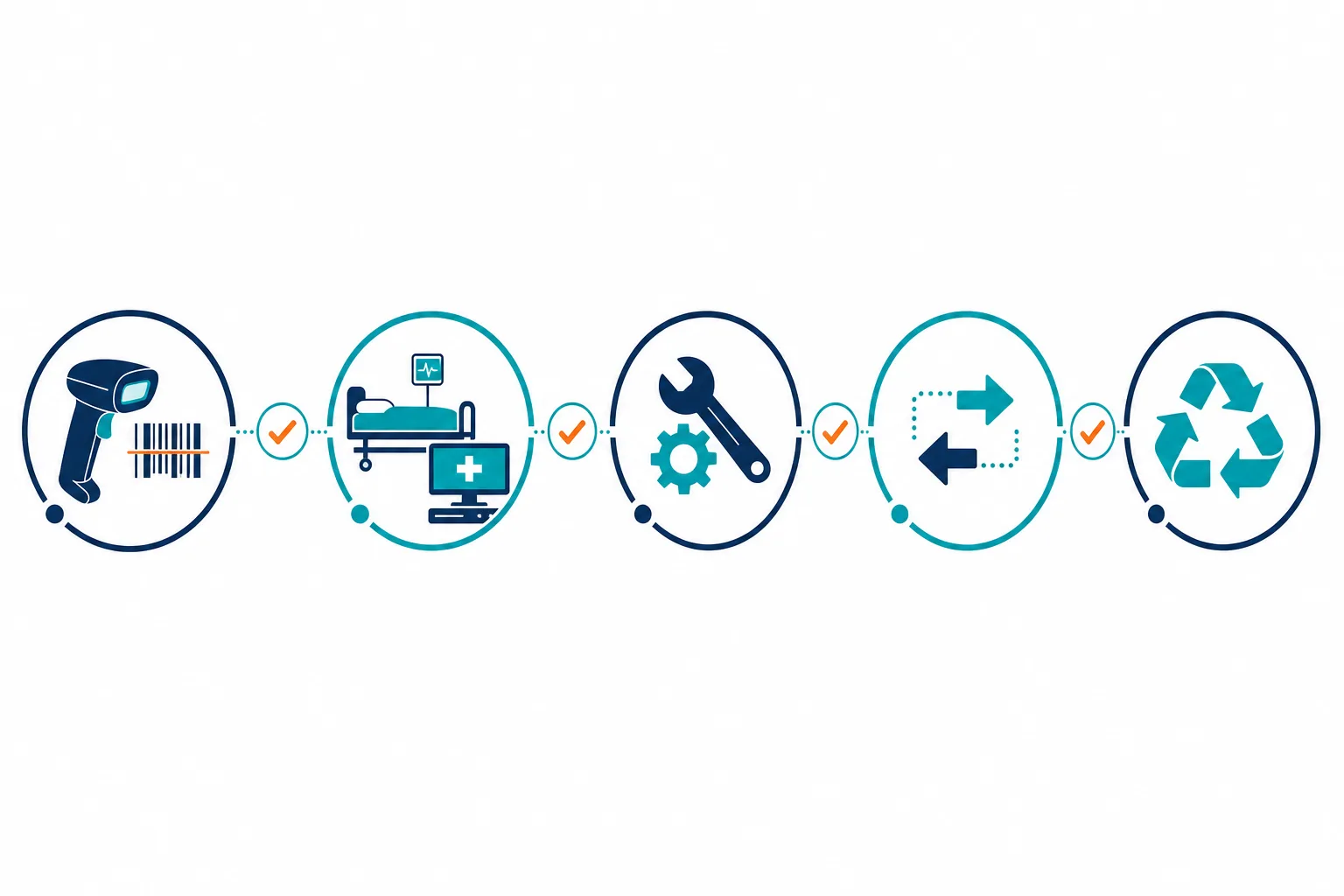
Tag everything at intake. Every asset — medical device, workstation, network switch, or connected monitor — should receive a unique identifier (barcode, RFID, or asset tag) at intake. Tagging after deployment is incomplete by definition.
Maintain a single, continuously updated inventory. Separate spreadsheets for clinical, facilities, and IT assets produce gaps and inconsistencies. The goal is one unified asset record each team can access with role-based views, kept current by automated discovery feeding a live CMDB instead of a static spreadsheet.
Define ownership for every asset. Each asset needs one accountable owner: a department, a team, or a named individual. Ownership drives accountability for maintenance schedules, patch status, compliance documentation, and end-of-life decisions. Shared ownership produces orphaned assets.
Ongoing practices: lifecycle, integration, and maintenance
Track the full asset life cycle. Hospital assets move through procurement, deployment, maintenance, transfer, and disposal. Skipped stages — no deployment ticket, no transfer handoff, no decommission record — create inventory gaps and compliance risk.
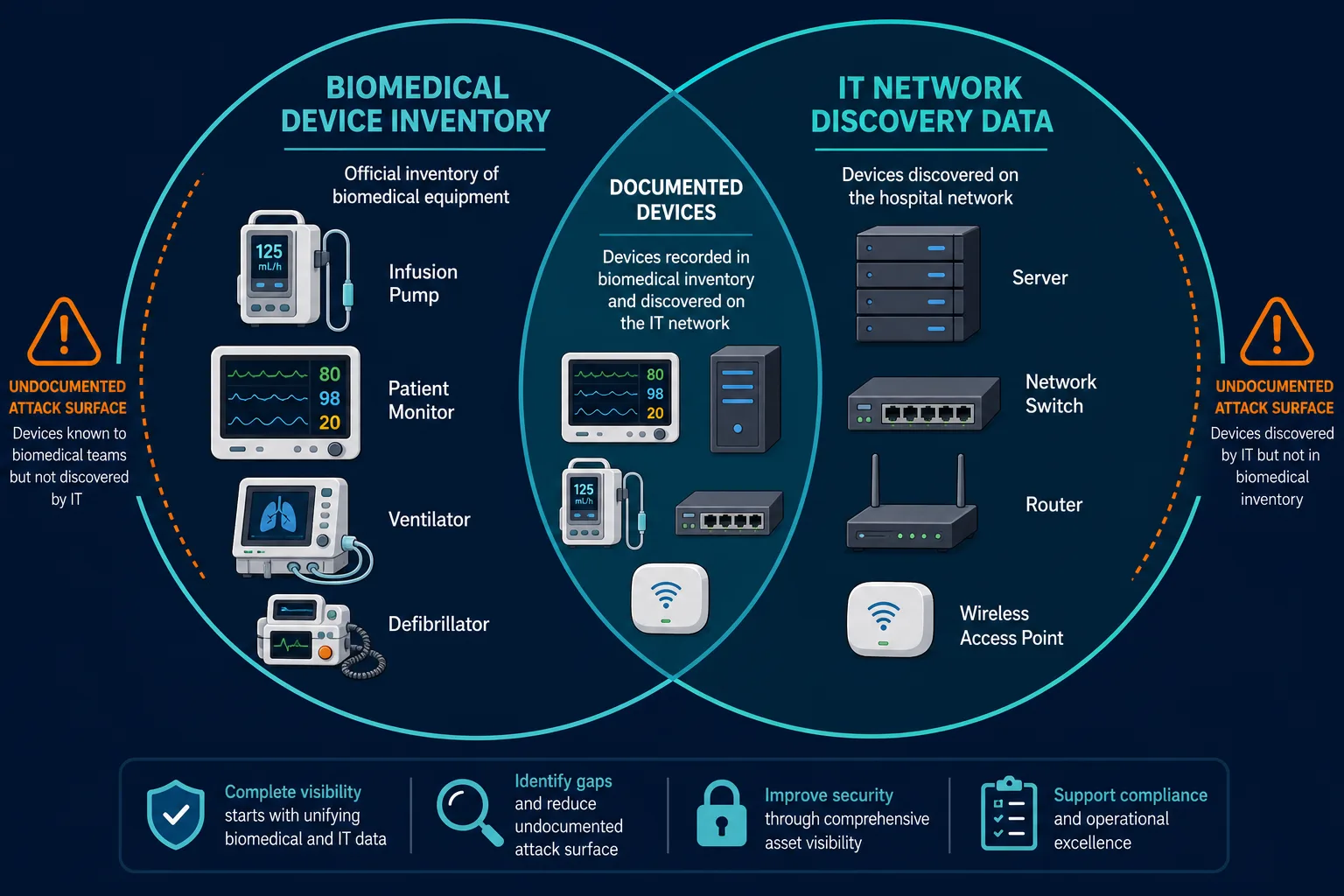
Integrate biomedical and IT records for connected devices. A networked infusion pump is simultaneously a clinical asset (biomedical) and an IT network asset (IT security), yet most hospitals track it in separate systems. Cross-referencing biomedical identifiers against network discovery data closes a significant security blind spot.
Plan preventive maintenance proactively. Clinical equipment requires manufacturer-specified maintenance intervals. Reactive maintenance increases downtime and creates compliance gaps; a scheduled program driven by accurate asset records reduces both.
What are the best practices for hospital asset management?
Tag assets at intake. Maintain a single updated inventory across clinical, facilities, and IT assets. Assign one owner to every asset. Track the full asset life cycle from procurement to disposal. Integrate biomedical and IT records for connected medical devices. Run preventive maintenance on schedule rather than reactively.
IT asset management in hospitals: the HIPAA dimension
IT asset management in hospitals carries a compliance requirement most other industries don’t face at the same severity: HIPAA.
Under HIPAA’s Security Rule, covered entities must conduct a risk analysis identifying where ePHI lives — every server, workstation, application, cloud service, or connected device that stores or transmits patient data. An asset not in the inventory is outside the risk analysis, and outside HIPAA compliance. A 2025 proposed update to the Security Rule (NPRM) would go further, requiring covered entities to maintain a written technology asset inventory and network map, reviewed and updated at least every 12 months — turning automated discovery from an efficiency gain into a compliance requirement.
The challenge is scale: a mid-sized health system may have tens of thousands of IT assets across campuses, clinics, and remote locations, and manual inventory cannot keep pace. Automated IT discovery is the only practical way to keep it accurate enough for HIPAA risk analyses.
IT Discovery uses agentless, API-based discovery across hospital IT environments to build a continuously refreshed asset inventory. Every discovered asset — server, endpoint, network device, or cloud resource — flows into the CMDB as a configuration item with its relationships intact, becoming the accurate, defensible asset record HIPAA risk analyses and compliance audits require.
To see how discovery-sourced asset data provides the operational foundation hospital IT teams need, explore Trusted Runtime Truth.
Connected medical devices: the asset management gap most hospitals have
The fastest-growing asset management challenge in hospitals is connected medical devices: patient monitors, infusion pumps, imaging systems, and telemetry devices now connect to hospital networks in growing numbers.
Most hospitals track these devices in two incomplete, disconnected ways: biomedical tracks them as clinical equipment, while IT may not know they exist on the network. The result is an undocumented attack surface at real scale: 99% of hospitals and healthcare delivery organizations manage connected medical devices with at least one known exploited vulnerability, and the average device carries 6.2 flaws, according to ORDR’s 2026 Medical Device Breach Statistics Report. Attacks on healthcare organizations climbed 45% year over year over the same period, per C2A Security’s aggregation of Check Point data.
These devices are among the most exploited entry points in healthcare cyberattacks — they typically run older operating systems, receive infrequent patches, and are rarely enrolled in endpoint management. During a connected-device incident, Virima’s ViVID™ service maps show the blast radius immediately, instead of leaving IT and biomedical teams to trace dependencies manually.
Closing this gap means cross-referencing network discovery data against biomedical inventory identifiers — devices on the network but missing from the biomedical inventory, or vice versa, need immediate attention. One health system’s discovery scan turned up 607 CMDB gaps tied to exactly this kind of undocumented device — see shadow IT discovery healthcare network.
Run this cross-reference yourself: the Virima earns “Vendor to Watch” for IT Asset Inventory and Service Management walks through matching biomedical and IT records step by step.
How should hospitals manage connected medical devices?
Hospitals should cross-reference IT network discovery data against biomedical inventory records. Devices that appear on the network but not in the biomedical inventory, or vice versa, represent undocumented assets and unmanaged attack surface. IT and biomedical teams need a shared or connected asset record, not two separate siloed inventories.
Hospital asset management software categories
No single platform covers all three hospital asset categories; most health systems run separate tools by category, with varying degrees of integration.
Computerized Maintenance Management Systems (CMMS) track preventive maintenance schedules, work orders, calibration records, and inspection documentation for clinical and facilities equipment. Common healthcare platforms include IBM Maximo, Accruent Verisae, and TMA Systems.
IT Asset Management (ITAM) platforms handle the IT infrastructure layer: hardware inventory, software licensing, patch status, life cycle tracking, and HIPAA compliance documentation. IT Asset Management built on discovery automation provide the most accurate inventories because they don’t depend on manual data entry.
CMDBs (Configuration Management Databases) provide the relationship layer for IT assets — not just what exists, but how assets connect and what breaks if one goes down. A CMDB is the foundation of HIPAA risk analysis and IT change management in hospital environments. Virima integrates with ServiceNow integration, Jira Service Management integration, Ivanti, HaloITSM, Virima + Xurrent Integration: Real-Time CMDB Data for Your ITSM Platform, and Hornbill ITSM, bringing CMDB-accurate asset data into the ITSM workflows hospital service desks already use.
IoT/OT asset visibility platforms address connected medical devices using passive network monitoring to discover and classify devices without disrupting clinical workflows, then feed that data into CMDB and ITAM platforms to close the biomedical-IT gap.
Know every asset. Protect every patient.
Every untracked device in a hospital is a maintenance gap, a compliance liability, and a potential attack surface — and a discovery-sourced, continuously updated inventory closes all three at once.