HaloITSM: Features, Pricing & Review 2026

| HaloITSM is an ITIL v4-aligned IT service management platform that packages every module — incident management, change control, CMDB, and AI-assisted triage — into a single per-agent price. Trusted by over 100,000 users across 75 countries, it supports both cloud-hosted and on-premises deployment. This guide covers its core features, pricing model, deployment options, and the integration that gives its CMDB discovery-driven accuracy. |
You’ve narrowed your ITSM shortlist and HaloITSM keeps appearing. It’s ITIL-aligned, packages every module into a single per-agent price, and has 25+ years of service desk experience behind it. What you need now is a straight read on what the platform does, how it prices, and where teams typically find they need an additional layer. This guide is most useful for IT Ops Managers and IT Directors at mid-market and enterprise organizations running a hybrid IT environment — often in the middle of a cloud migration, ITSM consolidation, or post-outage review. It covers HaloITSM’s core features, pricing model, deployment options, and the integration that makes its built-in CMDB significantly more reliable.
What is HaloITSM?
Every feature — incident management, change control, CMDB, self-service portal, and AI tools — comes included at a single per-agent price. It supports both cloud-hosted and on-premise deployment, and more than 100,000 users across 75+ countries rely on it daily.
- Developed by Halo, a UK-based software company, the platform has served IT service desks for over 25 years and now supports more than 100,000 users across 75+ countries. Its model is straightforward: every feature — incident management, change control, CMDB, self-service portal, AI tools, and more — comes included at a single per-agent price. There are no additional modules to unlock and no feature tiers that limit access for smaller teams.
- HaloITSM is built around full ITIL v4 compliance. Specifically, workflows follow ITIL practices structurally, rather than being retrofitted onto a generic ticketing system. HaloITSM supports both cloud and on-premise deployment, giving IT teams the choice of a fully managed hosted environment or full control over their own infrastructure.
- With a 4.6 rating on Gartner Peer Insights across 164 verified reviews, HaloITSM is a well-regarded option for mid-market and enterprise buyers evaluating ITSM platforms.
HaloITSM key features
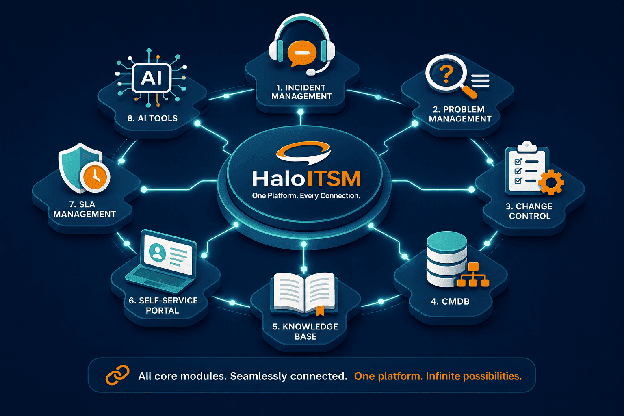
HaloITSM covers the full ITIL process stack in a single interface. Every item below comes included as standard, with no separate licensing required.
Incident management
HaloITSM’s incident management module handles ticket routing, SLA tracking, and workflow automation for service desk teams. Built-in AI tools triage and summarize incoming incidents, giving agents faster context without manual sorting. For teams connecting incident records to asset data, see how ITSM incident management links to CMDB accuracy in practice.
Problem management
The problem management module connects recurring incidents to root causes. IT teams can escalate from incident to problem, investigate systematically, and document resolutions so the same issues do not recur across the service desk. For a broader view of how IT visibility supports incident and problem management, see our practical guide on business service mapping.
Change control
HaloITSM’s change management capability gives teams a structured process for tracking, planning, and executing changes at any scale. Teams manage approvals, deadlines, and change documentation from a single view. For organizations where change accuracy affects downstream risk, pairing change workflows with an accurate CMDB directly reduces failed changes. See our guide on change risk intelligence.
Self-service portal
A fully customizable, white-label portal lets end users raise tickets, access knowledge articles, and request services without contacting the help desk directly. HaloITSM’s Emotion AI and Virtual Agent features handle common request routing, reducing first-contact volume before requests reach an agent queue.
SLA management
SLA groups, priority tiers, response windows, and escalation rules are configurable within the platform. Automated escalation notifications keep stakeholders informed when resolution targets are at risk.
CMDB and configuration management
HaloITSM includes a built-in Configuration Management Database (CMDB) for tracking configuration items (CIs) and visualizing dependencies between them. CI records connect to open incidents and planned changes, giving service desk agents asset context when a ticket arrives.In practice, the accuracy of those CI records depends on how the CMDB is populated — a question addressed directly in the section below.
Knowledge base
The knowledge base module converts resolved incidents into searchable articles. The system scopes content by user group, supports rich media formatting, and surfaces articles in the self-service portal or directly inside ticket workflows.
AI tools
HaloITSM includes AI-powered ticket triage, summarization, and categorization as standard. AI-assisted knowledge article generation draws from resolved incidents and internal documentation to build a knowledge base that improves as the service desk handles more requests. For a full breakdown of what works and what fails in AI in IT service management, see our practical guide.
HaloITSM CMDB: built-in tracking and the discovery layer
HaloITSM’s built-in CMDB tracks assets and maps relationships between configuration items. In stable environments, manual imports keep CI data current. In hybrid IT — where cloud workloads, containers, and remote endpoints change frequently — CI records can age between updates. A Gartner survey (2024) found that only 25% of enterprises derive meaningful value from their CMDB, with stale CI data as the primary obstacle.
- HaloITSM’s CMDB tracks assets and maps relationships between configuration items. Teams log incidents and problems against specific CIs, identify systemic patterns, and get dependency context directly inside ticket workflows.
- Where most ITSM-native CMDB tools face a practical limitation is keeping CI data current at operational frequency. Manual imports and scheduled scripts work well in stable environments. In hybrid IT environments — where cloud workloads, virtual machines, containers, and endpoints change frequently — CI records can age out between updates, creating gaps that affect incident response and change approval quality. When a server is replaced overnight and no one updates the CMDB, the next morning’s change request is already flying blind.
- A Gartner survey (2024) found that only 25% of enterprises receive meaningful value from their CMDBs, with stale or incomplete CI data cited as the primary reason.
- Successful CMDB implementation depends on CI data quality, and CI data quality depends on how that data is collected. Understanding the difference between agentless and agent-based discovery methods helps teams choose the right approach for their environment. A CMDB populated through high-frequency discovery cycles gives every change request, incident, and impact analysis a starting point that reflects what actually exists.
- This is where Virima’s integration with HaloITSM adds direct value. Virima performs discovery-driven scans across on-premise and cloud assets, then pushes discovery-sourced CI data directly into the HaloITSM CMDB. The result is a CMDB that HaloITSM users can trust, populated from what Virima found in the environment rather than from what someone remembered to update.
- When a CMDB is grounded in discovery-sourced data, every incident, change, and impact analysis runs on Trusted Runtime Truth — the condition where IT operations data reflects what actually exists.
HaloITSM pricing
HaloITSM charges per named agent per month, with all modules included as standard. Pricing is not publicly listed and varies by agent count, deployment type, and contract length. Third-party resellers report starting prices around $49 per agent per month. Contact Halo directly for accurate enterprise or volume pricing at usehalo.com.
HaloITSM uses a per-named-agent pricing model. Unlike platforms that gate features behind tiers, HaloITSM includes every module — incident management, change control, CMDB, AI tools, and all others — at a single per-agent rate. Pricing is quote-based and scales with agent count, deployment type, and contract length. For enterprise teams with large agent populations, Halo also offers a flat-rate unlimited-user plan. Contact usehalo.com directly for enterprise pricing.
The all-inclusive model is straightforward for procurement: there are no separate fees for AI tools, CMDB access, or change management modules that some competing platforms charge for individually. As agent headcount grows, pricing scales predictably with named agents, not with the number of end users or assets managed.
Cloud deployment is hosted and managed by Halo. On-premise deployment gives teams full control over data residency and infrastructure, with access to all platform features and Halo’s expert support in both cases.
HaloITSM review: strengths and practical considerations
HaloITSM earns strong marks from verified buyers: 4.7 out of 5 on Capterra (44 reviews), 4.6 on Gartner Peer Insights (164 reviews), and 4.7 on G2 (163+ reviews). Customer reviews highlight strong platform configurability and responsive implementation support.
What HaloITSM does well
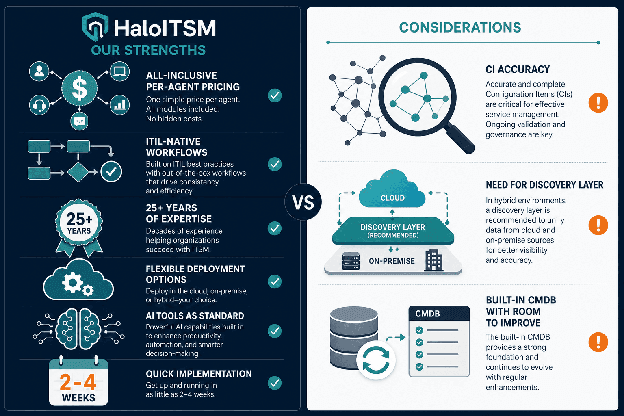
HaloITSM’s all-inclusive model removes the module-by-module negotiation common with larger ITSM vendors. Every capability is available from day one, including AI tools, without needing to unlock additional tiers or purchase add-ons.
The platform’s ITIL alignment is structural rather than cosmetic. Workflows follow ITIL practices out of the box rather than requiring significant configuration work to conform to ITIL standards. For teams adopting ITIL for the first time or standardizing across a growing IT organization, this shortens onboarding time significantly.
Implementation typically runs two to four weeks — significantly shorter than the six to eighteen month timelines typical of larger ITSM suites like ServiceNow. For teams that cannot afford a lengthy onboarding programme, this is a genuine time-to-value advantage.
A 25-year track record supports that assessment. Customer reviews on G2 and Capterra cite strong platform configurability and quality implementation support from Halo’s team.
Where teams typically add a layer
HaloITSM’s CMDB is designed to serve as a centralized hub for configuration data. Organizations with complex hybrid IT environments — spanning multiple cloud providers, virtual infrastructure, and remote endpoints — often add a dedicated discovery layer to keep CI records current at the frequency that operational decisions require.
Configuration and change-management failures account for a significant share of major IT outages, according to the Uptime Institute Annual Outage Analysis 2024. A CMDB built from live discovery data rather than manual input directly reduces that exposure. See how IT teams are addressing this challenge with a single pane of glass approach to IT operations.
Comparing HaloITSM against other platforms? Our 2026 ITSM comparison guide puts HaloITSM alongside ServiceNow, Jira Service Management, Ivanti, Xurrent, and Hornbill — feature by feature. Read the full comparison.
HaloITSM integrations
HaloITSM connects with a wide range of enterprise tools, including Microsoft 365, Slack, Okta, Jira, Splunk, and Active Directory. For an IT team consolidating toolchains, HaloITSM’s integration library covers most common enterprise applications without custom development. Understanding how ITOM and ITSM work together can help IT directors get the most from those integrations.
For CMDB enrichment and IT discovery, HaloITSM partners with Virima directly. Customers can purchase Virima through HaloITSM, making it one of the few ITSM platforms where the path to a discovery-driven CMDB runs through the same procurement relationship as the service desk itself.
For teams comparing HaloITSM against other platforms, our 2026 ITSM comparison guide covers it alongside ServiceNow, Jira Service Management, Ivanti, Xurrent, and Hornbill.
High-frequency discovery across hybrid IT
Virima performs high-frequency discovery cycles across on-premise and cloud assets using agentless IP-based scanning, supplemented by over 140 extendable probes. API integrations cover hypervisors, cloud platforms, containers, orchestration layers, network devices, and monitoring tools. Discovery data flows into the HaloITSM CMDB directly, maintaining CI accuracy without manual intervention between cycles.
ViVID™ service maps with HaloITSM ticket overlays
Virima’s ViVID™ service maps build visual dependency views that show infrastructure relationships, application dependencies, and system communications across the IT environment. HaloITSM records — open incidents and planned changes — appear as overlays on the map. When a change request arrives, the service desk can see exactly what else that change touches before approving it, giving change managers the impact context that a ticket alone cannot provide.
A no-code integration
Setup runs entirely through both platforms’ user interfaces — no developer involvement, no custom scripts, and no change-control tickets to IT for a middleware integration. Your team can have the connection live without a dedicated implementation project. See full setup details on the Virima HaloITSM integration page.
Purchase Virima through HaloITSM
HaloITSM customers can purchase Virima directly through their Halo contract, making procurement straightforward for teams already working in a Halo contract cycle.
Getting full value from HaloITSM in a hybrid IT environment
HaloITSM gives IT teams an ITIL-aligned foundation that covers every service management discipline at a predictable per-agent price. Its all-inclusive model, deployment flexibility, and 25-year implementation track record make it a strong fit for mid-market and growing enterprise IT organizations that want ITSM depth without the cost complexity of larger platforms.
The area where most HaloITSM deployments benefit from an additional layer is CMDB accuracy. As IT environments grow to include cloud workloads, virtual infrastructure, and remote endpoints, keeping CI records current through manual processes becomes increasingly difficult. Understanding the relationship between CMDB and IT asset management is a useful starting point for teams planning that expansion. That’s where the discovery layer becomes critical.
Pairing HaloITSM with Virima addresses this directly. The CMDB becomes a regularly refreshed, discovery-driven foundation — one the entire service desk can rely on for incident response, change approvals, and audit readiness. A CMDB built from live discovery data does more than improve incident resolution times. It gives every change request, audit, and impact analysis a starting point that reflects what actually exists.
Move faster. Act safely with a discovery-driven CMDB.
Get live, explainable runtime truth across your entire estate — without replacing your existing ITSM stack.
Frequently Asked Questions
What is HaloITSM used for?
HaloITSM is used by IT service desk teams to manage incidents, problems, changes, service requests, and assets in a single ITIL-aligned platform. Common use cases include service desk operations, change management, CMDB maintenance, and SLA tracking across mid-market and enterprise IT organizations.
Does HaloITSM support on-premise deployment?
Yes. HaloITSM supports both cloud-hosted and on-premise deployment. Teams with data residency requirements or infrastructure compliance constraints can deploy HaloITSM on their own servers and retain full access to every platform feature.
What are the main HaloITSM alternatives?
Common alternatives to HaloITSM include ServiceNow, Jira Service Management, Ivanti, Xurrent, and Hornbill. Each platform has different strengths in module depth, pricing models, and ecosystem integrations. Our 2026 ITSM comparison guide covers a full side-by-side breakdown.
How does Virima integrate with HaloITSM?
Virima integrates with HaloITSM through a no-code connection that pushes discovery-driven CI records directly into the HaloITSM CMDB. ViVID™ service maps then overlay HaloITSM ticket data — open incidents and planned changes — on a live dependency map. This gives change managers impact context and speeds up incident root cause investigation, with no custom scripting required.
How long does HaloITSM take to implement?
HaloITSM implementations typically take two to four weeks from contract signature to go-live, depending on team size, integration complexity, and deployment type. Halo provides expert onboarding support for both cloud-hosted and on-premise deployments. This timeline is significantly shorter than enterprise ITSM platforms where implementations commonly require six months or more.