What Is IT Asset Disposition (ITAD)? Process & Best Practices

Every year, organizations retire thousands of IT assets: laptops, servers, network gear, mobile devices. Most have a clear process for what happens when a device arrives. Few have one for what happens when it leaves. What is IT asset disposition (ITAD)? It’s the structured process of decommissioning, sanitizing, and retiring IT assets once they reach end of life, covering everything from data wiping to resale, recycling, or destruction. That gap between arrival and retirement is where data breaches happen, compliance fines land, and budget quietly disappears. This guide walks through the ITAD process step by step, and the practices that keep it defensible.
What Is IT Asset Disposition (ITAD)?
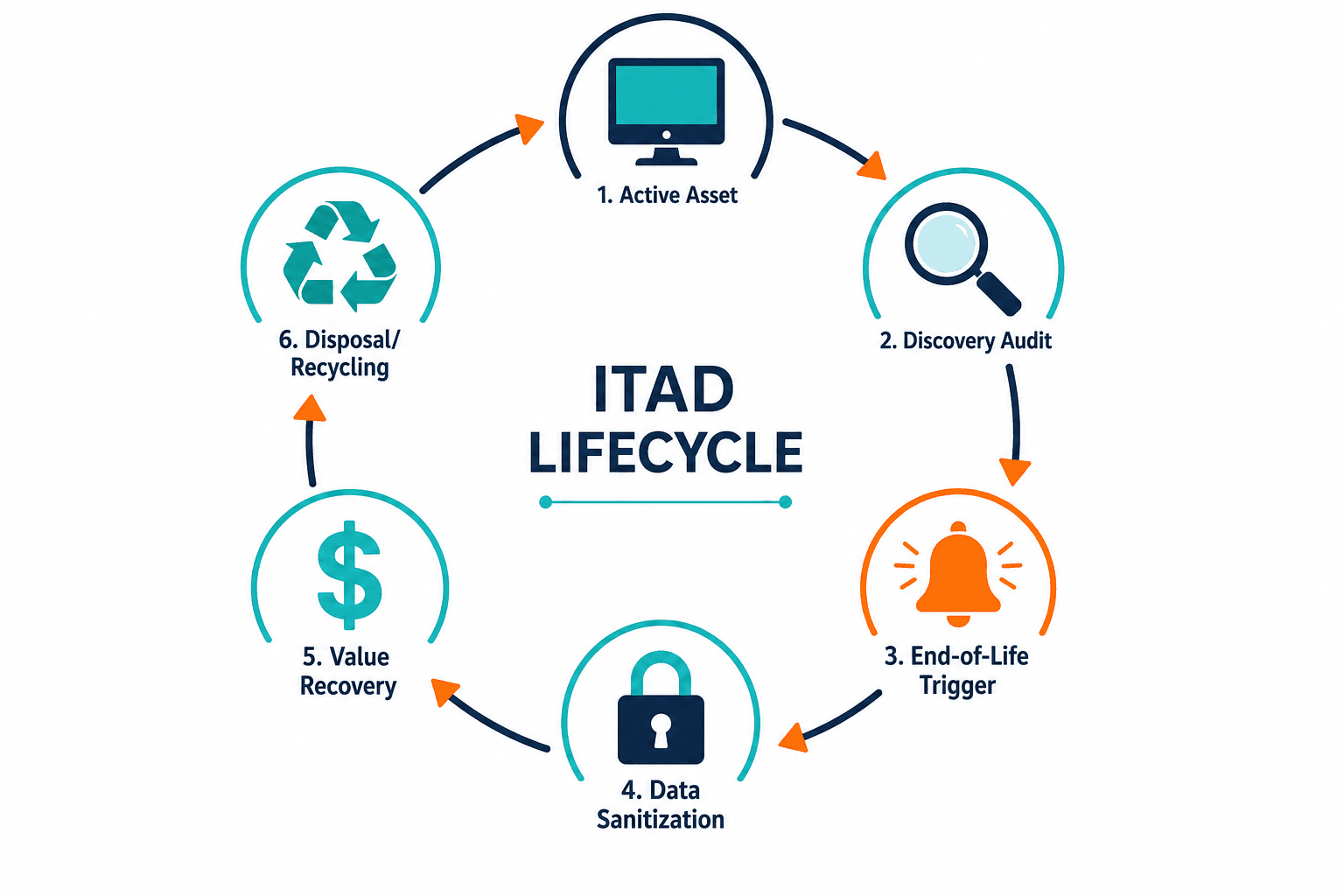
IT asset disposition is the structured process organizations use to decommission, sanitize, and retire IT assets, hardware and the data on it, once those assets reach end of life. It covers data classification and sanitization, valuation, resale or donation, recycling, and certified destruction, along with the documentation that proves each step happened.
ITAD is a discipline, not a task you bolt onto the end of a hardware refresh. A single laptop moving through disposition touches data security, environmental compliance, financial recovery, and audit reporting at once. Treating it as an afterthought is how residual data ends up on a resold drive, or how a retired server disappears from the books without anyone noticing.
Ownership is usually shared. The IT Asset Manager typically runs the process day to day, IT Operations executes the physical decommission, Procurement tracks the financial and vendor side, and Legal or Compliance signs off on data handling and retention requirements. When none of those groups owns it clearly, assets stall in limbo, still listed as active, occasionally still connected, with nobody accountable for what happens next.
In short: IT asset disposition (ITAD) is the end-to-end process of retiring IT hardware safely and compliantly, from data sanitization through resale, recycling, or destruction, with a documented chain of custody at every step.
Why ITAD Matters: Risk, Compliance, and Cost
Skipping or rushing ITAD creates exposure across four fronts.
Data security risk. Devices retired without proper sanitization can carry residual data long after they leave the building. An improperly wiped hard drive can cause a breach that costs the same as any other breach: the global average cost of a data breach reached $4.44 million in 2025, according to IBM’s Cost of a Data Breach Report. Retired hardware is not a lower-stakes attack surface just because it’s no longer in production.
Regulatory exposure. GDPR Article 5 requires data minimization and storage limitation, meaning personal data on a decommissioned device is still your liability. HIPAA treats PHI on a retired device as a covered entity’s responsibility until it’s provably destroyed. SOX requires asset records to be accurate, so a disposed asset still listed as active creates audit exposure that has nothing to do with security and everything to do with bad bookkeeping.
Environmental liability. The world generated 62 million tonnes of e-waste in 2022, and only 22.3% of that was documented as properly collected and recycled, leaving roughly $62 billion in recoverable resources unaccounted for, per the UN’s 2024 Global E-waste Monitor. That volume is projected to reach 82 million tonnes by 2030. Organizations that skip certified recycling channels are contributing directly to that gap, and increasingly, regulators are watching for it.
Financial leakage. Ghost assets, hardware still on the books that was quietly retired, replaced, or lost, distort budget planning and depreciation schedules. Assets that still hold resale or reuse value often go unclaimed simply because nobody has an accurate count of what’s actually being retired.
In short: improper IT asset disposition creates four kinds of exposure at once: data breaches from unsanitized devices, regulatory penalties under GDPR, HIPAA, and SOX, environmental liability tied to e-waste volume, and financial leakage from ghost assets nobody tracked to end of life.
The IT Asset Disposition Process: Step by Step
A defensible ITAD process runs through seven stages. Skipping any one of them is usually where the gap opens.
Step 1: Asset Identification and Inventory Audit
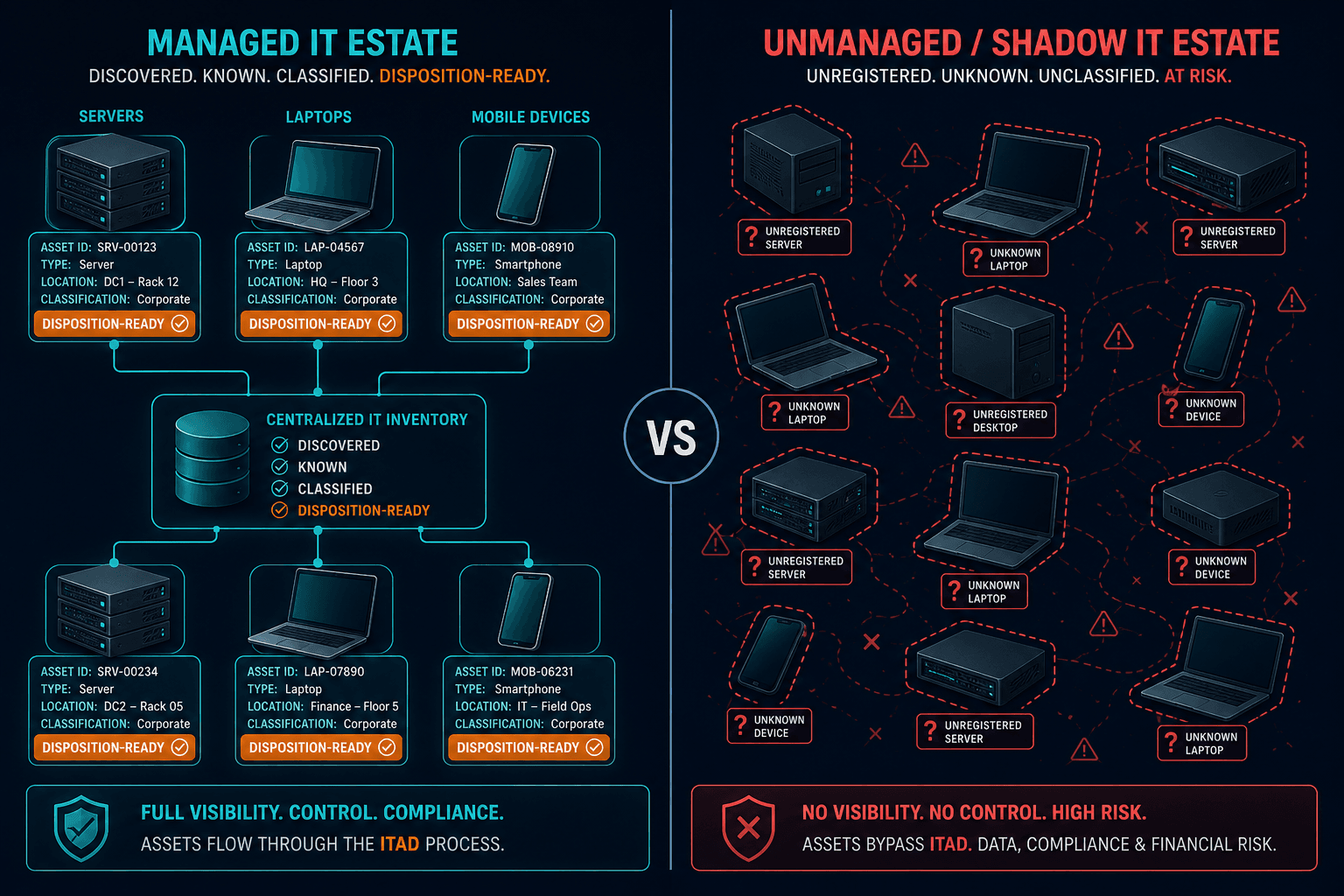
Before anything can be dispositioned, it has to be found. This is where most ITAD programs quietly fail: an asset that was never registered, a laptop issued outside procurement, a cloud workload nobody logged, simply never enters the disposition queue at all. It sits unaccounted for until someone stumbles on it, or worse, until it’s the subject of a breach investigation. Picture a mid-sized IT team running its annual audit: three laptops issued directly by a department outside procurement’s approval chain turn up mid-review, still connected to the VPN, never logged in any system of record. That’s not an edge case — it’s the default state of any inventory that isn’t continuously discovered. Disposition decisions are only as good as the inventory behind them. Trusted Runtime Truth page explains how discovery-sourced asset data closes this gap before assets reach end of life.
Step 2: Data Classification
Not every asset carries the same risk. Classify what’s on each device, sensitive customer data, regulated PHI, source code, before deciding a sanitization method. This step determines whether a drive needs a single wipe or physical destruction.
Step 3: Data Sanitization
Wiping, degaussing, or physical destruction, matched to the classification from Step 2. NIST SP 800-88, “Guidelines for Media Sanitization,” is the standard most auditors and ITAD vendors reference directly. Don’t paraphrase your sanitization policy against a lesser standard when NIST 800-88 is the one your auditors will ask about.
Step 4: Asset Valuation
Determine whether an asset has resale, donation, or scrap value. This is also where financial leakage gets caught: a laptop or server that skips a valuation review often has its residual value scrapped along with the hardware, instead of recovered, simply because nobody checked before it left the building.
Step 5: Vendor Selection
Work with a certified ITAD provider, R2 or e-Stewards certified specifically, not just a generic recycler. Certification is what makes the chain of custody defensible if a regulator or customer ever asks where a device ended up.
Step 6: Chain of Custody Documentation
Every asset needs a certificate of destruction or a documented transfer of ownership. Without it, “we recycled it” is an unverifiable claim, not an audit trail.
Step 7: Environmental and Regulatory Reporting
Close the loop with reporting that ties back to the original asset record, so ITAD outcomes are traceable from the CMDB entry through to final disposition.
ITAD Best Practices
Maintain a continuously refreshed, discovery-sourced asset inventory, not a point-in-time spreadsheet. A spreadsheet updated quarterly is already stale by the time an asset hits end of life. An inventory built from active discovery reflects what’s actually in the environment, not what was true last audit cycle.
Define a formal end-of-life policy with clear triggers. Age, failure rate, and vendor support end dates should all automatically flag an asset for disposition review, not wait for someone to notice it.
Check service dependency before decommissioning. Retiring a server that a production service quietly depends on causes an unplanned outage, not a clean disposition. Mapping which services rely on an asset before pulling the plug turns a guess into a documented decision.
Work only with R2 or e-Stewards certified ITAD vendors. Certification is the baseline for defensible chain of custody, not an optional upgrade.
Require a certificate of destruction for every asset. This is an audit requirement, not a nice-to-have, and it should be non-negotiable regardless of asset value.
Automate ITAD triggers inside your existing ITSM workflow. When an asset crosses its age or support threshold, a ticket should open automatically, so disposition starts from a system record instead of someone’s memory. Virima IT asset lifecycle management guide goes deeper on structuring lifecycle policy around these triggers.
In short: the best ITAD programs treat disposition as the last stage of a lifecycle policy, not a standalone cleanup project, triggered by data, not by whoever remembers to ask.
ITAD Compliance: Key Standards and Regulations
A handful of standards and regulations govern what a defensible ITAD process actually requires:
- NIST SP 800-88 sets the media sanitization guidelines most auditors treat as the de facto standard for wiping, purging, or destroying data-bearing devices.
- GDPR Article 5 requires data minimization and storage limitation, meaning personal data on a retired device remains your organization’s liability until it’s provably destroyed.
- HIPAA holds covered entities responsible for PHI on decommissioned devices, disposition doesn’t end that responsibility, proper sanitization does.
- SOX requires accurate asset records; a “ghost asset” still listed as active after disposition creates audit exposure independent of any security risk.
- R2 and e-Stewards are the two certification standards for ITAD vendors themselves, covering both data security and environmental handling.
In short: ITAD compliance rests on one sanitization standard (NIST SP 800-88), three overlapping data-liability regulations (GDPR, HIPAA, SOX), and two vendor certifications (R2, e-Stewards) that verify a disposition partner meets chain-of-custody and environmental documentation requirements.
How Virima Supports ITAD Readiness
Virima isn’t an ITAD vendor, and it doesn’t compete with certified disposition providers. Virima ensures the ITAD process starts from an accurate asset record instead of a guess.
For IT Ops teams managing a hybrid estate of a few thousand devices across ServiceNow, Jira Service Management, or a similar ITSM stack, this is exactly the gap where audits get flagged.
Virima’s agentless, agent-based, and API-based discovery finds assets across the environment before they reach end of life, including unagented endpoints, cloud workloads, and shadow IT that was never formally registered. That matters because an asset that was never discovered never enters the disposition queue in the first place.
Before a device gets decommissioned, ViVID™ service maps show which services and dependencies rely on it, so IT teams can see the likely impact of retiring an asset before they pull the plug rather than finding out after an outage. Those maps reflect service definitions your team provides or imports, giving disposition decisions real dependency context instead of a blind guess.
That discovery-sourced asset data flows into the major ITSM platforms IT teams already use — including ServiceNow, Jira Service Management, and Ivanti — so ITAD tickets are triggered against a regularly refreshed asset record rather than a spreadsheet nobody has touched since the last audit.
Achieve IT resilience with asset discovery and service mapping to see where ghost assets might be hiding in your environment before they become an ITAD problem.
ITAD Done Right Starts With Knowing What You Own
You can’t dispose of what you don’t know you have. Every gap in an ITAD process, an unregistered laptop, a ghost server, a shadow cloud instance, traces back to the same root cause: an asset that was never accurately tracked in the first place. Get the inventory right, and the rest of the process, sanitization, valuation, certified disposal, documentation, has something solid to build on.
Achieve IT resilience with asset discovery and service mapping to see how discovery-sourced asset data keeps your organization disposition-ready before assets ever reach end of life.