HIPAA & FDA 21 CFR Part 11 Compliance via CMDB for Boston Biotech and Pharma Teams

Kendall Square occupies about one square mile of Cambridge, Massachusetts, and holds the densest concentration of biotechnology and pharmaceutical operations in the world. Moderna, Biogen, and Takeda anchor it, the Broad Institute and MIT ring it, and hundreds of earlier-stage biotechs fill the space between. The regulated environment inside those buildings runs on the lab bench and the manufacturing floor. Laboratory information management systems (LIMS), electronic lab notebooks (ELN), instrument-attached workstations, quality management systems, and manufacturing execution systems (MES) hold the records that decide whether a therapy can be trusted.
Massachusetts adds a layer on top of any federal rule. The state data security regulation, 201 CMR 17.00, requires organizations holding personal information about a Massachusetts resident to maintain a written information security program (WISP), to account for where that information resides across paper and electronic systems, and to encrypt it in transit and on portable devices. Knowing where regulated data lives is the precondition the regulation sets before protection begins.
The same organizations operate under the Food and Drug Administration (FDA) electronic records rule, 21 CFR Part 11. Part 11 defines when the FDA accepts electronic records and signatures as trustworthy equivalents to paper, and it applies whenever a system creates, modifies, or stores records that an underlying FDA regulation already requires. Its controls are specific: validated systems, secure time-stamped audit trails recording who did what and when, access limited to identified users, and computer systems available for FDA inspection at any time.
The Health Insurance Portability and Accountability Act (HIPAA) reaches these organizations less uniformly, and the line is worth drawing precisely. HIPAA binds covered entities, meaning health plans, clearinghouses, and providers, along with the business associates that handle protected health information on their behalf. A biotech working only with de-identified preclinical data can sit outside HIPAA, its records governed by FDA predicate rules alone. The obligation attaches once identifiable participant health information enters the environment, through a clinical trial run with a hospital partner, a data-handling role performed for a covered entity, or a research unit inside a hybrid entity. Because Kendall Square biotechs work so closely with Mass General Brigham, Dana-Farber, and Boston Children’s, most organizations at clinical stage cross that line and carry HIPAA and Part 11 together.
Both regimes converge on one operational demand. When the FDA inspects, or when the Office for Civil Rights (OCR) opens a breach investigation, each measures the same thing: what the environment actually contained at the moment under examination. An asset record that stays current and defensible at any point in time is the compliance parameter both regulators apply.
What sits in scope inside a Kendall Square lab
The compliance surface in a life sciences environment extends well past servers and laptops. A single lab runs sequencers, mass spectrometers, and chromatography systems, each tethered to a control workstation that stores raw data. Freezer and environmental monitoring sensors track sample integrity around the clock. LIMS and ELN platforms carry experimental records, while quality and manufacturing systems govern batch production and release. Most of this runs across a hybrid estate, with on-premise instrument networks connected to cloud workloads in AWS and Azure, and vendor-managed systems and contract research organization (CRO) connections extend the surface into infrastructure the organization does not directly control. Every one of these components can create, store, or transmit a regulated record, which places it inside the inventory both the FDA and HIPAA expect an organization to maintain.
See how Virima’s discovery-sourced runtime truth keeps life sciences asset records defensible under HIPAA, Part 11, and state compliance requirements
Where HIPAA attaches, and where it stops
The distinction between a covered entity and a business associate decides how much of HIPAA applies. A preclinical biotech studying compounds in cell lines and animal models generates data that HIPAA does not govern, because no identifiable human health information is involved. That same organization enters HIPAA’s scope the moment it handles protected health information for a covered entity, most often as a business associate under a signed business associate agreement (BAA) with a hospital or health system partner. A clinical-stage biotech running trials through Mass General Brigham or Dana-Farber typically signs such an agreement, and the BAA carries direct HIPAA Security Rule obligations, including the requirement to maintain an accurate inventory of the systems that touch that data. Some organizations operate as hybrid entities, where one division falls under HIPAA and another does not, which turns the boundary between regulated and unregulated systems into an internal mapping problem rather than a corporate-level yes or no. Drawing that boundary correctly is the first compliance task, because an inventory that treats every system as in-scope wastes effort, and one that misses a regulated system fails an audit.
The Part 11 layer, and an inspection that arrives unannounced
Part 11 applies a second, overlapping set of demands to the same systems. It requires that electronic records stay attributable, legible, contemporaneous, original, and accurate, and that the systems holding them remain validated and access-controlled. Enforcement has sharpened. In the second half of 2025 the FDA issued 327 warning letters, a 73 percent increase over the same period in 2024, with data integrity and quality-system failures the leading citations. In September 2025 the FDA finalized its Computer Software Assurance guidance, moving software validation toward a risk-based model that ties validation effort to the impact a system has on record integrity. Both developments raise the same practical demand at inspection time: an organization must show which systems hold regulated records, that those systems are validated, and that their audit trails are intact. An FDA investigator schedules around no annual review cycle. The state the inspector documents is the state the environment is in on the day of the visit.
One asset record, three overlapping demands
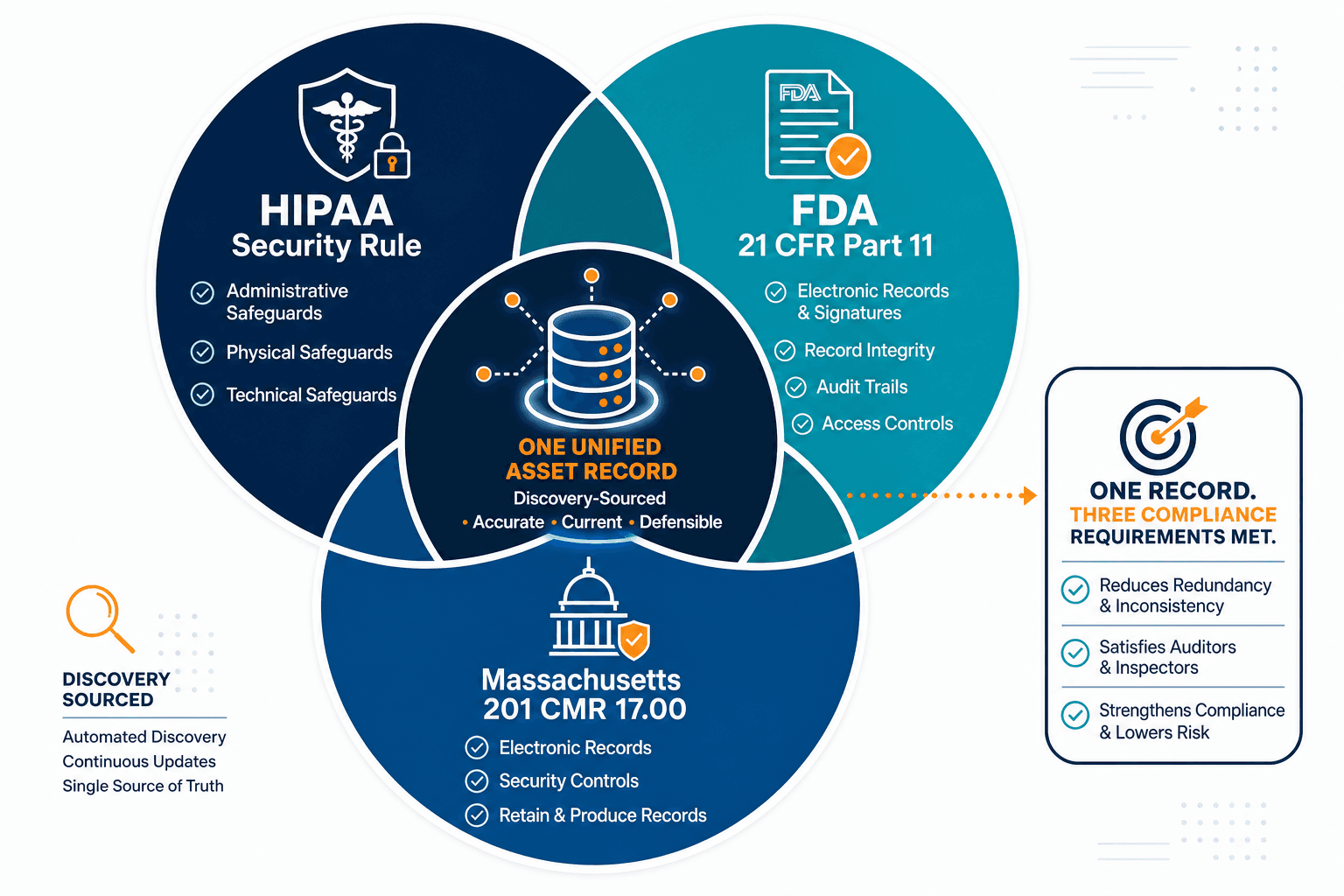
The federal direction reinforces what Massachusetts already requires. The proposed HIPAA Security Rule update, published as a Notice of Proposed Rulemaking (NPRM) on January 6, 2025, would make a written technology asset inventory and a network map explicit requirements, reviewed at least every 12 months and after any operational change affecting electronic protected health information (ePHI). That rule remains proposed rather than final, and its inventory requirement mirrors the accounting obligation 201 CMR 17.00 already imposes on any Boston organization holding a Massachusetts resident’s personal information. A Kendall Square biotech therefore answers to three overlapping demands for the same underlying record: the state WISP obligation, the federal HIPAA inventory expectation, and the FDA Part 11 validation and inspection requirements. A separate inventory built for each regulator multiplies the work and lets the three versions drift apart. A single accurate record of what exists, where it sits, and what data it touches satisfies all three.
The distance between the last review and the inspection
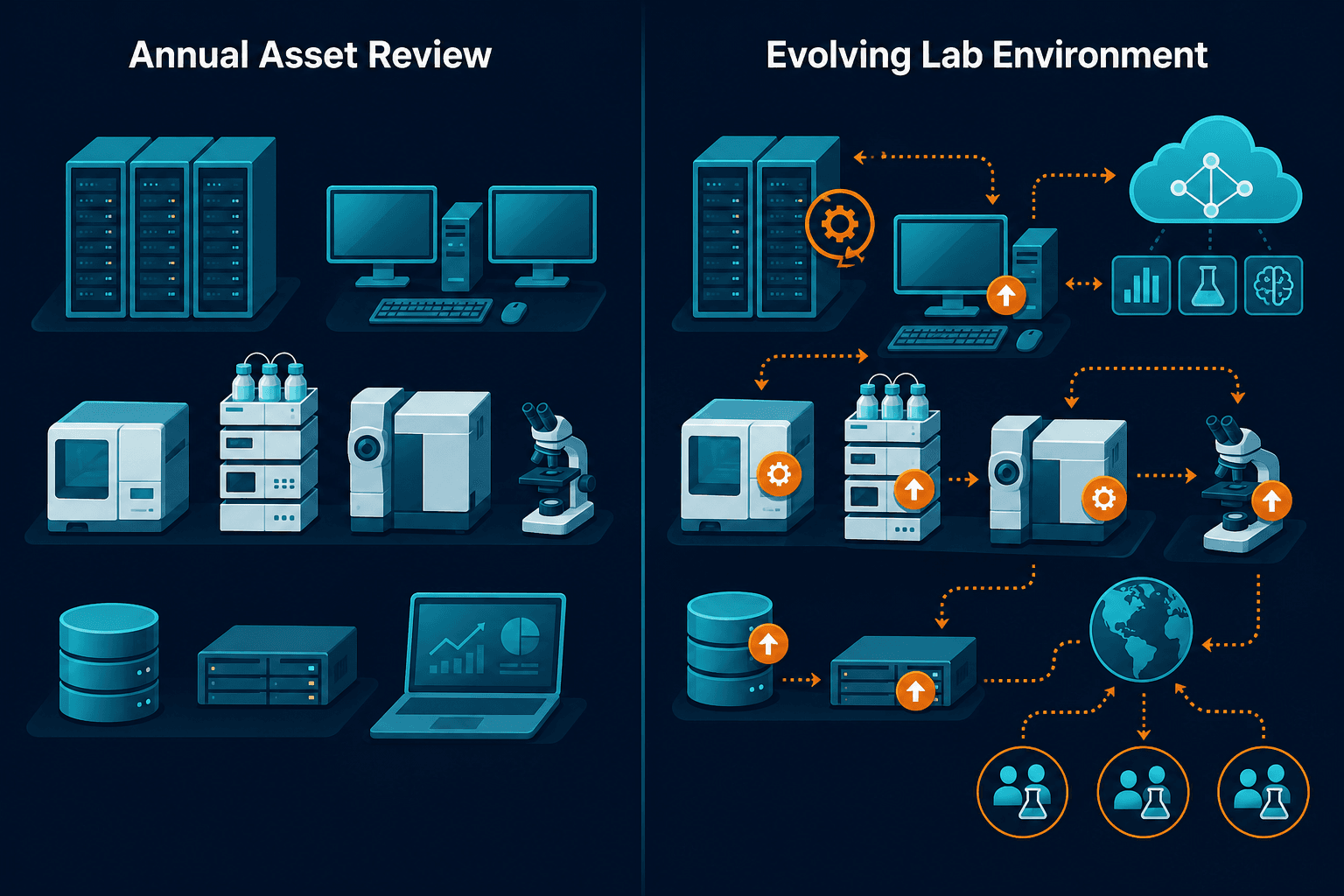
The annual review is a point-in-time record, accurate on the day it is completed and decaying from that day forward. In a working lab, the estate changes constantly between reviews. Instrument firmware updates ship, new ELN modules and cloud tools come online, CRO connections open and close, and staff provisioning changes access to regulated systems. Each change moves the real environment away from the documented one. The exposure is the gap between the two: an inventory finalized in January describes a lab that no longer exists by the time an OCR investigation or an FDA inspection arrives in October. Closing that gap requires a record that reflects the current operational state rather than the state captured at the last scheduled review.
Building an asset record that holds up under either regulator
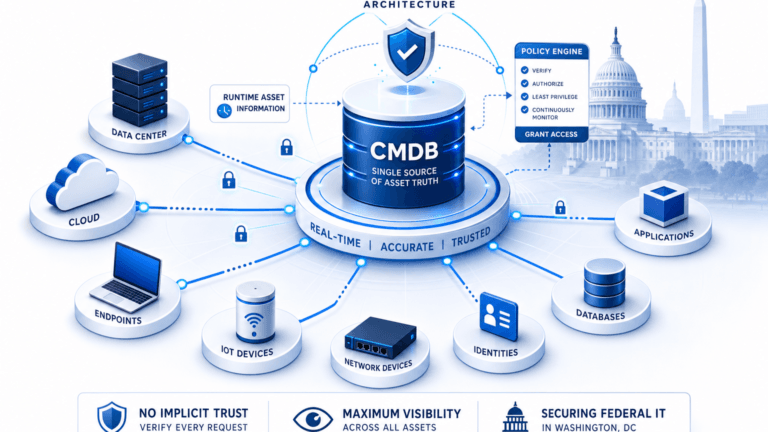
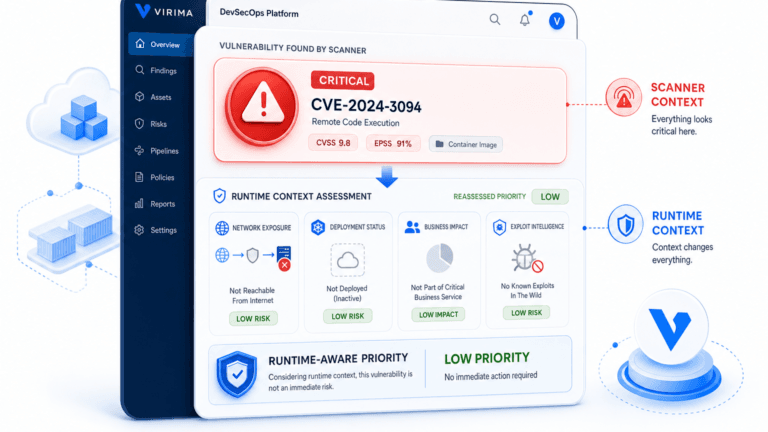
Virima operates at this infrastructure layer. Its discovery-sourced configuration management database (CMDB) builds an asset record from the operational state of the environment rather than from manual documentation. High-frequency scheduled discovery cycles identify the devices, applications, instruments, and cloud workloads that create, store, or transmit regulated data, including vendor-managed systems and AWS and Azure infrastructure, and flag changes between formal reviews so the annual inventory starts from current state. ViVID service maps show how regulated data moves between systems and which connections touch it, giving compliance teams a dependency record that holds up when an OCR investigator or an FDA inspector asks what the environment contained. The annual review remains the regulatory floor, and a discovery-sourced record is what keeps that review defensible on any day between cycles.
The record that survives the visit
For a Kendall Square biotech, the regulated environment answers to a hospital partner’s BAA, a state security regulation, and an FDA inspection schedule that follows no calendar the organization sets. What each of them examines is the same underlying record of what exists and what it touches. An organization that can produce that record accurately on any given day has already answered the question all three will ask.
Schedule a demo to see how Virima builds and maintains a defensible asset record for biotech and pharma compliance