How Does Virima Connect ITSM Incident Management to CMDB? A Practical Guide

ITSM incident management and CMDB integration close the gap between knowing an incident occurred and knowing what it affects. Connecting ITSM incident management to the CMDB means every configuration item (CI) is automatically linked to its incident ticket, so responders see the affected asset, its service dependencies, recent change history, and blast radius from the moment the ticket opens, before any manual investigation begins. This guide explains how Virima handles ITSM incident management CMDB linkage automatically, what ViVID™ service mapping provides during active incidents, and how the connection supports ITIL v4 compliance.
Why most teams skip CI linkage in practice, and what it costs
Connecting incident management to the CMDB is a core ITIL v4 requirement. It is also one of the most commonly skipped steps in real ITSM implementations. Three problems drive that skip.
First, manual CI linkage is tedious. When responders must search the CMDB, find the correct CI, and attach it to a ticket in the middle of an active incident, most do not bother — or they do it after resolution as a checkbox, too late to help.
Second, CMDB data is often stale. If the record does not reflect the current state of the environment, responders distrust it. A CMDB with outdated hardware specifications or wrong ownership data is worse than no CMDB at all — it sends teams in the wrong direction.
Third, the value is not obvious until a high-severity incident exposes the cost. Industry research consistently links formalized incident-response procedures, including CI linkage, to higher-performing ITSM programs. But organizations without a P1 event forcing the issue routinely deprioritize the integration for months.
Virima addresses all three barriers. CI linkage is automatic, built into the incident creation workflow. CMDB data is sourced directly from high-frequency IT discovery cycles, not from manual input. And the value is visible on the first major incident.
See how Virima builds the foundation for faster, more accurate incident response:
How Virima links incidents to CMDB configuration items
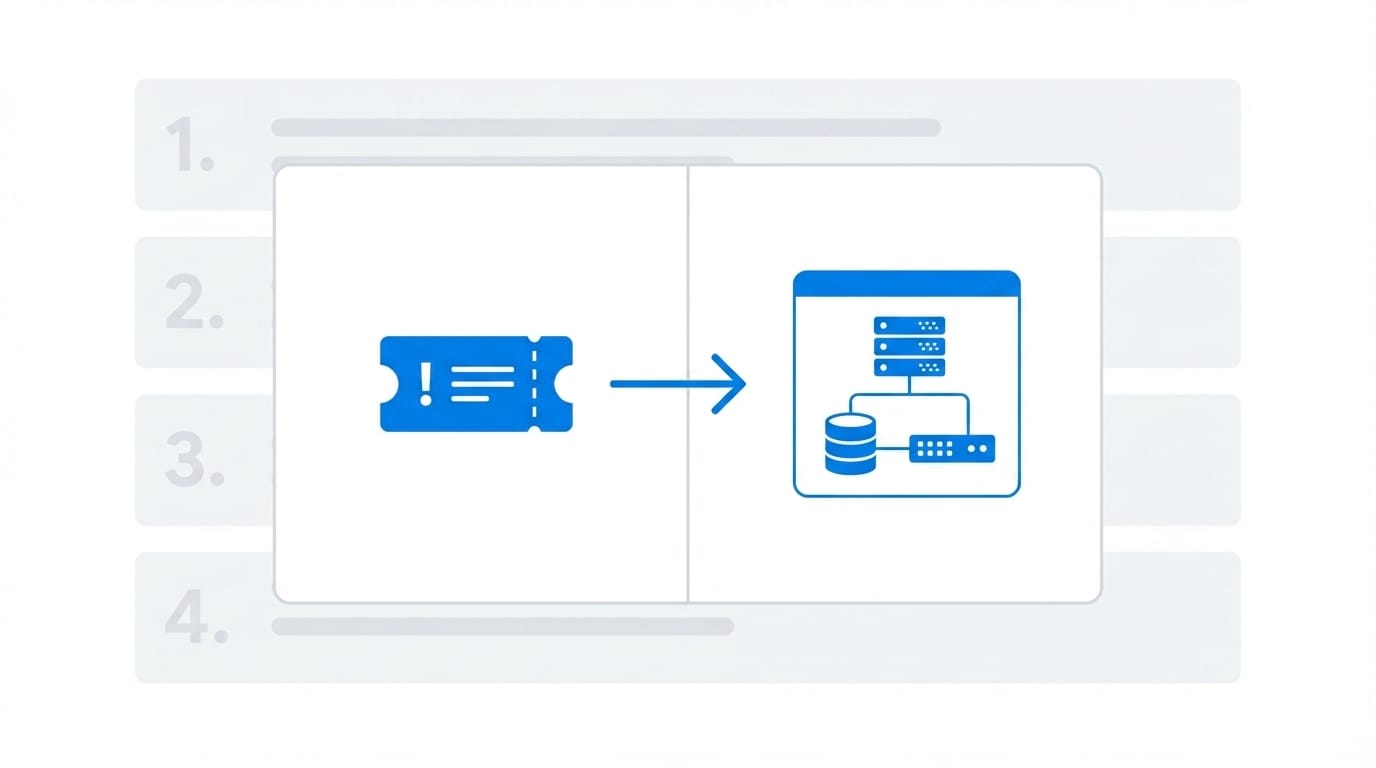
Every incident in Virima carries a direct link to the CMDB configuration item involved. This association is not a manual lookup — it is built into the incident creation workflow.
When a new incident is created, Virima identifies the affected CI based on the incident source (monitoring alert, user submission, email, or manual entry). The CI record attaches to the incident automatically, giving the responder immediate access to:
- Full CI description and classification
- Hardware or software specifications
- Configuration attributes from the last discovery cycle
- CI ownership and assigned support group
- Change history (recent changes to the CI)
- ViVID™ service map position
- Related CIs and dependencies
This context is available within the incident ticket — not in a separate CMDB interface. Responders see the full picture from the moment the ticket opens.
When ITSM incident management is connected to a CMDB, every incident ticket should carry the affected CI’s full classification, hardware or software specifications, configuration attributes from the last discovery cycle, ownership and assigned support group, recent change history, and dependency map position. This CMDB context on the incident ticket eliminates the first 15–20 minutes of a major outage bridge call — the time typically spent answering questions the CMDB should have already answered.
Correct ticket routing from ticket creation is the single largest lever for SLA compliance. When a P1 incident opens against a CI with outdated ownership records, the SLA clock runs against the wrong team. For a full breakdown of how CMDB-to-ITSM data flow determines incident routing accuracy, see SLA monitoring and reporting: a complete guide for IT teams
Can incidents be created automatically from external monitoring tools?
Yes. Virima can auto-create incidents from external monitoring and event management systems.
Monitoring tool integration
When a monitoring tool detects a threshold breach or generates an alert, it sends the event to Virima via integration. Virima creates the incident record, identifies the affected CI from the alert data, links the CI to the incident, and routes the incident to the correct support group based on SLA rules — without manual intervention.
By the time a responder opens the incident, the CI is identified, the service topology context is attached, and the SLA clock is running. The responder starts investigation immediately rather than spending the first 15–20 minutes reconstructing what is affected.
Email and self-service portal intake
Virima also accepts incidents from email (auto-creates a record from inbound support emails) and from the self-service portal (user-submitted, with guided CI selection). Both intake paths attach CI context to the ticket — the difference is that monitoring-sourced incidents arrive with the CI pre-identified from the alert data, while portal submissions guide the user to select the affected CI directly.
The CMDB staleness problem: why incident context is only as good as discovery freshness
CI association is only valuable when the CI data is accurate. This is where many CMDB implementations fall short: the data gets populated once during initial setup, discovery runs infrequently, and within months the records no longer reflect the actual environment. A CMDB that shows the wrong server specifications, wrong ownership, or outdated configuration attributes does not help responders — it misleads them.
Virima addresses this at the source. CMDB records in Virima are populated and refreshed by high-frequency IT discovery cycles, not by manual data entry or one-time imports. When an incident ticket is created, the CI context it displays reflects what discovery last captured from the device or environment — hardware state, installed software, configuration attributes, and network relationships.
This discovery-driven approach means the CI record that attaches to an incident ticket is grounded in what the asset actually looks like today, not what it looked like when someone last edited the record manually.
Why data freshness determines incident accuracy
For incident teams, this distinction matters on every major incident. When the CI record shows the correct owner, the correct server configuration, and the correct service relationships, responders trust what they see and act on it. When they do not trust the CMDB, they ignore it and spend the first 20–60 minutes of a high-severity incident reconstructing context that should have already been there.
CMDB data becomes stale when records depend on manual updates or infrequent discovery runs. During an incident, responders using stale CI data see wrong ownership, outdated configuration attributes, and service relationships that no longer reflect the environment. Records built from discovery — refreshed each high-frequency discovery cycle rather than maintained manually — give incident teams CI context they can act on immediately.
Looking ahead: as teams begin adopting agentic IT workflows, this same accuracy requirement becomes a hard dependency. AI agents acting on incident data will need the same CI context human responders rely on — and they will need to trust it before executing any action.
How ViVID™ service maps support incident resolution
ViVID™ service mapping gives responders dependency-aware visual context of all IT services, showing which CIs support which services and how services relate to each other. During an active incident, ViVID™ provides three critical views.
Blast radius. Which services and CIs depend on the affected CI? A ViVID™ overlay on the incident shows every downstream dependency at risk — immediately, without manual investigation.
Dependency chain. Which upstream CIs does the affected CI depend on? If the root cause is a dependency failure (a database the application relies on, rather than the application itself), ViVID™ makes that visible in seconds.
Restoration sequence. For major incidents requiring staged recovery, the ViVID™ dependency chain shows which CIs to restore first. Responders follow the map rather than improvising a sequence based on incomplete knowledge.
ViVID™ service maps update with each discovery cycle, so the service relationships responders see during an incident reflect the current environment.
Service mapping during incident resolution reveals three pieces of information unavailable without manual investigation: blast radius (downstream services at risk), dependency chain (upstream CIs whose failure may be the true root cause), and restoration sequence (which CIs to recover first in staged recovery). Maps built from discovery and updated each cycle give responders dependency data that reflects the current environment — not infrastructure topology documented months ago and never refreshed.
How Virima reduces MTTR with CMDB context during major incidents
Reducing mean time to resolution (MTTR) in Virima comes from eliminating the manual data reconstruction that extends every high-severity incident bridge call.
Without CMDB context, responders spend 20–60 minutes on a major incident bridge call answering basic questions — what is affected, who owns it, what changed recently, what else will break. With Virima CMDB context, those answers are present in the incident ticket from the first minute:
- Affected CI: identified automatically at incident creation
- Change history: last changes to the CI visible without switching tools
- Service impact: ViVID™ shows the full blast radius immediately
- Ownership: CI owner and support group in the CI record
- Dependencies: upstream and downstream CIs visible on the ViVID dependency view
Stakeholder communication is also faster. Virima’s dependency map context allows the incident manager to notify affected business units proactively — based on ViVID™ data — rather than reactively as downstream outages are reported one at a time.
CMDB-connected incident management reduces MTTR by eliminating manual data reconstruction. Without CI context, responders spend 20–60 minutes on a major incident bridge call answering basic questions — what is affected, who owns it, what changed recently. With CMDB context present in the incident ticket at creation, diagnostic work begins immediately.
Is Virima’s incident management ITIL v4 compliant?
Yes. Virima incident management aligns with ITIL v4 incident management practices across the full incident lifecycle: detection, logging, classification, diagnosis, resolution, and closure. As defined by ITIL 4, a configuration item (CI) is “any component that needs to be managed in order to deliver an IT service” — and Virima enforces that definition by requiring CI linkage on every incident record.
Key ITIL v4 elements present in Virima:
- Mandatory CI linkage on every incident record
- Impact and urgency matrix driving priority calculation
- SLA assignment based on incident priority
- Escalation workflows — functional and hierarchical, triggered on SLA breach
- Major incident procedures — distinct P1/P2 routing, bridge coordination, and stakeholder notification
- Closure with documented resolution and CI state update
Virima also includes a workflow generator for custom incident routing. Teams build and activate routing rules — by CI class, incident category, priority, or any combination — without coding.
From incidents to problem management: the CI-level connection
Virima supports the transition from incident management to problem management through CI-level incident history.
Every CI record in Virima tracks all incidents linked to it over time — how many occurred, when they occurred, and how each was resolved. When a CI shows a pattern of recurring incidents, the data is immediately visible: this CI has had seven incidents in 90 days, five with the same resolution category.
Problem managers use this data to open formal problem records, referencing the contributing incidents and the affected CI. The CMDB change history for that CI — accessible from both the incident and problem records — helps identify the underlying cause: a configuration change, a software update, or a capacity constraint that keeps producing incidents.
CMDB-backed incident history enables problem management by surfacing CI-level incident patterns that would otherwise require manual correlation. When every incident is linked to the CI it affects, problem managers can query that CI’s history — frequency, resolution categories, change events — and open a problem record with evidence of the underlying cause. This CI-anchored trail connects incident frequency, change history, and configuration state into a single root cause analysis path.
What ITSM platforms does Virima integrate with?
Virima integrates with the major ITSM platforms in use across enterprise IT. Virima does not replace the ITSM tool — it enriches incidents in these platforms with CMDB and ViVID™ service map context that makes them more actionable. Specific integration capabilities vary by platform and deployment environment.
| ITSM platform | What Virima adds |
| ServiceNow | CMDB data and ViVID™ service map context enrich ServiceNow incident records |
| Ivanti | CI-backed incident enrichment for Ivanti ITSM |
| HaloITSM | Incident and service desk workflows enriched with CMDB context |
| Jira Service Management | CI context and CMDB data passed to Jira Service Management workflows |
| Xurrent | CI context for Xurrent incident environments |
| Hornbill | CMDB and service-map context for Hornbill Service Manager |
| TeamDynamix (under development) | CMDB-backed incident enrichment for TeamDynamix ITSM users |
For organizations without a dedicated ITSM platform, Virima provides a complete, self-contained incident management capability built on ITIL v4 principles. You can also build a CMDB with Virima as the foundation before introducing ITSM platform integrations.
CI linkage is the foundation of faster incident response
Connecting ITSM incident management to the CMDB is the difference between a responder who starts working immediately and one who spends the first 20–60 minutes of a major incident reconstructing context that should have already been there. When every incident ticket carries its CI, every CI carries its service map context, and every major incident gives responders an accurate picture of what is affected. The outcome is shorter incidents, faster root cause analysis, and a complete audit trail from detection to resolution.
That connection is what Virima provides — automatically, as a built-in capability, not as a configuration project.
Get runtime truth with a multi-source CMDB — schedule a Virima demo.
Frequently asked questions
What is CI linkage in ITSM incident management?
CI linkage connects an incident ticket to the specific configuration item (CI) in the CMDB that the incident involves. When CI linkage is automatic, every incident ticket carries the affected asset’s specifications, ownership, service topology position, change history, and downstream dependencies — giving responders accurate context from the first minute rather than requiring manual CMDB lookups during active resolution.
Why does CMDB data become unreliable during major incidents?
CMDB records become unreliable when they depend on manual updates or infrequent discovery runs. Over time, ownership changes, software updates, and configuration modifications go unrecorded — and the CI data that attaches to an incident ticket no longer reflects the actual environment. Discovery-sourced CMDB records, refreshed by high-frequency discovery cycles, reduce this drift and give incident teams CI context they can act on.
How does ITIL v4 require CMDB to support incident management?
ITIL 4 defines incident management across six stages: detection, logging, classification, diagnosis, resolution, and closure. CI linkage is a foundational requirement because it gives responders the configuration data needed for accurate classification, faster diagnosis, and complete closure documentation. Without CI linkage, incident records are incomplete and root cause analysis requires manual correlation across multiple systems.
Can CMDB-connected incidents feed directly into problem management?
Yes. When every incident is linked to a CI, problem managers can query CI-level incident history — frequency, resolution categories, change events — without manual correlation. A CI with recurring incidents and a shared resolution category is a problem record candidate. The CMDB change history tied to that CI then supports root cause analysis by showing what changed before the incident pattern began.
Does Virima replace our existing ITSM tool?
Virima does not replace existing ITSM platforms. For organizations running ServiceNow, Jira Service Management, Ivanti, HaloITSM, Xurrent, Hornbill, or TeamDynamix, Virima enriches those platforms with discovery-sourced CMDB data and ViVID™ service map context. Virima also provides a standalone incident management capability for organizations that do not yet have a dedicated ITSM platform.
Is Virima’s discovery agent-based or agentless?
Both. Virima discovers infrastructure across hybrid environments using agentless discovery, agent-based discovery, and API integrations — so the CMDB and CI context attached to each incident reflect on-premises systems, cloud platforms, and distributed infrastructure. Teams choose the discovery method that fits each part of their environment.