Free IT Asset Management Software: Are the Savings Worth The Compromises?

Keeping track of hardware, software licenses, and cloud resources matters for daily operations and security. Free IT asset management software promises to handle this without the licensing fees, especially when compared to freeware IT asset management software or other low-cost tools. But before committing to a free tool, you need to understand what you’re actually giving up.
The allure of free IT asset management software
Free IT asset management software appeals to teams looking to manage IT assets without upfront licensing costs, particularly those evaluating IT asset management software open source alternatives. Here’s why these tools attract attention:
- Cost savings: Freeware removes the immediate cost of ITAM software licensing.
- Easy access: Free software is widely available, making it simple to start tracking assets.
- Basic features: Many free tools cover asset discovery and inventory at a basic level, sometimes including QR code tagging or barcode scanning for easier tracking.
- Low-risk trial: Free tools let you explore ITAM options before committing budget.
- Community input: Some free and open-source tools have active user communities for support and development.
Free ITAM software can work for small businesses and startups with limited budgets, especially when leveraging freeware IT asset management software for basic inventory needs.
These tools provide basic asset tracking and inventory, giving initial visibility into what’s running in your environment.
But the appeal of free IT asset management software often masks real limitations and operational risks.
The hidden costs of free IT asset management software
Free IT asset management software may look like a quick win, much like many open-source IT asset management software solutions at first glance. In practice, the hidden costs often outweigh the savings. These are the most common problems:
Limited features
Free ITAM tools typically lack the capabilities found in paid solutions. You may not get automated discovery, dependency mapping, or license management, all of which matter once your environment grows past a handful of assets.
Security gaps
Free tools often have weaker security controls, including limited access control mechanisms. Without regular patches, audit logging, or compliance certifications like SOC 2 Type II, your asset information sits exposed to threats that paid platforms are built to handle, with the average cost of a data breach reaching $10 million in 2025.
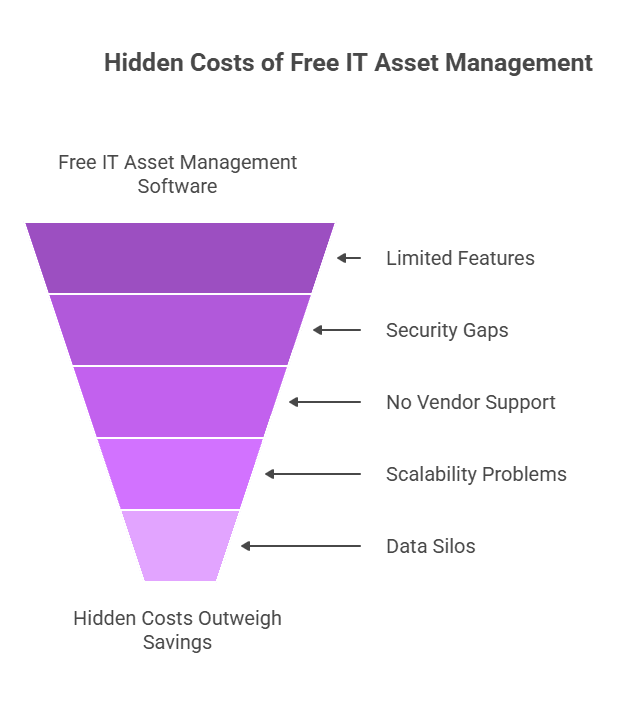
No vendor support
Most free ITAM tools offer little or no technical support. When something breaks, or you need help with configuration, you’re on your own, especially without support through a dedicated mobile app. For an ops team managing hundreds or thousands of assets, that’s a serious risk, especially when nearly 45% of organizations have spent over $1 million on software audits in recent years.
Scalability problems
Free tools rarely scale well. As your IT environment grows across on-premises, cloud, and remote endpoints, free software struggles to keep up with the volume and complexity.
Data silos
Free IT asset management software often doesn’t integrate with your ITSM platform, a limitation commonly seen in freeware IT asset management software as well,CMDB, or cloud providers. This creates data silos that block the cross-team visibility you need for incident response and change management.
What features should IT asset management software include?
Before evaluating any ITAM tool, free or paid, you need a clear picture of what the software should actually do. At a minimum, a production-ready ITAM or asset management solution should cover:
- Automated discovery: Agentless and agent-based scanning across on-premises, cloud, and remote assets.
- CMDB integration: Asset data should feed directly into a configuration management database for relationship mapping and change impact analysis.
- Software license management: Track license entitlements against actual installs to avoid audit surprises and reclaim underused licenses.
- Lifecycle tracking: Manage physical assets from procurement through deployment, production, and decommissioning.
- ITSM integration: Connect asset data to incident, change, problem management, and work orders workflows.
- Vulnerability awareness: Cross-reference assets against known vulnerabilities, ideally with built-in access to a database like the NIST NVD.
- Service mapping: Visualize dependencies between assets so you know the blast radius when something fails.
Most free tools cover only the first item on this list, and often only partially. That gap is where operational risk builds up.
IT asset management open source software: A viable alternative?
Open-source ITAM software gives you access to the source code, making IT asset management software open source an attractive option for customization, which allows customization and potentially more advanced features than proprietary freeware.
But open-source solutions often demand significant technical effort to install, configure, and maintain. Security patches and ongoing maintenance can strain teams that lack dedicated internal resources for ITAM.
Challenges of open source ITAM tools, including those categorized as IT asset management software open source
- Feature gaps: Open source tools often miss capabilities like contract management, license optimization, or detailed compliance reporting.
- Integration difficulty: Connecting open source ITAM with enterprise systems like ServiceNow, Jira Service Management, or cloud platforms often requires custom development.
- Inconsistent support: Community support varies. Urgent issues may sit unanswered for days.
- Security risks: Community-driven development, often without strong version control, can leave vulnerabilities unpatched longer than commercial alternatives.
- Scalability limits: Open source ITAM may not handle the asset volumes and environment complexity that mid-size and large organizations require.
- Customization overhead: Tailoring open source software to your specific workflows takes engineering time that could go toward higher-value work.
How to reduce the risks
- Define your requirements first. Know exactly what your ITAM tool needs to do before evaluating open source options.
- Stay active in the community. Monitor updates, contribute where possible, and keep your deployment current.
- Bring in professional help. Specialized consultants can accelerate implementation and fill support gaps.
- Consider a hybrid approach. Use an open source tool for basic inventory and a commercial platform for discovery, CMDB, service mapping, and compliance.
Weighing these trade-offs carefully helps you capture the benefits of open source ITAM without absorbing unnecessary operational risk.
Can free ITAM software handle cloud asset management?
Most free and open-source ITAM tools, including freeware IT asset management software, were built for on-premises environments. They struggle with cloud asset discovery, particularly across multi-cloud setups involving AWS, Azure, and GCP.
Cloud assets spin up and down constantly. A tool that relies on manual inventory or periodic network scans will miss ephemeral instances, auto-scaled resources, and infrastructure-as-code deployments. Without cloud-native integrations, your asset inventory goes stale within days.
Paid platforms like Virima include built-in AWS and Azure integrations that automatically discover cloud resources alongside on-premises assets, keeping a single, real-time inventory without manual effort.
What’s the difference between ITAM and CMDB?
ITAM tracks the business side of assets: ownership, cost, contracts, license compliance, and lifecycle status. A CMDB tracks the technical side: configuration details, relationships between assets, and service dependencies.
In practice, you need both. An ITAM tool tells you that a server’s warranty expires next month. The CMDB tells you that the same server supports three business-critical applications and connects to a database cluster. Without the CMDB, you’re managing assets in isolation, with no visibility into what breaks when something changes.
Most free ITAM tools don’t include a CMDB at all, which forces you to maintain a separate system or operate without dependency data entirely.
Why Virima delivers what free IT asset management software can’t
Virima is built to solve the exact problems that free and open-source ITAM tools leave unresolved. Here’s what that looks like in practice:
Discovery that covers your entire environment
Virima IT discovery uses agentless IP-based scanning plus optional agents for Windows, macOS, and Linux to find and inventory every connected asset. API integrations extend coverage to cloud providers, hypervisors, containers, and monitoring platforms. With 100+ extendable probes, it covers assets including hardware, software, and cloud resources across data centers, edge, and multi-cloud environments. You schedule scans per subnet, and Virima keeps your inventory current automatically.
NIST National Vulnerability Database (NVD) integration comes included at no extra cost, so every discovered asset gets cross-referenced against known vulnerabilities without buying a separate tool.
Virima Visual Impact Display (ViVID™) for operational clarity
Virima Visual Impact Display, or ViVID™, turns service maps into a heads-up display for IT operations. It overlays ITSM incidents, change records, and NVD vulnerability data directly onto your dependency maps. When a change request comes in or an incident fires, your team sees exactly what’s affected and what depends on it.
This isn’t a static diagram. ViVID maps are filterable, shareable, and update automatically as Virima Discovery detects configuration changes. For ops teams, that means faster root-cause identification and fewer change-induced outages.
ITSM integration across seven platforms
Virima integrates with ServiceNow, Jira Service Management, Ivanti, HaloITSM, Cherwell, Xurrent, and Hornbill, giving your team a unified view of asset data within the ITSM platform you already use. No rip-and-replace required.
CMDB automation and ITIL compliance
Virima is PinkVERIFY ITIL 4 certified across six processes: SACM, change, incident, problem, request fulfillment, and knowledge management. The CMDB is the foundation for SACM, and discovery data feeds directly into it with automated CI relationship mapping. Granular business rules let teams create custom workflows and manage custom fields for promotion and maintenance tasks that would otherwise eat your team’s time.
Autonomic Social Discovery™ for the data probes can’t reach
Virima’s Autonomic Social Discovery™ (ASD) automates human intelligence gathering for asset attributes that discovery probes and agents can’t capture automatically: asset lifecycle status, ownership, business criticality, policies, and SLAs. ASD assigns tasks to the right people, learns from prior responses, and keeps your CMDB and ITAM data complete without manual spreadsheet chasing.
Built for security and compliance
Virima is SOC 2 Type II certified and deployed on AWS with full data segregation between tenants. For teams where the security concerns around free tools are a deal-breaker, Virima’s compliance posture removes that risk from the conversation.
Operational confidence beats false savings on free IT asset management software
Free IT asset management software saves on licensing costs, but it costs you in accuracy, security, scalability, and integration. For operations teams responsible for uptime, compliance, and asset control, those trade-offs add up fast.
Virima gives you automated discovery, a certified CMDB, seven ITSM integrations, ViVID™ service mapping, and built-in vulnerability management in one platform. No hidden costs. No data silos. No gaps where it matters most.
Ready to see how Virima handles your environment? Schedule a demo today.