What Atlanta’s Fulton County Ransomware Attack Reveals About Unmanaged IT Assets

In early 2024, Fulton County, the government seat of metro Atlanta, disclosed a ransomware incident that disrupted courts, jail operations, tax systems, and property records. Officials later said the intrusion began when one employee clicked a malicious link. The county refused to pay the ransom demand. Recovery stretched for months, and reporting put the related IT overhaul in the multimillion-dollar range. Nearly a year later, the U.S. State Department was still offering a large reward for information on a suspect.
That sequence landed in a metro with a dense cybersecurity company base and a nationally ranked Georgia Tech cybersecurity program. Talent and vendor concentration did not automatically produce complete device-level visibility inside every organization operating there. For security directors and incident response leads, the harder lesson sits after initial access: once an attacker has a foothold, containment and damage assessment depend on knowing which devices exist, how they connect, and which business services sit downstream. Unmanaged devices ransomware risk is less about the first click and more about how long unknown endpoints stay outside patching, monitoring, and scoping.
A Costly Reminder, Close to Home
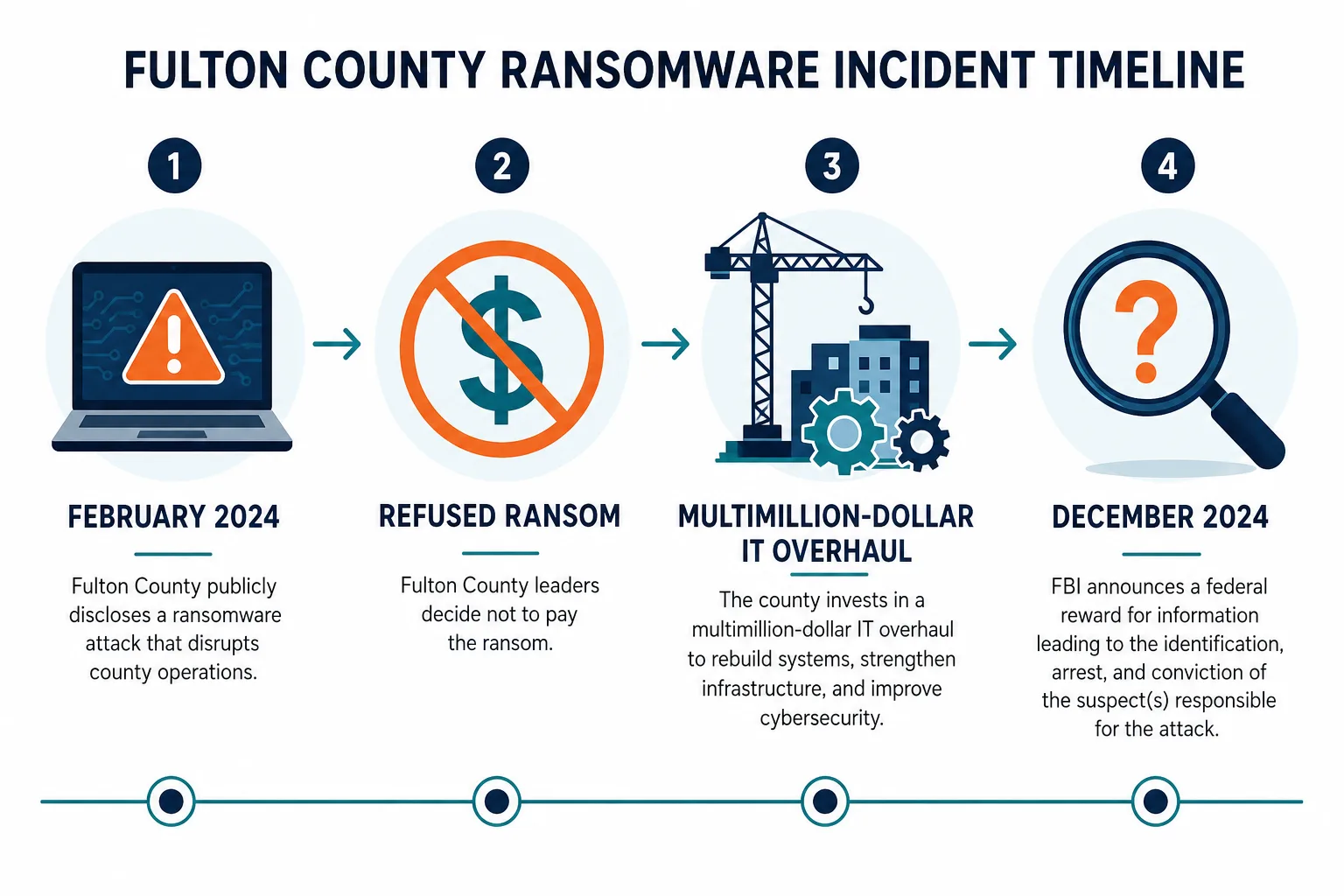
In February 2024, CNN Business reported that Fulton County systems had been hit by a ransomware attack attributed to the LockBit group. County and public reporting described impacts across court, jail, tax, and property systems. Officials stated that election systems were not affected.
Later the same year, county leadership told Atlanta News First that the intrusion traced back to one employee clicking a malicious link. That is the publicly reported initial-access account. It does not describe which controls failed after the click, which devices were inventoried, or how dependency maps were used during response.
The county refused to pay the ransom. GovTech coverage described a resulting IT overhaul in the $10 million range. In December 2024, Atlanta News First reported that the U.S. Department of State offered a $10 million reward for information on a suspect tied to the attack. Federal attention months after disclosure shows how long a local-government recovery can stay public.
None of those facts prove that incomplete asset inventory caused this specific breach. They do show what a single foothold can cost when recovery requires rebuilding systems under public scrutiny. Security teams should separate the reported entry path from the operational question every response lead still faces: can we name every device in scope, and can we show what that device touches?
The Irony of a Recognized Cyber Hub
Atlanta is not short on cybersecurity capability. Georgia Tech’s undergraduate cybersecurity program ranked No. 2 nationally in U.S. News rankings covered by the Georgia Tech College of Computing. The School of Cybersecurity and Privacy sits in Atlanta and feeds a local talent pipeline that security vendors and enterprise SOCs both recruit from.
Company density is also high by industry estimates. A 2021 Apptega piece citing Crunchbase described Atlanta as home to more than 100 cybersecurity companies, naming firms such as OneTrust, IRONSCALES, and long-standing Atlanta-rooted security brands. That figure is a dated industry estimate, not a current official census, and should be treated as directional density rather than a live headcount.
Local security-sector investment has continued into 2025. In 2025, the Atlanta Journal-Constitution covered OneTrust opening a new roughly 74,000-square-foot headquarters on the Atlanta Beltline. Secureworks, founded in Atlanta, completed its acquisition by Sophos in February 2025 per Sophos’s public announcement of the deal closing. Other metro names frequently associated with the local security market include Pindrop, BeyondTrust in Johns Creek, IRONSCALES, and Apptega. None of those companies are referenced here as customers or partners of Virima; they illustrate market density only.
Atlanta’s fintech and payments cluster, often called Transaction Alley, adds another layer of security and compliance demand. For how CMDB accuracy supports payment-processor controls in that corridor, see Virima’s companion piece on PCI DSS accuracy in Atlanta.
The point of this juxtaposition is structural, not personal. A metro can host ranked academic programs and dozens of security vendors while any single enterprise still runs unknown endpoints, stale spreadsheets, or partial CMDB coverage. Ecosystem expertise does not automatically equal device-level inventory completeness inside one organization. Ransomware response quality tracks what the organization can see after the first compromise signal, not only how many security firms share the same zip codes.
Does a dense local cybersecurity market reduce ransomware risk for every organization in that city?
Dense local markets do not automatically lower ransomware risk for every organization in that city. Vendor and talent concentration improve hiring and product choice, but they do not inventory endpoints, map service dependencies, or keep patch scope current inside a specific enterprise or agency. Ransomware containment still depends on that organization’s own device and relationship records after initial access.
Why Unmanaged Devices Are the Blind Spot Attackers Count On
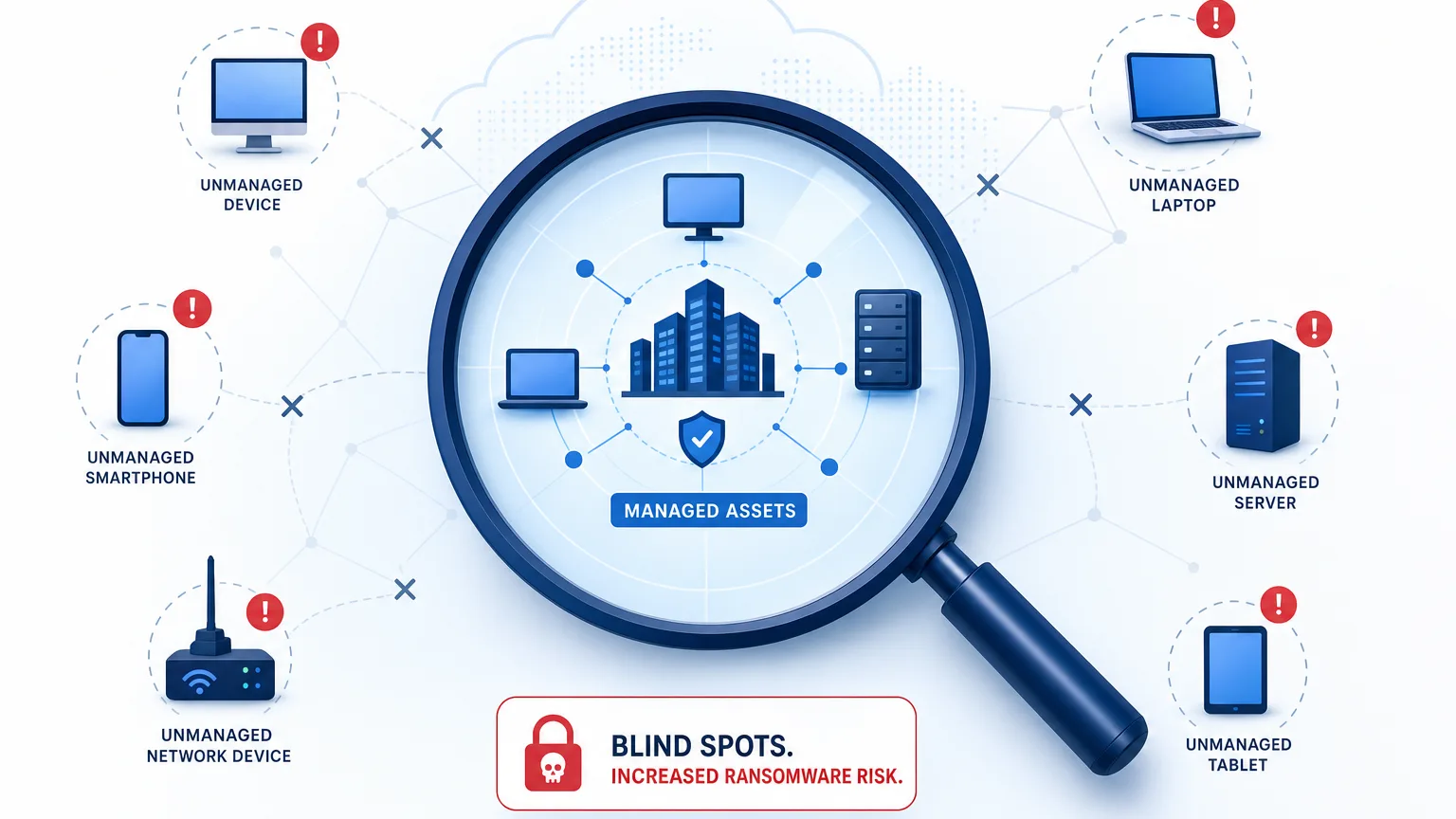
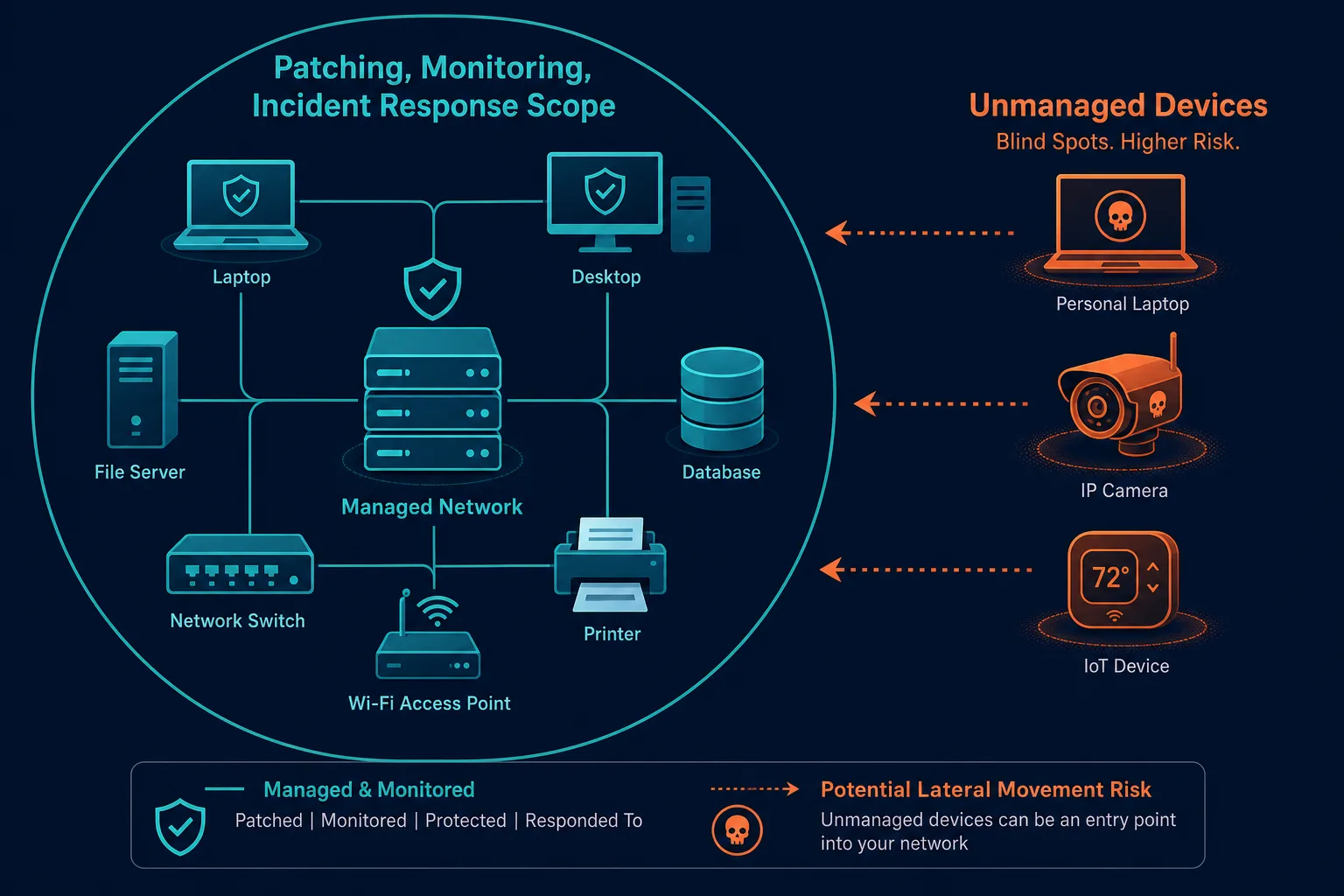
Any device or endpoint outside the recorded inventory is hard to patch on a schedule, hard to place under the same monitoring baselines as known assets, and easy to miss when responders build an incident scope list. Unknown endpoints security risk shows up as silent dwell time: the attacker operates on systems the SOC’s known-good list never included.
Virima has published that 57% of IT teams do not have complete visibility across their technology stack, a figure covered in depth in the company’s guide to IT asset visibility gaps. That statistic describes a general IT asset visibility gap. It is not a claim about Fulton County’s environment. It matches what security and operations leaders report when hybrid estates grow faster than manual inventories.
Initial access can arrive through phishing, stolen credentials, an unpatched service, or a misconfigured remote path. After that moment, the work converges. Teams must decide which hosts to isolate, which identities to reset, which shared storage or middleware paths to trust, and which business services stay online. Those decisions require a current list of devices and a usable map of relationships. Without both, scoping expands by rumor, ticket history, and partial scanner results.
That gap is why a single foothold can cascade into multi-week recovery and multimillion-dollar rebuild programs of the kind public reporting described after Fulton County’s incident. The cascade is not proof of one root-cause category. It is the predictable cost curve when responders lack a trusted picture of what exists and what connects to what.
Prefer the language of unmanaged devices or unknown endpoints over “unmanaged assets” in search and security conversations. The latter phrase collides with unrelated wealth-management usage and weakens intent match for this topic.
Manual or ad hoc tracking fails for a mechanical reason. Normal IT churn adds laptops, cloud instances, virtual machines, lab systems, contractor gear, and short-lived test hosts faster than spreadsheet owners can reconcile. Point-in-time audits freeze a moment. By the next change window, the record and the runtime estate have already diverged. Every unrecorded device is a place controls built around the known inventory do not fully reach.
Why do unmanaged devices raise ransomware risk even when the first compromise is phishing?
Phishing explains how credentials or a session may be obtained. Containment still requires knowing which hosts, identities, and downstream services sit in the blast radius. Devices missing from inventory are rarely patched or monitored with the same rigor, so lateral movement and recovery take longer once the attacker is inside.
What High-Frequency Discovery and CMDB-Driven Visibility Look Like
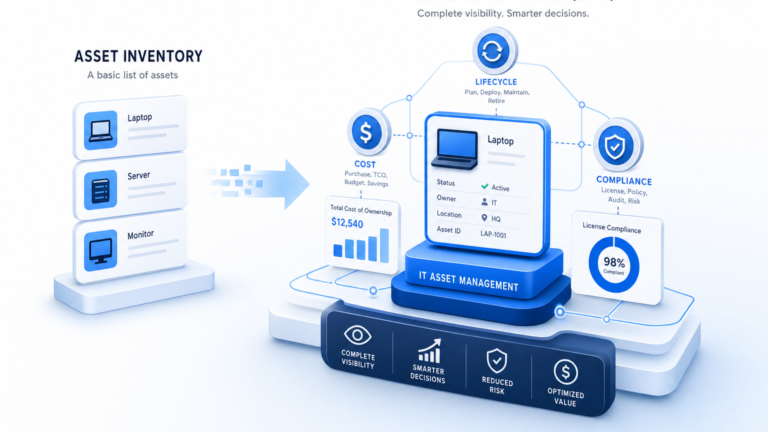
Closing the gap starts with discovery that runs on a schedule teams can trust, not with another annual spreadsheet sweep. Agent-based methods deepen endpoint inventory. Agentless network methods cover infrastructure that cannot or should not run an agent. API-based methods pull cloud and platform inventories where credentials and integrations allow. Together they feed a configuration management database (CMDB) that security and operations can share. Method detail lives on Virima’s IT discovery overview.
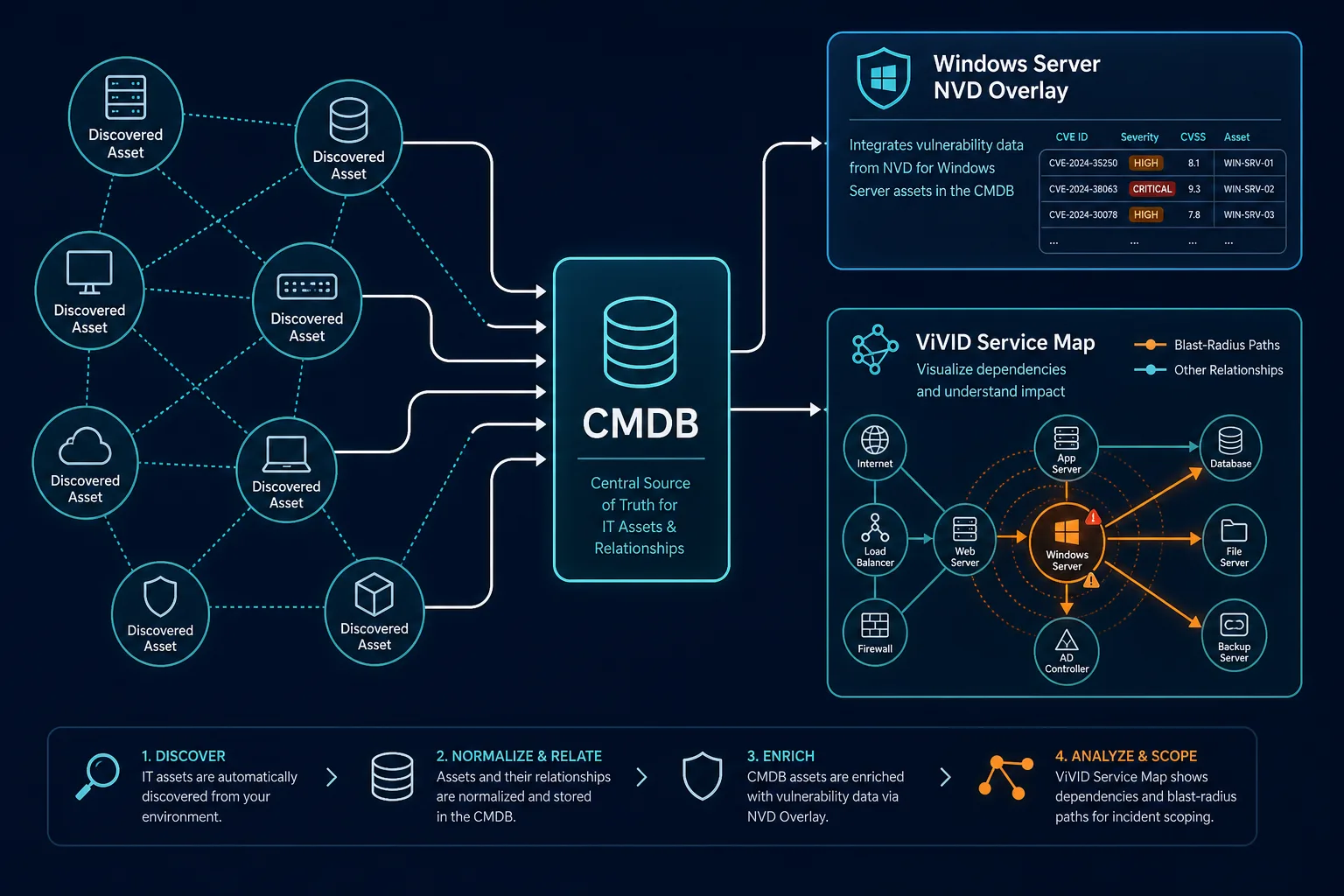
Discovered attributes such as operating system, patch level, and installed software become more useful when they are joined to vulnerability intelligence. Virima’s cybersecurity asset management capabilities include mapping discovered Windows Server findings to NIST National Vulnerability Database (NVD) CVE data and weighting exposure with asset and business-service criticality. That is not a claim that Virima replaces a full multi-OS vulnerability management scanner. It is a discovery-sourced inventory plus a Windows Server NVD overlay that helps prioritize what matters first when patch capacity is limited. Feature depth is documented on the cyber asset management page.
Service mapping adds the relationship layer scanners alone do not provide. With ViVID™, teams supply service definitions (manually, by spreadsheet, or through architecture integrations). Virima then builds and maintains application-to-infrastructure dependency maps from discovery-backed configuration items. During an incident, responders can trace paths from a compromised host toward the business services that host supports. That is blast-radius context for containment decisions, not a substitute for forensics tooling. Dependency and impact views are covered on the service mapping feature page.
Security leaders often resist “more discovery” after a breach story because discovery itself expands privileged access. Discovery should run under role-based access control, encrypted channels, credentials that are not transmitted externally, and logged configuration-item changes. Virima publishes SOC 2 Type II and ISO/IEC 27001:2022 certifications as independent posture signals for that process. Treat certifications as evidence about the vendor’s control environment, not as a promise that any customer estate is breach-proof.
Map vulnerability blast radius using discovery-sourced Trusted Runtime Truth. SecOps teams use that layer when alert triage needs immediate asset and service context instead of another flat host list.
How is a CMDB for cybersecurity different from a vulnerability scanner alone?
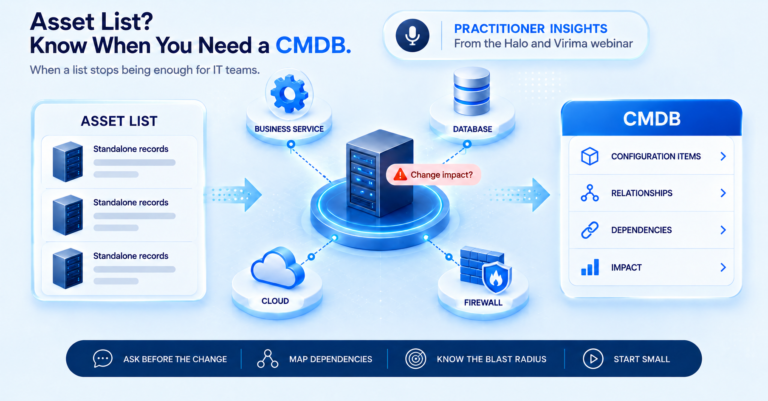
A vulnerability scanner reports weaknesses on hosts it can reach. A configuration management database (CMDB) stores configuration items, ownership, and relationships across the estate. Joined together, scan findings gain business-service context, change history, and blast-radius paths that pure scan queues do not carry.
Applying the Lesson: Before and After an Incident
Before an incident, high-frequency discovery shrinks the set of unknown endpoints attackers can occupy without appearing on inventory. CVE-aware prioritization on discovered Windows Server exposure helps limited patch windows hit systems that carry both technical severity and service criticality. Neither step prevents every phishing click. Both reduce the number of dark corners left after the click succeeds.
During an incident, service maps give responders a current picture of what connects to a compromised configuration item. Scoping still needs identity, log, and malware analysis. It moves faster when the infrastructure relationship layer is already built instead of reverse-engineered under pressure.
After an incident, organizations forced into a rapid infrastructure rebuild benefit from a reconciled CMDB with audit history. Public reporting described a large IT overhaul after Fulton County’s event. Any organization in a similar rebuild should treat inventory authority as part of reconstruction, so the new estate does not reintroduce the same blind spots under new hostnames. That rebuild guidance is general operational practice. It does not claim Fulton County used Virima, evaluated Virima, or should be read as a customer story.
What Security Leaders in Atlanta Should Take From This Case
Atlanta’s 2024 home-county ransomware case is a local reminder with national mechanics. Reported entry was a malicious link. Documented impact included core county systems, a refused ransom, a costly rebuild, and months of federal attention. The surrounding metro still hosts ranked cyber education and a large security-vendor footprint. Those facts can sit side by side without blaming one agency team or pretending vendor density is a control.
Unmanaged devices remain a foundational blind spot in ransomware defense because patching, monitoring, and incident response all assume a trustworthy inventory. High-frequency discovery, CMDB relationships, selective NVD-backed prioritization on Windows Server findings, and service maps close parts of that gap. They reduce risk and shorten scoping. They do not guarantee an organization will never be breached.
Security directors who treat the Fulton County coverage as a prompt for an internal inventory honesty check are using the news correctly. Start with what you cannot name, what you cannot map, and what you cannot prioritize. Then decide whether your discovery and CMDB practices can answer those questions on a schedule the incident commander would trust at 2 a.m.
See how SecOps teams enrich alert triage with immediate asset context. Schedule a security demo to walk discovery, Windows Server NVD overlay behavior, and ViVID™ blast-radius views against your own estate model.
Frequently Asked Questions
What caused the 2024 Fulton County ransomware attack?
Public reporting attributed the incident to the LockBit group. County leadership later said the intrusion traced back to one employee clicking a malicious link. Those are the sourced accounts available from CNN Business, Atlanta News First, and related coverage. No public source in this article’s research base establishes that incomplete asset inventory caused the initial compromise.
What is IT asset visibility, and why does it matter for ransomware defense?
IT asset visibility means knowing which devices, software, and related configuration items are present, owned, and connected in the environment you defend. Ransomware defense depends on it because patching, monitoring, isolation, and recovery scoping all assume that list is current. Gaps create endpoints attackers can use without matching the controls built around known inventory.
How is a CMDB different from a vulnerability scanner?
A vulnerability scanner identifies weaknesses on systems it can assess. A configuration management database stores configuration items, relationships, ownership, and change-oriented context across the estate. Security programs need both: scanners for exposure findings, and a CMDB for service impact, ownership, and blast-radius paths during response and change work.
How do organizations discover unmanaged or unknown devices on their network?
Teams combine agent-based inventory on endpoints, agentless network discovery for infrastructure, and API-based pulls from cloud and platform sources. Results should reconcile into a shared CMDB on a high-frequency schedule rather than a one-time audit. Unknown devices then become tracked configuration items instead of permanent exceptions.
Does better asset visibility guarantee an organization will not be breached?
Better asset visibility does not guarantee an organization will avoid every breach. It reduces the number of unknown endpoints, improves patch prioritization, and speeds incident scoping. It does not remove phishing, credential theft, zero-days, or every misconfiguration. Treat visibility as risk reduction and response acceleration, not as a prevention guarantee.