CMDB Automation for Atlanta’s Logistics and Supply Chain Enterprises

A new distribution center opens on the Atlanta perimeter, scanners and edge boxes hit the floor, and the ticket queue still points at last quarter’s spreadsheet. For an IT operations director or configuration manager running dozens of warehouses and terminals, that gap is familiar. The physical network moved again. The configuration management database (CMDB) did not. In a metro where industrial space keeps absorbing square footage while rail, parcel, and fulfillment footprints reshape, manual CMDB upkeep stops being a process preference and starts looking like operational lag.
Why Atlanta’s Logistics Engine Never Stops Expanding
Atlanta sits where major interstates meet, including the I-75, I-85, and I-285 loop that carries heavy daily traffic around the core (Interstate 285). The city grew as a rail terminus and still runs as a freight and distribution crossroads. Hartsfield-Jackson Atlanta International Airport ranked as the world’s busiest airport by passenger volume in 2025, with more than 106 million passengers, according to ACI World. That passenger and cargo node sits on top of truck and rail density that keeps distribution operators clustering here.
Headquarters presence makes the story stickier than a pass-through corridor. UPS has kept its global headquarters in Sandy Springs since 1994. Norfolk Southern anchored a large Midtown headquarters investment, with reporting around a $575 million project and major job creation and retention commitments as the company shifted corporate operations into Atlanta (AJC coverage of the HQ move). Manhattan Associates, a global warehouse and supply-chain software company, is headquartered in Atlanta as well. The region hosts operators and the software stack that runs warehouses elsewhere.
The footprint is still expanding in current market data. JLL’s Atlanta industrial market reporting for 2026 shows multi-million square feet of net absorption year to date, a large pipeline under construction, and vacancy near the high single digits. New buildings mean new racks, new WAN edges, and new device fleets long before a quarterly walkthrough can catch them.
Why do logistics IT teams in metro Atlanta face faster CMDB drift than single-campus enterprises?
Atlanta concentrates interstate, airport, rail, and headquarters logistics activity while industrial inventory keeps adding millions of square feet. Each new warehouse or terminal introduces network gear, scanners, and edge hosts that point-in-time inventories miss between audit cycles.
The Infrastructure Behind the Boom Is Distributed, Physical, and Constantly Changing
Every warehouse, intermodal yard, and fulfillment node carries its own stack: switches, wireless, handheld scanners, printers, edge servers, and network-reachable sensors. Unlike a single data center refresh, this estate changes site by site as leases open, lines expand, or networks merge.
Atlanta-headquartered Home Depot has been a clear illustration of supply-chain buildout at scale. Over roughly eight years the company added on the order of 200 logistics facilities, including regional fulfillment centers and local delivery operations, as it grew a large ecommerce fulfillment network (facility buildout reporting). That is a distribution and fulfillment story, not an in-store POS tour, and each site still needs inventory discipline for IT and network-reachable gear.
Corporate infrastructure is moving at the same time. In March 2025, NTT DATA and UPS announced a multi-year collaboration covering data-center operations, modernization, and cloud migration work. Large parcel operators do not only add edge sites; they re-platform core compute while the edge keeps changing.
Merger pressure adds another class of change. Union Pacific’s proposed acquisition of Norfolk Southern, still in the regulatory path as of late 2025 reporting, is expected to reshape Atlanta-based headquarters and workforce footprints according to the Atlanta Journal-Constitution. Pending deals force two naming schemes, two discovery habits, and two incomplete inventories into one operating model. None of these companies is presented here as a product customer. They show the pattern logistics IT already recognizes: more sites, more consolidations, more devices than a static register can hold.
Where Manual CMDB and Asset Tracking Breaks Down
A spreadsheet export or a quarterly discovery sweep records the estate as it looked at collection time. In a metro adding industrial capacity while operators open and rewire sites, the gap between last recorded and currently true widens every week. Teams cannot walk hundreds of warehouse floors often enough to close it by hand.
Configuration drift shows up in ordinary ways. A switch gets swapped on a weekend cutover and never returns to the CMDB. A scanner fleet ships to a new market delivery node and never enters inventory. An edge host is imaged from a golden build, then quietly replaced after a failure. Incident commanders still open the old diagram.
Blast-radius uncertainty follows. When a site uplink fails, or a core service in a regional hub degrades, responders need to know which business flows and which downstream CIs sit on that path. Without current relationships, mean time to understand stretches even when mean time to touch hardware is short.
Audit and compliance pressure rises next. Asset records that cannot be defended as current become liabilities in formal reviews, insurance questionnaires, and customer security schedules. For CMDB owners, that is the familiar fear of being the most questioned person in the room after a change-related outage or a failed sample.
These failures are not abstract CMDB theory. They are the cost of treating a multi-site logistics network like a stable campus LAN.
| Manual pattern | What breaks in multi-site logistics | Operational result |
|---|---|---|
| Quarterly floor audits | New DCs and edge gear arrive between cycles | Unknown devices on production paths |
| Spreadsheet CMDB exports | No reliable relationship or ownership history | Slow impact analysis during incidents |
| Last-scan-wins updates | Conflicting sources overwrite better data | False confidence in CI fields |
| Visio maps maintained by hand | Maps lag facility and circuit changes | Change windows accept hidden risk |
What breaks first when a logistics CMDB stays point-in-time across many warehouses?
Device identity and relationship accuracy degrade first. Incident and change teams lose trustworthy blast-radius views, so recovery work starts with discovery on the call instead of with a current configuration record.
What Discovery-Driven CMDB Automation Looks Like
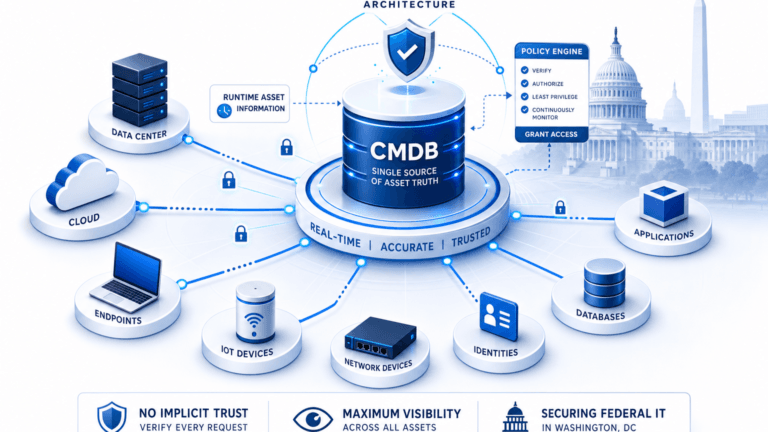
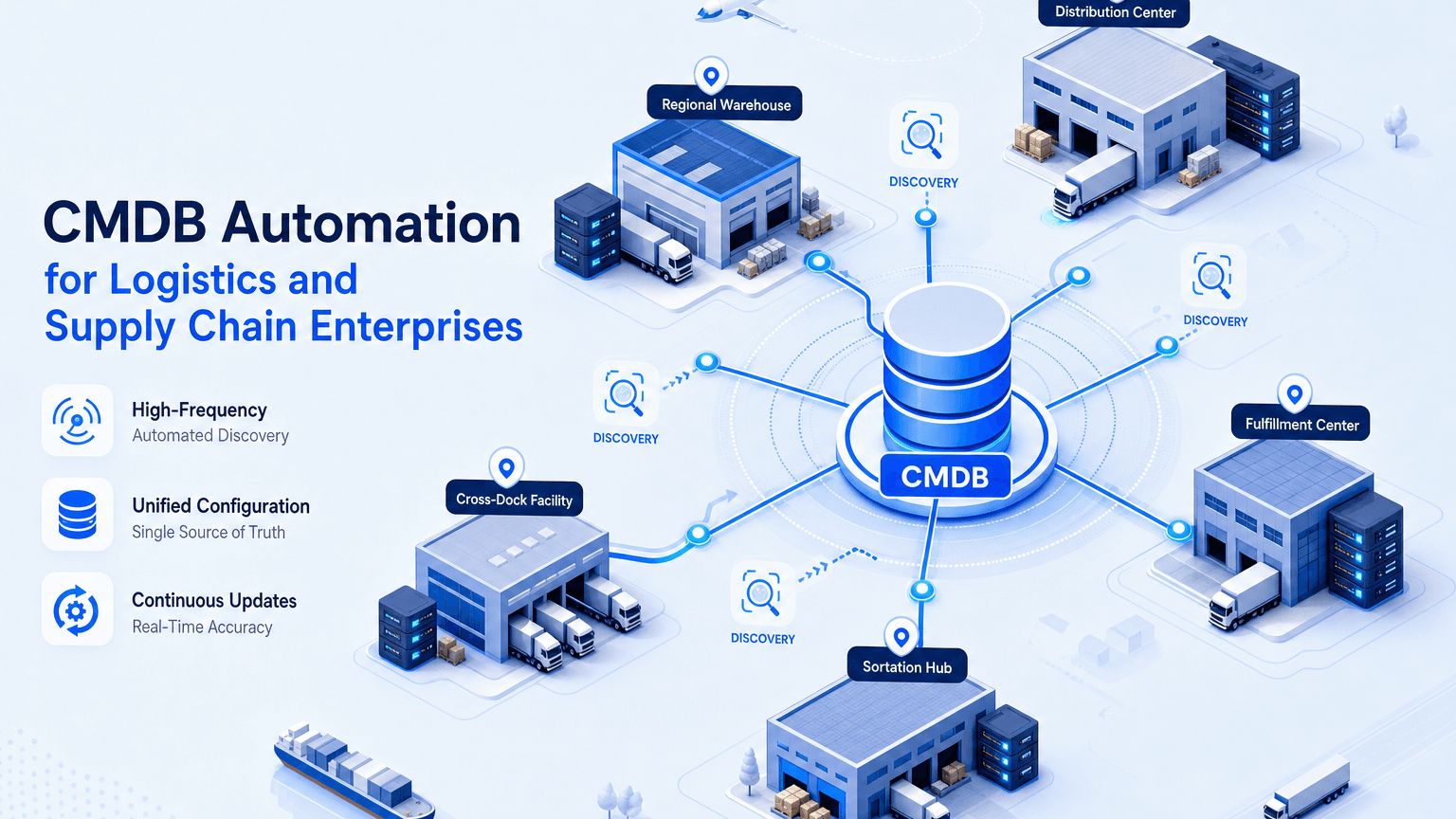
CMDB automation in this setting means high-frequency, protocol-based discovery cycles that repopulate and reconcile configuration items from what is reachable in the environment, then feed service maps and ITSM workflows. It is not a promise of passive, event-by-event streaming on every warehouse device. It is a deliberate operating model: discover on a schedule dense enough for the rate of change, reconcile by rule, and map dependencies once service definitions exist.
Discovery usually combines methods. Agentless probes use credentials and protocols such as SNMP, WMI, SSH, and ICMP across network and server estates. Agents deepen inventory on Windows, macOS, and Linux where installed. API-based collection covers cloud and virtualization platforms such as AWS and Azure. For warehouse floors, coverage for scanners, controllers, and sensors applies where devices are network-accessible and speak supported protocols. Proprietary or isolated OT segments still need an honest boundary conversation.
Reconciliation matters as much as collection. When two sources disagree, authority rules decide which field wins instead of silently accepting whichever job finished last. Duplicate CI prevention and full history give CMDB owners something to defend in audit and in post-incident review.
Dependency and service mapping turns current CI data into blast-radius views for change and incident work. Service composition (which applications and sites make a business service) is still provided by the team or by architecture imports. Map building and refresh then follow from discovered relationships rather than from redrawing every Visio by hand.
This layer is built to augment ITSM platforms already in place. Data can feed ServiceNow, Jira Service Management, Ivanti, HaloITSM, Xurrent, Hornbill, and related systems through integration rather than a rip-and-replace story. See Virima’s integrations hub for the partner list in one place.
Virima’s IT Discovery, ITOM / CMDB, and ViVID™ service mapping capabilities sit on that model: scheduled multi-method discovery, rule-based reconciliation, and dependency maps that stay aligned as infrastructure changes after service definitions are supplied.
| CMDB owners |
|---|
| Reduce data decay with discovery-sourced Trusted Runtime Truth before the next multi-site change window. |
How does CMDB automation differ from a one-time discovery project?
A project freezes inventory at go-live. Automation repeats discovery on a defined cycle, applies authority rules when sources conflict, and refreshes dependency maps so the CMDB tracks facility growth instead of a single baseline.
Applying This to a Multi-Site Logistics and Distribution Network
Picture a logistics network operating dozens of Atlanta-area facilities plus regional hubs. Three moments show where automation earns its keep.
New facility onboarding. When a distribution center goes live, discovery jobs bring network devices, servers, and protocol-reachable edge gear into the CMDB without staffing a weeks-long clipboard audit for every subnet. ITAM lifecycle and warranty fields can follow serial-driven hardware records so stockroom and floor assets share one lifecycle view. Ownership and location attributes still need process discipline. Discovery removes the blind spot of devices that never entered the register.
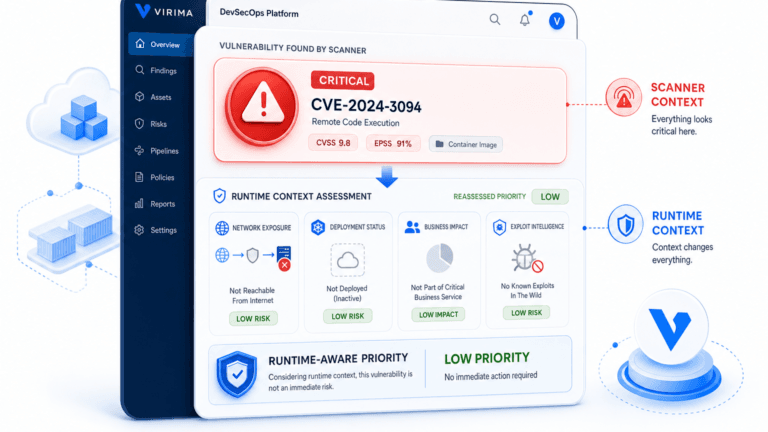
Incident response. When a site link or core service fails, ViVID™ maps help responders trace installed-on, runs-on, and network dependency paths after services are defined. Virima materials report materially faster mean time to repair in mapped environments, including an 82% faster MTTR figure in company reporting. Treat that as vendor-reported performance context, not an industry benchmark study. The operational point holds either way: current relationships shorten the “what else breaks” debate on the bridge call.
Integration and consolidation. During a merger-style network join, two incomplete inventories produce duplicate CIs, colliding names, and unknown shared services. An authority-based CMDB with discovery behind it gives integration leads a single working set to normalize, instead of merging two stale spreadsheets after cutover. The same pattern applies when a parcel or rail operator consolidates data centers while edge sites keep opening.
Across these moments, the automation story stays additive to the ITSM system of record. Discovery and mapping improve the quality of CIs and relationships that change, incident, and asset workflows already consume.
For Atlanta operators under the same growth pressure described above, the decision is whether CMDB practice matches the physical expansion rate the industrial market is already printing.
| Next step for multi-site ops leaders |
|---|
| Request a demo to see discovery, CMDB reconciliation, and ViVID™ dependency views against a distributed logistics-style estate. |
Matching CMDB Practice to Atlanta’s Logistics Pace
Metro Atlanta’s logistics identity is not a slogan. It is interstate density, a top global airport node, Fortune-scale parcel and rail headquarters, supply-chain software HQ presence, and industrial stock that still absorbs and builds at scale. That reality multiplies configuration items across warehouses, terminals, and fulfillment nodes faster than point-in-time CMDB habits can follow.
Discovery-led CMDB automation, rule-based reconciliation, and service mapping give IT operations and configuration teams a way to keep records aligned to the floor without linear headcount growth. Virima focuses on that trusted runtime truth layer for hybrid estates and feeds the ITSM platforms logistics enterprises already run. Teams that treat CMDB hygiene as a quarterly project will keep describing networks that no longer exist. Teams that treat discovery as an operating rhythm will enter incidents and expansions with a register they can defend.
If you own CMDB quality across a growing Atlanta logistics or distribution footprint, schedule a working session to pressure-test discovery coverage, reconciliation rules, and blast-radius views against your site topology.
Frequently Asked Questions
What is a CMDB, and why does it matter for logistics and distribution operations?
A configuration management database stores configuration items and their relationships so change and incident teams can see what depends on what. In logistics, those items span corporate systems plus gear in many warehouses and terminals, so stale records delay recovery and raise change risk.
How is CMDB automation different from IT asset management (ITAM)?
ITAM focuses on lifecycle, financial, contract, and inventory control of assets. CMDB automation focuses on keeping configuration items and relationships current through discovery and reconciliation so operations and service maps stay trustworthy. Many teams run both on shared discovery data.
How do you track scanners, edge devices, and network equipment across many warehouse sites?
Use scheduled agentless and agent discovery against network-accessible, protocol-compatible devices, then reconcile results into the CMDB by authority rules. Isolated or proprietary OT fleets may need complementary sources; do not assume every handheld is visible without network reachability.
How does CMDB automation help during a facility expansion or network merger?
High-frequency discovery brings new site subnets and hosts into inventory faster than clipboard onboarding. During consolidation, rule-based reconciliation and clean relationship data reduce duplicate CIs and hidden shared-service risk before cutover.
Does CMDB automation replace ServiceNow or Jira Service Management?
No. Discovery and CMDB automation are designed to enrich the ITSM platforms logistics enterprises already use, including ServiceNow and Jira Service Management, by supplying fresher CIs and relationships rather than forcing a platform swap.