Cybersecurity and IT Asset Visibility via CMDB: The Complete Guide to Securing What You Can Actually See

When the cybersecurity heads of five nations (the United States, United Kingdom, Canada, Australia, and New Zealand) collectively sign a statement and publish it through CISA, it signals a global consensus rather than a geo-specific issue. The Five Eyes intelligence alliance addressed enterprise boards and executives directly in a joint statement published June 22, 2026, with their first practical recommendation: “Reduce your attack surface: Limit unnecessary system access and external connectivity. Challenge whether systems need to be exposed at all and isolate those that do not.”
Twelve days earlier, CISA had issued Binding Operational Directive 26-04, replacing blanket patch deadlines with a four-variable risk model that determines whether a vulnerability must be fixed in three days or deferred to the next system upgrade. The first variable: asset exposure. Is the vulnerable asset reachable from the internet? Every remediation timeline in the directive is contingent on answering that question accurately, for every asset, continuously.
Per Verizon’s 2026 Data Breach Investigations Report, cited by CISA in their Patch Smarter, Not Harder blog on the same day BOD 26-04 was issued, only 26% of vulnerabilities on the Known Exploited Vulnerabilities catalog were fully remediated by organizations in 2025, down from 38% the year before, with median resolution time rising to 43 days. Organizations applying equal urgency to thousands of vulnerabilities simultaneously produce effective urgency on none of them.
CrowdStrike’s 2026 Global Threat Report found that 82% of detections in 2025 involved no malware. Adversaries moved through environments using valid credentials, trusted identity flows, and approved SaaS integrations, exploiting the visibility gaps between security tools rather than triggering them. Signature-based controls cannot catch an attacker using a legitimate account to perform actions a legitimate user also performs. The signal is behavioral deviation, and behavioral deviation requires a baseline, which requires knowing what assets exist.
This article covers what the asset visibility problem looks like operationally in 2026, why the security stack most enterprise teams have built leaves a structural gap underneath their controls, and what the infrastructure layer that closes that gap actually does.
Why Asset Visibility Became the Foundation of Enterprise Cybersecurity in 2026
For most of the last decade, enterprise cybersecurity investment flowed into detection and response: EDR platforms, SIEM deployments, threat intelligence feeds, SOC buildouts. The assumption embedded in that investment was that the perimeter was knowable, and that the job was to monitor it. The threat landscape in 2026 has made that assumption operationally expensive.
The average eCrime breakout time fell to 29 minutes in 2025, with the fastest observed case at 27 seconds, according to CrowdStrike’s 2026 Global Threat Report. In one documented intrusion, data exfiltration began within four minutes of initial access. The actors maintaining persistent access were moving through blind spots: assets outside standard monitoring, systems with stale records, infrastructure that security tools had no baseline for because it had never been accurately cataloged.
The regulatory response arrived in a concentrated 20-day window. On June 2, Executive Order 14409 directed federal agencies to harden civilian systems against AI-accelerated threats and extend equivalent posture to private-sector critical infrastructure operators. On June 10, CISA issued Binding Operational Directive 26-04. On June 22, the Five Eyes alliance published their joint statement to enterprise boards. Three coordinated signals, one operational prerequisite: know what you have, know what is exposed.
BOD 26-04 replaces CVSS severity scores as the primary remediation driver (a methodology CISA explicitly retired) with four binary questions evaluated per vulnerability, per asset: is the asset publicly exposed, is the CVE on the Known Exploited Vulnerabilities catalog, can exploitation be automated by an adversary, and does exploitation yield partial or total control of the asset. The combination of those four answers determines whether the remediation deadline is three days, fourteen days, sixty days, or deferred to the next scheduled system upgrade.
CISA’s rationale is direct: cyber threat actors exploit unpatched vulnerabilities, and their use of AI may further narrow the time defenders have to react between patch release and possible exploitation. In an initial analysis at one large civilian agency, only 1% of vulnerability instances fell into the three-day category, and over 60% were deferred to the next system upgrade. The framework concentrates remediation effort on the vulnerabilities that actually represent exploitable risk, rather than treating a low-risk internal finding with the same urgency as a publicly exposed, actively exploited, automatable flaw.
Variable 1 in that framework (asset exposure) is answered entirely by the quality of an organization’s asset inventory. A vulnerability on an internet-facing server triggers a three-day clock. The same vulnerability on an internal system with no public exposure may defer to the next upgrade cycle. Organizations without current, accurate asset inventory data cannot enter the decision tree. They default to treating everything as equally urgent, which, as the 26% KEV remediation rate confirms, produces the same result as treating nothing as urgent at all.
The Asset Visibility Gap: What It Looks Like in a Real Enterprise Environment
Vulnerability scanners return findings on assets that have no corresponding CMDB record. Network discovery tools surface devices that no team owns. Cloud cost reports list workloads that never went through standard provisioning. Each represents an asset that exists in the environment and is absent from the inventory.
Trend Micro’s research published at RSA Conference 2025, drawing on a global study of over 2,000 cybersecurity leaders, found that 74% had experienced security incidents due to unknown or unmanaged assets. 91% acknowledged that attack surface management is directly connected to their organization’s business risk. 43% use dedicated tools to proactively manage it.
Cloud workloads are the most chronically undercounted. Development teams spin up instances outside standard provisioning pipelines. Temporary environments become permanent. Multi-cloud estates across AWS and Azure generate assets faster than any manual update cycle can track. Trend Micro’s 2025 Defenders Survey found that nearly 20% of security teams identified cloud assets as the hardest category to maintain an accurate, up-to-date inventory on.
Edge devices (VPNs, firewalls, routers, and network appliances) sit outside most EDR coverage by design. CrowdStrike’s 2026 Global Threat Report found that China-nexus actors grew activity 38% year over year, with 40% of that activity targeting edge devices specifically. Exploits on edge devices were weaponized within two days of disclosure in documented 2025 campaigns, precisely because these systems are frequently unmonitored and infrequently inventoried.
Legacy on-premises systems are known (they appear in the CMDB), but their records are stale. Software versions are undocumented. Network exposure status has changed since the last manual update. The Five Eyes statement published June 22, 2026 named legacy systems explicitly: “Unsupported systems are easy targets. They are not just technical debt, they are strategic liabilities.”
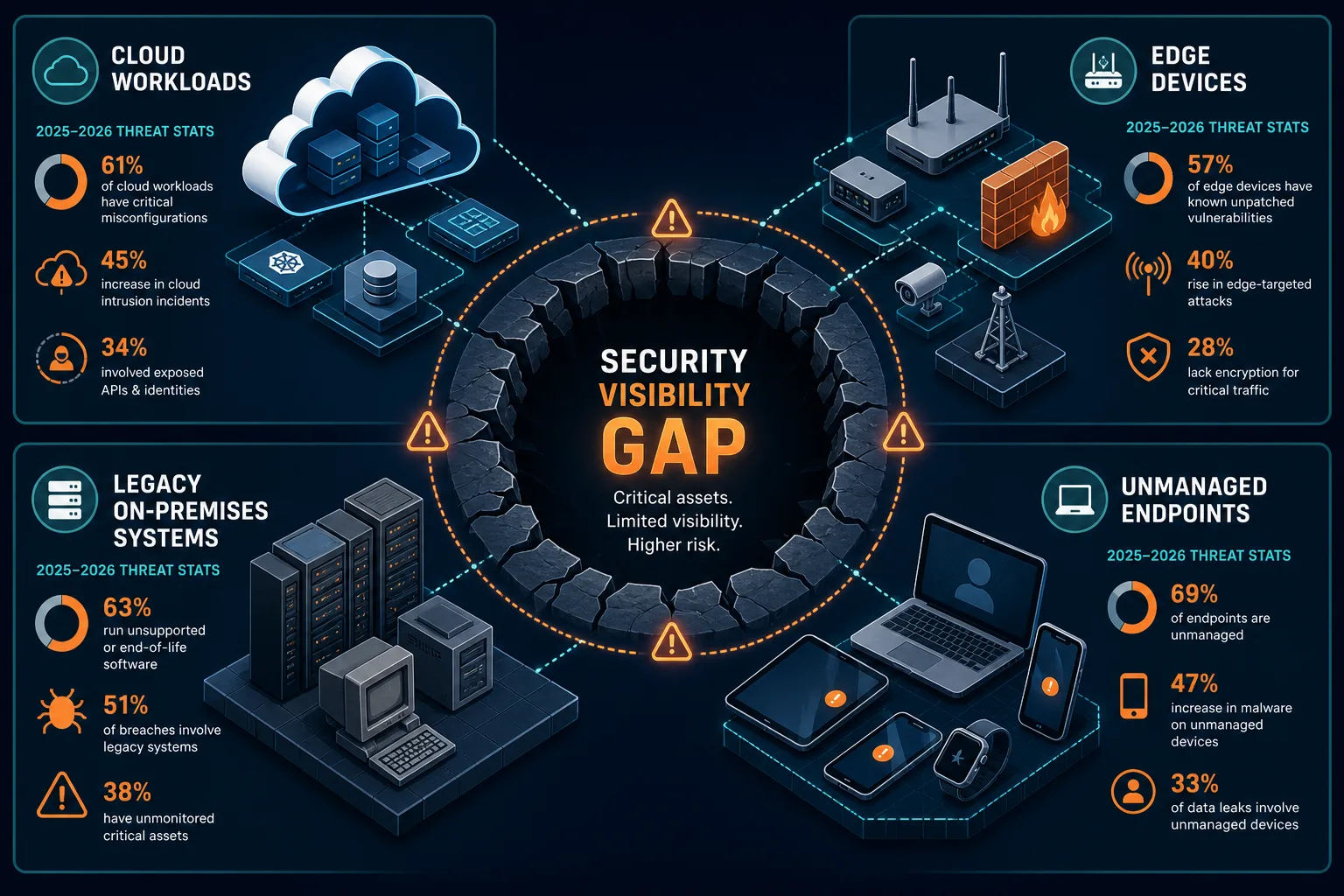
Unmanaged endpoints (personal devices, contractor equipment, IoT hardware) complete the picture. Verizon’s 2025 Data Breach Investigations Report found that 46% of compromised devices with corporate logins were non-managed systems. Devices that carry legitimate credentials into the environment without appearing in any inventory create access paths that identity controls alone cannot close.
The EZO 2026 State of IT Maturity Report found that 16% of organizations still rely on spreadsheets as their primary system of record for asset tracking, and 53% use CMDB or ITSM platforms. The inventory is only as current as the last time someone updated it, and in environments where assets change daily, manual update cycles produce records that are structurally behind the actual environment.
What causes IT asset visibility gaps in enterprise security? The four primary sources are cloud workloads provisioned outside standard pipelines, edge devices excluded from EDR coverage, legacy on-premises systems with stale CMDB records, and unmanaged endpoints carrying legitimate credentials without appearing in any inventory. Each category creates attack surface that security tools cannot monitor, prioritize, or assign to an owner.
How CMDB Accuracy Directly Affects Vulnerability Management
A vulnerability scanner returns findings against assets. Whether those findings become remediation actions depends entirely on what the CMDB knows about each asset: who owns it, whether it is internet-facing, what systems depend on it, and how critical it is to business operations. A scanner finding on an asset with no CMDB record cannot be prioritized, assigned, or tracked to closure.
A record 48,185 CVEs were published in 2025. Security Boulevard’s analysis of 2026 vulnerability data found 131 new CVEs disclosed per day, with 38% rated High or Critical. No enterprise security team patches everything. The operational question is what gets patched first, and that question cannot be answered without asset context.
The speed of exploitation makes sequencing non-negotiable. Mandiant’s M-Trends 2026 report puts estimated mean time to exploit at negative seven days: exploitation routinely occurs before a patch is available, compared to a 63-day window in 2018. The April 2026 Qualys enterprise patch benchmark found mean time to remediation for complex enterprise applications at 5 months and 10 days. Palo Alto Networks Unit 42 found opportunistic scanning for newly disclosed CVEs begins within roughly 15 minutes of publication.
BOD 26-04’s Variable 1 (asset exposure) determines which remediation clock applies. But answering it requires more than knowing an IP address exists. Risk-based vulnerability management requires four asset attributes a current CMDB supplies: network exposure status, business criticality, ownership and remediation team, and relationships to other systems that determine impact scope. A CVE on a standalone development server and the same CVE on a server feeding a customer-facing payment application carry fundamentally different remediation urgency. That difference lives in the CMDB, not in the CVE.
Organizations that have operationalized this connection track unmatched vulnerabilities as a KPI: findings that arrive from scanners against assets with no corresponding CMDB record. Each unmatched finding is an asset the security team cannot prioritize, assign, or track to closure. Driving that count toward zero runs as a parallel track to remediation velocity. Vulnerability scanning surfaces assets the CMDB missed, and CMDB records provide the context that makes vulnerability findings actionable.
Houston-area energy enterprises managing mixed IT/OT estates face a specific version of the exposure problem: OT assets that were never designed for network connectivity are now reachable, and their inventory status in enterprise CMDBs is frequently incomplete or absent. CISA’s August 2025 joint guidance on OT asset inventory, issued with the FBI, NSA, and international partners, identified OT asset inventory as the foundational requirement for vulnerability management in critical infrastructure environments. IT asset visibility for Houston energy security teams covers the OT/IT inventory problem in the context of TSA compliance specifically.
How does CMDB accuracy affect vulnerability remediation speed? BOD 26-04 uses asset exposure as its first variable in determining remediation urgency. Without an accurate CMDB, an organization cannot answer whether a vulnerable asset is internet-facing, who owns it, or what depends on it. The result is default equal-urgency treatment for all findings, which produces the same remediation outcomes as no urgency at all.
Asset Visibility as the Prerequisite for Zero Trust Architecture
Zero trust architecture has a sequencing problem that most implementation guides understate. The frameworks (NIST SP 800-207, CISA’s Zero Trust Maturity Model 2.0, the DoD Zero Trust Implementation Guidelines published January 2026) all describe identity verification, micro-segmentation, and least-privilege access as the core mechanisms. What they also specify, consistently, is that none of those mechanisms can be implemented without first knowing what assets exist in the environment.
NIST’s zero trust implementation project identifies lack of adequate asset inventory as a primary barrier to ZTA adoption, specifically citing no clear understanding of what assets exist, their criticality, or the communications between them. The DoD Zero Trust Implementation Guidelines designate the Discovery Phase (collecting information on all assets, their configurations, and their interdependencies) as Phase Zero. Identity verification and access policy enforcement come after.
Gartner’s 2025 Strategic Roadmap for Zero Trust projects that 10% of large enterprises will have a mature and measurable ZTA program in place by end of 2026, up from less than 1% in 2023. The zero trust security market reached $48.43 billion in 2026. Every implementation depends on a continuously updated asset inventory as foundational infrastructure, an ongoing operational requirement that ZTA policy decisions query in real time, not a preparatory step completed before the real work begins.
NIST SP 800-207 describes the Policy Decision Point (the component that evaluates whether a subject should be granted access to a resource) as querying current asset state before making access decisions. ZTA enforcement is only as current as the inventory it queries. Assets never catalogued in the CMDB cannot be enrolled in the identity provider, cannot have access policies applied, and sit outside the ZTA perimeter regardless of what other controls are in place.
Washington DC’s federal IT environment represents the most concentrated deployment of zero trust mandates in the country. Federal agencies under BOD 26-04, FISMA, and Executive Order 14409 are simultaneously managing ZTA implementation and exposure-based vulnerability remediation, both of which run against the same underlying asset inventory. Zero Trust Architecture and CMDB for DC federal IT covers ZTA implementation dependencies, and NIST 800-53 control mapping via discovery-driven CMDB for government IT teams covers the audit and control mapping requirements in that environment.
Why does zero trust architecture require asset inventory before implementation? Every ZTA enforcement mechanism (identity verification, least-privilege access, micro-segmentation) requires knowledge of what assets exist. NIST SP 800-207 identifies lack of asset inventory as the primary barrier to ZTA adoption. An asset not in the CMDB cannot be enrolled in the identity provider, cannot have access policies applied, and sits outside the zero trust perimeter regardless of other controls.
The 82% Problem: Why Malware-Free Attacks Require Behavioral Visibility
When adversaries move through environments using valid credentials and legitimate administrative tools, signature-based detection has no signature to match against. The only signal available is behavioral deviation from a known baseline. Establishing that baseline requires knowing the asset exists, knowing its function, and having a CMDB record that reflects its current configuration and relationships.
A SOC analyst investigating anomalous activity on a server needs to know what normal looks like on that server: what processes it runs, what accounts access it, what external connections it makes, what volume of data it typically transfers. An asset with no CMDB record has no established baseline. Activity on that asset generates no alert because no reference point exists against which to evaluate it.
Mandiant’s M-Trends 2026 found the median time between initial access and handoff to a secondary threat group collapsed from over eight hours in 2022 to 22 seconds in 2025. Initial access brokers now deliver access directly on behalf of secondary groups, compressing the window defenders have to act before lateral movement begins. At that speed, detection cannot depend on signature matching. It depends on behavioral context, which depends on asset inventory.
The CISA blog published alongside BOD 26-04 addresses the living-off-the-land technique directly: adversaries using tools and credentials already present in the environment are better addressed through hardened system configurations and network segmentation than through patching. Both controls depend on asset visibility. Hardening a configuration requires knowing the asset’s current state. Segmenting traffic requires knowing the asset’s communication dependencies.
Check Point’s Cyber Security Report 2026 identified continuous exposure created by misconfigurations, identity weaknesses, and unmanaged assets as a consistent condition across multiple breached environments in 2025. Assets outside the inventory accumulate configuration drift, receive no monitoring baseline, and present an attack surface that behavioral detection tools have no reference point to evaluate.
Atlanta’s enterprise cybersecurity cluster (anchored by SecureWorks, Georgia Tech’s Institute for Information Security and Privacy, and a concentration of financial technology and payment processing firms) operates security operations programs that run directly into this problem. IT asset visibility for Atlanta cybersecurity teams covers what that looks like operationally for security programs in that market.
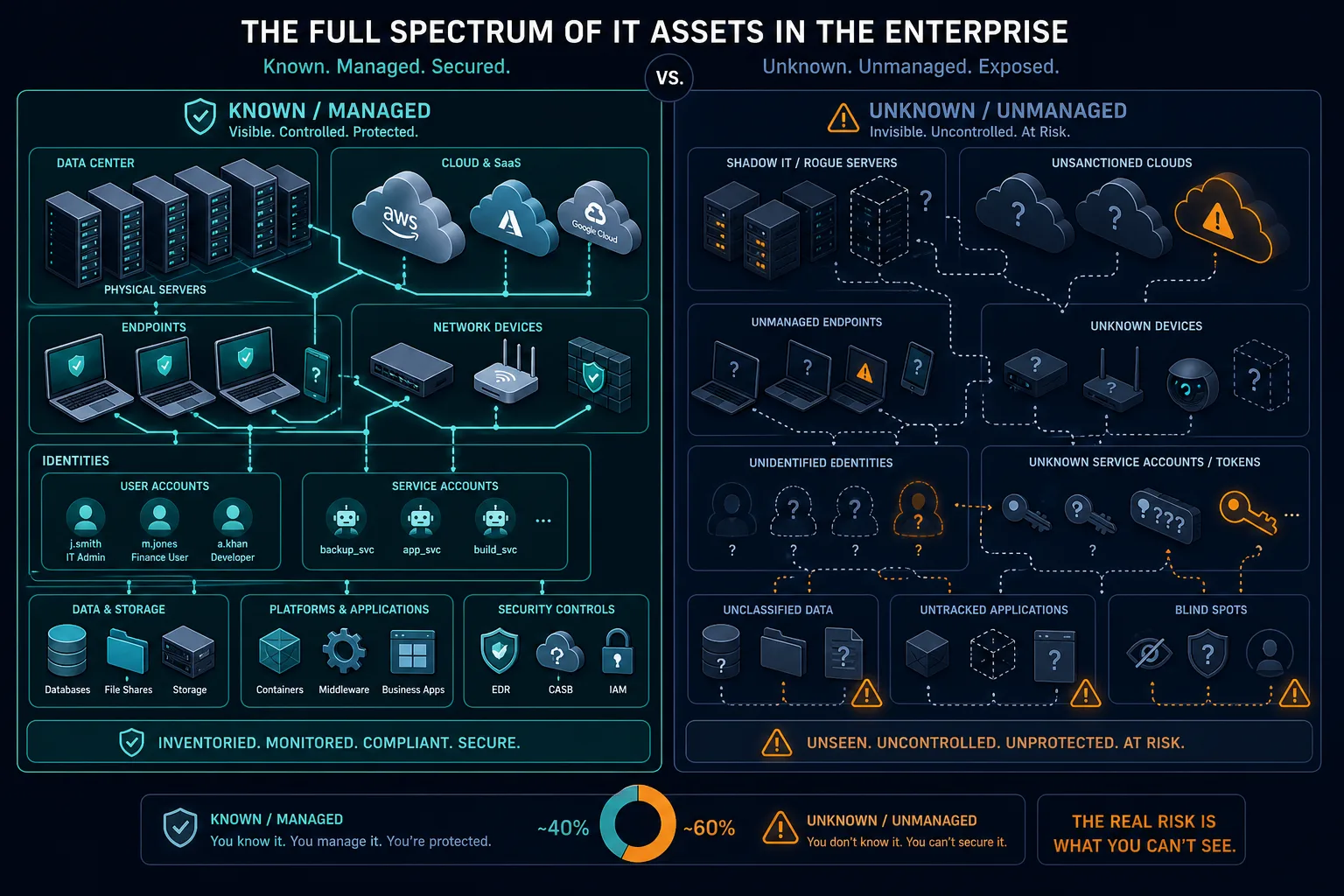
How does asset visibility support behavioral threat detection? Behavioral detection requires a known baseline for each asset: what processes it runs, what accounts access it, what external connections it makes. An asset with no CMDB record has no baseline. Without a reference point, anomalous activity generates no alert. The 82% of 2025 detections that involved no malware exploited precisely this gap in unmonitored, uninventoried assets.
Incident Response Depends on Knowing Your Scope
When a breach is detected, the most consequential question is what the impact scope is and which systems are affected. The answer determines the containment strategy, the remediation perimeter, the regulatory notification obligations, and, for public companies under the SEC’s four-business-day material incident disclosure rule, what gets filed and when.
Mandiant’s M-Trends 2026 found global median dwell time at 14 days in 2025, with espionage campaigns and nation-state operations running a median of 122 days. An organization discovering a breach after 122 days of attacker presence needs to reconstruct what was accessed, what was modified, and what was exfiltrated across that entire window. That reconstruction depends on knowing what systems existed in the environment during that period, what their configurations were, and what their normal access patterns looked like. A CMDB with stale or incomplete records makes that reconstruction an estimate rather than an audit.
The report states the operational consequence directly: if an organization cannot prove the scope of an intrusion due to logging gaps, it risks being forced to assume and disclose a worst-case data theft scenario. The SEC’s cybersecurity disclosure rules require public companies to disclose material incidents within four business days of a materiality determination, describing the nature, scope, and timing. Scope is an asset inventory question. An organization that cannot accurately enumerate affected systems cannot make a defensible materiality determination on the timeline the rule requires.
Containment carries the same dependency. Containing a breach requires understanding which systems communicate with the compromised asset, which credentials it shares, and which downstream services depend on it. An accurate dependency map produces a containment boundary. An incomplete one produces a containment guess, and containment guesses frequently result in reinfection as the attacker moves through paths the response team did not know existed.
Federal agencies under BOD 26-04 must complete forensic triage of the highest-risk assets within the same three-day remediation window, determining whether the asset was compromised before the patch was applied.
What High-Frequency Discovery Actually Means, and Why Periodic Scanning Falls Short
Enterprise IT environments change faster than any scheduled scan cycle can track. A cloud workload provisioned on Tuesday, a contractor device connected on Wednesday, a SaaS integration approved on Thursday: each expands the attack surface before the next discovery run captures it. The gap between when an asset enters the environment and when it appears in the CMDB is the window during which it carries no security controls, no monitoring baseline, and no ownership assignment.
Periodic scanning produces point-in-time inventory. An asset discovered in a Monday scan may be decommissioned by Wednesday and replaced by three new instances by Friday. The Monday record persists in the CMDB as active. The three new instances have no records. Vulnerability management programs running against that CMDB are prioritizing remediation on a ghost and missing three live attack surfaces.
High-frequency discovery runs across multiple sources simultaneously (network traffic analysis, cloud provider APIs, agent-based telemetry, agentless probing, and ITSM event feeds), keeping CMDB records current as the environment changes. New assets appear in the inventory within minutes of entering the environment. Decommissioned assets are flagged rather than silently persisting as active records. Gartner’s research on continuous exposure management found that organizations adopting continuous exposure management approaches are three times less likely to suffer breaches than those relying on periodic assessment cycles. BOD 26-04’s Required Action 7 (continuously identify and tag all agency-owned assets reachable from outside the agency network) uses the word continuously deliberately. The three-day remediation clock for the highest-risk vulnerabilities requires inventory that reflects the environment as it exists now.
Misconfigurations caused or worsened 28% of security incidents in enterprise environments in 2025, according to Panaseer’s 2026 security metrics research. Configuration drift (the gradual divergence between a system’s documented state and its actual running state) accumulates in the gaps between periodic scans and is invisible until it becomes the attack surface an adversary exploits.
What is the difference between periodic and high-frequency IT asset discovery? Periodic scanning produces a point-in-time snapshot. In environments where assets are provisioned daily, records become structurally outdated within hours. High-frequency discovery runs across cloud APIs, agent telemetry, and ITSM event feeds simultaneously, keeping CMDB records current as the environment changes. Gartner found organizations using continuous exposure management are three times less likely to experience breaches.
CMDB as the Security Operations Layer: How It Connects to Your Existing Stack
Most enterprise security teams operate a stack built around a SIEM, an EDR platform, a vulnerability scanner, and increasingly a SOAR layer for automated response. Each tool generates findings, alerts, and tickets. The quality of what they produce is determined by the asset context they can access, and that context lives in the CMDB.
A SIEM correlates events across systems to identify attack patterns. An alert that an unusual process executed on a server is more actionable when the SIEM knows that server hosts a regulated application, was recently modified in a change window, and has three downstream dependencies that would be affected by isolation. Without that context, the alert is a data point. With it, the alert is a prioritized incident with a defined impact scope and an assigned owner.
EDR coverage metrics (the percentage of endpoints with an active agent) are only meaningful against a known total. An organization that believes it has 94% EDR coverage may have 74% coverage if its asset inventory is incomplete. Panaseer’s 2026 security metrics research identified this directly: low vulnerability counts can result from insufficient scanning coverage rather than a strong security posture. The denominator in every coverage metric is the CMDB.
Vulnerability scanners produce findings that require CMDB context to become remediation actions. A scanner identifies a CVE on an IP address. The CMDB translates that IP address into an asset record with an owner, a business function, an exposure status, and a set of system relationships. The finding routes to the right team with the right priority and the right SLA. Organizations integrating scanner output with CMDB records track remediation velocity, SLA compliance by severity tier, and unmatched findings as parallel metrics.
SOAR platforms automate response playbooks against CMDB data at each step. The isolation action needs the asset’s network position and dependencies. The credential revocation needs which accounts are associated with the asset. The owner notification needs to know who is responsible for it. A SOAR platform running against a stale CMDB automates the wrong actions at speed, the same misconfiguration risk that applies to manual response, amplified by automation velocity.
The Infrastructure Layer: How Virima Delivers Runtime Truth for Security Teams
Virima runs agent-based and agentless discovery across on-premises infrastructure, public cloud environments (AWS and Azure), containers, virtual machines, and network devices. Discovery runs on high-frequency discovery cycles, keeping CMDB records current as configurations change across the estate. Assets are tagged with exposure status, environment type, and asset classification within the CMDB, providing the asset context that risk-based prioritization frameworks require.
ViVID™, Virima’s service mapping capability, builds and maintains relationship maps between CIs (application-to-server, server-to-network device, service-to-database). Those maps are what incident response teams run impact scope analysis against, what ZTA policy engines query for access decisions, and what change management teams use to assess downstream impact before a maintenance window.
Virima’s integration with the NIST National Vulnerability Database cross-references discovered assets against published CVEs, surfacing vulnerability findings with ownership and exposure context already attached. The output is a prioritized remediation queue organized by CVSS severity, asset criticality from the CMDB, and ViVID™ service map context, giving security teams a risk-ranked list that reflects both the vulnerability’s severity and the operational importance of the affected asset.
Bi-directional sync with ServiceNow, Jira, and other ITSM platforms closes the loop between discovery, vulnerability findings, and remediation tracking. A CVE identified against an exposed asset generates a ticket with the asset owner, the remediation SLA, and the dependency context pre-populated. Closure of that ticket updates the CMDB record. The loop between what exists, what is vulnerable, and what has been remediated runs without manual intervention.
What Changes When the CMDB Is Current
The question BOD 26-04 and the Five Eyes statement are both asking (in regulatory language and in intelligence-community language, respectively) is the same question a breach will ask in operational language: do you know what you have, and do you know what is exposed? When that question arrives at 2 AM on a Tuesday, attached to a SIEM alert and a four-business-day SEC disclosure clock, the answer either exists in the CMDB or it gets reconstructed under pressure from incomplete records. Reconstruction under pressure is how 122-day dwell times stay hidden. It is how containment guesses become reinfection events. It is how worst-case disclosure assumptions get filed.
The organizations that close this gap do not experience a dramatic transformation. They experience a quieter kind of operational confidence: patch windows that reflect actual exposure rather than theoretical severity, ZTA rollouts that stop stalling at the asset enrollment stage, incident scopes that are a query rather than a reconstruction, alert triage that runs against a baseline that actually exists. The security stack performs as intended because the layer underneath it finally reflects what is actually running.
Frequently Asked Questions
What is IT asset visibility and why does it matter for cybersecurity?
IT asset visibility is the ability to accurately identify, classify, and track every hardware and software component in an enterprise environment, including on-premises systems, cloud workloads, virtual machines, network devices, and endpoints. Every major security control (vulnerability management, zero trust enforcement, behavioral detection, and incident response) requires accurate knowledge of what assets exist and what state they are in. Assets outside the inventory receive no security controls, no monitoring baseline, and no remediation ownership.
How does a CMDB support vulnerability management?
A CMDB supports vulnerability management by providing the asset context that turns scanner findings into prioritized remediation actions. A scanner identifies a CVE on an IP address. The CMDB provides the owner, business criticality, exposure status, and dependency relationships for that address. BOD 26-04’s four-variable risk model uses asset exposure as its first variable, and without a current CMDB, that variable cannot be answered accurately. Virima’s NVD integration cross-references discovered assets against published CVEs and prioritizes findings by CVSS severity, asset criticality, and ViVID™ service map context.
What is the difference between high-frequency and periodic scanning?
Periodic scanning runs discovery on a schedule (weekly, monthly, or quarterly) and produces a point-in-time snapshot. High-frequency discovery runs across multiple sources simultaneously, including cloud provider APIs, network traffic analysis, agent telemetry, and ITSM event feeds, updating asset records as the environment changes. In environments where assets are provisioned daily, periodic scanning produces records that are structurally behind reality. BOD 26-04’s Required Action 7 explicitly mandates continuous identification and tagging of exposed assets, reflecting that point-in-time inventory is insufficient for risk-based vulnerability prioritization.
Does BOD 26-04 apply to private-sector organizations?
BOD 26-04 is legally binding on Federal Civilian Executive Branch agencies. Federal contractors whose contracts are modified to incorporate its requirements also come under its scope. For private-sector organizations outside those categories, the directive creates indirect pressure through two channels: federal contractors in supply chains face contractual compliance obligations, and the four-variable vulnerability prioritization model the directive codifies reflects the direction the broader enterprise security market is moving, as confirmed by the Five Eyes joint statement published June 22, 2026, which addressed the same recommendations directly to private-sector boards and executives.
How does asset visibility support zero trust architecture?
Zero trust architecture requires knowing what assets exist before enforcing least-privilege access on them. NIST SP 800-207 identifies asset inventory as a primary barrier to ZTA implementation. The Policy Decision Point (the core enforcement mechanism in zero trust) queries current asset state to evaluate access requests. An asset not in the CMDB cannot be enrolled in the identity provider, cannot have access policies applied, and sits outside the ZTA perimeter. The DoD Zero Trust Implementation Guidelines designate discovery as Phase Zero of ZTA deployment for this reason.
What does Virima do that conventional asset management tools do not?
Conventional asset management tools typically run infrequent discovery cycles and require manual updates to maintain accuracy. Virima runs agent-based and agentless discovery across hybrid environments on high-frequency discovery cycles, keeping CMDB records current as the estate changes. ViVID™ builds and maintains CI relationship maps that conventional tools do not capture, enabling impact scope analysis for incident response and change impact assessment. Integration with the NIST NVD surfaces vulnerability findings with ownership and exposure context attached, producing a remediation queue prioritized by CVSS severity, asset criticality, and ViVID™ service map context.
How does CMDB accuracy affect incident response timelines?
CMDB accuracy directly determines how quickly an organization can scope a breach, contain it, and meet disclosure obligations. Mandiant’s M-Trends 2026 states that organizations unable to prove the scope of an intrusion due to inventory gaps risk forced worst-case disclosure under the SEC’s four-business-day material incident rule. Containment requires accurate impact scope analysis: which systems communicate with the compromised asset, which credentials it shares, which downstream services depend on it. Inaccurate records produce inaccurate containment boundaries, which frequently result in reinfection.