Service Mapping for Retail and E-commerce: Preventing Checkout and Inventory Outages

During Easter weekend, a cyber incident disrupted point-of-sale terminals, contactless payments, and Click & Collect systems across stores operated by Marks & Spencer. The company suspended online fulfillment for six weeks while teams contained the breach and restored operational systems. Marks & Spencer later quantified the impact at approximately £300 million in lost operating profit, as reported by Euronews.
When digital storefronts and physical checkout lanes fail simultaneously, the root cause is rarely an isolated application error. Modern retail relies on shared middleware, payment gateways, and inventory synchronization pipelines that span cloud services and physical store hardware. When IT teams lack visibility into these underlying connections, a single configuration error or security event can cascade across online and in-store channels.
Service mapping for retail and e-commerce establishes an authoritative record of how business services depend on IT infrastructure. By linking checkout engines, inventory databases, and payment processors to their underlying configuration items, retail IT organizations can identify blast radii, evaluate change risks, and accelerate incident recovery.
What Is Service Mapping for Retail and E-commerce?
In ITIL Service Asset and Configuration Management (SACM) framework guidelines, service mapping identifies a named business service and renders the configuration items (CIs) that deliver it. These items include cloud servers, local database instances, middleware APIs, network switches, and point-of-sale endpoints.
In retail environments, service mapping connects customer-facing capabilities, such as Buy-Online-Pickup-In-Store (BOPIS) or mobile checkout, to technical infrastructure components. This operational mapping differs from customer journey mapping. While customer journey maps illustrate user touchpoints for experience design, IT service mapping charts technical dependencies to maintain system uptime and data integrity.
Annual holiday retail spend surpasses $1 trillion, according to data from the National Retail Federation. Delivering these sales volumes requires coordinated alignment across e-commerce platforms and store systems. When configuration data remains trapped in disconnected spreadsheets, technical dependencies stay hidden until system failures occur.
| Operational Situation | Hidden Dependency and System Impact |
|---|---|
| A payment gateway configuration update is deployed for e-commerce checkout | The gateway shares middleware with in-store card terminals. Unmapped dependencies cause payment processing failures across physical stores. |
| An inventory synchronization job relies on a shared middleware container | Unannounced middleware updates interrupt stock feeds between warehouse systems and the digital storefront, leading to stockouts or overselling. |
| A regional franchise location provisions an unapproved POS device vendor | Unrecorded hardware endpoints introduce unmonitored network connections, complicating PCI DSS scope boundary reviews during audits. |
| A third-party channel manager API experiences elevated network latency | Front-desk and store associates cannot distinguish whether order sync delays stem from local PMS hardware or external vendor endpoints. |
See how retail and e-commerce IT leaders establish Trusted Runtime Truth to eliminate checkout dependency blind spots and prevent multi-channel outages.
Why Is Service Mapping Important for E-commerce and Retail?
Retail operations operate under strict uptime requirements where system disruptions directly impair revenue generation and customer retention. During peak shopping events, such as Cyber Week, system availability dictates commercial performance.
High-density transaction volumes put continuous pressure on core infrastructure dependencies:
- Adobe Analytics reported that 2025 U.S. holiday online spend reached $257.8 billion, with mobile transactions driving 56.4% of web orders.
- Buy-Online-Pickup-In-Store (BOPIS) orders accounted for 35% of online fulfillment during the final week before Christmas, requiring synchronous data exchange between e-commerce carts and store inventory nodes.
- During Cyber Monday 2025, checkout disruptions impacted merchants across the Shopify network, as reported by NBC News.
- When core checkout infrastructure experiences downtime, operational losses accumulate rapidly across transaction processing, fulfillment logistics, and customer service teams.
Four Points Where Dependency Chains Snap
- Unmapped Payment Gateway Dependencies
IT teams modify payment gateway API settings for a web release without recognizing that store POS terminals use the same endpoint.
Result: In-store card readers fail to authorize transactions, forcing store staff to handle cash-only purchases. - Middleware Desynchronization Across Stock Feeds
A shared middleware service processing inventory updates encounters database lockouts during peak order volumes.
Result: The e-commerce site displays out-of-stock items as available, generating order cancellations and customer service backlog. - Pre-Holiday Change Deployments Without Blast-Radius Context
Engineering teams deploy a software patch to a central customer database before a holiday freeze without mapping downstream dependencies.
Result: The patch disrupts loyalty program authentication across mobile apps and store registers during peak trading hours. - Third-Party Vendor Disruption Spreading Across Channels
A cyber incident or infrastructure outage hits an external logistics or inventory vendor connected to core retail applications.
Result: The disruption spreads across digital ordering and physical fulfillment channels, delaying order processing across multiple weeks.
Why do retail checkout and inventory systems fail together during outages?
Retail checkout and inventory systems rely on shared middleware, unified payment gateways, and centralized databases. When IT teams update or manage these components in isolation without service mapping, a change in one system can unintentionally disrupt connected channels, causing widespread checkout and inventory failures.
Where the Damage Lands Across Retail Teams
For CIOs and IT Leadership
Unplanned outages during key shopping windows result in direct financial losses, reduced brand trust, and potential board oversight. CIOs require clear visibility into core business services to manage operational risk, allocate infrastructure investment, and ensure system resilience across all channels.
For IT Operations and CMDB Owners
Configuration managers spend substantial time attempting to manually track complex relationships between servers, cloud instances, and retail software modules. Maintaining these records through static spreadsheets is ineffective, as store rollouts, vendor updates, and cloud migrations quickly render manual documentation obsolete. Learn more in our guide on CMDB best practices and how to get it right.
For Store Operations and Fulfillment Teams
Store associates and warehouse staff rely on synchronized inventory systems to fulfill BOPIS orders and manage store stock. When IT system dependencies break, store personnel must rely on manual workarounds, leading to order fulfillment delays, inaccurate inventory counts, and customer dissatisfaction.
For Compliance and Security Teams
Retail IT infrastructure must comply with data protection standards, including PCI DSS requirements. While service mapping does not replace security controls or compliance audits, maintaining an accurate inventory of connected CIs provides visibility into systems that handle cardholder data. Review our analysis on the role of CMDB compliance in IT security.
How Service Mapping Fixes This
Establishing an accurate, discovery-driven service map addresses dependency gaps through three key mechanisms:

1. Discovery-Sourced Dependency Data
Automated IT discovery software continuously scans corporate networks, cloud environments, and store subnets to identify active hardware, software instances, and network connections. Scheduled discovery updates the CMDB automatically, replacing static diagrams with accurate operational records. To understand why manual tracking fails, explore our analysis of operating a CMDB without discovery.
2. Dependency Visualizations with ITSM Overlay
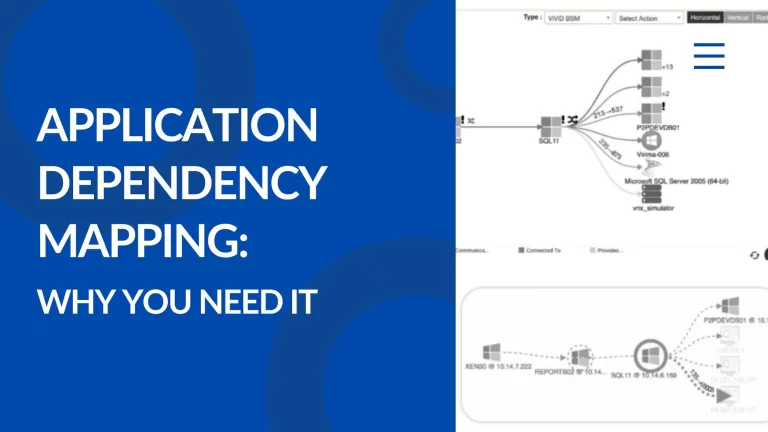
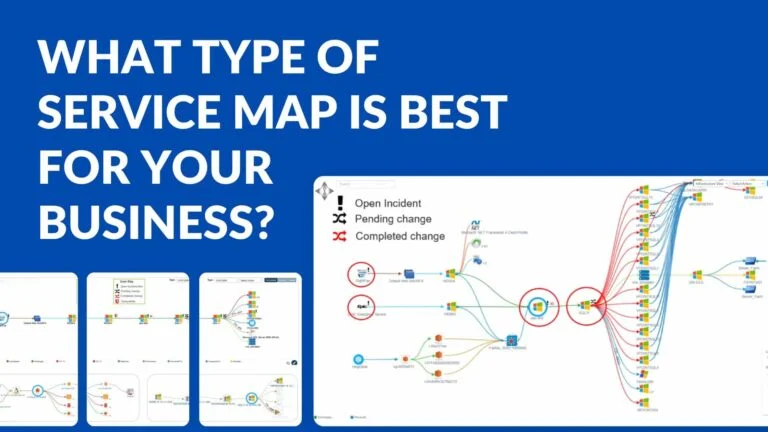
Dynamic ViVID™ service mapping maps dependencies between configuration items and customer-facing business services. By overlaying active ITSM incidents, open change requests, and known vulnerabilities onto the visual map, IT teams can assess change blast radii before approving system updates. For a foundational overview, read how business service mapping enables improved IT visibility.
3. Integration with Existing ITSM Workflows
Centralized dependency data connects directly into enterprise ITSM platforms, including ServiceNow, Jira Service Management, and Ivanti. Virima enriches existing IT service management workflows with discovery-sourced mapping data, ensuring change managers can evaluate dependency risks without leaving their primary tools. Learn how these integrations function in our guide to Halo integrations with Virima IT discovery.
Note on Capabilities: Virima discovers network-connected infrastructure, application dependencies, and cloud assets. Virima does not analyze client-side checkout scripts in web browsers or enforce PCI DSS network segmentation. It delivers the operational infrastructure map required for IT teams to manage service availability.
| Operational Dimension | Manual Spreadsheet Records | Discovery-Driven Service Mapping |
|---|---|---|
| Dependency Accuracy | Based on static diagrams created during initial deployment | Refreshed regularly via automated, high-frequency discovery scans |
| Incident Triage Effort | Requires manual cross-referencing of vendor logs across isolated teams | Displays affected CIs and upstream/downstream service impacts in one view |
| Change Risk Assessment | Relies on tribal knowledge and manual change review meetings | Visualizes exact blast radii and dependent services prior to change execution |
| Multi-Store POS Visibility | Requires manual inventory reconciliation across regional sites | Automatically indexes store hardware, local gateways, and server connections |
How does automated service mapping improve retail IT incident response?
Automated service mapping displays technical dependencies and active ITSM incidents on a single visual map. When a checkout or inventory system fails, IT teams can trace the incident directly to its underlying server, database, or API dependency, significantly reducing root-cause identification time.
How Virima Powers Service Mapping for Retail and E-commerce
Rapid Incident Resolution
During high-traffic shopping periods, ViVID™ service maps provide IT responders with an immediate visual representation of failing services and underlying CIs. Teams can identify root causes instantly, avoiding prolonged diagnostic discussions between application, infrastructure, and payment vendor leads.
Sustained Dependency Accuracy
High-frequency scheduled discovery ensures that system maps stay accurate as retail environments evolve. As stores add new POS terminals, update payment gateways, or expand cloud microservices, Virima automatically discovers new CIs and updates dependency records. To evaluate dependency mapping solutions, read our step-by-step guide to service dependency mapping tools.
Workflow Integration Across Hybrid Estates
Virima connects with existing ITSM ecosystems, enabling IT teams to access dependency maps directly within their current ticketing and change management platforms. For multi-store retail organizations operating under managed services models, explore our specialized MSP capabilities. Additionally, hardware asset lifecycles across store networks can be managed through our ITAM features.
Moving from Static Diagrams to Discovery-Driven Maps
Transitioning to automated service mapping involves shifting from manual documentation to a discovery-driven operational model:
| Current State | Future State |
|---|---|
| Manual network diagrams stored in static document repositories | Automated service maps updated via high-frequency discovery scans |
| Siloed management of online store and physical retail infrastructure | Unified dependency mapping across e-commerce, POS, and warehouse systems |
Implementation Steps for Retail IT Teams
- Identify Critical Business Services
Define core retail services, including e-commerce checkout, store POS authorization, BOPIS inventory sync, and loyalty processing. - Execute Network and Cloud Discovery
Run agent-based and agentless discovery scans across cloud environments, corporate data centers, and store networks to establish a baseline CI inventory. - Define Service Relationships in the CMDB
Map discovered software components, databases, and network paths to their corresponding business service definitions. - Overlay ITSM Workflows
Connect service maps to your ITSM change and incident management processes to visualize risk during operational updates. - Establish High-Frequency Scan Cadences
Schedule recurring discovery scans to maintain map accuracy across store rollouts, software updates, and seasonal infrastructure scaling.
Organizations seeking to build operational resilience can explore how Virima delivers Trusted Runtime Truth™ across complex IT environments. To see how ViVID™ service mapping visualizes dependencies across your retail ecosystem, request a demo with our team.
Frequently Asked Questions
What is service mapping for retail and e-commerce?
It is the practice of discovering and visualizing the IT infrastructure, databases, middleware, and third-party APIs that support retail business services like checkout, inventory sync, and POS processing to prevent outages and manage operational risks.
Why is service mapping important for e-commerce?
E-commerce relies on complex, interconnected systems including payment gateways, cart microservices, and inventory databases. Service mapping provides visibility into these dependencies, allowing IT teams to assess change blast radii and accelerate outage recovery.
How does service mapping help prevent checkout downtime during peak shopping periods?
Service mapping displays all underlying CIs tied to checkout services. Before deploying pre-holiday changes, IT teams can evaluate exact dependency risks, preventing unmapped software updates from accidentally taking down payment or ordering systems.
What is the difference between inventory sync monitoring and IT service dependency mapping?
Inventory sync monitoring tracks data flow errors between stock databases. IT service dependency mapping visualizes the underlying servers, network routes, database CIs, and middleware applications that enable inventory synchronization across channels.
Does service mapping help with PCI DSS scoping?
Yes. Service mapping discovers and documents the server infrastructure, database connections, and network endpoints connected to payment processing. This accurate infrastructure inventory helps security teams establish and maintain clear boundaries for PCI DSS scoping.