Tracking IT Systems Across Sprawling Campus Networks

When fall semester registration opens, a single university can push tens of thousands of students, faculty, and researchers onto shared systems at once. Identity platforms, learning management systems, research clusters, and residential Wi-Fi all take the surge together. Behind that surge sits a campus network that rarely looks like a single corporate LAN.
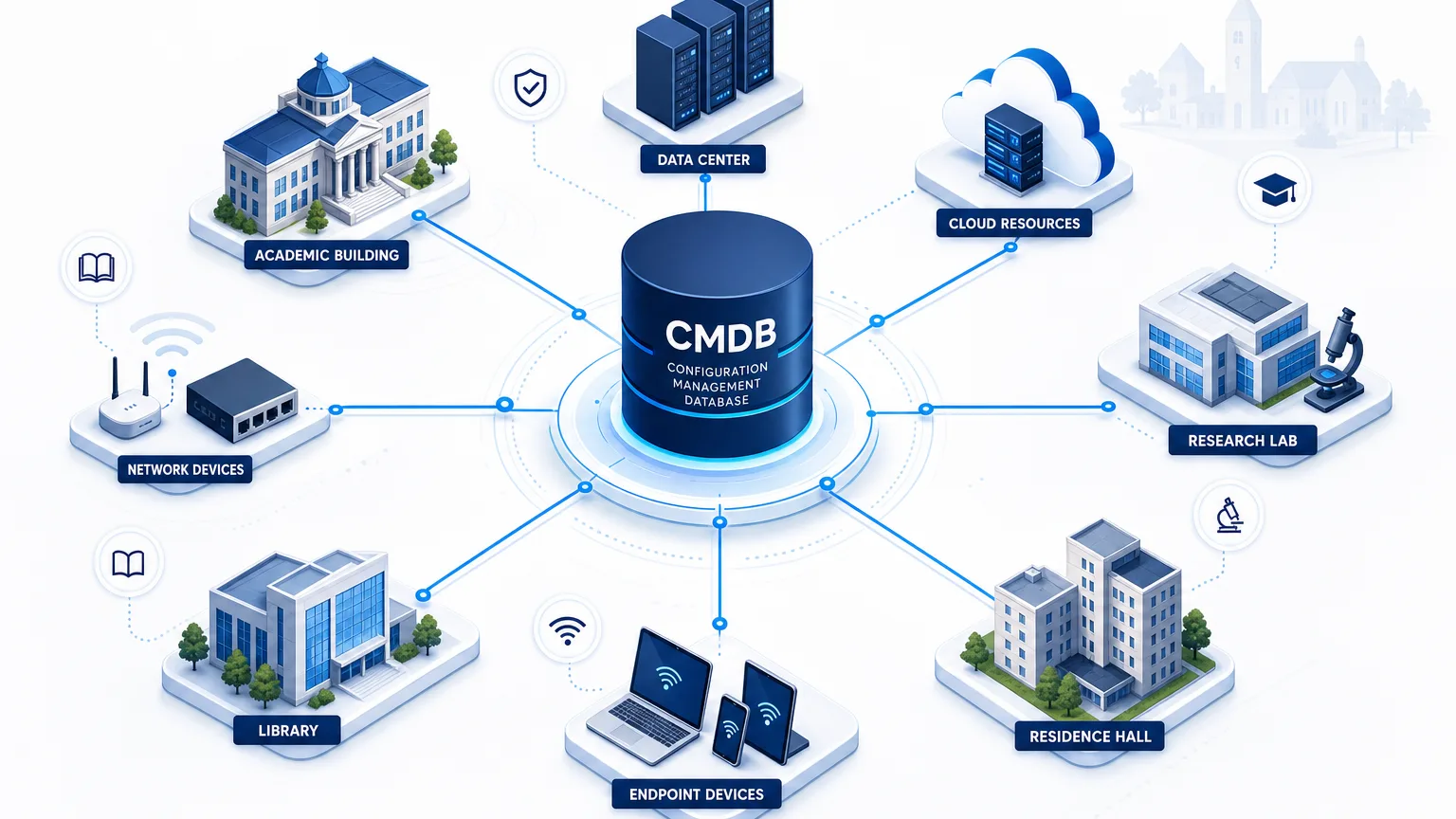
Academic buildings, medical clinics, research labs, athletics venues, residence halls, and satellite campuses each run their own mix of departmental servers, specialized lab hardware, and cloud-connected applications. Central IT is accountable for security, license compliance, and uptime, yet many systems remain owned and operated by colleges, institutes, or principal investigators.
When campus CIOs and directors of IT infrastructure rely on department spreadsheets or annual physical inventories, shadow systems and ghost hardware accumulate between audits. Tracking systems across sprawling campus networks requires continuous automated discovery, core-aware configuration management, and a single CMDB that central IT and distributed owners can trust.
Why is tracking systems across sprawling campus networks difficult for higher education IT?
Universities operate multi-building, multi-campus environments with departmental servers, research clusters, clinical systems, and student devices. Without automated discovery, central IT cannot maintain an accurate inventory for license audits, security baselines, or capital budget requests across colleges and institutes.
How campus networks fragment system visibility
Higher education IT is organizationally and technically federated. Central IT often runs the core network, identity platform, and enterprise ERP or student information system, while academic units deploy servers for research computing, specialized software, and instructional labs.
EDUCAUSE research on higher education technology identifies distributed ownership as a primary barrier to enterprise-wide asset and security programs. That gap is measurable: research cited by asset-visibility vendor runZero puts the average at just three security staffers per 10,000 students, faculty, and staff across higher education. That leaves little capacity for manual, spreadsheet-driven inventories. That fragmentation shows up as three recurring inventory failures.
1. Departmental shadow systems and unmanaged lab hardware
Faculty and lab managers purchase servers, GPU workstations, and network-attached storage with grant funds or department budgets. Devices join the campus network with limited central registration.
Between annual inventory cycles, those systems change hands, move buildings, or get replaced without CMDB updates. Security teams cannot confirm patch status, and license managers cannot prove installed software matches purchased entitlements. Capital planners still carry retired machines on financial records as ghost assets — a pattern our guide to tracking and auditing decommissioned IT assets breaks down in more detail. A continuous, multi-method discovery process closes that gap by re-scanning departmental subnets automatically instead of waiting for the next inventory cycle.
2. Multi-campus and hybrid cloud sprawl
Public universities and multi-college systems often support main campuses, regional centers, and online programs. Research groups also burst workloads into AWS and Azure while keeping on-premises high-performance computing clusters.
When cloud instances and campus VMs are tracked in separate tools, central IT loses a single view of what systems exist and who owns them. That gap also hides which business or academic services depend on them. Semester peaks then expose inventory gaps as outages, failed changes, or surprise license true-ups. A registration-week login surge is a predictable moment to test that inventory, not a discovery exercise IT wants to run for the first time under pressure.
3. Ownership records that do not survive turnover
Graduate researchers, postdocs, and student workers frequently administer lab servers and departmental applications, and that ownership rarely gets handed off formally when a person graduates or a grant ends. The device stays online, but the CMDB record still lists a contact who no longer has a campus account.
When an incident or license audit needs a real owner, IT ends up chasing department chairs and old email threads instead of a current record. Automated discovery that revalidates ownership and last-seen activity on every scan cycle catches these handoffs before they turn into an asset nobody can account for.
How does automated discovery help universities track systems across multi-campus networks?
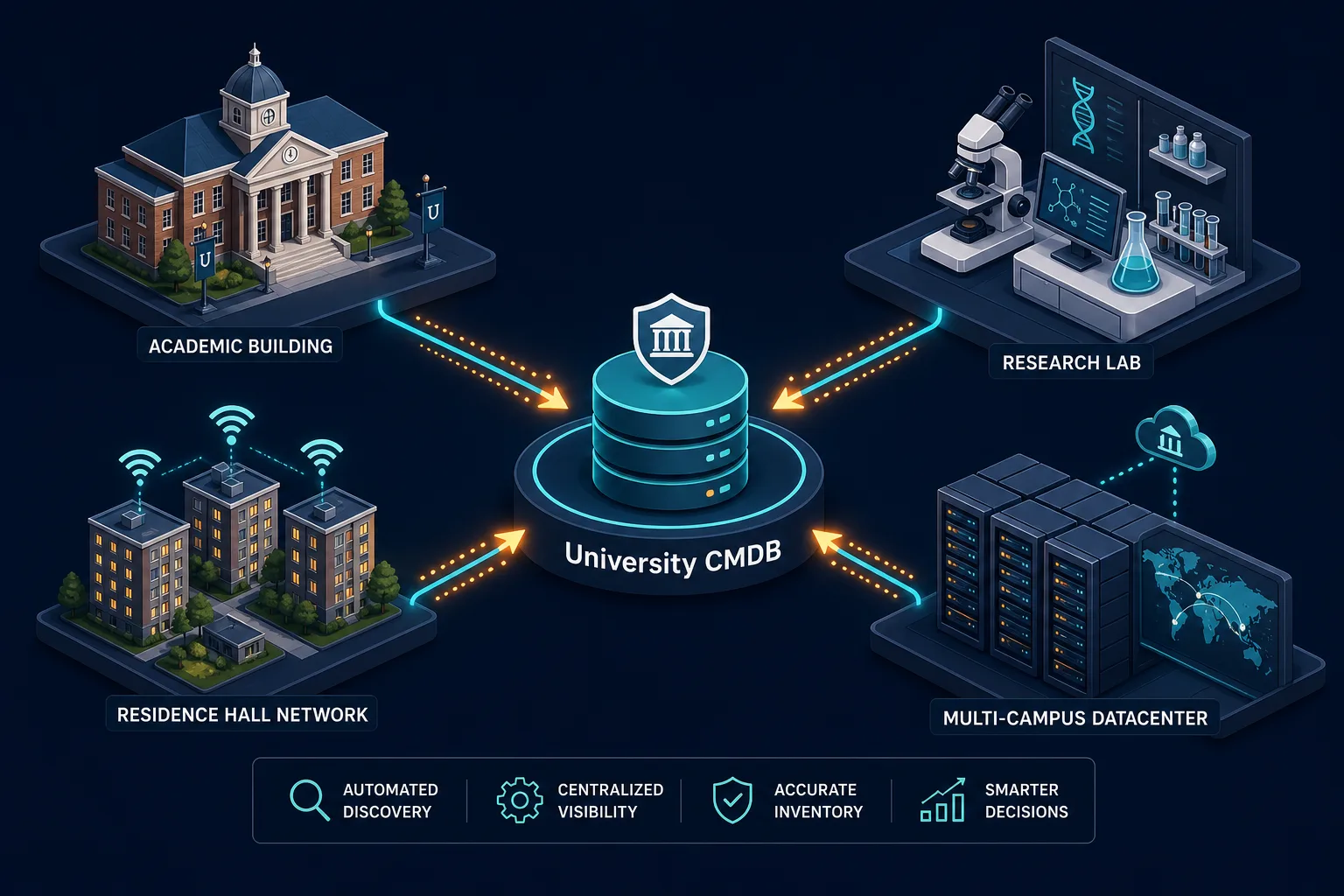
Automated discovery uses agentless probes, subnet collectors, and cloud API connectors to inventory servers, workstations, hypervisors, and installed software across academic buildings and satellite campuses. Results consolidate into one CMDB for audit, security, and service desk workflows.
Building discovery that respects academic network reality
Campus networks balance open research collaboration with regulated segments such as student records (FERPA), health clinics (HIPAA), payment systems (PCI-DSS), and research data controls. Discovery must work across segmented VLANs without disrupting instructional or research traffic.
Discovery architecture for higher education campuses
- Central Datacenter Probes: Agentless WMI, SSH, and SNMP collectors inventory enterprise servers, storage, and hypervisors that host student information systems, identity directories, and shared file services.
- Building and College Subnet Collectors: Localized gateway collectors scan departmental server rooms, instructional lab VLANs, and research subnets, then relay encrypted configuration metadata to the central CMDB.
- Cloud and Research Connectors: API integrations track AWS and Azure workloads used for teaching and research, capturing instance types, tags, and lifecycle events that batch spreadsheets miss.
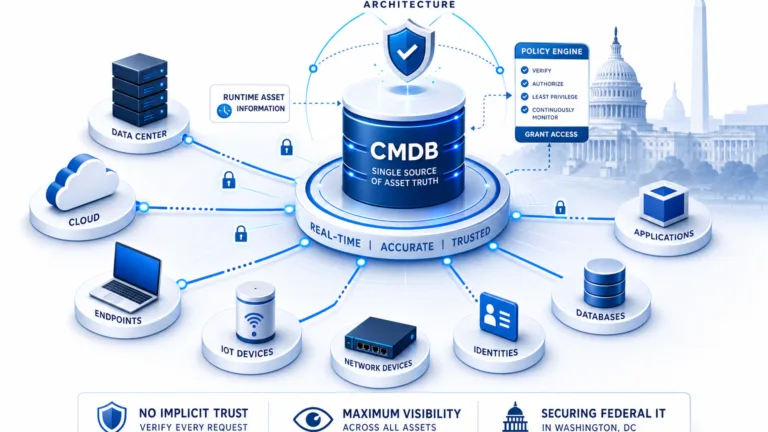
Consolidating these feeds gives directors of infrastructure a living inventory instead of a once-a-year snapshot, one that also underpins accurate IT asset management for license and lifecycle tracking — the foundation of reliable campus IT infrastructure tracking across every building and satellite site. To see how automated discovery connects with campus service desks, visit the Virima integrations hub.
From raw inventory to campus service and budget context
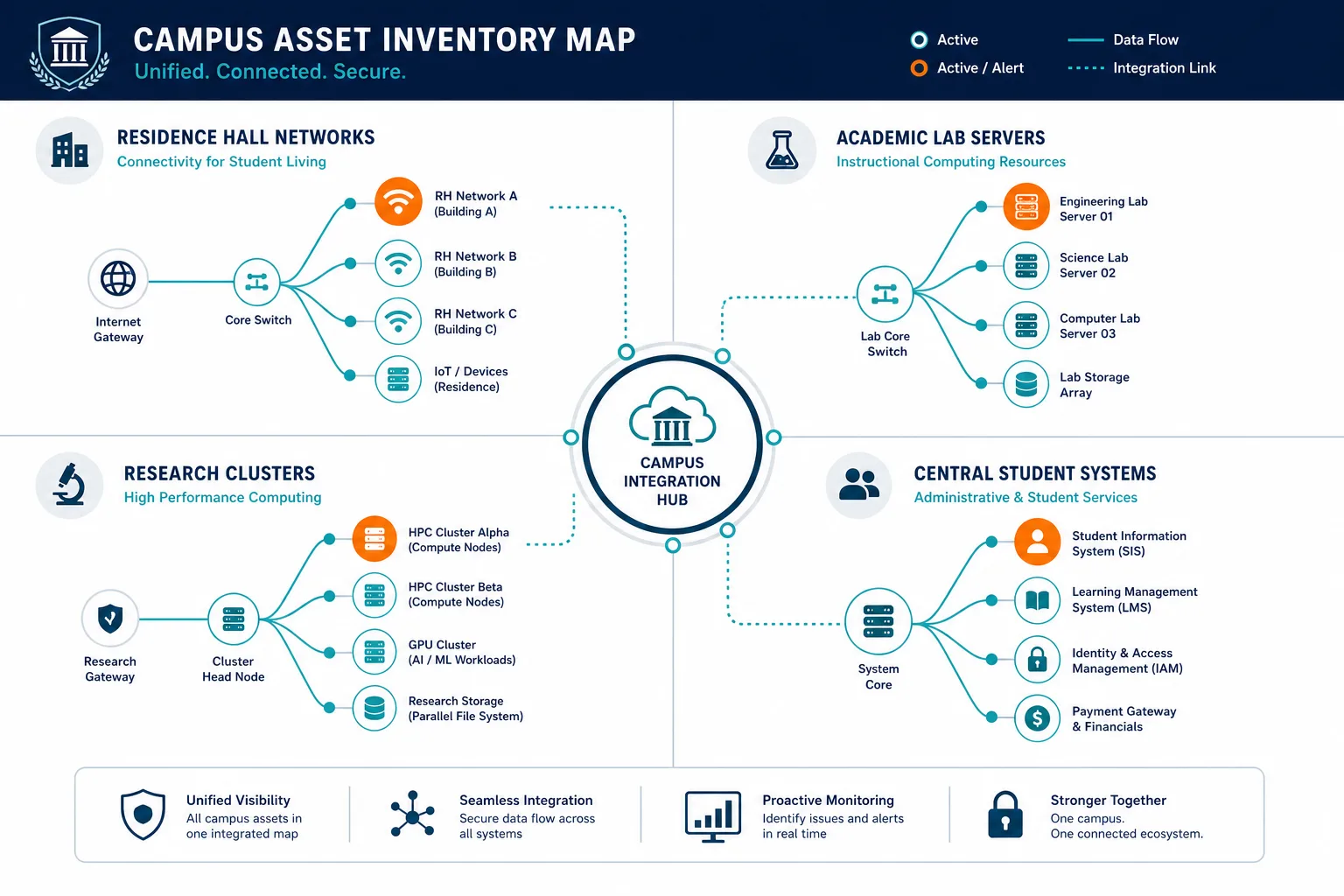
Finding every system is necessary but not sufficient. Higher education leaders need inventory tied to ownership, software entitlement, and service impact.
License compliance across shared academic software
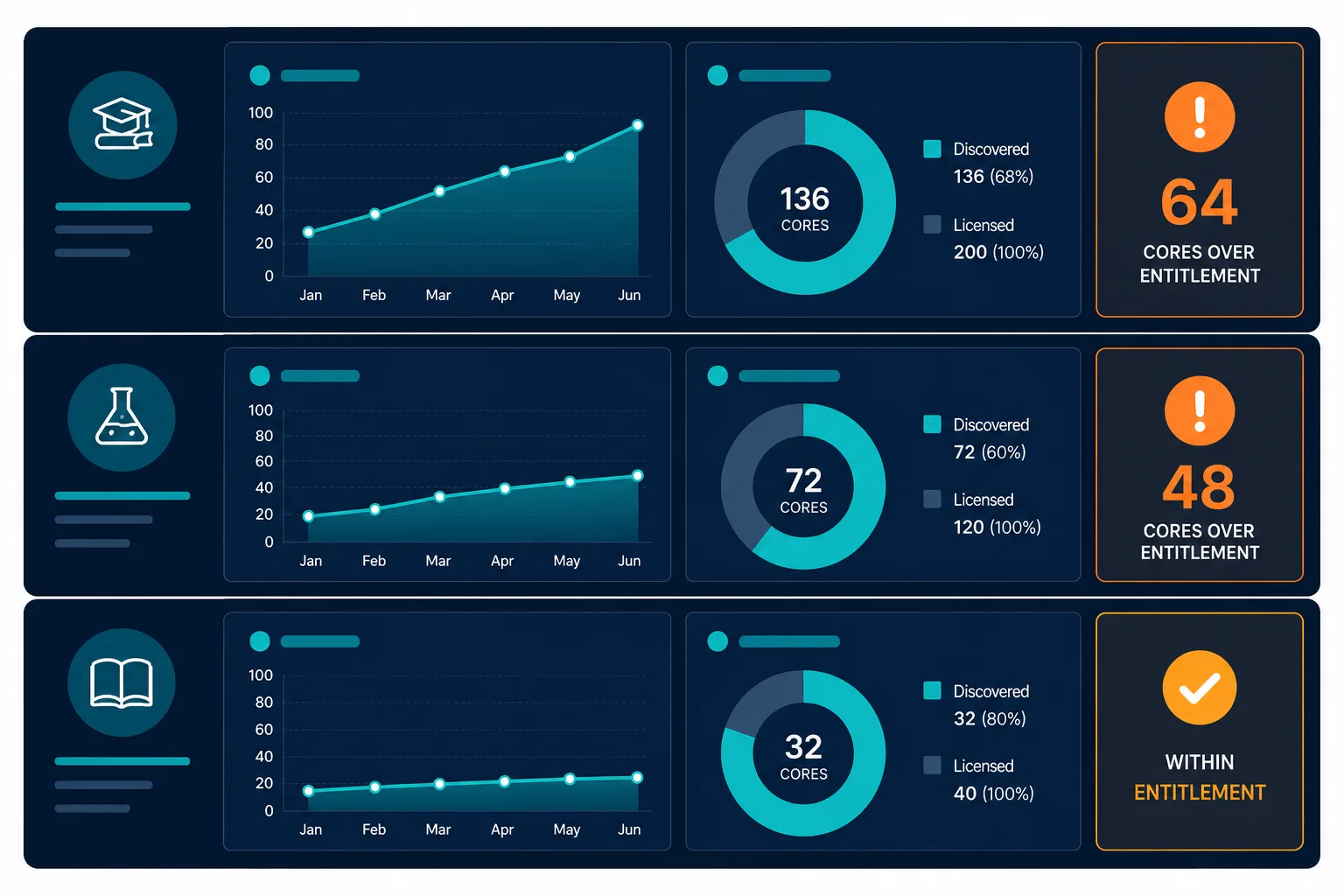
Campus-wide agreements for productivity suites, statistical packages, CAD tools, and research applications often charge by user, device, or core. When virtual lab hosts and research VMs expand core counts without ITAM visibility, universities face audit exposure similar to commercial enterprises managing software license compliance.
Automated discovery records installed software builds and host core density — a foundation of higher education IT asset management. ITAM teams reconcile those findings against entitlement pools before vendor true-ups disrupt academic budgets mid-year.
Capital planning and end-of-life hardware
Boards and state systems demand evidence for hardware refresh requests, and that evidence carries more weight as budgets tighten. A 2025 EDUCAUSE QuickPoll found that 42% of higher education IT leaders expect their budgets to shrink for the 2025-2026 academic year, with a median expected decline of 8% (source). That leaves little room to guess at what needs replacing. Discovery-sourced serial numbers, model data, and OS build ages let CIOs show which classroom, residence, or research systems have reached vendor end-of-life, instead of relying on incomplete departmental lists. The same inventory discipline that IT audits require applies just as well to capital planning cycles, since both start from the same discovery-sourced record.
Service mapping for registration and instruction paths
Virima’s ViVID™ service maps connect discovered systems to registration portals, learning management platforms, library services, and identity federation. When a change is proposed on a shared database host, change managers can see blast radius across colleges before a maintenance window coincides with drop/add deadlines.
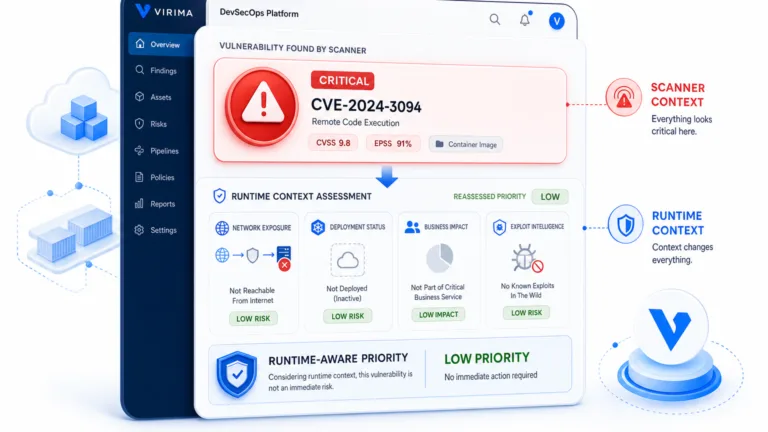
Campus teams that need discovery-sourced operational context can review how IT leaders establish Trusted Runtime Truth.
Best practices for tracking campus systems at scale
Universities that stabilize sprawling campus inventories combine automation with clear governance across central IT and academic units.
- Standardize naming, ownership fields, and criticality ratings so college-level servers and central systems report the same way in one CMDB.
- Schedule discovery scans more often for enterprise server pools and cloud accounts; use regular cycles for lab and departmental subnets where change is constant.
- Compare discovered installs and core counts to campus license agreements before peak audit or renewal windows.
- Feed discovery-sourced CIs into ServiceNow, Jira Service Management, or Ivanti so technicians see accurate ownership and location when students or faculty open tickets. Virima’s discovery layer enriches these platforms’ CMDB tables with campus-wide asset data rather than replacing them, keeping existing ITSM workflows intact.
When planning multi-campus consolidation, research computing expansion, or annual compliance reviews, evaluating automated discovery helps central IT keep systems accountable. See how ViVID™ service maps connect discovered systems to registration and instruction paths across your campus.
What benefits do universities gain from automated campus system tracking?
Automated tracking reduces license audit risk, removes ghost assets from maintenance budgets, shortens incident diagnosis when instructional systems fail, and supplies verifiable inventory for capital funding and security baseline reports.
Closing the gap between campus sprawl and central accountability
Higher education will continue to expand hybrid learning, research computing, and multi-campus delivery. Device and system counts will not shrink. Manual inventories cannot keep pace with semester turnover, grant-funded hardware, and cloud burst capacity.
By combining continuous multi-site discovery, core-aware ITAM, and service dependency mapping, university IT organizations gain a single, defensible view of systems across sprawling campus networks. They protect academic continuity, satisfy auditors, and allocate limited budgets against real infrastructure, not outdated spreadsheets.
Frequently Asked Questions
How does automated discovery work on segmented campus networks with research and student VLANs?
Discovery uses localized gateway collectors inside approved subnets and agentless protocols that read configuration metadata only. Encrypted results roll up to the central CMDB without requiring full mesh access across every academic VLAN.
Can campus discovery track both on-premises lab servers and cloud research workloads?
Yes. Platforms combine agentless campus scanning with AWS and Azure API connectors so research VMs, teaching environments, and central enterprise systems appear in one inventory with ownership and configuration history.
How does Virima help higher education IT prepare for software and capital asset audits?
Virima maintains discovery-sourced hardware and software records with core counts, install evidence, and configuration history. Audit teams generate inventory and entitlement reports quickly instead of reconciling college spreadsheets under deadline pressure.
Sprawling campus networks do not have to mean sprawling risk. Get the Campus IT Asset Tracking Checklist — a discovery-cycle framework for auditing shadow lab hardware, cloud research workloads, and ownership handoffs before your next semester turnover.