Halo Integrations: Full IT Discovery and Service Mapping for HaloITSM

Halo integrations with Virima add three things to HaloITSM: IT discovery, service dependency mapping, and ViVID™ visualization. Together, they give you a live, accurate picture of your assets, their relationships, and the impact of every change. And you see it all inside the ITSM platform you already use. HaloITSM runs your service delivery workflows. Virima feeds those workflows the runtime truth they need, so they act on current data instead of stale records.
Without discovery and service mapping, full visibility is hard to keep. Asset records go stale. Dependencies stay hidden. Configurations drift out of date. As a result, you get inefficiency, downtime, and open security gaps. In fact, the Uptime Institute 2025 Annual Outage Analysis found that roughly 1 in 10 outages still causes serious or severe disruption. Stale, inaccurate configuration data is one cause you can actually control.
Virima changes how your HaloITSM team manages infrastructure. You get high-frequency IT discovery, machine-learned dependency mapping, and ViVID™ service visualization. Because of this, you see your whole environment in near real time. And with that clear view comes real operational control.
Key capabilities at a glance:
- Full IT asset discovery — finds your hardware, software, cloud, and network components, and updates them in near real time
- Service dependency mapping — maps how your CIs connect, so you resolve incidents faster and cut change risk
- ViVID™ visualization — overlays HaloITSM incidents, changes, and vulnerabilities onto interactive service maps, so your team acts on what it sees
- Security built in — NIST NVD lookups flag known vulnerabilities against your asset inventory to support audits and risk reviews
IT Discovery for HaloITSM
Virima adds high-frequency IT discovery to HaloITSM. First, agentless IP scanning and agent-based discovery find devices across your network. The agentless side needs no extra software. Next, Virima connects to your hypervisor, cloud, container, orchestration, network, storage, and monitoring tools. These API and configuration links extend your view well beyond IP scanning alone. On top of that, more than 140 extendable probes back up the agentless scans. And the HaloITSM discovery integration lets you schedule every scan on your own terms.
What does Virima add to HaloITSM that it doesn’t provide natively? Virima adds high-frequency IT discovery, machine-learned service dependency mapping, and ViVID™ visualization to HaloITSM. HaloITSM runs your service delivery workflows. But it does not discover assets across hybrid environments or build live dependency maps on its own. Virima fills that gap. It scans your hardware, software, cloud, and network components. Then it pushes the discovered data straight into the HaloITSM CMDB through pre-built blueprints. No scripting or custom development required.
Do you need deeper detail on each device? Virima also offers discovery agents for Windows, macOS, and Linux. These agents capture installed patches, running services, and local software that agentless scans can miss. As a result, your team gets reliable data, fewer manual tasks, and a smoother ITSM process.
Agentless vs. agent-based discovery: what’s the difference?
Agentless discovery scans your network remotely with standard protocols. Because it installs nothing on your devices, it deploys fast and covers broad network segments. Agent-based discovery works differently. It puts a lightweight agent on each device to capture deeper detail, such as installed patches, running services, and local software.
Most teams use both methods together. Agentless scans handle the bulk of network-wide discovery. Meanwhile, agents fill the gaps on the critical servers and workstations where full visibility matters most. For a side-by-side look, see our guide to agent-based vs. agentless discovery.
What Virima identifies inside HaloITSM
| Asset Type | What Virima Discovers |
|---|---|
| Hardware | Servers, workstations, network devices, storage systems |
| Software | Installed applications, operating systems, software versions and patches |
| Cloud resources | Virtual machines, cloud services, configurations across AWS and Azure |
| Network components | Routers, switches, firewalls, and their interconnections |
In short, your HaloITSM team gets a complete picture of its IT infrastructure. You also see asset status and configuration updates in near real time. Because of that, you resolve issues sooner, allocate resources smarter, tighten security, and simplify compliance.
Service Dependency Mapping for HaloITSM
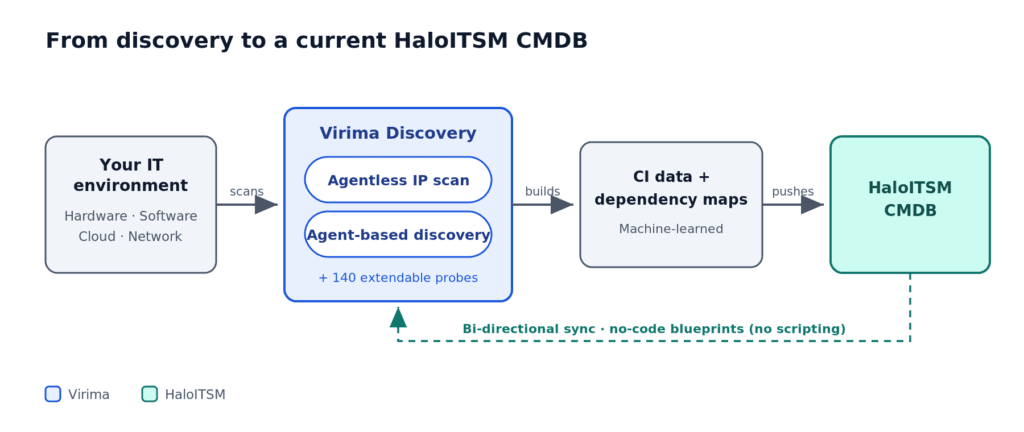
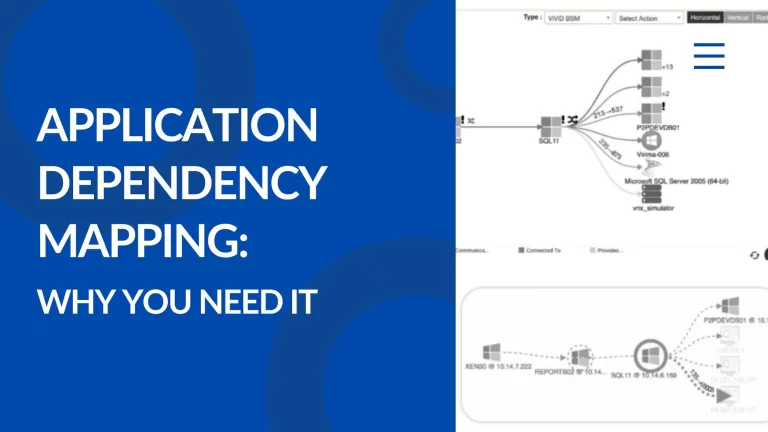
Service dependency mapping shows how your IT components connect. It documents the links between servers, applications, and network devices, and the business services they support. Virima builds these maps for you with machine-learned dependency mapping. It uses your discovered CI data to cover infrastructure relationships, application dependencies, network topologies, and system communications. Then ViVID™ service maps display those relationships inside HaloITSM in near real time.
How does service dependency mapping help HaloITSM teams?
Virima’s service dependency mapping gives HaloITSM teams a visual model of how applications connect to the infrastructure beneath them. It covers infrastructure relationships, application dependencies, network topologies, and system communications. Virima builds the model automatically from discovered CI data. So when an incident occurs, your team spots the affected services and CIs in seconds instead of after 20 minutes of manual tracing.
How service mapping improves incident, problem, and change management
Incident management: Virima’s service maps show how your services and components connect. So when an incident hits, your HaloITSM team finds the affected areas fast. That speeds up resolution inside the Halo ticketing system and makes ticket creation more useful. After all, most human-error outages trace back to changes made without clear process or dependency visibility. Visual dependency maps target that exact problem.
Problem management: Clear dependency visibility helps you trace recurring issues to their root causes. As a result, you cut repeat incidents. You also build a stronger CMDB foundation for long-term problem resolution.
Change management: A large share of IT outages start with planned changes made without clear dependency visibility. Virima’s service maps fix that. They show how a change will affect connected systems. And post-change validation confirms that what you planned actually happened. So instead of reviewing a spreadsheet of CIs, your change advisory board sees the live map with active incidents highlighted. That makes every approval faster and more confident.
→ Schedule a demo to see Virima + HaloITSM in action
ViVID™: Operational Intelligence Inside HaloITSM
Virima Visual Impact Display (ViVID™) overlays live data onto your service dependency maps. It adds your ITSM incidents, changes, event alerts, and NIST NVD vulnerabilities right on top of the maps built by Discovery and Service Mapping. ViVID also pulls in alerts from monitoring tools like SolarWinds, Nagios, and LogicMonitor. As a result, your service maps turn into operational dashboards you can act on, not static diagrams.
What is ViVID™ and how does it work with HaloITSM? ViVID™ (Virima Visual Impact Display) overlays open HaloITSM incidents, planned changes, and NIST NVD vulnerabilities directly onto live service dependency maps. Your engineers see affected services, downstream CIs, and active vulnerabilities in one view. As a result, both change impact analysis and root cause identification take far less time.
ViVID speeds up two jobs in particular. First, it sharpens impact analysis for proposed changes. Second, it helps you find root causes during service disruptions. So when ViVID™ and HaloITSM work together, your team manages change, incidents, and problems with better information and far less guesswork.
Virima vs. Lansweeper for HaloITSM: What’s the Difference?
Both Virima and Lansweeper integrate with HaloITSM, and both help populate your CMDB. The real difference comes down to operational depth.
| Capability | Lansweeper | Virima |
|---|---|---|
| IT asset discovery | ✓ | ✓ |
| Service dependency mapping | — | ✓ Machine-learned, from CI data |
| ViVID™ interactive service maps | — | ✓ With ITSM record overlays |
| NIST NVD vulnerability lookups | — | ✓ Mapped to asset criticality |
| Bi-directional ITSM sync | — | ✓ Two-way with HaloITSM |
| ITIL 4 PinkVERIFY certification | — | ✓ 6 processes certified |
| No-code integration | ✓ | ✓ |
Do you just need a populated CMDB fast? Then Lansweeper delivers. But maybe you also need blast-radius analysis, change impact visualization, and vulnerability mapping on top of accurate asset data. In that case, Virima adds the extra operational layer. And if you run several ITSM platforms, Virima also supports ServiceNow, Jira Service Management, Ivanti, and Xurrent through the same discovery-sourced architecture.
Security and Compliance with NIST NVD
Virima’s IT discovery also strengthens your security and vulnerability management. It connects directly to the NIST National Vulnerability Database (NVD). Once linked, your IT asset data becomes the base for smarter remediation. You can then prioritize fixes by asset criticality. Virima even checks your assets automatically against Common Platform Enumerations (CPEs) and Common Vulnerabilities and Exposures (CVEs).
How does Virima’s NIST NVD integration work inside HaloITSM? Virima checks every discovered CI against known CVEs and CPEs in the NIST NVD automatically. Then ViVID™ shows you which assets carry vulnerabilities and how those vulnerabilities affect connected services. So your HaloITSM team can prioritize remediation by asset criticality and service impact, not just by severity score alone.
Virima maps your asset relationships and likely attack paths. As a result, your team can focus fixes on the CIs that support your most valuable business services. On top of that, Virima keeps your records accurate and audit-ready. It tracks configurations continuously, logs software inventory, and supports licensing, patch, security, and GRC reporting. So if you want a CMDB that doubles as a security foundation, this integration is where you start.
Virima as the Trusted Runtime Truth Layer for HaloITSM
HaloITSM manages your workflows and tickets. Virima supplies the accurate, discovery-sourced data those workflows depend on.
Here is why that matters. When a HaloITSM workflow or runbook checks change risk, it reads from the CMDB. But if that CMDB is stale, the process runs on bad information. Virima prevents that. Its high-frequency discovery cycles keep the HaloITSM CMDB current with the real state of your infrastructure. That includes hardware, software, cloud resources, dependencies, change history, and ownership. So every decision reflects your environment today, not 90 days ago.
This is the core value of Virima in your Halo integrations: trusted runtime truth. It stays live, explainable, and grounded in what discovery finds in your environment. Picture a network switch failing at 2 AM. With Virima, your on-call team sees an accurate map of which services are affected, which CIs sit downstream, and who owns them. That is the difference between a 15-minute triage and a 2-hour scramble.
Want the full picture on CMDB accuracy and discovery-sourced runtime truth? Download the EMA ServiceOps report on real-time discovery and CMDB maturity.
How the Halo Integrations Setup Works
Virima connects to HaloITSM through a no-code integration. You usually authenticate it with a client ID to link both platforms securely. After that, the assets, configurations, and relationships Virima finds flow into the HaloITSM CMDB automatically. Pre-built, customizable blueprints handle the mapping into your Halo asset groups and types. And when you update something in HaloITSM, it syncs back to Virima, so both systems stay aligned without ongoing manual data entry. Best of all, you run the whole setup through friendly interfaces in both platforms, with no scripting or custom development.
The integration also reaches beyond HaloITSM. Virima supports bidirectional sync with popular ITSM platforms, including ServiceNow, Jira Service Management, Ivanti, and Xurrent. So you can pull IT data from several platforms into one source of truth.
You can also buy Virima directly through HaloITSM, which makes it easy to get started. And for the technical details, download the Discovery and Service Mapping for HaloITSM whitepaper.
Frequently Asked Questions
What does Virima add to HaloITSM that it doesn’t provide natively?
HaloITSM runs your service delivery workflows. But on its own, it does not discover assets across hybrid environments or build live service dependency maps. Virima adds those layers. You get high-frequency IT discovery, machine-learned dependency mapping, and ViVID™ service visualization, all flowing into the HaloITSM CMDB through a no-code integration. As a result, you get accurate asset data and visual service context with far less manual effort.
Can HaloITSM do automated service mapping?
HaloITSM supports CI tracking and dependency visualization. However, it does not build service dependency maps automatically from discovered CI data. Virima adds that ability. Its machine-learned dependency mapping builds maps from your discovered CI relationships. Then it surfaces them through ViVID™ inside HaloITSM, with your incidents and changes overlaid for full context.
What is the difference between Virima and Lansweeper for HaloITSM?
Lansweeper integrates with HaloITSM to populate your asset inventory. Virima goes further. It adds machine-learned service dependency mapping, ViVID™ visualization with ITSM record overlays, NIST NVD vulnerability lookups, and bi-directional sync. So if you need blast-radius analysis and change impact visualization alongside accurate asset data, Virima adds the operational layer Lansweeper does not cover.
How does Virima support ITIL compliance in HaloITSM?
Virima holds PinkVERIFY ITIL 4 certification across six processes. These cover service asset and configuration management, change management, incident management, problem management, request management, and knowledge management. So if your HaloITSM team focuses on ITIL maturity, this certification gives you independent proof that Virima’s processes follow established best practices.
Run HaloITSM on Accurate Data
Virima adds high-frequency IT discovery, service dependency mapping, and ViVID™ visualization to HaloITSM. In turn, it helps you cut Mean Time to Repair (MTTR) and raise Mean Time Between Failures (MTBF). Those are the exact metrics your IT operations team is measured on.
So from high-frequency discovery cycles to ViVID™ service maps, Virima helps you run HaloITSM on trusted runtime truth. You close security gaps. And you stay audit-ready.
→ Get trusted runtime truth for HaloITSM — schedule a demo