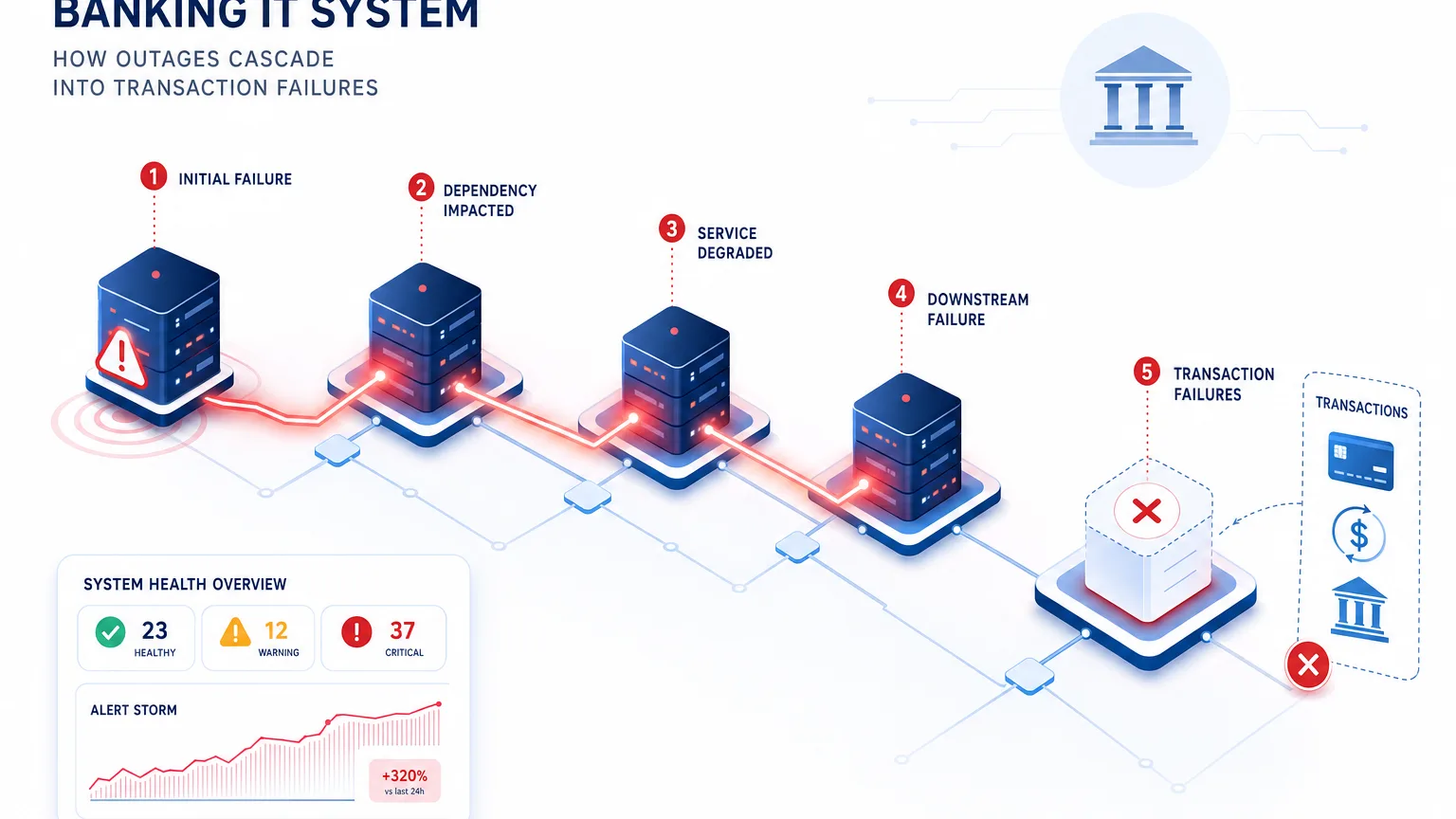
Banking and Financial Services: Tracing How System Outages Cascade Into Transaction Failures

At 2:15 PM on a busy trading afternoon, payment processing response times spike across a commercial bank’s digital channels. Within minutes, mobile transfers freeze, point-of-sale authorizations fail, and automated clearing house (ACH) batch files fail to reconcile.
The incident response team opens war rooms across network, database, application, and cloud operations. Standard monitoring dashboards display green status indicators for the main core banking application servers and payment gateway nodes. What the dashboards miss is a subtle dependency cascade: a DNS lookup delay on an unmapped internal identity server triggered thread pool exhaustion on a secondary security token service, which in turn blocked message queues connecting the payment gateway to backend transaction ledgers.
In enterprise banking and financial services, system failures rarely happen in isolation. Tracing how system outages cascade into transaction failures requires automated discovery, real-time application dependency mapping, and a CMDB built on actual runtime truth.
How do minor IT system outages cascade into widespread transaction failures in banking?
Banking architectures rely on tightly coupled microservices, load balancers, database pools, and legacy messaging buses. A minor failure in a secondary service, such as an identity server or network switch, exhausts connection queues downstream, quickly stalling core payment channels and customer transactions.
The Domino Effect: Anatomy of a Cascading Banking Outage
Modern financial institutions process millions of transactions hourly across distributed architectures. A simple account transfer or credit authorization requires uninterrupted coordination between web frontends, fraud check engines, customer record stores, and interbank messaging rails.
Research from Gartner indicates that complex inter-system dependencies account for the vast majority of extended IT outages in financial enterprises. When one component slows down, upstream services backlog, creating a domino effect across the operational stack.
1. Connection Pool Exhaustion and Backpressure Propagation
When a backend service experiences latency, calling applications do not fail immediately. Instead, they hold open network connections and retry failed requests.
In high-volume financial environments, thousands of incoming transaction requests per second quickly fill application connection pools. Once connection limits are reached, memory consumption spikes, causing application gateways to drop new inbound payment requests across online and mobile channels.
2. Hidden Dependencies in Integration Middleware
Financial networks depend heavily on integration middleware, message queues, and API translation layers to bridge legacy mainframes with cloud-native applications. These middleware components sit between core banking ledgers and customer-facing interfaces.
Because message routing logic exists inside software code and queue configurations rather than physical cabling, traditional network monitoring tools see only generic IP traffic. When a queue manager experiences thread starvation, IT operators struggle to identify which financial services are affected.
Why do standard monitoring tools fail to identify the root cause of cascading banking outages?
Standard monitoring tools evaluate individual servers or applications in isolation without mapping live dependency connections. When an outage cascades, monitoring tools trigger hundreds of simultaneous alerts across healthy systems, masking the underlying root cause behind a wall of noise.
Why Traditional Monitoring Tools Fail to Catch Outage Cascades
Financial IT teams deploy array of specialized monitoring software, including Application Performance Monitoring (APM), network packet analyzers, and infrastructure metrics dashboards. Yet during major incidents, war rooms still spend hours trying to isolate root causes.
1. The Alert Storm Dilemma
When a cascading failure occurs, every application and server downstream of the failure registers an error. Database connection timeouts trigger web server alerts, which trigger API gateway errors, which fire synthetic transaction monitoring alarms.
This flood of simultaneous alerts creates an alert storm. On-call engineers receive dozens of high-priority notifications at once, making it difficult to distinguish the initial failure point from secondary symptoms.
2. Lack of Topology and Cross-Domain Context
APM tools excel at tracking code execution inside specific application stacks, while network tools monitor router throughput. However, neither tool provides a unified view of how physical hardware, virtual hypervisors, cloud subnets, and application software connect.
Without cross-domain topology context, database teams blame the network, network teams blame the cloud provider, and application developers blame database connection limits. Meanwhile, customer transactions remain blocked.
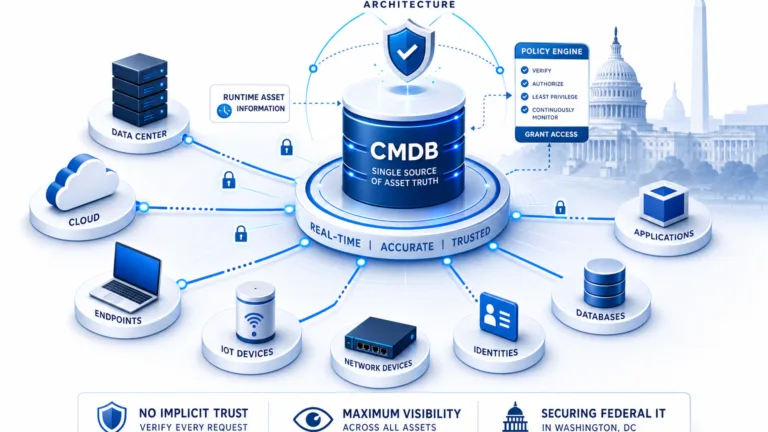
To trace cross-domain dependencies and prevent cascading transaction failures, financial IT leaders implement discovery-sourced Trusted Runtime Truth.
Architecting Service Mapping for Root Cause Tracing in Financial IT
To halt cascading outages quickly, financial IT organizations require dynamic service mapping tools that map application relationships across every infrastructure layer.
1. Agentless Discovery Across Complex Banking Networks
Banking environments combine mainframe ledgers, Unix database clusters, Windows application hosts, and cloud-native microservices. Deploying software monitoring agents across every host introduces performance overhead and administrative maintenance burdens.
Agentless discovery uses standard administrative protocols (WMI, SSH, SNMP, and cloud APIs) to inspect system configurations safely. By scanning subnets during scheduled windows, discovery tools build precise inventories of active network interfaces, running processes, and established TCP/IP connections.
2. Dynamic Service Dependency Mapping
Capturing raw asset inventories is only the baseline. IT operations teams need to visualize how individual assets combine to power business services, such as “Real-Time Wire Transfers,” “ATM Clearing,” or “Mobile Account Statements.”
Dynamic service mapping processes network connection data to construct live, visual dependency trees. These service maps display infrastructure relationships alongside application messaging paths, allowing incident managers to trace failure propagation routes during live war rooms.
To see how automated discovery integrates with enterprise ITSM platforms, visit the Virima integrations hub.
How does dynamic service mapping accelerate root cause analysis during banking incidents?
Dynamic service mapping visualizes the exact technical relationships connecting physical hosts, virtual machines, middleware, and application endpoints. When an incident occurs, operators trace alert paths backward through the dependency graph to locate the origin server instantly.
Preventing Cascade Failures Through Proactive Change Impact Analysis
While rapid root cause isolation reduces mean time to resolution (MTTR), preventing outages entirely is the ultimate goal. Most cascading failures in financial IT stem from unanalyzed software updates or hardware changes.
1. Evaluating Blast Radius Before Change Windows
Financial IT teams execute hundreds of system updates, patches, and reconfigurations during scheduled maintenance windows. Evaluating a proposed change against an isolated server record obscures secondary service risks.
Dynamic service maps calculate the complete blast radius of any proposed change. Before an engineer reboots a host or updates a database schema, change managers review the dependency graph to verify every upstream application and business service that will be impacted.
2. Identifying Single Points of Failure Across Redundant Architectures
Financial systems design redundant active-passive or load-balanced clusters to ensure high availability. However, configuration drift often introduces hidden single points of failure over time.
For example, two redundant payment processing nodes might inadvertently rely on the same backend identity server or storage array. Automated discovery detects these hidden structural bottlenecks, allowing architecture teams to reinforce redundancy before an outage occurs.
Best Practices for Isolating System Outages in Banking Infrastructure
Financial IT teams that eliminate cascading transaction failures follow a disciplined operational framework that combines automated discovery with incident management governance.
- Map Mission-Critical Payment Paths First: Concentrate discovery and service mapping efforts on core revenue and regulatory services, including core ledgers, wire transfer rails, and mobile payment gateways.
- Schedule High-Frequency Automated Discovery: Run agentless discovery scans frequently across dynamic virtual and cloud tiers to capture configuration drift before scheduled change windows.
- Incorporate Dependency Maps into Incident War Rooms: Require incident commanders to pin dynamic service maps at the center of war room discussions to maintain shared situational awareness.
- Mandate Blast Radius Analysis in Change Advisory Boards: Ensure change management workflows automatically pull live dependency data to evaluate risks prior to approving infrastructure updates.
- Connect CMDB Data to Enterprise Service Management: Integrate discovery-sourced CIs directly into incident, problem, and change workflows within your IT service desk platform.
Banking IT organizations looking to prevent cascading outages can evaluate automated discovery by requesting a Virima product demo.
Protecting Banking Operations with Discovery-Sourced Incident Context
In modern banking, digital infrastructure is the business. When a minor system latency cascades into widespread transaction failures, financial institutions face immediate revenue losses, regulatory scrutiny, and severe customer dissatisfaction.
Static CMDB records and isolated monitoring tools cannot unravel the complex web of modern financial technology. By deploying continuous agentless discovery and dynamic service mapping, banking IT leaders gain total visibility into system relationships. They isolate root causes in minutes, prevent change-induced outages, and keep financial transactions moving safely.
Frequently Asked Questions
How does automated service mapping trace the root cause of cascading transaction failures across complex banking networks?
Automated service mapping builds live dependency visualizers using active process data and network connection records. During an outage, operators trace error signals backward along the dependency graph, bypassing symptom alerts to identify the exact originating server or service failure.
Why do traditional APM dashboards fail to reveal why a transaction processing gateway stalled?
APM tools focus primarily on code performance within specific application boundaries. They lack visibility into underlying physical hardware, virtual hypervisors, network switches, and un-agentized middleware queues that frequently trigger cascading connection bottlenecks.
How does Virima help banking IT teams analyze change blast radius before maintenance windows?
Virima generates discovery-sourced service maps that illustrate every upstream application, database, and business process connected to a target CI. Change advisory boards review these maps before maintenance windows to evaluate blast radius and prevent change-induced transaction outages.