PCI DSS v4.0.1 and CMDB: What Enterprise Payment Teams Need to Know in 2026

PCI DSS CMDB compliance is the foundation every other payment security control builds on — and in 2026, every runway for getting it wrong has closed. The payment industry ran on the same compliance framework from 2013 to 2022. PCI DSS v3.0 established the structural baseline the industry operated on for nine years. The versions that followed were patches: SSL vulnerability fixes, MFA clarifications, minor language adjustments. The compliance model itself did not change.
PCI DSS v4.0 arrived in March 2022 and changed the model entirely. Sixty-four new or updated requirements. A formal shift from annual point-in-time validation to continuous operational assurance. A new customized approach option that gave enterprises flexibility in how they met requirements. And fifty-one requirements designated as future-dated: organizations had until March 31, 2025, to implement them.
PCI DSS v4.0.1, a minor revision published in June 2024 to correct typographical errors and clarify intent with zero new requirements, is now the sole operative standard.
In 2026, every runway has closed. Every requirement that was once future-dated is a hard pass/fail line item in every assessment conducted this year. There is no transition window left to invoke, no prior version still active, no grace period remaining.
For most enterprises, the compliance response has focused on the visible requirements: MFA expansion, authenticated internal scanning, penetration testing methodology documentation. What shows up less often, and fails more quietly, is the requirement underneath all of them: an accurate, current, maintained record of every system component in the cardholder data environment.
Four of PCI DSS v4.0.1’s requirements depend on that record directly. None of them can be satisfied by a spreadsheet, a manual inventory, or a CMDB last updated before the most recent cloud migration. What they require is discovery-backed asset data that reflects the environment as it exists today, not as it existed at the last assessment.
Quick Answer: What is PCI DSS v4.0.1?
PCI DSS v4.0.1 is the current operative version of the Payment Card Industry Data Security Standard, published June 2024. It applies to any organization that stores, processes, or transmits cardholder data. All transition windows closed March 31, 2025. In 2026, every requirement is a hard pass/fail line item in QSA assessments with no grace periods remaining.
What PCI DSS is, who enforces it, and what non-compliance costs
PCI DSS is not a government regulation. It is a contractual standard, created in December 2004 by the five founding payment card brands: American Express, Discover Financial Services, JCB International, Mastercard, and Visa.
Before it existed, each card brand maintained its own security program, and merchants accepting multiple card types were required to comply with each separately. The unified standard replaced that fragmentation with a single set of requirements applicable to any organization that stores, processes, or transmits cardholder data.
The PCI Security Standards Council, formed in September 2006 as an independent body to govern and evolve the standard, publishes and maintains PCI DSS. The PCI SSC does not enforce it.
Enforcement runs through acquiring banks and card brands. When a merchant or service provider is non-compliant, the acquiring bank levies fines, raises transaction fees, or restricts card processing privileges on behalf of the card brands.
The financial consequences of non-compliance are structured and escalating. Fines run from $5,000 to $10,000 per month for the first three months, rising to $25,000 to $50,000 per month for months four through six, and $50,000 to $100,000 per month beyond that.
A confirmed cardholder data breach while non-compliant compounds the exposure significantly. Financial services organizations — the sector most directly affected by PCI DSS — averaged $5.56 million per data breach in 2025, according to the IBM Cost of a Data Breach Report 2025. That figure covers forensic investigation, card replacement charges billed by issuing banks, notification costs, and remediation — and rises further when card-brand fines and potential loss of processing privileges are added.
The enforcement reality that most enterprises underestimate: because PCI DSS compliance is contractual rather than statutory, the acquiring bank is under no obligation to provide extended remediation timelines. An organization that fails its 2026 assessment faces immediate financial consequences, not a regulatory grace period.
What changed in v4.0.1: the 12 requirements and what’s new
PCI DSS is organized into 12 high-level requirements covering six security domains. v4.0 introduced 64 new or updated requirements across this structure. The 12 requirements are:
- Install and maintain network security controls
- Apply secure configurations to all system components
- Protect stored account data
- Protect cardholder data with strong cryptography during transmission
- Protect all systems and networks from malicious software
- Develop and maintain secure systems and software
- Restrict access to system components and cardholder data by business need-to-know
- Identify users and authenticate access to system components
- Restrict physical access to cardholder data
- Log and monitor all access to system components and cardholder data
- Test security of systems and networks regularly
- Support information security with organizational policies and programs
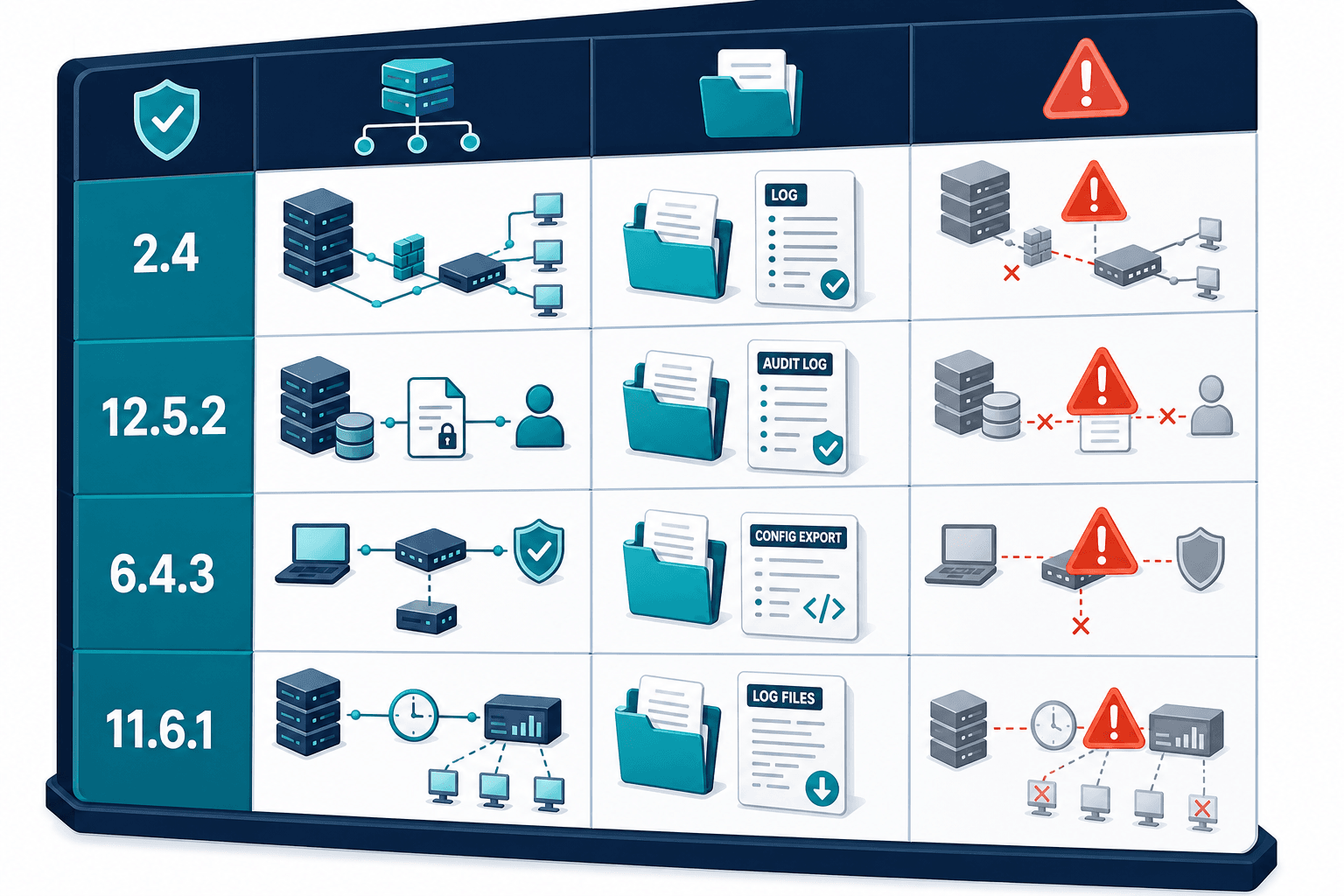
Four of these requirements bear directly on the asset inventory problem and are among the most commonly failed in 2026 assessments.
Requirement 2.4 requires organizations to maintain an inventory of all in-scope system components. The inventory must include a description of function and location for each component. Under v3.x, enforcement was often light. Under v4.0.1, assessors verify the inventory against actual network scans and data flows. An inventory that was accurate six months ago but has not been updated since a cloud migration is not compliant.
For Atlanta’s payment processors in Transaction Alley, where the majority of US card transactions by volume are processed according to payment industry estimates, the QSA audit boundary question around CDE scope is more operationally acute than anywhere else in the country.
Requirement 12.5.2 requires that PCI DSS scope be confirmed at least every 12 months and after any significant change to the environment. Scope confirmation is not a review of existing documentation — it is a validation that the documented CDE boundary still reflects reality. Organizations that expanded to new cloud regions, onboarded new payment channels, or migrated applications without updating their CDE definition will fail this requirement regardless of how strong their other controls are.
Requirement 6.4.3 requires that all scripts permitted to load and execute on the consumer-facing payment page be managed: each must be authorized with a written justification, its integrity confirmed, and a maintained inventory must exist. This requirement was introduced specifically in response to web-skimming attacks that inject malicious JavaScript into checkout pages to steal card data in the browser — exploiting the absence of exactly this inventory.
Requirement 11.6.1 requires a change-detection mechanism that alerts personnel to unauthorized modifications to HTTP headers and script contents on payment pages. Combined with Requirement 6.4.3, these two requirements establish the payment page as a formally monitored component of the CDE — a classification most organizations had not previously made.
The broader structural change in v4.0 is the shift from annual compliance to continuous compliance. Controls must demonstrably operate year-round. In 2026, assessors are looking for 12 months of continuous operational evidence — logs, alerts, documented risk analyses refreshed on their stated cadence — not a snapshot showing that controls were switched on before the audit.
What “continuous compliance” actually demands from asset inventory
The annual compliance model had a structural convenience: asset inventory could be assembled in the weeks before the assessment. Teams would conduct a network scan, reconcile it against whatever CMDB or spreadsheet existed, document the CDE boundary, and submit. Under v4.0.1, that approach no longer works.
Continuous compliance requires that controls operate year-round and that evidence of their operation accumulates continuously. An organization that implemented a control in March 2025 to meet the future-dated requirement deadline and then never operated it cannot demonstrate 12 months of continuous operation in a 2026 assessment. The control exists. The evidence does not.
For asset inventory specifically, continuous compliance means three things that point-in-time assessments did not require. First, the inventory must reflect changes as they happen. Second, the CDE scope must be reconfirmed whenever a significant change occurs, not just annually. Third, the evidence of those updates must be producible at assessment time.
The most common gaps in 2026 assessments are consistent: CDE scope diagrams last updated before a cloud migration, payment page script inventories created at the deadline and never maintained, and Targeted Risk Analyses produced once and never refreshed. Fewer than half of organizations maintain full PCI DSS compliance year-round, according to Verizon’s 2024 Payment Security Report — a pattern consistent across multiple assessment cycles and attributable in large part to environments that change faster than documentation follows.
The root condition behind all these failures is the same. The organization does not have a system that maintains an authoritative, discovery-backed record of everything in its environment. When the environment changes — and in cloud-hybrid enterprise IT, it changes constantly — the documented state drifts from the actual state. The drift is invisible until an assessor or an attacker finds it.
New York financial services firms face this compliance cadence twice simultaneously. NYDFS 23 NYCRR 500, amended in November 2023 with significantly stronger enforcement provisions, imposes its own continuous asset inventory requirement on top of PCI DSS. The same CMDB record has to satisfy both regimes at once.
Quick Answer: What does PCI DSS v4.0.1 require for asset inventory?
Requirement 2.4 mandates a maintained inventory of all in-scope system components with function and location documented. Requirement 12.5.2 requires CDE scope confirmation at least annually and after any significant change. Both require an inventory that reflects the current environment, verified against actual network scans — not a static snapshot from a prior assessment period.
Why CMDB is now a PCI DSS CMDB compliance requirement, not a good-to-have
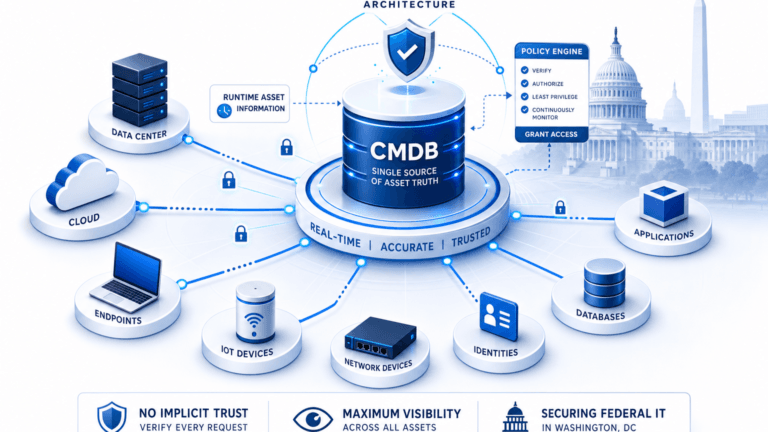
A Configuration Management Database has historically been framed as an IT operations tool: useful for change management, incident response, and service mapping, but not a compliance asset in its own right. PCI DSS v4.0.1 changes that framing directly.
Requirement 2.4 is, operationally, a CMDB requirement. It asks for a maintained inventory of all in-scope system components with function and location documented. That inventory cannot be manually assembled and remain accurate across a year of continuous operation in a cloud-hybrid environment. It requires high-frequency discovery cycles that populate and update the record on a governed schedule.
Requirement 12.5.2 requires scope confirmation at least annually and after significant changes. Scope confirmation requires knowing what is connected to the CDE right now — not what was connected six months ago. That knowledge comes from dependency mapping: understanding which systems communicate with which, what third-party integrations reach into the payment environment, and what cloud resources have been provisioned since the last assessment.
Requirements 6.4.3 and 11.6.1, which govern the payment page script inventory and change detection, require an authorized baseline of what is permitted to exist on the payment page. That baseline has to be built from discovery, not from memory or from what a developer believes is there.
What happens when the CMDB is manual, stale, or absent is predictable. Scope errors — systems that are in the CDE but not in the inventory, or systems assumed to be out of scope that can in fact reach in-scope components — are among the most consequential findings in PCI DSS assessments. A system mistakenly excluded from scope is an audit failure and a security exposure simultaneously. The CMDB audit process that identifies these gaps before a QSA does is what separates organizations that pass on the first assessment from those that spend months in remediation.
For enterprise retailers and hospitality firms with hundreds of locations, each with POS systems, network segments, and third-party integrations, the CDE scoping problem multiplies with every location. Chicago’s concentration of retail and financial services headquarters makes this one of the most operationally complex PCI DSS environments in the Midwest.
Virima delivers the discovery-sourced CMDB your PCI DSS compliance program depends on. See how Trusted Runtime Truth powers compliance readiness
How Virima supports PCI DSS CMDB compliance
Virima operates at the infrastructure layer — the layer that determines whether the compliance controls above it can function.
Virima’s agentless discovery scans on-premises, cloud, and hybrid environments without requiring agents on every endpoint. For Requirement 2.4, this means the system component inventory is built from actual discovery data, not from what was manually entered or accurate at the previous assessment. Every discovered component enters the CMDB as a source-attributed configuration item with a documented timestamp and a traceable origin.
For Requirement 12.5.2, Virima’s ViVID™ service maps produce the dependency map that scope confirmation requires. ViVID™ shows which systems communicate with which, which third-party integrations reach into the payment environment, and which cloud resources are connected to in-scope components. When a significant change occurs, the updated dependency map supports a scope reconfirmation that reflects the actual current state.
For Requirements 6.4.3 and 11.6.1, Virima provides the infrastructure-layer foundation that the payment page governance process requires. The servers hosting the payment page environment, the CDN relationships loading content into it, and the third-party systems connecting to it are discoverable and mappable at the infrastructure level. The browser-runtime monitoring that Requirement 11.6.1 mandates requires specialist client-side tooling that operates at the browser layer. Virima provides the infrastructure foundation beneath it. Both layers are required. Neither replaces the other.
The governed reconciliation between discovery cycles is what makes the 12-month evidence trail possible. The CMDB functions as a live record, updated on a governed schedule, with conflicts surfaced and resolved rather than silently overwritten.
For Fortune 500 enterprises managing large, multi-datacenter IT estates — Dallas has one of the highest such concentrations in the country — this governed reconciliation is what makes scope reconfirmation under Requirement 12.5.2 operationally viable across distributed environments.
Explore how Virima IT discovery and ViVID™ service maps support enterprise compliance programs. Request a demo
PCI DSS compliance by region: when the national standard is only the starting point
PCI DSS sets the baseline. Where an enterprise operates determines what stacks on top of it, and how much more complex the asset inventory problem becomes.
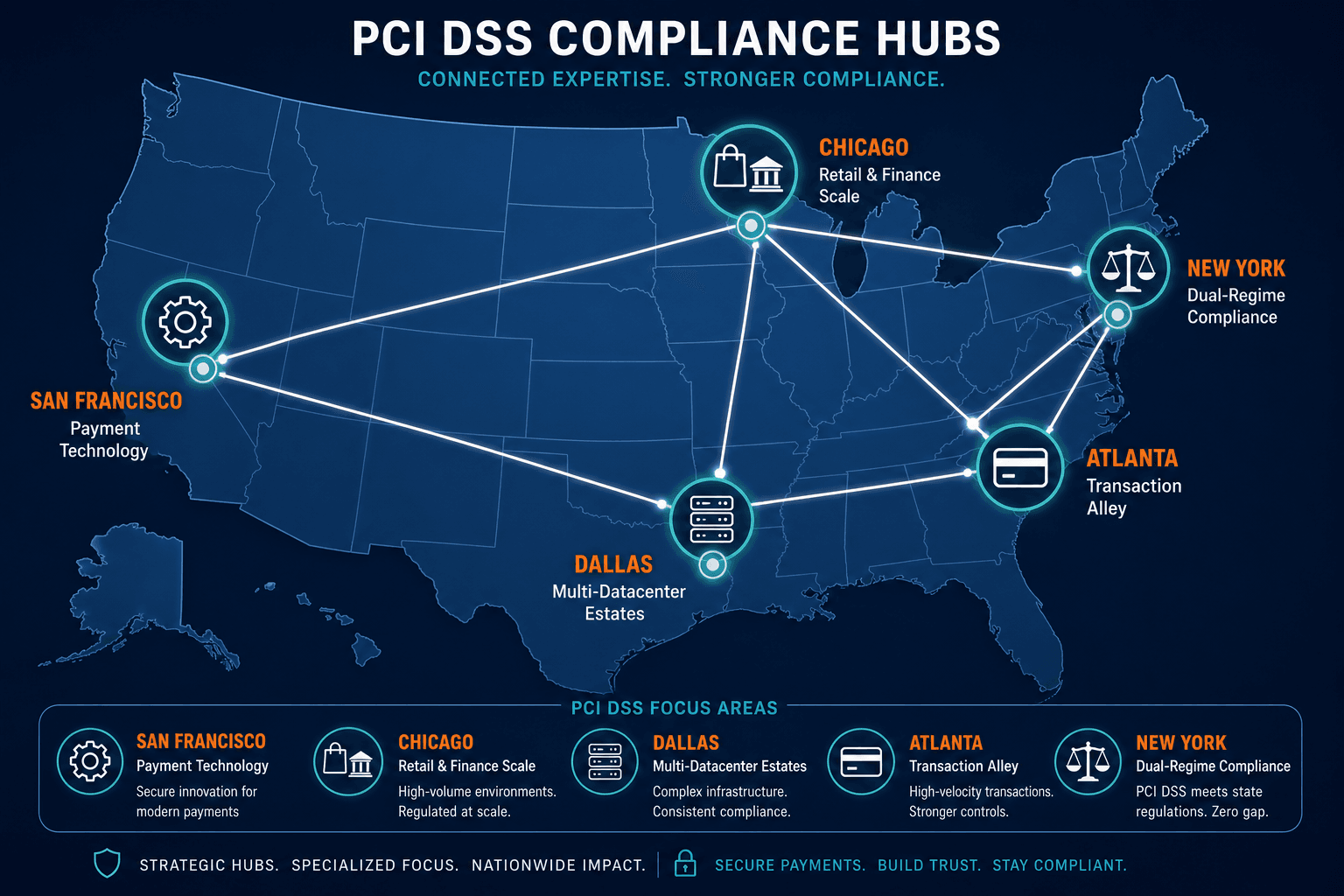
In Atlanta, the complexity comes not from a state regulatory layer but from sheer concentration. The majority of US card transaction volume flows through infrastructure headquartered in the city, making it the highest-density PCI DSS environment in the country by processing scale. For fintech firms and payment processors in Transaction Alley, the QSA audit boundary question is more operationally acute here than anywhere else in the country.
In New York, the complexity comes from a state layer that sits directly on top of PCI DSS. NYDFS 23 NYCRR 500 applies to every financial services firm licensed to operate in New York State, carrying its own asset inventory requirement, audit cycle, and penalty structure. A New York financial services firm processing card payments satisfies both standards simultaneously, and both demand the same underlying asset record.
In Chicago, Discover Financial — one of the five founding card brands of PCI DSS — is headquartered alongside McDonald’s, Walgreens, and Hyatt. Every one of them processes card payments at enterprise scale, across hundreds of locations, with CDE scope that spans POS systems, cloud environments, and third-party integrations simultaneously.
In Dallas, the Fortune 500 concentration (7-Eleven, AT&T, McKesson, ExxonMobil) means large, multi-datacenter IT estates where a CDE scope error is simultaneously an audit failure and a security exposure.
In San Francisco, the PCI DSS audience differs from every other city in this list. Stripe, Square, Brex, and Marqeta are not enterprises managing PCI DSS as a compliance burden. Their product is the payment infrastructure itself. For Bay Area payment technology companies, Trusted Runtime Truth functions as a product requirement — not just an IT operations concept.
What your QSA will verify for PCI DSS CMDB compliance in 2026
The five questions below are what a QSA conducting a 2026 v4.0.1 assessment will ask of any organization whose compliance program depends on an accurate CDE. Each one requires a discovery-backed, maintained asset record to answer.
1. Show the complete inventory of all system components in the CDE, including function and location for each. This is Requirement 2.4. The inventory must reflect the current state, not the state at the last assessment.
2. Show the documentation confirming that the CDE scope was validated within the last 12 months and after any significant changes. This is Requirement 12.5.2. If a cloud migration or new payment integration occurred since the last scope confirmation and no reconfirmation was conducted, this requirement fails.
3. Show the authorized script inventory for the payment page, including written justification for each script and the method used to confirm each script’s integrity. This is Requirement 6.4.3. The inventory must be current — not a list produced at the March 2025 deadline and never updated since.
4. Show the change-detection mechanism for payment page script contents and HTTP headers, including alert logs from the last assessment period. This is Requirement 11.6.1. If no alerts have ever fired, the assessor will ask how the organization knows the mechanism is functioning.
5. Show the Targeted Risk Analysis for any requirement where the organization has defined its own frequency for a periodic control. The TRA must be documented, approved, and refreshed on the cadence it defines. A TRA produced once and never revisited does not satisfy the requirement.
An organization that can answer all five questions from a live, maintained CMDB record is in a materially different position than one that needs to reconstruct the answers before the assessment. The difference is not the quality of the security controls — it is whether the operational evidence of those controls was accumulating on a governed schedule or was assembled under pressure.
For payment technology companies whose product is the payment infrastructure itself, these five questions are not annual audit preparation. They are operational baselines that must hold continuously.
Ready to demonstrate compliance readiness before your next QSA assessment? Request a demo with Virima
Frequently asked questions
Q1: Is PCI DSS a legal requirement or a contractual obligation?
PCI DSS is a contractual standard, not a government regulation. It is enforced through your relationship with your acquiring bank and the card brands, not through a regulatory agency. Non-compliance results in fines, increased transaction fees, or loss of card processing privileges levied by your acquiring bank — not a government fine or legal penalty. That said, a cardholder data breach while non-compliant can trigger regulatory action under separate laws: state breach notification statutes, the FTC Safeguards Rule, or sector-specific regulations like NYDFS 500 in New York.
Q2: Our CMDB exists but was last fully updated 18 months ago. Are we non-compliant?
Almost certainly yes, on at least two requirements. Requirement 2.4 requires a current inventory of all in-scope system components. Requirement 12.5.2 requires CDE scope to be confirmed at least every 12 months and after any significant change. If your environment has changed in the last 18 months — a cloud migration, a new payment integration, a network segmentation change — and your CMDB does not reflect those changes, your scope documentation does not reflect reality. In a 2026 assessment, assessors verify inventory against actual network scans, not accepting documentation at face value. Our guide on IT compliance audit preparation covers what assessors look for in practice.
Q3: We use a hosted payment page from our payment processor. Does that put us out of scope for Requirements 6.4.3 and 11.6.1?
Not necessarily. If your website loads any scripts — analytics, A/B testing, tag management, chat widgets — on the same page that redirects to the hosted payment form, those scripts are in scope under Requirement 6.4.3. The requirement applies to the consumer-facing payment page as received by the browser, not just the payment form itself. Your QSA will want to see an inventory of every script loading on that page, regardless of whether the payment processing happens on your infrastructure or your processor’s.
Q4: What is the difference between a CMDB and a CSAM, and do we need both for PCI DSS?
A CMDB inventories IT assets — servers, applications, network devices, cloud resources — along with their relationships and configuration attributes. A cybersecurity asset management tool focuses specifically on security posture: vulnerabilities, exposure, and control coverage for each asset. For PCI DSS, the CMDB is the foundation. It defines what is in scope, what connects to what, and what has changed. The CSAM layer sits on top and assesses the security posture of those scoped assets. PCI DSS requirements 2.4, 12.5.2, and 6.4.3 are fundamentally CMDB requirements. An accurate asset record has to exist before you can assess its security posture.
Q5: How often does Virima refresh the CMDB, and is that frequency sufficient for PCI DSS continuous compliance?
Virima’s discovery runs on a configurable schedule. The refresh frequency is governed by the Targeted Risk Analysis your organization defines under Requirement 12.3.1. PCI DSS does not mandate a specific discovery cadence — it requires that the cadence be defined, documented, risk-justified, and executed on the defined schedule. Virima provides governed reconciliation between discovery cycles, surfacing changes against the last known good state rather than waiting for the next scheduled scan. The combination of scheduled discovery plus continuous reconciliation is what produces the 12-month evidence trail a 2026 assessor will look for.