How to streamline IT compliance audit with Virima

An IT compliance audit checks your IT systems, policies, and controls. It confirms that you meet the laws, regulations, and standards that apply to you. Most teams, however, prepare at the last minute. They rush to collect evidence only when an auditor shows up. As a result, they scramble to recreate records the auditor expects to already exist. The teams that pass cleanly work differently. They keep their IT asset data, controls, and evidence accurate all year — long before anyone schedules a review.
In this guide, you’ll learn what IT compliance audits check and the types you may face. You’ll also walk through the five steps of the audit process. Finally, you’ll see how Virima makes audit readiness a daily habit. Its discovery-sourced CMDB and ITAM platform replaces the yearly scramble.
What Is an IT Compliance Audit?
An IT compliance audit is an independent assessment of whether an organization’s IT systems, asset inventory, access controls, and processes meet the requirements of regulatory frameworks and industry standards such as ISO 27001, SOC 2, HIPAA, PCI DSS, and GDPR. Auditors review evidence and document findings in a report that identifies gaps and recommends corrective actions.
Some audits end in a formal certification, such as SOC 2, ISO 27001, or PCI DSS. Others are internal reviews that help you prepare for outside scrutiny. Either way, both rest on the same foundation: accurate, traceable IT asset data.
Compliance audits also carry real financial stakes. For example, GDPR fines can reach €20 million or 4% of global annual revenue, whichever is higher. In addition, Vanta’s 2025 State of Trust Report shares a telling stat. It found that 90% of security and compliance leaders name regulations as a top driver of security spending. In short, non-compliance usually costs far more than preparation.
Types of IT Compliance Audits
The main types of IT compliance audits are IT general controls (ITGC) audits, cybersecurity audits, regulatory compliance audits, software license audits, and change management audits. Each maps to specific frameworks — SOX, NIST CSF, ISO 27001, HIPAA, PCI DSS, GDPR, ITIL, and COBIT — and each requires evidence drawn from your IT asset environment.
The types of IT compliance audits you face depend on a few things. These include your industry, the frameworks you follow, and whether the review is internal or external.
| Audit Type | Primary Framework | What Auditors Request | Virima Capability |
|---|---|---|---|
| ITGC Audit | SOX, COSO | Access logs, change records, backup/recovery evidence, availability reports | CMDB change history, CI ownership records |
| Cybersecurity Audit | NIST CSF, ISO 27001, CIS Controls | Firewall configs, encryption proof, incident response plans, patch status | NIST NVD lookup correlation, discovery-sourced asset records |
| Regulatory Compliance Audit | HIPAA, PCI DSS, GDPR, SOX | Data handling docs, access controls, breach incident records | ITAM compliance tracking, policy exception dashboards |
| Software License Audit | ITAM frameworks, vendor contracts | Complete software deployment inventory vs. licensed entitlements | Software discovery via ITAM, license position tracking |
| Change Management Audit | ITIL, COBIT, SOX ITGC | Change records tied to CIs, approval chains, unauthorized change remediation | Discovery-sourced CMDB, CI change history, ownership documentation |
Internal vs. External IT Compliance Audits
An internal IT compliance audit is run by your own IT or compliance team to find and close gaps before an external review. An external audit is performed by an independent assessor — a PCI DSS QSA, an ISO 27001 certification body, or an AICPA-licensed SOC 2 auditor — to provide objective assurance to regulators and customers. Both rely on the same underlying asset evidence.
Your own IT or compliance team runs internal audits. The goal is simple: find gaps before an external auditor does. These reviews check how well you follow internal policies, governance frameworks, and risk practices. Better still, teams that audit themselves tend to stay compliant year-round instead of cramming before each review.
Independent auditors lead external audits. They may include a PCI DSS Qualified Security Assessor, an ISO 27001 certification body, an AICPA-licensed SOC 2 auditor, or a public accounting firm for SOX reviews. Their job is to give regulators, customers, and stakeholders objective proof that your IT controls meet the standard.
Both types rely on the same evidence. That means an accurate asset inventory, documented change history, access control records, and current policies.
IT Compliance Audit Steps: The Five-Stage Process
The IT compliance audit process follows five steps: (1) define scope, (2) collect evidence, (3) assess controls against the applicable framework, (4) document findings in a compliance audit report, and (5) remediate gaps and conduct a follow-up review. The same sequence applies regardless of which regulatory framework governs the audit.
The IT compliance audit steps below follow the same order, no matter which framework applies.
Step 1: Define scope. First, decide which systems, assets, processes, and frameworks the audit will cover. Usually, HR, finance, IT operations, and other teams all add input. This scope document then guides every evidence request that follows.
Step 2: Collect evidence. Next, gather your asset inventories, access records, configuration data, change logs, vulnerability records, incident reports, and policies. Here is where teams with outdated asset records hit their first big wall. This is also where a discovery-sourced CMDB pays for itself.
Step 3: Assess controls. Then compare your evidence against the framework’s requirements. Note which controls are fully in place, which are partial, and where gaps remain.
Step 4: Document findings. After that, write a compliance audit report. It should cover your current posture, the gaps you found, your risk exposure, and the fixes you recommend.
Step 5: Remediate and follow up. Finally, close the gaps. Patch vulnerable systems, update policies, revoke unused access, and secure missing licenses. A follow-up review then confirms that your fixes worked.
Why Your IT Asset Data Determines Audit Outcomes
Think about what an auditor asks for. Software licenses, hardware inventory, access logs, change history, vulnerability data — all of it comes from your IT asset environment. So when that data is incomplete, outdated, or kept by hand, your evidence is shaky before the first question. As a result, you start the audit on the back foot.
The teams that struggle most share one problem. They don’t know exactly what assets they have, where those assets sit, or how they’re configured. This is not a policy problem. It is a data problem.
The same idea applies to software licensing. After all, you can’t prove compliance for software you haven’t found yet. That’s why ongoing discovery isn’t a pre-audit chore. Instead, it’s a continuous part of running IT.
For change management audits, auditors ask three questions. Did the change follow your documented process? Who approved it? And what did it affect? Our CMDB answers all three. It gives you discovery-sourced CI data, change records tied to each asset, and clear ownership — all from one traceable source.
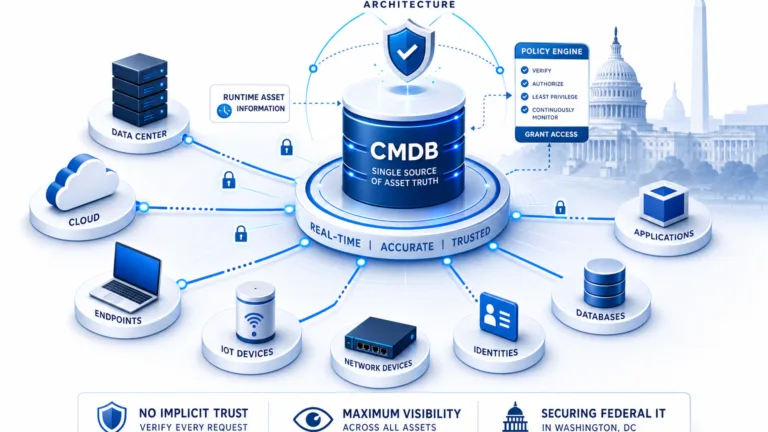
A discovery-sourced CMDB provides compliance auditors with a traceable, authoritative record of every IT asset — its configuration, its owner, its change history, and its current vulnerability status. Unlike manually maintained spreadsheets, a CMDB populated through high-frequency discovery cycles reflects the actual state of the IT environment, giving auditors the evidence they need.
See how Virima’s Trusted Runtime Truth layer — built on what exists, how it is connected, what changed, and who owns it — gives compliance teams the auditable, discovery-verified data that regulatory evidence demands.
How Virima Supports IT Compliance Audit Readiness
Our IT discovery platform supports both agent-based and agentless methods. As a result, it keeps an accurate, up-to-date picture of your IT environment. That picture then flows straight into your compliance workflows, across every audit type.
High-frequency discovery for current asset records
You control how often our discovery engine runs. It scans your networks, databases, applications, and cloud environments to build a detailed inventory. So when an auditor asks for an asset record, it shows what exists today — not what you logged months ago.
Compliance tracking and license management
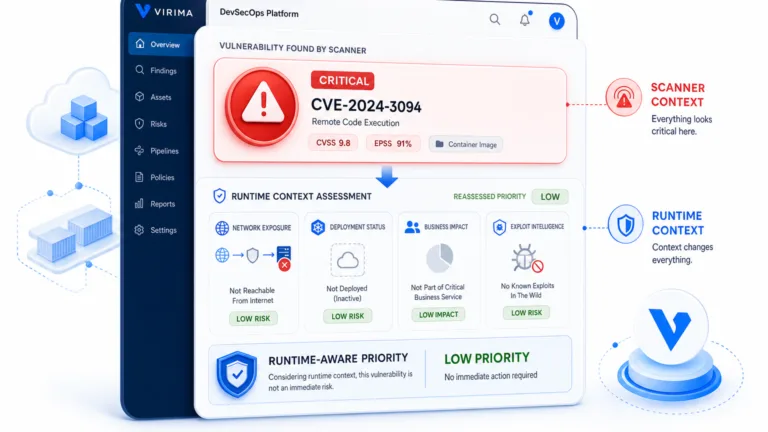
Our ITAM platform tracks software license status, hardware lifecycle stage, and asset compliance. So when a license nears expiration or a device drifts out of policy, you see it early — before it becomes an audit finding. The platform also matches NIST NVD vulnerability data to your discovered assets. As a result, you can see at a glance which assets carry unpatched risks, and you have the documentation to back up your fixes.
Discovery-sourced CMDB for audit-ready evidence
We cut the manual work of maintaining CI records. Discovery-sourced data and smart business rules keep your CMDB current and consistent. So when auditors ask for configuration baselines, change records, or ownership details, the data is already there — organized and ready to export.
Compliance dashboards for informed decision-making
Our ITAM reporting builds KPI dashboards for compliance managers. At a glance, you see license use, hardware lifecycle status, policy exceptions, and open vulnerabilities. Best of all, these dashboards update continuously. So you no longer wait for the next audit to reveal the gaps.
Adapting to new and updated regulations
Frameworks like ISO 27001, GDPR, HIPAA, and SOC 2 keep changing. To keep up, you need your evidence-gathering setup already in place. Because Virima collects discovery-sourced asset data all the time, a new requirement becomes a simple config change — not a big data-gathering project.
IT Compliance Audit Readiness Checklist: Key Practices
Use this IT compliance audit checklist. These readiness practices apply across frameworks and organization types.
- Run high-frequency discovery across your whole environment. Remember, an asset you haven’t discovered is one you can’t account for at audit time. Our dual-mode discovery uses both agent-based and agentless methods. So it even reaches places where you can’t install an agent, like legacy systems, network gear, and cloud instances.
- Set and maintain configuration baselines. Use your CMDB to define a compliant setup for each asset class. Then, when a device drifts from that baseline, you spot it right away — not at the next audit.
- Treat software discovery as ongoing, not a pre-audit sprint. When you track license positions through continuous discovery in a live ITAM platform, they stay documented and easy to defend.
- Deliver role-specific compliance reports. IT, finance, legal, and security each need a different view of the same data. So build report templates for each group. That way, you answer evidence requests in hours, not days.
Schedule a demo to see Virima’s IT compliance audit readiness capabilities in your environment.
Frequently Asked Questions
What is the difference between an IT compliance audit and a security audit?
An IT compliance audit measures adherence to specific regulatory frameworks — HIPAA, SOC 2, ISO 27001 — and produces documented evidence of compliance posture. A security audit evaluates the effectiveness of your security controls against potential threats, whether or not a regulatory framework requires it. The evidence requirements overlap significantly in areas like access control, vulnerability management, and change history.
How often should an organization conduct IT compliance audits?
Most regulatory frameworks require at least annual assessments. SOC 2, ISO 27001, and HIPAA typically mandate formal annual audits. Organizations in higher-risk sectors — financial services, healthcare, payment processing — commonly run quarterly internal audits alongside annual external assessments. The frequency of internal reviews should match the rate at which your IT environment changes.
What happens if an IT compliance audit finds gaps?
The audit report documents identified gaps and sets a remediation timeline. Auditors typically conduct a follow-up review to confirm that remediation is complete. Gaps that go unaddressed can result in regulatory penalties, loss of certification, increased insurance costs, or erosion of customer trust.
How does a CMDB help with IT compliance audits?
A CMDB provides auditors with a traceable record of every IT asset, its configuration, its owner, and its change history. Organizations with a discovery-sourced CMDB can respond to evidence requests quickly and accurately. Those relying on manually maintained records frequently cannot account for every asset or explain configuration changes with documentation an auditor will accept as authoritative.
Can Virima support SOC 2 audit readiness?
Yes. SOC 2 audits evaluate controls around security, availability, processing integrity, confidentiality, and privacy. Our discovery-sourced CMDB and ITAM platform provides the asset inventory, change records, and vulnerability data that SOC 2 auditors require for the security and availability trust service criteria.
Schedule a demo to see how Virima supports end-to-end IT compliance audit readiness, including SOC 2.