PCI DSS Compliance for Chicago Enterprises: Financial Security for Customers Begins With Proper Asset Inventory

Payment Card Industry Data Security Standard (PCI DSS) compliance is often treated as a documentation exercise: pass the assessment, file the report, move on until next year. The standard itself no longer works that way, and the asset record underneath a compliance program either reflects that shift or it doesn’t. An enterprise can pass a PCI DSS assessment with a complete and accurate scope on the day of the audit and still be blind to changes happening in its cardholder data environment (CDE) every week after. The gap between those two states (audited once a year, accurate every day) is where compliance failures start, and where an asset inventory either closes the distance or leaves it open.
Chicago is a useful place to see this play out, not because the city has a unique regulatory layer sitting on top of PCI DSS, but because its enterprise card-processing base is large, concentrated, and structurally complex enough that the gap shows up fast.
What Chicago’s Card-Processing Enterprises Actually Need
In Chicago, Discover Financial (one of the five founding card brands of PCI DSS) is headquartered alongside McDonald’s, Walgreens, and Hyatt. Every one of them processes card payments at enterprise scale, across hundreds of locations, with CDE scope that spans point-of-sale (POS) systems, cloud environments, and third-party integrations simultaneously.
That combination is what makes asset visibility a precondition for compliance rather than a nice-to-have. A single national chain with hundreds of Chicago-area locations does not run one POS platform on one software version everywhere. Store footprints get acquired, franchised, upgraded in phases, and integrated with third-party loyalty, delivery, and payment-processing vendors on different timelines. Each of those systems is a candidate for CDE scope, and each one needs to be accounted for, not assumed. An enterprise that only knows what it scoped during last year’s assessment is working from a snapshot in an environment that does not hold still.
Why This Is No Longer a 2027 Problem
The reason this matters specifically in 2026, and not on some future compliance horizon, is that the grace period is over. PCI DSS v4.0.1’s future-dated requirements became mandatory on March 31, 2025, and 2026 is the first full year in which every assessment — Self-Assessment Questionnaire or Report on Compliance — is conducted against the complete standard, with no transitional exceptions remaining. An organization that last validated under the older v3.2.1 standard, or validated under v4.0 without implementing the future-dated requirements, is now assessed against the full v4.0.1 requirement set with no bridge left to stand on.
Several of the requirements that are hardest to satisfy retroactively depend directly on having an accurate, current asset record. Multi-factor authentication requirements now extend to all access into the CDE, not just administrative accounts, which means every system touching cardholder data needs to be identified before access controls can be verified against it. Payment-page script monitoring requirements for e-commerce merchants depend on knowing which systems render payment pages in the first place. None of these controls can be demonstrated against a system the assessment scope never identified. The standard shifted from a once-a-year compliance event to an expectation of continuous, business-as-usual security. An asset inventory that is rebuilt each year for the assessment, rather than maintained continuously, is already out of step with what v4.0.1 assumes.
Virima gives PCI DSS teams an asset record that reflects the environment as it exists today, not as it looked at last year’s assessment. See how Virima’s Trusted Runtime Truth supports continuous PCI DSS compliance.
Where a CMDB Becomes Indispensable: Mergers and Network Migrations
The clearest illustration of why static, once-a-year scoping fails is happening in Chicago’s own backyard. Discover’s card network is currently being absorbed into Capital One following the companies’ merger, which officially closed on May 18, 2025. Capital One has since begun migrating core cards — including cards tied to major retail and travel brands — onto the Discover network in phases, moving high-volume debit portfolios first while phasing in premium credit portfolios more gradually to protect merchant acceptance during the transition.
A migration like this redraws the CDE boundary in motion, not once, but repeatedly, as each portfolio cuts over. The acquirer relationships, network endpoints, and authorization routing behind a card transaction can all change the day a given portfolio moves onto new rails, even though the systems physically processing that transaction may not change at all. An asset inventory that was accurate the week before a portfolio migration says nothing reliable about scope the week after. For any Chicago enterprise whose payment processing touches the Discover network during this transition — as an acquirer, a merchant, or a technology partner — the practical question is not whether their CDE has changed, but whether their asset records caught up to the change before the next assessment did.
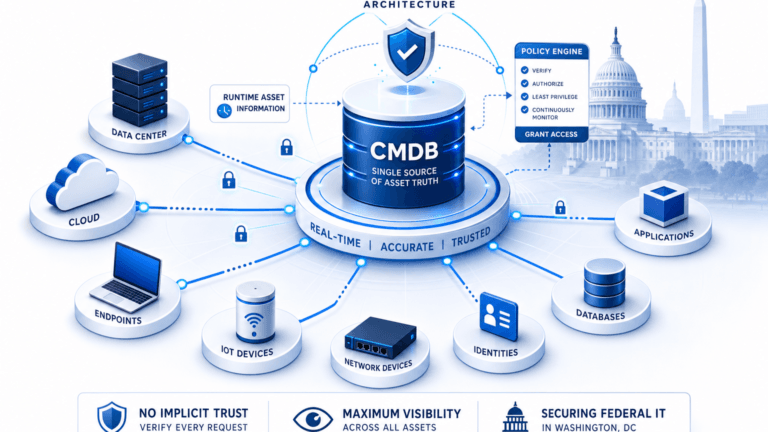
This is precisely the scenario a configuration management database (CMDB) is built to answer. A CMDB does not just list servers and terminals; it tracks the relationships between assets and the business services they support, so that when an upstream change occurs (a portfolio moving networks, a POS vendor upgrading firmware, an acquirer relationship changing) the downstream compliance impact is visible immediately, not discovered at the next audit cycle. Configuration items (CIs) that were network-agnostic yesterday and network-specific today are exactly the kind of drift a CMDB is designed to surface as it happens.
There is a second, quieter version of the same asset-visibility question worth naming honestly rather than answering with a guess. Amazon completed the shutdown of its Amazon One palm-payment service across all retail deployments — Whole Foods, third-party licensees, and venue partners alike — following a discontinuation announcement made in January 2026, with the company citing limited customer adoption as the reason. Amazon has not addressed, in any public statement, whether its own records could answer which of its retail deployments were simultaneously operating as biometric-data collection points subject to a separate compliance framework in the one state — Illinois — where such a framework has existed since 2008. That silence is not evidence of a cause. It is worth naming only because it shows how easily a device’s full capability set — payment processing on one hand, biometric capture on the other — can go unexamined by whichever compliance program happens to be looking at it, unless something is tracking the device’s actual functions rather than just its payment relevance.
How Virima Helps Chicago Enterprises Remain Compliant
The common thread across a fee-network migration, a compliance-standard transition, and a discontinued biometric payment pilot is the same: none of them are single events that a business addresses once. They are ongoing states that an enterprise’s records either keep pace with or fall behind.
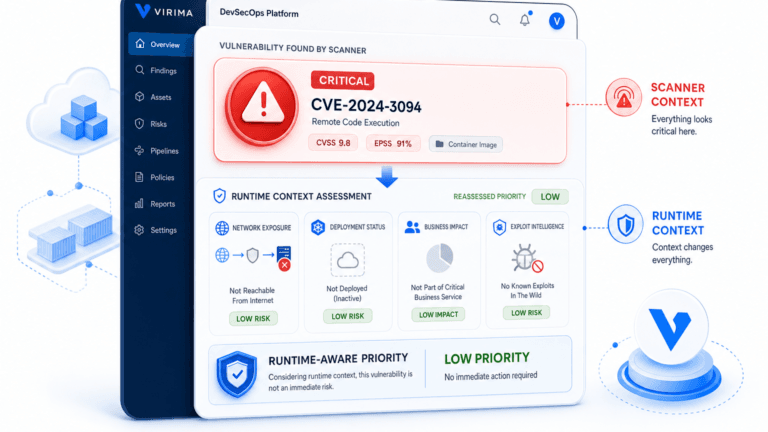
Virima’s IT asset management (ITAM) and CMDB capabilities are built for exactly this kind of continuous reconciliation. High-frequency scheduled discovery identifies what exists in the environment as it exists today, not as it existed at the last assessment, so that a portfolio migration, a vendor change, or a new device deployment shows up in the asset record before it becomes a scoping surprise. Service mapping extends that visibility one layer further, connecting individual configuration items — a POS terminal, a payment gateway, a network endpoint — to the actual business service they support, so a compliance team can see not just what changed, but what that change touches. IT service management (ITSM) integration ties changes to documented workflows, so that when a system moves in or out of CDE scope, that movement is ticketed, reviewed, and auditable rather than discovered after the fact.
For Chicago’s enterprise card processors, payment networks, and the merchants operating alongside them, the practical value is straightforward: an asset record that answers the compliance question on any given day, not just on assessment day.
See how Virima’s CMDB and ITAM capabilities keep your CDE scope accurate through mergers, migrations, and standard transitions. Schedule a demo.
The Estate Chicago’s Card Processors Actually Need to See
For Chicago’s enterprise card-processing base, the asset record behind PCI DSS compliance needs to move at the same pace as the environment itself. A CMDB built on continuous discovery, connected to service mapping and ITSM workflows, is how that pace gets matched.
To see how Virima’s CMDB, ITAM, and service mapping capabilities support enterprise PCI DSS compliance through mergers, standard transitions, and everyday infrastructure change, schedule a Virima demo today.