PCI DSS Compliance for Dallas Enterprises: Asset Visibility Across Multi-Entity Estates

A PCI DSS assessment measures a single moment. A Report on Compliance or Self-Assessment Questionnaire confirms that an organization’s cardholder data environment (CDE) met the standard on the day it was reviewed. What it cannot confirm is what happens to that environment the next day, the next quarter, or the next time a business unit changes a vendor, a subsidiary onboards a new point-of-sale (POS) platform, or a franchise location swaps payment processors. For a single-location merchant, that gap between audited and current is usually small enough to ignore. For an enterprise with dozens of business units, hundreds of locations, or a portfolio of subsidiaries each running its own systems, the gap opens fast, and it opens continuously.
Dallas is a useful place to see why scale changes the shape of this problem. The city sits at the center of one of the largest concentrations of large enterprises in the country, and the larger and more decentralized an organization is, the more its cardholder data environment behaves like a moving target rather than a fixed boundary.
What Dallas’s Fortune 500 Density Actually Means
The Dallas–Fort Worth metroplex is home to 24 Fortune 500 company headquarters as of the 2026 rankings, the fourth-largest concentration of Fortune 500 headquarters in the United States. Irving-based McKesson leads the group at $403.4 billion in 2025 revenue, ranking 8th nationally. AT&T, headquartered in downtown Dallas, ranks 32nd nationally with $125.6 billion in revenue. 7-Eleven’s U.S. headquarters sits in Irving, overseeing a franchise network of more than 70,000 stores worldwide.
None of these companies share a regulatory overlay unique to Dallas the way New York’s financial institutions answer to NYDFS on top of PCI DSS. What they share instead is architecture: each operates payment systems across a large number of semi-independent units (franchise locations, regional subsidiaries, business divisions, acquired brands) where cardholder data can enter, move, and exit the organization through many different paths at once. That structural fact, not any single incident, is what makes asset visibility a precondition for PCI DSS compliance in Dallas rather than a nice-to-have.
Why Multi-Entity Estates Break Static Scoping
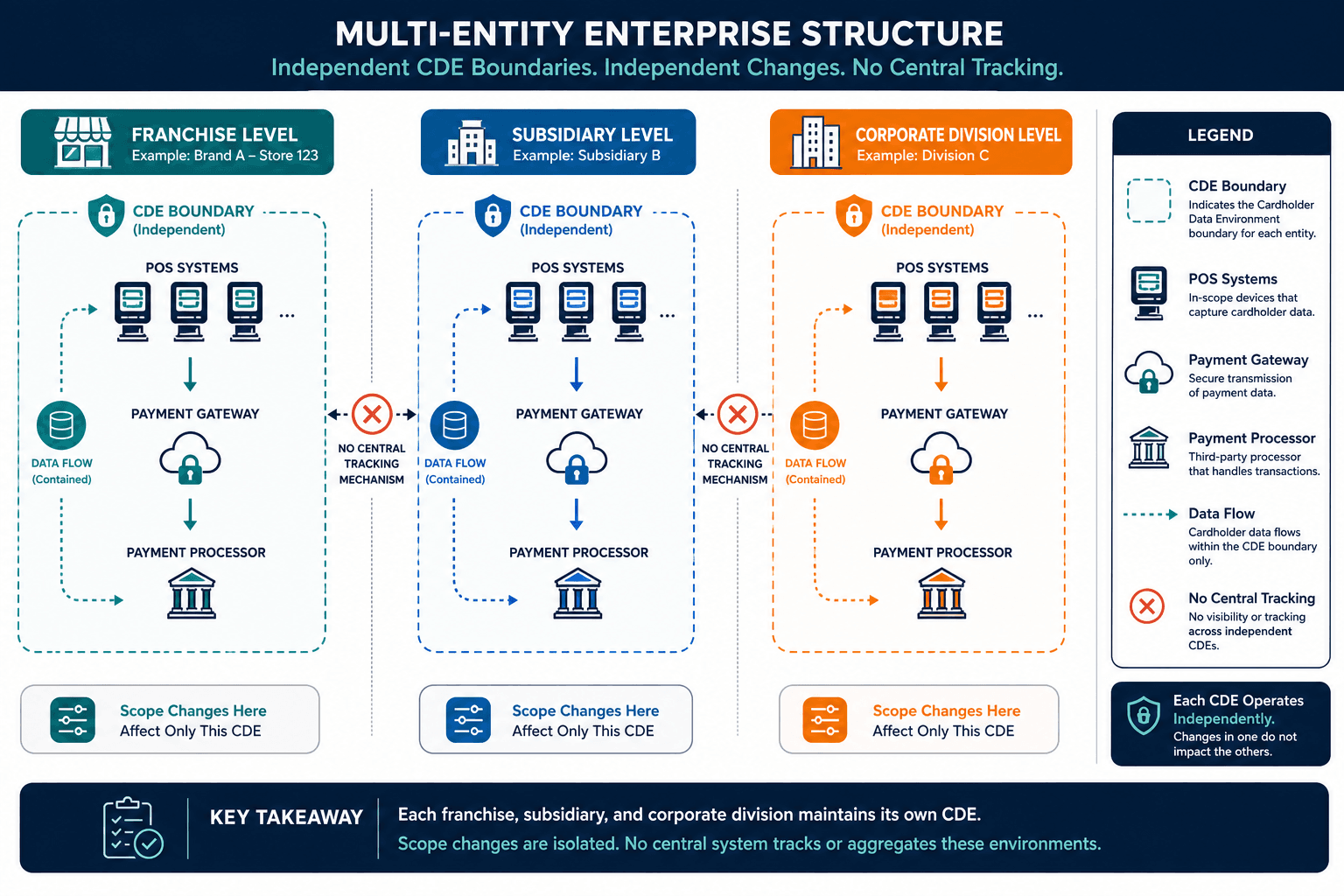
A national or global enterprise does not have one cardholder data environment; it typically has many, and they do not change on the same schedule. A franchise network onboards new locations continuously, each with its own POS hardware and software version. A holding company’s operating subsidiaries integrate different payment processors depending on region or business line. A corporate parent’s shared services division may process payments on behalf of multiple business units through systems those units do not directly control.
Each of these is a candidate for CDE scope, and each one can change independently of the others. An asset inventory built once for last year’s assessment reflects none of the changes that happened afterward: a new vendor integration in one division, a POS firmware upgrade in another, a divested business unit in a third. The organization’s actual cardholder data environment on any given day is the sum of all these independent changes, and a static inventory has no mechanism for tracking that sum as it moves.
The 2026 Compliance Floor: PCI DSS v4.0.1
This matters specifically now because the transition period is over. PCI DSS v4.0’s 51 future-dated requirements became mandatory on March 31, 2025, and the council has confirmed that the limited-revision update to v4.0.1 did not change that date. Every PCI DSS assessment conducted in 2026 (whether a Report on Compliance for a large processor or a Self-Assessment Questionnaire for a smaller merchant) is assessed against the complete standard, with no remaining exceptions for organizations still catching up.
Several of the requirements hardest to satisfy retroactively depend directly on an accurate, current asset record. Multi-factor authentication now applies to effectively all access into the CDE, not just administrative accounts, which means every system touching cardholder data needs to be identified before access controls can be verified against it. Payment-page script monitoring requirements for e-commerce merchants depend on knowing which systems render payment pages across every business unit that runs one. None of these controls can be demonstrated against a system the assessment scope never identified, and for a multi-entity enterprise, the number of systems capable of going unidentified scales with the number of business units, not with the size of the compliance team reviewing them.
Where a CMDB Closes the Gap
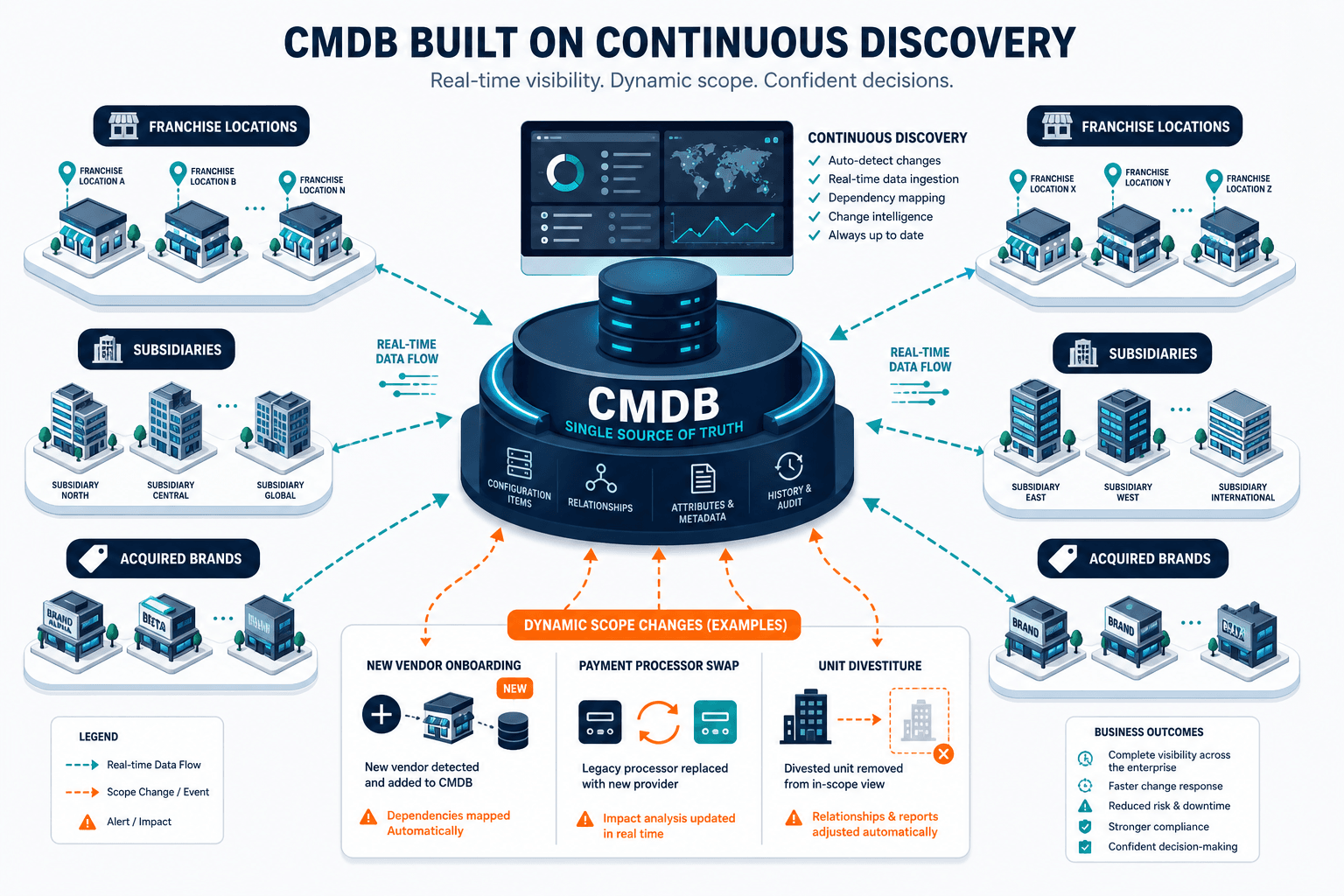
A configuration management database (CMDB) does not just catalog servers and terminals; it tracks the relationships between assets and the business services or entities they support. For a multi-entity enterprise, that relationship layer is the part a spreadsheet or an annual audit worksheet cannot represent. When a franchise location changes POS vendors, when a subsidiary integrates a new payment processor, or when a business unit is acquired or divested, a CMDB built on continuous discovery surfaces the change in the asset record as it happens, not months later when the next assessment cycle catches up to it.
This is the practical difference between an inventory that is rebuilt annually for an audit and one that is maintained continuously as business-as-usual. PCI DSS v4.0.1 was written with that distinction in mind, shifting the standard’s underlying expectation from a once-a-year compliance event toward continuous, current accuracy. An enterprise spanning dozens of business units cannot meet that expectation with a document that only gets updated when an assessor asks for it.
How Virima Helps Dallas Enterprises Remain Compliant
Virima’s IT asset management (ITAM) and CMDB capabilities are built for exactly this kind of continuous reconciliation across large, decentralized estates. High-frequency scheduled discovery identifies what exists across business units, subsidiaries, and locations as they exist today, so a new franchise POS deployment, a processor change, or a divested unit shows up in the asset record before it becomes a scoping surprise at assessment time.
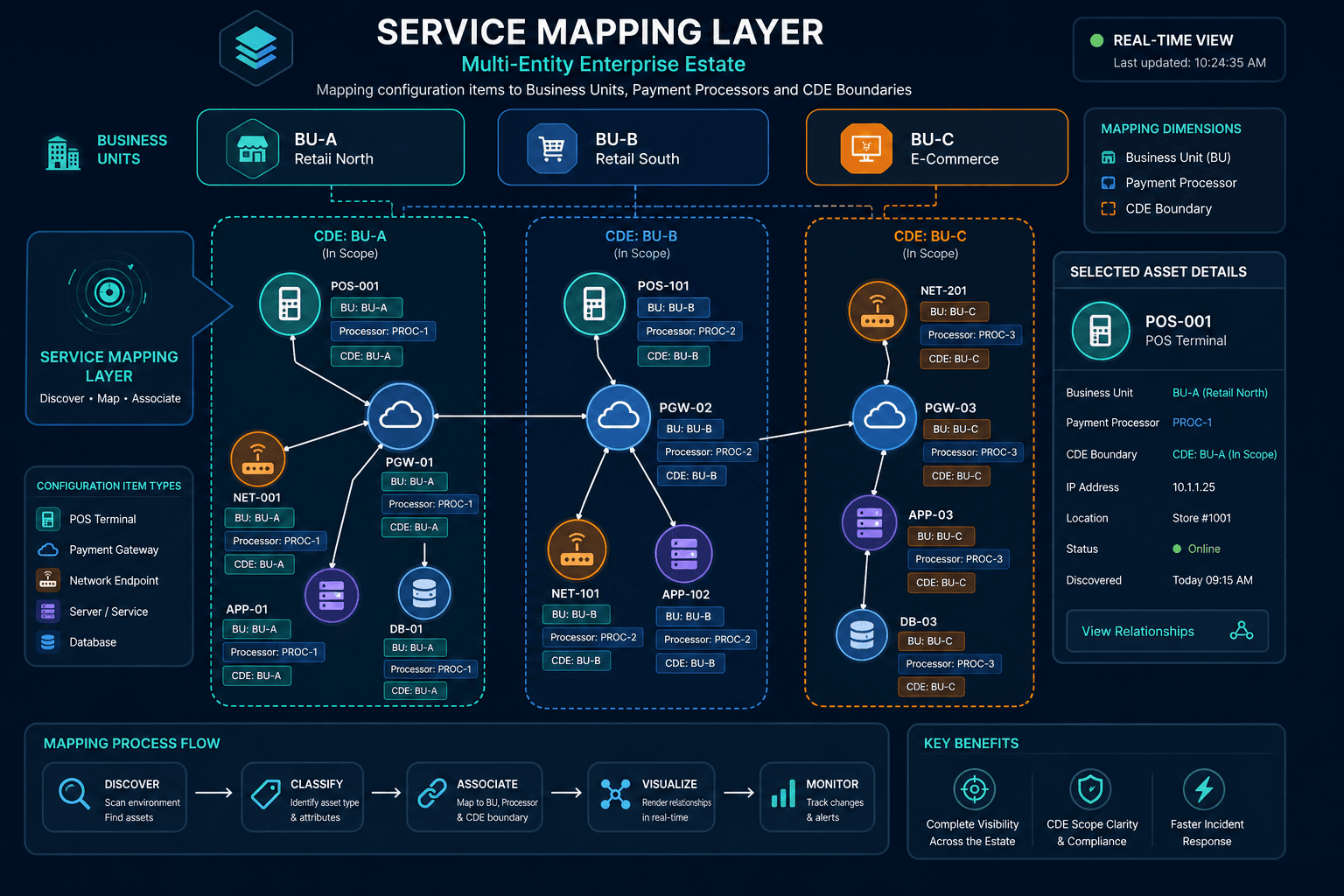
Service mapping connects individual configuration items (a POS terminal, a payment gateway, a network endpoint) to the business entity and service they actually support, so a compliance team can see not just what changed, but which part of the enterprise it belongs to. IT service management (ITSM) integration ties those changes to documented workflows, so that when a system moves in or out of CDE scope anywhere in a sprawling multi-entity estate, that movement is ticketed, reviewed, and auditable rather than discovered after the fact. For Dallas’s Fortune 500 concentration and the enterprises operating alongside them, the practical value is the same regardless of how many business units or locations are involved: an asset record that answers the compliance question on any given day, not just on assessment day.
To see how Virima’s CMDB, ITAM, and service mapping capabilities support PCI DSS compliance across multi-entity enterprise estates, schedule a Virima demo today.