Service Operations Insights: What They Are and How ITOM Delivers Them

What Are Service Operations Insights?
Service operations insights are the discovery-sourced operational data and contextual visibility that IT teams use to manage infrastructure, respond to incidents, and approve changes safely. They come from three sources: what assets exist in your environment, how those assets relate to each other, and what the current health of your services looks like.
Strong service operations insights answer the questions that determine how fast your team can act. Where is this incident originating? What will break if we approve this change? Is our CMDB data complete enough to trust? Without those answers, your team responds reactively and manages incidents with incomplete context.
As environments grow more complex, the gap between teams that have reliable service operations insights and those that don’t becomes the gap between proactive operations and constant firefighting.
| Service operations insights are discovery-sourced operational data and contextual visibility that IT teams use to manage infrastructure health, respond to incidents, and approve changes safely. They depend on accurate CI data in a maintained CMDB, service dependency maps, and integration with ITSM workflows. |
Why Most IT Teams Struggle to Get Reliable Service Operations Insights
- Many IT teams run ITOM tools. Yet most still lack the reliable service operations insights those tools are supposed to deliver. The problem usually comes from three gaps.
- First, discovery runs infrequently. When scans happen only weekly or monthly, CMDB data ages fast. Changes go undetected, and operations teams work from a picture of the environment that no longer reflects reality.
- Second, service dependencies are unknown or undocumented. Without a map showing which applications depend on which infrastructure, a single failing server triggers hours of manual triage. Your team chases symptoms instead of root causes.
- Third, ITSM and ITOM data live in separate silos. Incidents, changes, and assets don’t connect. So your team can’t answer quickly: “What is the blast radius of this change?”
- According to Gartner, the ITOM software market grew 9.0% in 2024 to reach $51.7 billion. That growth reflects genuine demand for better operational visibility. Yet investment in tooling alone won’t close the gap without fixing the underlying data quality problem first.
The Four Pillars of Reliable Service Operations Insights
To build service operations insights your team can act on, your ITOM practice needs four foundations. Each one builds on the previous.
1. High-Frequency Discovery Cycles
Your environment changes constantly. Servers are provisioned and decommissioned. Software gets installed and updated. Cloud assets appear and disappear. High-frequency discovery cycles catch those changes before they create data gaps in your CMDB. Virima’s IT discovery uses agentless scanning (WMI, SSH, SNMP), agent-based methods for Windows, macOS, and Linux, and API-based discovery for AWS and Azure. Your asset inventory stays current across your full hybrid environment.
2. An Accurate, Reconciled CMDB
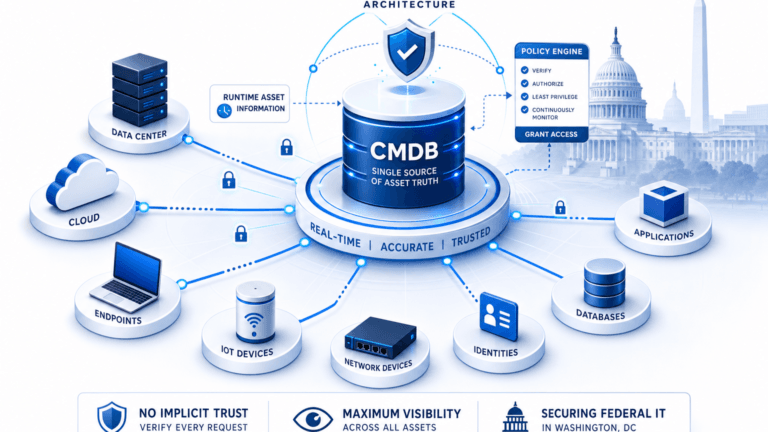
Discovery data only drives insights if it lands in a clean, reconciled CMDB. Virima normalizes CI data from multiple discovery sources, resolves duplicate records, and maps relationships between configuration items. That gives your operations team a single authoritative record for every asset, so the data your ITSM workflows rely on reflects what is actually deployed.
3. Service Dependency Maps
When an incident fires, you need to know which services are affected within minutes, not hours. ViVID™ service maps build dynamic dependency maps from your CI data, showing exactly how infrastructure tiers connect to business services. Those maps update as your CI data changes, so your runbooks always match reality.
4. ITSM Integration
Service operations insights reach their full value when they flow into the workflows your team already uses. Virima integrates with ServiceNow, Jira Service Management, Ivanti, Halo, and Xurrent. CI data, service maps, and change impact analysis are available inside your ITSM without manual data transfers.
How Discovery-Driven Data Powers Service Operations Insights
| IT discovery supports service operations insights by running high-frequency discovery cycles across hybrid infrastructure. Those cycles populate the CMDB with accurate CI data covering on-premises hardware, virtual machines, and cloud assets (AWS and Azure). Accurate CI data powers service dependency maps, change impact analysis, and incident correlation. |
Discovery-driven operations means your service operations insights are built on facts, not assumptions. When your discovery process runs on a defined schedule across your full environment, your CMDB reflects what is actually deployed. That changes everything downstream.
For example, when a change request comes in, your change manager can see which CIs are affected and which business services sit in the blast radius. That analysis comes directly from the CMDB data that discovery populated. Without it, change approval relies on judgment calls based on incomplete information.
Virima supports hybrid environments with both agentless and agent-based methods. API-based discovery covers AWS and Azure cloud assets. On-premises assets are covered through WMI, SSH, and SNMP scanning. Every method feeds normalized data into your CMDB through Virima’s multi-source reconciliation process.
You can explore the full approach on Virima’s IT operations management page.
ViVID™ Service Maps: From Asset Data to Service Context
- Raw asset data tells you what exists. Service dependency maps tell you what matters. That distinction sits at the heart of actionable service operations insights.
- ViVID™ service maps build dynamic dependency maps after your team provides service definitions. From there, Virima automatically constructs multi-tier application dependency maps, from web tier through app servers, databases, and network infrastructure. As your CI data changes, those maps update without manual maintenance.
- The practical benefit is faster incident triage. When an alert fires, your team sees the impact path from the failing CI to the affected business service immediately. That visibility reduces mean time to resolution and cuts the number of people pulled into unnecessary incident bridges.
- For teams managing IT asset management alongside ITOM, Virima ties hardware lifecycle, software license status, and contract data into the same operational picture.
Connecting ITOM Insights to ITSM Workflows
Service operations insights reach their full value when they feed directly into your service management workflows. Without that connection, your operations team manually transfers data between systems, which introduces errors and delays.
Virima’s Jira integration supports ticket-to-CI linking. When an incident ticket opens, your team sees which configuration items are involved and which services are affected. The same logic applies to change requests, with change impact analysis surfacing potential risk before your change advisory board reviews the request. You can also see the comparison between ITOM vs. ITSM to understand how both disciplines connect.
The EMA ServiceOps report covers how leading enterprise IT teams connect operational data to service management maturity. It is worth reviewing if you are evaluating your current ITOM approach.
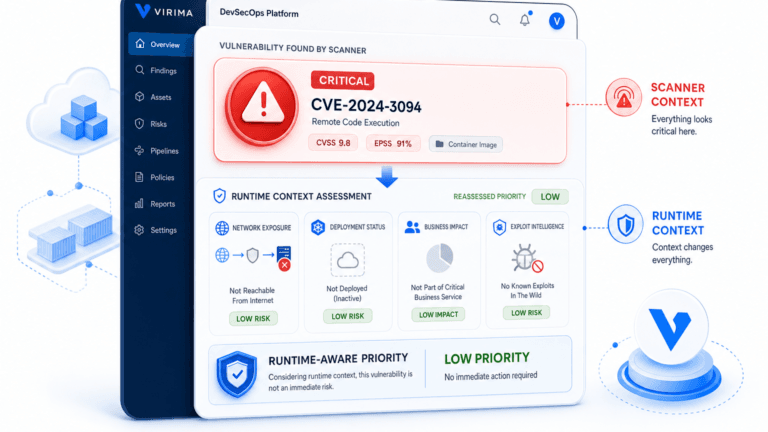
Your operations team deserves a trusted view of every service, asset, and dependency. See how Virima builds that foundation with Trusted Runtime Truth: Explore Trusted Runtime Truth.
Building a Service Operations Insights Program That Lasts
A service operations insights program starts with high-frequency discovery cycles that feed accurate data into your CMDB. From there, service dependency maps provide operational context, and ITSM integrations bring that context into incident, change, and problem workflows. The result is a connected operational picture that supports proactive IT management.
Most IT teams that improve their service operations insights follow a phased approach. Here is a practical path.
Fix your discovery foundation.
Schedule high-frequency discovery cycles across your full environment. Cover on-premises hardware, virtual machines, network devices, and AWS and Azure cloud assets. Make sure each discovery method feeds into your CMDB through a reconciliation process that handles duplicates and normalizes data.
Document service definitions.
Work with application and service owners to map which infrastructure components make up each business service. Start with your five most critical services and expand from there.
Activate your service maps.
Once service definitions are in place, let ViVID™ build the dependency maps. Connect those maps to your ITSM so that incident and change workflows benefit from service context immediately.
Measure outcomes.
Track CMDB health scores, mean time to resolution, and change-related incident rates. Those metrics reflect how well your service operations insights are working and where gaps remain.
For more detail on keeping your CI data clean through each phase, review CMDB best practices as you build out your program.
| Service operations insights matter because enterprise IT environments change constantly. Without high-frequency discovery, accurate CMDB data, and service dependency maps, IT teams respond reactively and approve changes with incomplete information. Strong service operations insights reduce MTTR, lower change-related incident rates, and support audit readiness. |
Service Operations Insights That Drive Confident IT Operations
Your service operations insights are only as good as the data behind them. Stale discovery data, inaccurate CIs, and undocumented service dependencies erode the visibility your team depends on. As AI agents take on more IT operational tasks, that data quality requirement grows stronger.
Virima gives you the discovery, CMDB accuracy, and service mapping your ITOM practice needs. You get the Trusted Runtime Truth behind every alert, change, and incident decision.
| Schedule a demo today and see how Virima builds the service operations insights your team needs to operate confidently. |
FAQ: Service Operations Insights and ITOM
What are service operations insights in ITOM?
Service operations insights are the discovery-sourced operational data and visibility that IT teams use to manage infrastructure, triage incidents, and approve changes safely. In ITOM, they depend on accurate CMDB data, service dependency maps, and integration with ITSM workflows.
How does IT discovery contribute to service operations insights?
IT discovery feeds current CI data into your CMDB through high-frequency discovery cycles. That data covers hardware, software, virtual machines, and cloud assets. Accurate CI data forms the foundation for service maps, change impact analysis, and incident correlation.
What is the difference between ITOM and ITSM for service operations?
ITOM focuses on the infrastructure layer: discovering assets, maintaining CMDB accuracy, and managing service dependencies. ITSM focuses on service delivery workflows: incidents, changes, and service requests. Service operations insights connect both layers so that ITSM workflows run on accurate operational data.
Why do service operations insights fail without CMDB accuracy?
When CMDB data is stale or incomplete, service maps are unreliable, change impact analysis produces incorrect results, and incident triage lacks the context needed for fast resolution. CMDB accuracy is a prerequisite for reliable service operations insights.
How does Virima support service operations insights?
Virima supports service operations insights through high-frequency discovery cycles, ViVID™ service maps that visualize application dependencies, and ITOM dashboards that surface infrastructure health across hybrid environments. Virima integrates with ServiceNow, Jira Service Management, Ivanti, Halo, and Xurrent to bring those insights into ITSM workflows.
| ITOM and ITSM connect through service operations insights. ITOM provides the discovery-sourced infrastructure data and service dependency maps. ITSM provides the workflows for incidents, changes, and service requests. When ITOM data flows into ITSM, teams respond faster, approve changes more safely, and manage services with accurate operational context. |