Network Device Discovery: What It Is, How It Works, and Why Your CMDB Depends on It

You ran the Discovery schedule last night. So the MID server dashboard glows green. Every job finished. No errors hit the log.
Then this morning, you approved a routine change. It was a firmware update on one distribution switch. By noon, three downstream services start failing. And the post-incident review asks its usual question: “Why didn’t the CMDB show those dependencies?”
The honest answer is simple. Your CMDB showed what your discovery pipeline reported. The pipeline saw only what you set it up to see.
It saw at the moment it last ran. And it reached only the segments your MID server could touch.
This gap matters. It turns your CMDB from a single source of truth into a single source of regret. It is also where CMDB data quality breaks down first.
Just look at the stakes. Gartner predicts that 99% of organizations using CMDB tooling that do not address Configuration Item data quality gaps will experience visible business disruptions. That number is no longer hypothetical.
For ServiceNow admins, the stakes climbed sharply this year. The platform now ships Context Engine, Action Fabric, AI Control Tower, and an Armis-fed CMDB. Soon, AI agents will start acting on the state of your CMDB.
So the question is no longer whether your CMDB is populated. Instead, the question is whether the data inside it is true.
This guide walks through four things. First, what network device discovery actually is. Second, how the mechanics work in practice.
Third, where most ServiceNow setups silently break down. And fourth, what you should audit against this quarter. Along the way, you will see CMDB data quality, IT discovery posture, and runtime truth as three views of one problem.
For a full breakdown of how network device discovery feeds CMDB accuracy, including all protocols and methods, see our complete guide.
What network device discovery actually is
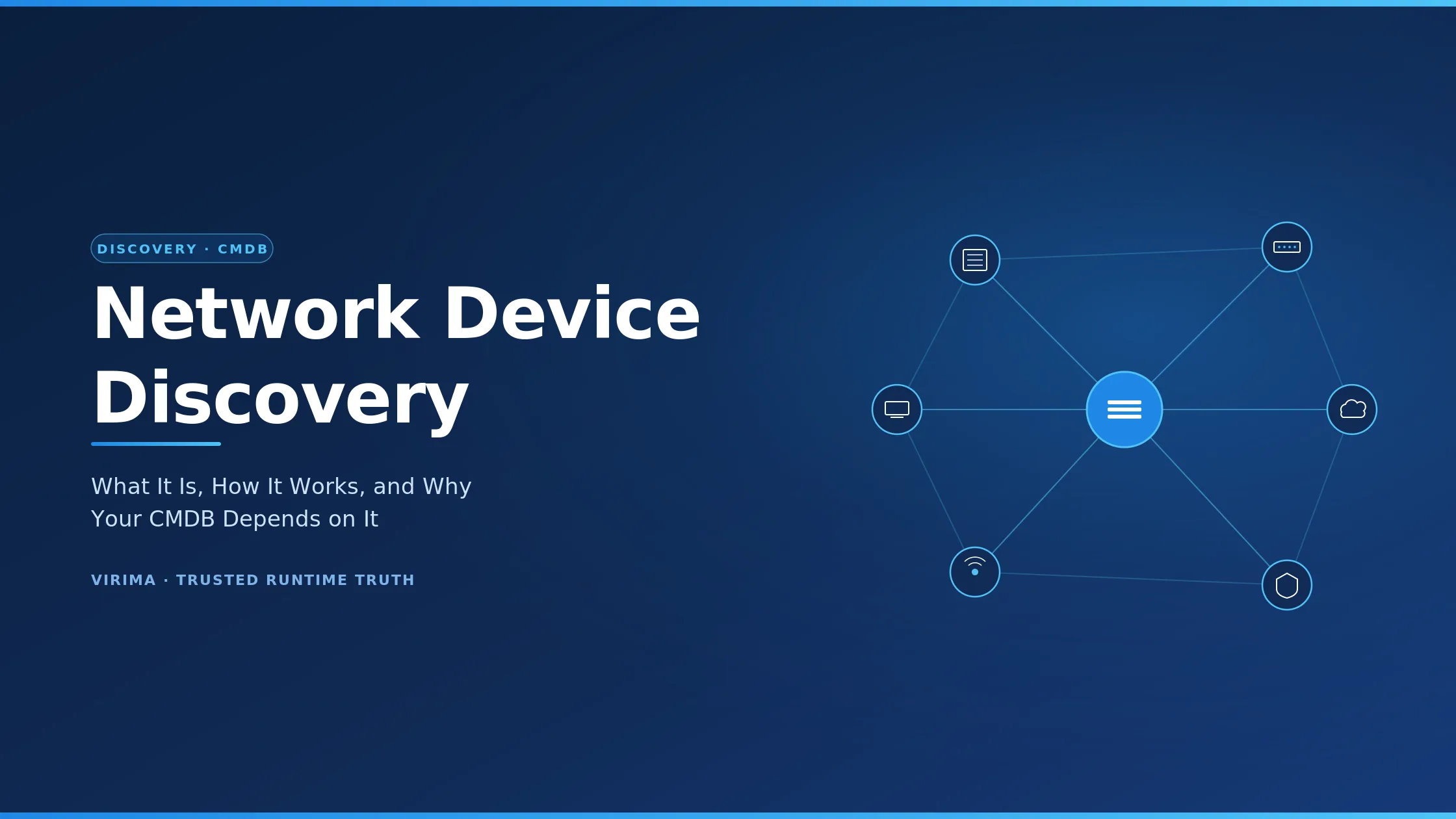
Network device discovery is a continuous process. It finds every device on your network. Then it learns enough about each one to help you make operational decisions.
So discovery is not a one-time inventory sweep. Nor is it monitoring. And it is not endpoint management. It also differs from the broader network asset discovery conversation, which centers on the financial and lifecycle value of every asset you own.
Here is the cleanest way to think about it. Monitoring tells you whether something is up. Inventory tells you whether someone bought it. By contrast, discovery tells you whether something exists, where it sits, what it touches, and what its attributes are right now.
That last phrase — right now — is where most discovery posture cracks. Meanwhile, your network changes every hour. Often, engineers add a switch, swap a line card, or move a VLAN. Sometimes they decommission a server, spin up a Kubernetes node, or attach an IoT sensor.
Some of those changes flow through change management. Many do not. So your discovery pipeline catches the gap between what should have happened and what did.
When discovery works, your CMDB matches operational reality. Service maps show actual dependencies. Blast radius calculations match what would really break.
Change risk scores also reflect real topology. And AI agents reasoning over the CMDB reason over the truth.
But when discovery fails — and most discovery fails in places — the CMDB drifts. The dashboards still look fine. The reports still run.
Yet the data underneath starts to lie. Quietly. By small amounts. In ways that surface only at the worst possible moment.
How network device discovery works: the protocols and methods
Network device discovery is not one tool. Instead, it is a stack of protocols. Each protocol suits a different network layer and a different class of device.
So understanding the stack matters. It is the difference between configuring discovery and trusting what it returns.
Here are the methods that matter most. Together, they make up the CMDB discovery techniques any modern pipeline relies on.
Layer 2 and Layer 3 sweeps
Almost every discovery pipeline starts with an IP sweep. ICMP echo finds live hosts. ARP tables on routers map IPs to MAC addresses.
Then come the neighbor protocols. CDP and LLDP stand for Cisco Discovery Protocol and Link Layer Discovery Protocol. Together, they reveal the physical neighbor relationships between switches, routers, and access points.
So these protocols help discovery draw your actual wiring diagram. Not just a flat list of IPs.
SNMP polling
Once discovery finds a device, SNMP pulls its attributes. That includes vendor, model, firmware version, and interface configuration. It also covers routing tables, VLAN membership, MAC address tables, and port status.
In production, SNMPv2c and SNMPv3 are the practical versions. The pipeline walks the device’s MIB (Management Information Base). Then it pulls structured data back.
However, MIB coverage varies wildly across vendors and firmware versions. Also, SNMP credentials stay notoriously fragmented across most networks.
SSH and CLI probes
Routers, switches, firewalls, and load balancers expose more through CLI than through SNMP. So a credentialed SSH session can pull running configs, ACLs, route tables, neighbor relationships, and high-availability state.
This is where vendor-specific parsing matters. Cisco IOS, Cisco NX-OS, Arista EOS, Juniper Junos, Palo Alto PAN-OS, and F5 TMOS all return different shapes of data for similar questions.
WMI and SSH for endpoints and servers
For Windows servers, discovery usually uses Windows Management Instrumentation (WMI). For Linux hosts and hypervisors, it uses SSH. Credentialed access then returns the operating system, installed software, and running processes. It also returns network configuration, mounted storage, and the local view of interfaces and routing.
Flow-based discovery
NetFlow, sFlow, and IPFIX export records of network conversations. These records come from your routers and switches. They do not tell you what a device is. But they tell you what is talking to what.
So flow data reveals implicit dependencies. Examples include:
- The application that quietly calls a database the docs never mention
- The integration that depends on an endpoint nobody owns anymore
- The service-to-service call pattern that drives blast radius
API-based discovery for cloud and SDN
Cloud environments do not respond to SNMP or CDP. Instead, AWS, Azure, GCP, and OCI each expose their inventory through APIs. Software-defined networks like Cisco ACI, VMware NSX, and Arista CloudVision do the same.
So discovery pipelines built only for traditional networks miss most of the cloud estate by design.
Unlike traditional network device discovery which relies on SNMP and SSH, cloud environments require API-based discovery via AWS, Azure, and GCP endpoints.
Agentless versus agent-based
Agentless discovery uses protocols already on the device. That includes SNMP, SSH, WMI, NetFlow, and vendor APIs. By contrast, agent-based discovery installs software on the endpoint. The software then reports back.
Agentless deploys faster. It also reaches devices you cannot install software on. Examples include network gear, OT controllers, medical devices, printers, and IoT sensors.
Meanwhile, agent-based gives deeper visibility into endpoint state. So most production discovery mixes both, by necessity.
Credentialed versus uncredentialed
Uncredentialed discovery finds that a device exists. By contrast, credentialed discovery tells you what it is. So credentialed discovery yields useful asset records. Uncredentialed discovery yields little more than a name on a list.
Discovery methods at a glance
Here is how the methods compare in one view.
| Method | What it tells you | Coverage | Credentialed? |
| ICMP and ARP | Device exists, MAC address | All IP-reachable hosts | No |
| CDP and LLDP | Physical neighbor relationships | Network gear | No |
| SNMP | Device attributes, interfaces, VLANs | Network gear, servers, printers | Yes |
| SSH and CLI | Running config, ACLs, HA state | Routers, switches, firewalls | Yes |
| WMI | OS, installed software, services | Windows endpoints and servers | Yes |
| NetFlow, sFlow, IPFIX | Who talks to whom | Routers and switches | No |
| Cloud APIs | Cloud inventory and config | AWS, Azure, GCP, OCI | Yes |
| SDN controllers | Logical topology and policy | ACI, NSX, CloudVision | Yes |
So no single method covers the whole problem. A CDP sweep maps the network topology. But it says nothing about server-to-service dependencies.
For context on the full network device discovery pipeline — including how SNMP, SSH, and neighbor protocols work together — see our complete guide.
SNMP returns device attributes. But it says nothing about flow behavior. Cloud APIs return the cloud estate. But they ignore on-prem.
The pipeline only works when you layer the methods. And something downstream still has to reconcile their conflicts.
Why your CMDB depends on network device discovery
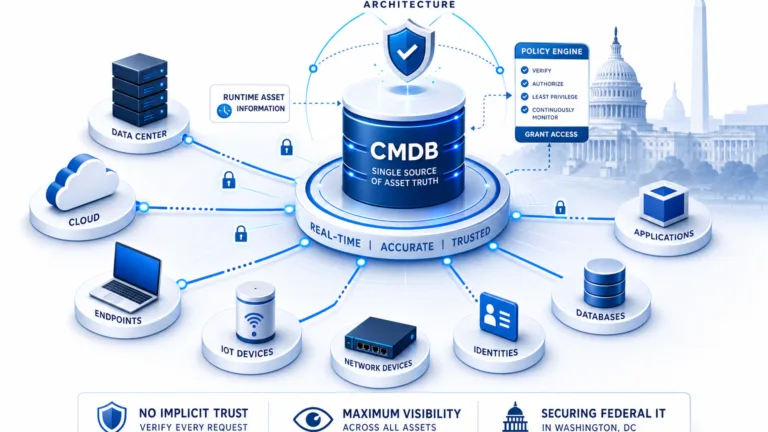
Your CMDB sits downstream of discovery. So whatever discovery sees becomes truth inside the CMDB. And whatever discovery misses becomes a blind spot. That blind spot then shows up in every service map, every change impact analysis, every compliance report, and every AI agent decision.
So here is the most important sentence in this guide. Your CMDB does not produce truth. Your CMDB stores what discovery produces.
Most CMDB problems are actually discovery problems wearing a CMDB costume. Consider three common examples:
- The change that took down a service. It was approved against a CMDB whose service map was three sweeps behind reality.
- The audit finding that flagged unmanaged assets. The discovery pipeline failed to credential-walk a network segment.
- The AI agent that recommended consolidating onto an EOL host. It reasoned over discovery output that had not refreshed in two weeks.
ServiceNow itself drew this distinction unusually cleanly at Knowledge 2026. On Day 2, the keynote introduced Context Engine. Context Engine reasons across Knowledge Graph, Cyber Asset Graph, Access Graph, and Decision Graph.
ServiceNow built it on workflow history. The exact framing: “context is the history of every decision your business has made, how that decision got made, and what happened next.”
That is a useful definition of context. Notably, it also admits something important.
Workflow context is the history of decisions. By contrast, runtime truth is the operational reality those decisions assumed. So they are not the same thing.
When workflow context says a change was approved last quarter, runtime truth tells you what actually happened next. Did the change actually deploy? Does the deployed version match the approved version?
Is the upstream library on the expected version? Has the environment drifted in the months since?
So workflow context tells you the policy. Meanwhile, runtime truth tells you what is actually running.
For a ServiceNow admin, the implication is clear. Your CMDB is only as useful as the runtime truth feeding it. Context Engine, Action Fabric, AI Control Tower, and the new AI Specialists all operate on the state of your CMDB.
So if that state is stale, partial, or conflicted, every downstream automation inherits the problem. Governed action on incomplete state is not actually governed. It is governance theater.
Network device discovery is the source of that runtime truth. Application discovery, identity discovery, and software inventory also contribute. But network device discovery sits underneath all of them. Until you know what devices exist, where they live, and how they connect, no other layer of operational truth holds.
Where most discovery pipelines silently break down
You probably run ServiceNow Discovery with MID servers. So do most of your peers. It is a serviceable playbook.
But it has predictable failure modes. They compound quietly until something visible breaks.
Here are the six that come up most often.
MID server reach
ServiceNow Discovery only sees what your MID servers can route to. So network segments behind firewalls without MID server access become discovery dark zones. That includes OT networks, DMZs, partner segments, isolated lab networks, and most cloud VPCs.
Each one demands another MID server deployment. That means more infrastructure, more credentials, more firewall changes, and more ongoing burden. So the default state of most ServiceNow Discovery setups is that part of the network stays invisible.
Credential management at scale
Discovery runs on credentials. Every network device needs working credentials. Every server, every cloud account, the same.
Each credential needs the right scope. Each one needs rotation on schedule. And the right MID server has to access the right secret.
Credential rot is one of the biggest causes of discovery decay. A switch that stops returning SNMP data did not disappear. It just lost its community string when someone rotated it. And nobody updated the discovery configuration.
Schedule lag
ServiceNow Discovery usually runs on a nightly or weekly cadence. But networks change every hour. So the window between sweeps is also the window during which your CMDB drifts.
A change deployed at 10 a.m. stays invisible to the CMDB until the next run. That might be tomorrow. It might be next week. It is almost never now.
Attribute conflicts
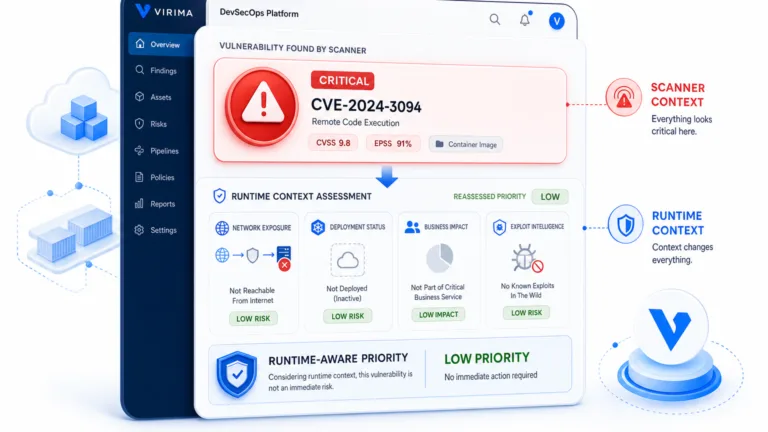
When two sources return data about the same CI, something has to pick a winner. Say SNMP reports the switch is on firmware 15.2(7)E. Then a vulnerability scanner says it is on 15.2(4)E. So which one wins?
Most ServiceNow Discovery setups default to “last write wins.” That means the most recent sweep overwrites the previous one. The CMDB ignores which source is actually authoritative. So your data reflects whichever pipeline ran most recently. Not whichever one knows the answer.
The single-vendor discovery problem
ServiceNow Discovery is one vendor’s view of one network. The Armis acquisition stretches that view across OT, IoT, and medical devices. But it is still one vendor’s view. And it still feeds into one platform’s CMDB.
Now consider two scenarios:
- The day you want a second source confirming what Armis says about a medical device segment. You have no clean answer.
- The day you need the same operational truth outside ServiceNow. Maybe for a Jira Service Management workflow, or an Ivanti or Halo deployment. Maybe for an analytics pipeline or a security data lake. Either way, you have a problem.
Single-vendor discovery carries a single-vendor failure mode. When the vendor pivots, your CMDB pivots with it. When the vendor’s roadmap drops a discovery method you depend on, your CMDB drops with it.
If you want to understand how network device discovery works across protocols like SNMP, CDP, LLDP, and SSH before diving into vendor coverage, start with our foundational guide.
Cloud and OT splintering
Today, a typical mid-size enterprise spans many environments. That includes AWS, Azure, and on-prem VMware. It also includes an OT network with PLCs and HMIs, a campus network with thousands of IoT endpoints, and usually an MSP-managed remote office network.
ServiceNow Discovery handles some of this natively. It handles some through add-on packs. It handles some through partner integrations. And it ignores the rest.
So your CMDB stays strong where ServiceNow’s story is strongest. But it stays silently incomplete everywhere else.
None of these failure modes show up on the dashboard. The MID server health page tells you the jobs ran.
But it does not tell you that they ran against an incomplete network picture. It does not tell you that a third of devices used stale credentials. It does not tell you that the schedule missed the last six days of change.
If you are a ServiceNow customer, this is usually where the cost conversation starts. Most teams we talk to pay premium pricing for the same structural failure modes. So they look for the same operational truth at significantly lower TCO. That is a fair frame for your next budget conversation — and a good moment to weigh the costs, limits, and alternatives alongside what you already pay.
What multi-source discovery looks like
The alternative to single-vendor discovery is not no discovery. Instead, it is multi-source discovery. Here, authority is not assumed. Authority gets established attribute by attribute, source by source, with the reasoning visible.
So this is the model worth building toward. Whichever platform you ultimately pick.
Multi-source, multi-protocol coverage
Multi-source discovery does not bet on a single method. It runs SNMP where SNMP works best. It runs CLI probes where CLI works best.
It also runs flow analysis for dependencies, cloud APIs for cloud, and agentless protocols for OT and IoT. So it accepts that no single method covers the whole estate. And it builds the pipeline around the layering.
Source attribution
Say your CMDB reports a switch is running firmware 15.2(7)E. The discovery layer should also tell you which source said so. It should tell you when that source last said it. And it should tell you what other sources said.
Knowing which source said what, when, is the difference between a defensible audit answer and an apology.
Freshness scoring
Not all CMDB data carries the same freshness. The hostname might come from a sweep two hours ago. The interface configuration might come from a sweep last night. The downstream service dependency might come from a continuous flow analysis.
So trusted discovery surfaces freshness per attribute. That way, your human operators and your AI agents can weight their decisions accordingly.
Conflict resolution logic
When sources disagree, the pipeline should not default to last-write-wins. Instead, it should apply explicit logic. Examples include:
- Which source is authoritative for which attribute class
- What the confidence weighting is when sources partly agree
- When to flag a conflict for human review rather than silently overwrite it
This is the difference between data that drifts toward chaos and data that stays coherent under pressure.
Portability across ITSM
Discovery that feeds only one ITSM is platform-bound discovery. By contrast, portable discovery sends the same operational truth into ServiceNow, Ivanti, Halo, Xurrent, Jira Service Management, and TeamDynamix. It also feeds the AI agents your team already uses.
So if the runtime truth lives outside the ITSM, the ITSM choice becomes a workflow decision. Not a data lock-in decision.
Foundation under workflow context
Multi-source discovery is the foundation that workflow context operates on. ServiceNow’s Context Engine knows what happened. It tracks decisions, approvals, and history.
By contrast, discovery-sourced runtime truth knows what exists. It knows how things connect. And it knows what will break.
Both layers matter. Workflow context without runtime truth reasons over assumptions. Meanwhile, runtime truth without workflow context lacks decision history. So the architecture you want runs both, with runtime truth as the foundation.
This is the model Virima delivers. Not as a replacement for ServiceNow. Instead, as the discovery and runtime truth layer underneath.
So ServiceNow’s workflow context, governed action, and AI agent investments work better. Today, Virima delivers this through high-frequency discovery cycles, service map rescan, and confidence scoring against multi-source ingestion.
Source attribution, freshness scoring, and conflict resolution are part of how the discovery layer works. Not premium add-ons. So the same operational truth feeds the named ITSMs above. And it feeds the AI agents your team already uses.
A practical audit for your discovery posture
Whatever platform you run, ask these six questions of your discovery posture this quarter. They come from a ServiceNow admin’s perspective. But they apply to any CMDB. If multiple answers come back as gaps, pair this audit with a deliberate framework for selecting the best CMDB discovery technique for each asset class.
- Can you trace any CI attribute in your CMDB back to its source and timestamp? If not, source attribution is missing. So your CMDB cannot defend itself in an audit.
- When two sources return different values for the same attribute, do you know which one wins and why? If the answer is “whichever ran last,” your CMDB drifts toward chaos by design.
- How fresh is each class of attribute in your CMDB? Think hardware identity, firmware version, interface state, service dependency, and software inventory. If the answer is “we run Discovery nightly,” that is a schedule. Not a freshness model.
- Which network segments lack coverage from your current discovery pipeline? Think OT, medical, partner segments, isolated labs, cloud accounts owned by other business units, and MSP-managed remote sites. Every uncovered segment is a CMDB blind spot.
- If you migrated off ServiceNow next year, how much of your discovery investment would migrate with you? If the answer is “almost none,” your operational truth is platform-bound. That is a strategic risk on its own.
- If an AI agent acted on your CMDB right now, would you stand behind the action? For most teams, the honest answer is “it depends on the action.” But that answer needs to become “yes” within the next planning cycle. The actions are coming. Your CMDB needs to be ready.
Shadow IT makes this audit more urgent than ever. Gartner notes that a meaningful share of enterprise tech spending now happens outside formal IT oversight. So every device that arrives that way needs a home in your CMDB. Otherwise, it becomes invisible risk — which is also a good reason to compare the best CMDB software options against the discovery foundation each one assumes.
Next steps: from inventory to runtime truth
Network device discovery is the unglamorous foundation of every operational automation. Also of every compliance report, every service map, and every AI agent decision tied to the CMDB. So it is one of the easiest layers to under-invest in.
IT discovery failures stay quiet. They accumulate slowly. They only surface at the worst possible moment. So CMDB data quality lives or dies on the discovery layer underneath.
The shift toward agentic IT, governed action, and AI-native operations does not change this dynamic. Instead, it amplifies the dynamic. AI agents do not fix bad data. They act on it faster.
So the CMDB you want for the next five years is one fed by multi-source discovery you can trust. That means source-of-truth tracking, explicit conflict resolution, and freshness scoring. It also means portability across the ITSMs and AI agents you actually use. That CMDB lets you discover with authority, understand operational reality in context, and govern every action your humans and your AI agents take.
Move faster. Act safely. Start with the discovery layer. For broader context on this discipline, our comprehensive IT discovery guide covers the full landscape. And if you are still mapping vendors, our roundup of the top CMDB discovery tools is a useful place to anchor the comparison.
We cover network device discovery in depth separately — including the exact protocol stack your pipeline needs and where most ServiceNow setups silently break down.
Get live, explainable runtime truth with Virima IT Discovery — multi-source, source-attributed, and portable across your ITSM stack.
Schedule a demo