How does ManageEngine AssetExplorer compare to other asset management tools?

It usually starts with a win.
An IT team rolls out ManageEngine AssetExplorer, finally centralizes inventory, and gets software licensing under control. Reports are easier. Tracking feels cleaner. For a while, asset management stops being a daily headache.
Then the environment changes.
Cloud workloads grow. Remote devices multiply. SaaS expands quietly. And suddenly, the questions get harder: Is this inventory still accurate? Can we prove ownership history? Can we defend this data during an audit?
For many mid-market and enterprise IT teams, AssetExplorer works well at the beginning. As infrastructure becomes hybrid and compliance demands increase, the IT asset management system shifts from tracking assets to driving operational maturity.
This article explores how AssetExplorer compares to modern ITAM platforms, and when it may be time to consider an alternative.
What Is ManageEngine AssetExplorer?
ManageEngine AssetExplorer is a tool that helps you manage IT assets. You can use it to track your hardware and software from start to end.
It focuses on the most important IT asset tasks. For example, you can discover assets and track who owns them. You can also manage software licenses and stay compliant. Finally, you can create clear reports to understand your assets better.
If you already use the ManageEngine ecosystem, AssetExplorer can feel like a natural next step. It fits well with the tools you already know.
It also helps you manage your inventory in one central place. As a result, you can clearly see your devices, software installs, and contracts. In addition, it helps you stay organized and avoid missing important details.
For environments where simply tracking existing assets is sufficient, AssetExplorer may be a suitable solution.
It helps you list and monitor your assets in a simple way. As a result, you can see what exists in your environment. Therefore, you can stay aware of your hardware and software at all times.
Key features of ManageEngine AssetExplorer

- ManageEngine AssetExplorer helps you discover and manage your IT assets in a clear way. It supports asset lifecycle management and tracks software licenses. As a result, you can stay organized and avoid license issues.
- It helps your IT team build and maintain one central inventory. You can also track warranty details and purchase information. In addition, you can monitor software usage and compare it with your license limits. Therefore, you can stay compliant and reduce risks.
- It also gives you reports that support internal rules and software audits. As a result, you can review your data with more confidence.
- At a basic level, AssetExplorer answers simple but important questions. For example, what assets do you have? Who owns them? Are you following license rules?
- For some organizations, this level of detail is enough. However, if you work in a regulated industry, you may need much deeper control and insight.
How ManageEngine AssetExplorer compares to other asset management tools
The difference between AssetExplorer and many modern IT asset tools is not just about features. Instead, the real difference is the main focus and strategy.
AssetExplorer mainly works as an inventory and license management tool. In contrast, many newer ITAM platforms focus on bigger goals. For example, they help you prepare for audits, reduce risk, connect IT systems, and manage hybrid environments.
As a result, you can clearly see this difference in five key areas.
Discovery and hybrid infrastructure visibility
Traditional IT asset discovery works best when your setup stays stable and mostly on-site. AssetExplorer can track inventory well when you set discovery correctly. However, you must also keep it updated over time.
Today, many IT environments change fast. You may have remote laptops, cloud systems, and more SaaS tools. In fact, by 2025, 85% of enterprises will embrace a cloud-first strategy
The main challenge is not finding assets one time. Instead, you need steady and reliable visibility all the time. You also want to avoid too much manual work.
Modern ITAM platforms focus on hybrid discovery across on-site and cloud systems. They also clean and match data to keep it consistent. In comparison, many teams find that AssetExplorer needs more admin tuning to stay accurate at scale.
Compliance and audit readiness
Software license compliance is a key part of IT governance. Recent industry research shows that 62% of organizations were audited by a major software vendor within the past year.
AssetExplorer supports this area well. It gives you reports to track software installs and manage license risk.
However, regulated industries need more than basic tracking. For example, banks and healthcare groups must meet strict rules. In these cases, you need deeper compliance visibility.
Audit readiness often requires a clear and detailed asset history. You must track ownership over time. You also need links to change management software and a clear view of how assets affect operational risk.
In many organizations, AssetExplorer becomes only one of several data sources. As a result, your IT team may export reports and compare them with other tools. You may also need to fix mismatched data and fill in missing details by hand.
When compliance pressure grows, this work becomes harder to manage. In fact, 32% of organizations reported audit-related financial liabilities exceeding $1 million. Therefore, many IT leaders start looking for an alternative to ManageEngine AssetExplorer. They want a tool that supports audits and governance needs in a more built-in way.

Integration and ecosystem alignment
AssetExplorer works best with other ManageEngine tools. So, if you already use that ecosystem, your workflows can feel simpler.
Most regulated enterprises don’t run a single platform. Your team may be managing assets alongside ServiceNow for ITSM, Jira Service Management for development workflows, Microsoft tools for endpoint management, and vulnerability scanners for security operations. In that environment, your ITAM tool is only as useful as its ability to share clean data across all of them.
Virima ships with pre-built integrations for ServiceNow, Jira Service Management, and security tooling, so asset and CMDB data flows into the systems your team already uses, without custom middleware or manual exports.
In these cases, the real value of your ITAM tool depends on integration. You need it to connect easily with other systems. You also need it to share clean and well-organized data.
If your asset data stays locked in one tool, problems can grow. Industry analysis suggests that the accuracy of most CMDBs hovers around 60%without strong automation and governance. As a result, auditors may question the data. During major incidents, your team may also struggle to trust the information.
Therefore, integration strength often becomes a key factor. Many organizations look closely at this when they compare ManageEngine AssetExplorer with other asset management tools.
Usability, scalability, and long-term ROI
Cost is often a main reason you may choose AssetExplorer. At first, it can look more affordable than some enterprise platforms.
However, the total cost of ownership includes more than the license price. You must also think about setup time and daily admin work. In addition, you need to consider integration effort and audit preparation time.
Therefore, in regulated environments, these extra factors can strongly affect your return on investment.
If you must fix data by hand all the time, your costs can rise quickly. If you also need to match reports across tools, the work increases. As a result, your operational cost can cancel out your early savings.
At the same time, scalability becomes very important as you grow. For example, multi-site companies and MSP-style teams need strong central visibility. They also need flexible deployment options.
Therefore, many IT leaders start looking at more modern platforms at this stage.
Virima: A modern alternative to ManageEngine AssetExplorer
| ManageEngine AssetExplorer | Virima | |
| Deployment | ServiceNow, Jira Service Management, HaloITSM, Xurrent, etc | SaaS or on-prem; no infrastructure burden in cloud deployment |
| Asset Discovery | Network scans + agents; strong for stable on-prem environments | Agentless and agent-based; discovers across on-prem, cloud (AWS, Azure), and hybrid |
| Service Mapping | Not included | ViVID™, visual dependency mapping showing how assets connect to business services |
| CMDB | Basic asset records; no native relationship mapping | Full CMDB with automated population and relationship alignment |
| Compliance Reporting | Software license compliance and basic audit reports | Structured reports linked to ownership history, change events, and governance requirements |
| Integrations | ManageEngine suite (ServiceDesk Plus, OpManager); limited third-party | ServiceNow, Jira Service Management, HaloITSM, Xurrent etc |
| Scalability | Requires separate instances per site or client | Multi-site and multi-tenant capable under one platform |
Virima is built for organizations that need more than simple inventory tracking. It helps you support compliance, operational stability, and hybrid visibility.
AssetExplorer mainly focuses on asset records and license compliance. In contrast, Virima treats ITAM software as a core part of governance. As a result, you can manage assets in a way that also supports risk-aware operations.
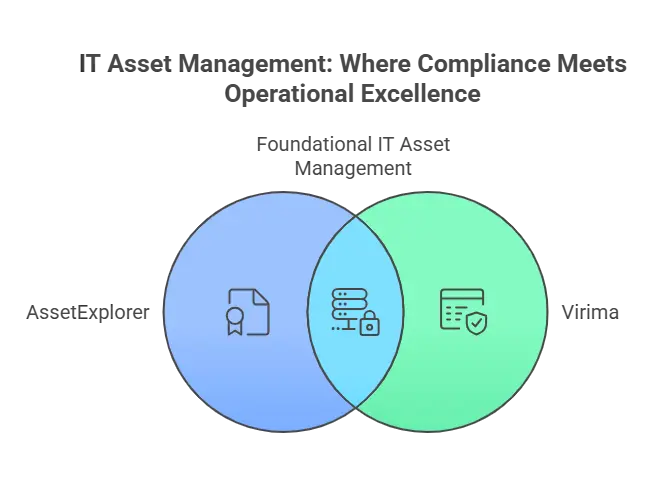
Virima brings automated discovery, IT asset management software, CMDB alignment, and service mapping into one platform, including ViVID™, Virima’s visual dependency mapping engine that shows how assets connect to business services in real time. As a result, you don’t just see what assets exist. You see what depends on them, and what breaks if they go down.
For regulated IT teams, this change is very important. You receive built-in, structured reports instead of exporting data for audits. Therefore, you can align your reporting directly with governance needs.
During incidents, relationship visuals help you see dependencies quickly. Considering that the average cost of IT downtime is estimated at $5,600 per minute, faster dependency mapping can significantly reduce financial impact.
As a result, you do not need to map them manually. Asset management in IT also becomes part of daily IT work. It supports both operations and compliance, instead of sitting in a separate tool.
Virima works especially well for mid-market and enterprise organizations. This includes healthcare, financial services, and other compliance-driven industries. In these sectors, audit readiness and hybrid visibility are often critical.
Why regulated IT teams choose Virima

- Agentless and agent-based discovery across on-prem infrastructure, AWS, and Azure with continuous sync, not point-in-time scans
- Automated CMDB population with ViVID™ powered service mapping shows asset relationships and business service dependencies visually
- Structured compliance reports linking assets to ownership history, change records, and learning curve governance requirements, without spreadsheet exports
- Pre-built integrations with ServiceNow, Jira Service Management, and security tooling via open REST API
- Dedicated onboarding and implementation support, not a shared ticket queue
When to consider an alternative to ManageEngine AssetExplorer
ManageEngine AssetExplorer can work well if your main goal is asset inventory and license tracking. It is a good fit when your environment is stable and does not change often.
However, you may need an alternative in some cases. For example, audit prep may take too much time. Hybrid systems may also create visibility gaps.
Research shows that 53% of organizations say cloud adoption has increased compliance complexity. In addition, integration may feel limited, or scaling may become too complex.
In those situations, the discussion changes. You stop comparing features and start comparing strategy. The real question becomes this: Is your ITAM tool only tracking assets, or is it also reducing operational risk?
If your evaluation extends to the ITSM layer — specifically whether ManageEngine ServiceDesk Plus can anchor your service desk and CMDB at scale — the Virima vs ManageEngine ServiceDesk Plus comparison covers that decision in full, including hybrid cloud coverage, audit posture, and ITSM portability.
Final thoughts
ManageEngine AssetExplorer is still a solid IT asset management tool. It works well for basic inventory and license tracking needs.
However, regulated enterprises now face higher compliance pressure. At the same time, hybrid IT environments add more complexity. In addition, integration demands continue to grow. Therefore, IT asset management solutions must move beyond simple tracking.
Virima reflects this next step. It helps you move from basic asset visibility to audit-ready and risk-aware IT operations. As a result, you can manage IT with more control and confidence.
See how Virima compares in your environment
If you are evaluating ManageEngine AssetExplorer, you may also be looking for a more scalable option. In that case, Virima can help you review your current ITAM approach. It helps you check how well you support compliance, discovery, and integration goals.
Request a tailored demo to experience Virima in action. Discover how it provides hybrid visibility, seamless CMDB alignment, and audit-ready reporting within a unified platform. As a result, you can support regulated IT environments with more confidence.
FAQs
1) Is ManageEngine AssetExplorer a full ITAM solution?
ManageEngine AssetExplorer is a solid IT asset management tool for core needs. It helps you track hardware and software inventory. It also supports ownership tracking and license compliance.
For many organizations, this is enough. It covers the foundational parts of an IT asset management analyst.
2) Can AssetExplorer support regulated industries like healthcare and finance?
AssetExplorer can help regulated teams with basic inventory and license reporting. It gives you a clear view of what you own and what is installed.
However, highly regulated environments often need much more. You may need deeper audit readiness and stronger proof for every asset change. You may also need better alignment with governance and operational risk.
3) What are the common limitations teams report with AssetExplorer?
The three limitations that come up most consistently are: (1) inventory drift in hybrid environments; AssetExplorer requires ongoing admin tuning to stay accurate when cloud workloads and remote devices change frequently; (2) audit prep overhead, because AssetExplorer sits alongside other tools rather than integrating deeply, teams often export reports, reconcile data manually, and repeat the process each audit cycle; and (3) integration limits outside the ManageEngine ecosystem, connecting AssetExplorer to ServiceNow, security tooling, or external CMDBs typically requires custom scripting rather than pre-built connectors.
4) How is Virima different from AssetExplorer?
AssetExplorer mainly focuses on inventory and license compliance. It helps you track what you own and manage software licenses.
In contrast, Virima supports regulated IT operations across three areas that AssetExplorer doesn’t cover well: hybrid discovery (cloud and on-prem in one view), CMDB alignment with automated relationship mapping via ViVID™, and structured compliance reporting tied to governance workflows. The result isn’t just a more complete inventory. It’s an asset foundation your auditors, security team, and operations staff can all work from without reconciling data between tools.