Revolutionize IT operations with Virima and Jira Integration

Poor IT operations cost real money every hour they stall. A widely cited IBM and Ponemon Institute survey put uninterrupted IT downtime at roughly $150,000 per hour for small and mid-sized companies, and far higher for large enterprises.
More recently, Uptime Institute has reported that human error-related outages caused by failure to follow procedures rose by ten percentage points between 2024 and 2025. That shift shows why disciplined IT operations processes matter as much as the tools behind them.
Growing infrastructure complexity makes it pivotal to pair the right tools together to limit downtime and keep operations steady. This is where Virima and Jira come together, offering an integration that strengthens day-to-day IT operations.
Virima, a leading provider of IT automation solutions, focuses on discovery, dependency mapping, and asset management. Through this approach, teams gain clearer visibility into their IT environments, helping them spot issues and tune performance earlier.
Jira, meanwhile, streamlines IT service management with a suite of tools built to automate processes and improve collaboration across teams.
Together, Virima and Jira create an integrated solution that addresses common friction points in modern IT operations. The integration supports easy data sharing between platforms, so your IT team consistently works from accurate, current data. That helps teams manage IT environments proactively, which in turn reduces downtime and supports business goals.
Below, we look closer at the benefits of pairing Virima and Jira for stronger IT operations.
Virima and IT Operations Management (ITOM)
Virima’s ITOM Essentials is an IT automation solution that combines infrastructure discovery, automatic dependency mapping, Service Asset and Configuration Management (SACM), ITSM, Virima Visual Impact Display (ViVID™), and dependency and service mapping.
It is built to strengthen IT operations while supporting asset, service, security, risk, and compliance management. Virima’s ITOM Essentials can run as an all-in-one solution or alongside common ITSM platforms such as Jira, avoiding costly displacements or disruption to existing workflows. For a deeper look at how these functions fit together, see this guide to IT operations management functions.
Optimize ITOM health and beyond with Virima
ViVID™ maps, paired with Virima’s affordable and easy-to-deploy IT Operations Management solution, help improve the health of your IT operations. The benefits are wide-ranging, delivering better operational stability and efficiency.
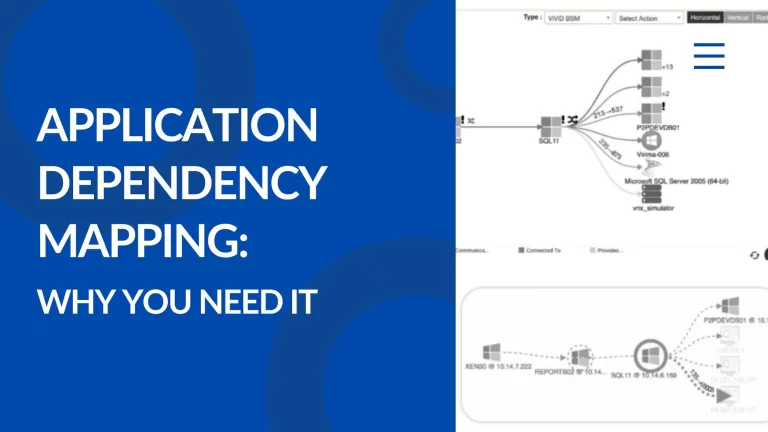
These advantages include reduced risk during changes through clearer impact analysis, ready access to accurate configuration and dependency data, and faster root cause analysis through ViVID™-powered dynamic business service maps. These maps show the infrastructure components tied to a service, recent changes, and auto-generated open tickets.
The solution tracks a broad range of hardware and software configuration attributes across data center, edge, cloud, and Internet of Things (IoT) assets. Teams can also build custom dashboards for CMDB data, including asset counts by blueprint, locations, recently updated CIs, migration status, and software inventory.
Discovery-driven mapping across your infrastructure
Virima’s Discovery feature supports discovery-driven mapping of infrastructure relationships, application dependencies, and host-to-host communications through high-frequency discovery cycles rather than one-off manual audits.
This capability helps organizations connect business services to the technology that runs them. It supports visualized service representations, so teams can quickly assess potential impact, risk, and root causes. As a result, organizations are better positioned for change planning and faster response when issues surface. This guide to business service mapping for incident management walks through the connection in more detail.
Maintaining a complete configuration database matters because it pulls data from many diverse sources, informing and improving decision-making. It also lets teams use CMDB tools to dissect data and generate reports.
These reports can help manage inventory, oversee software licenses, strengthen security, and support audits tied to governance, risk, and compliance (GRC).
Hassle-free installation and configuration
Virima’s solution is straightforward to set up and customize without deploying agents. It uses IP-based scanning, giving teams the flexibility to select specific subnets and ranges for scanning. With a range of ready-to-use, expandable IT asset discovery probes, sensors, and blueprints, Virima is designed to avoid network overload from scan storms and preserve device performance. Scan reports clearly outline successful and unsuccessful scans along with reasons for scan failures, keeping the process transparent. Learn more about the IT asset management capabilities behind this discovery approach.
Jira and IT Operations Management
Jira strengthens IT operations with a full suite of IT Service Management (ITSM) tools, including an Asset and Configuration Management Database (CMDB) and service mapping capabilities.
Service mapping and change management plans
Change management is an essential part of IT operations, and service mapping plays a key role in supporting it by giving teams a clear view of dependencies and the potential impact of proposed changes. By integrating Jira with tools like ViVID™, organizations can build stronger change management plans grounded in real dependency data.
Enhancing IT service performance with integrated Jira CMDB and ITSM solutions
Jira’s CMDB and ITSM solutions work well together for managing IT operations. Combined, they help organizations improve IT service performance and boost overall efficiency. For more on how Virima and Jira reinforce each other on data quality, see how Jira CMDB and Virima integration build data trust.
Here is how CMDB integration supports several core ITSM processes:
Incident management: Swift resolution guided by CI
Incident management becomes more streamlined with access to relevant Configuration Item (CI) data through CMDB integration. This helps IT teams quickly identify affected systems and components, speeding up incident resolution, shortening downtime, and limiting the impact on business operations.
Problem management: Uncovering root causes and impacted CIs
Problem management centers on finding and resolving the root causes of recurring incidents or serious issues. With CMDB integration, IT teams can evaluate CI relationships more easily, spotting patterns and dependencies that contribute to problems. This proactive step helps prevent future issues and supports a more stable IT environment overall. This guide to ITIL incident and problem management covers the broader ITIL framework behind this process.
Change management: Evaluating CI impact from changes
Change management supports planning, testing, and implementing changes to IT infrastructure with minimal disruption to services. Integrating CMDB with ITSM platforms surfaces the likely impact of these changes on associated CIs, improving risk assessment, supporting stronger decisions, and helping smooth transitions that reduce the chance of unexpected fallout or service interruption.
Service catalog: Offering precise service information
A service catalog is the consolidated inventory of the IT services an organization offers. Merging CMDB with ITSM makes sure current IT asset information is available when users request and manage services, helping people find services suited to their needs and available resources.
Knowledge management: A unified repository for CI-related information
Knowledge management covers the creation, upkeep, and sharing of information tied to IT services, processes, and infrastructure. CMDB integration works alongside knowledge management by supporting a unified repository of CI-related knowledge, giving IT teams and users faster access to relevant information. It supports self-service, eases the load on support teams, and helps keep accurate, current information available for decisions and problem resolution. This look at IT visibility and ITIL processes expands on why visibility underpins all of these ITSM functions.
Bring Virima and Jira Together for Stronger IT Operations
In short, the Virima and Jira partnership strengthens IT operations, reduces downtime, and helps move your organization toward its goals.
| See Virima and Jira working together on your own environment. Schedule a demo |
Frequently Asked Questions About Virima and Jira for IT Operations
What does the Virima and Jira integration actually connect?
The integration connects Virima’s discovery-driven CMDB and ViVID™ service maps with Jira’s ITSM workflows, so both platforms share the same configuration item and dependency data for IT operations tasks like incident and change management.
Does Jira already have a CMDB, so why add Virima?
Jira Service Management includes CMDB and asset tracking features, but Virima adds discovery-driven mapping across infrastructure, applications, and dependencies. That gives the Jira CMDB richer, more current context for IT operations decisions.
How does this integration help with change management specifically?
With shared CI data, teams can see which services and components a proposed change will touch before it happens. That clearer impact view supports better risk assessment and fewer unplanned outages during change windows.
Which ITSM platforms does Virima integrate with besides Jira?
Virima integrates with several ITSM platforms, including ServiceNow, Ivanti, Halo, Jira Service Management, and Xurrent, giving teams flexibility depending on the ITSM tool they already use.