Achieving Superior IT Governance: Virima and Jira Leading the Way

Most IT governance programs don’t fail because teams lack process. They fail because the data underneath those processes is wrong.
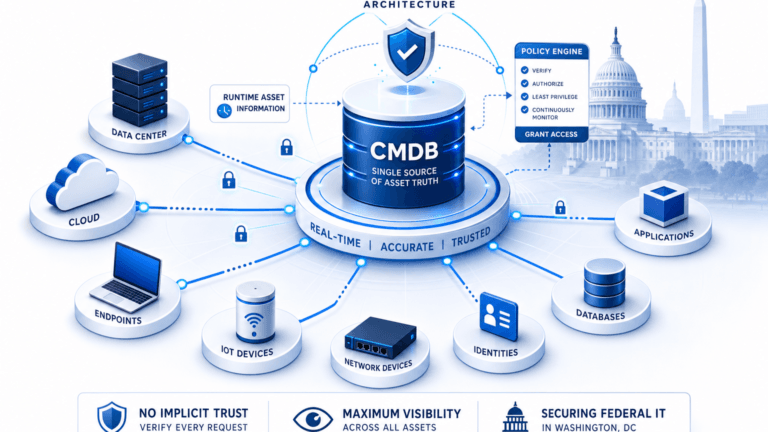
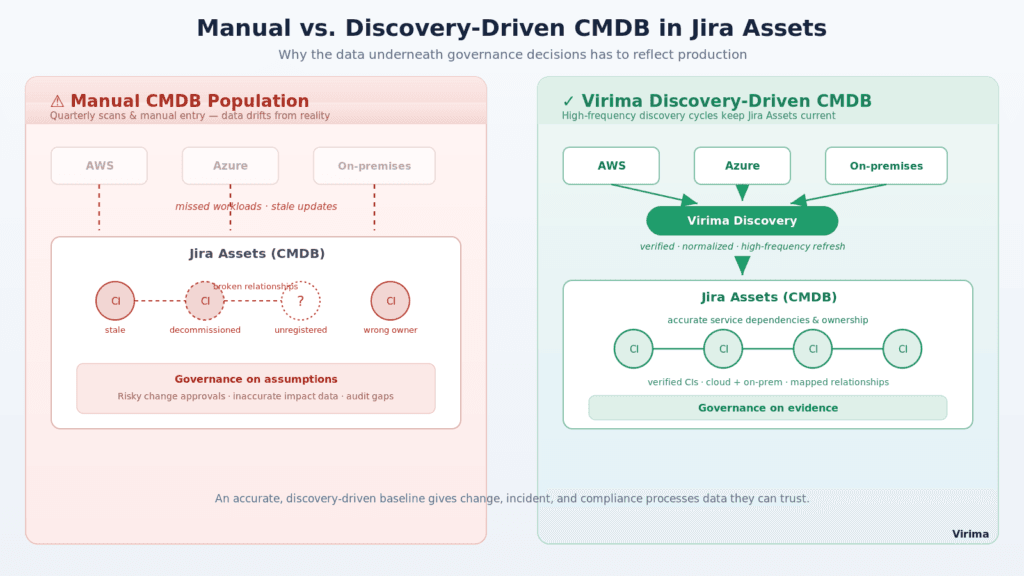
When the CMDB feeding your Jira Service Management instance relies on manual entry or quarterly scans, every governance decision (change approvals, incident triage, compliance audits) carries a structural risk. The asset and dependency data being acted on may no longer reflect what’s running in production.
Virima solves this at the source, using high-frequency discovery cycles to populate Jira Assets with accurate, discovery-driven runtime truth. It gives governance teams an accurate configuration baseline for every ITSM process they own.
What IT Governance Actually Requires
IT governance is the set of policies, processes, and accountability structures that align IT resource management with business objectives, regulatory requirements, and acceptable risk levels.
Frameworks like COBIT 2019 and ITIL 4 define its structural components: strategy alignment, value delivery, risk management, resource optimization, and performance measurement.
Each of these depends on one prerequisite most organizations underestimate — the ability to see what exists in the IT environment and trust that data enough to act on it.
Without that visibility, IT governance defaults to documentation governance. Approval workflows exist, but approvers lack the configuration context to evaluate blast radius. Audit trails exist, but the records don’t reflect what was actually running when each decision was made. Compliance reporting exists, but auditors are reviewing snapshots that have drifted from production.
Jira Service Management provides the workflow and process layer for IT governance. But Jira Assets — the CMDB — only stores what teams tell it. Runtime truth (what’s actually running, connected, and owned across the environment) has to come from somewhere else.
| IT governance is the framework of policies and controls that aligns IT resource management with business objectives, risk tolerance, and regulatory requirements. Effective IT governance depends on accurate CMDB data to support change management, incident response, and compliance audits. Without verified, discovery-sourced configuration data, governance processes operate on assumptions rather than a current picture of the production environment. |
Why a Stale CMDB Is a Governance Risk
Jira Assets gives IT teams a structured place to register configuration items, track relationships, and tie asset data to service requests, incidents, and change requests. The challenge is that Jira Assets is a repository, not a discovery engine. It records what teams register — not what actually exists.
This creates a predictable gap. A server is decommissioned, but its CI stays active in Jira. A new cloud workload spins up but never gets registered. A dependency shifts after a patch, but no one updates the service map. Each gap is a direct governance exposure: change approvals reference stale relationships, incident responders work from inaccurate impact data, and compliance teams review records that no longer reflect the production state.
Configuration accuracy is a widely recognized prerequisite for effective change risk assessment — yet most organizations struggle to maintain it through manual processes alone.
Virima closes this gap through discovery-driven scans across on-premises infrastructure and cloud environments (AWS and Azure). Those scans push validated, normalized CI records directly into Jira Assets on a regular refresh cycle. The result is a discovery-sourced CMDB that reflects the environment as it currently exists, not as it was documented at last quarter’s audit.
| Ready to see what a discovery-sourced Jira CMDB looks like? Explore the Virima Trusted Runtime Truth Platform. |
| A stale CMDB creates IT governance risk by allowing change approvals, incident response, and compliance audits to proceed on outdated configuration data. Discovery-driven tools like Virima refresh Jira Assets through high-frequency discovery cycles, pushing verified CI records from AWS, Azure, and on-premises infrastructure into Jira Service Management — eliminating the configuration drift that turns governance decisions into guesses. |
ViVID™ Service Maps and Change Governance
One of the most common governance failures in change management is approving a change without understanding which services, users, and systems it touches.
Change advisory boards need blast-radius context before a change window opens — not after an incident proves the impact was broader than anticipated.
Virima’s ViVID™ service mapping capability gives CABs exactly that context. Teams define each IT service by specifying the applications, infrastructure components, and dependencies it depends on. Those definitions can be provided manually, imported via spreadsheet, or pulled in through supported integrations. Once the service definitions are in place, Virima builds and maintains a visual service dependency map automatically from that input.
When a change request is raised in Jira, the ViVID™ service map shows which services and CIs sit in the blast radius of that change. This shifts the governance conversation from reactive (post-incident root cause) to preventive (pre-change risk assessment), and creates an auditable record of the service context that informed each approval decision.
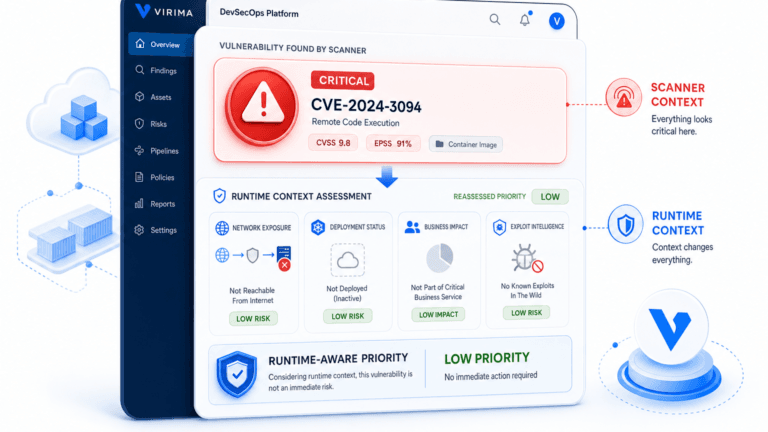
ViVID™ also supports security and vulnerability governance by surfacing the full dependency chain for any service. This identifies which infrastructure components underpin critical services, flags components with open vulnerabilities from NVD lookups, and clarifies ownership so remediation assignments are based on confirmed data rather than guesswork.
| ViVID™ is Virima’s service mapping capability that builds visual dependency maps from team-provided service definitions. When connected to Jira Service Management, ViVID™ shows the blast radius of any proposed change — which services, CIs, and users are at risk — giving change advisory boards the verified, discovery-sourced context they need to approve, defer, or reject changes with confidence before a change window opens. |
ITAM as a Governance Control
IT asset management is a core IT governance discipline. Knowing what hardware, software, and network resources an organization holds, who owns them, what they cost, and when they need renewal or retirement is not optional. In regulated industries, it is a compliance requirement.
Virima’s ITAM capability tracks the complete asset lifecycle from acquisition through decommissioning. When integrated with Jira Service Management, asset lifecycle data surfaces directly in service requests and incidents — giving governance teams the configuration context they need without switching systems.
The practical governance outcomes are specific. License compliance audits move faster because software entitlements are mapped against actual deployments discovered in the environment. End-of-life hardware is removed from the active CI record in Jira when physically retired. Budget planning runs on accurate asset counts rather than spreadsheet estimates. See how this connects to the broader CMDB implementation process for organizations building governance from the ground up.
IT Governance in the Age of Agentic Operations
Enterprise IT operations increasingly involve AI agents that execute tasks autonomously: ticket resolution, infrastructure remediation, change execution, and capacity adjustments. This changes what IT governance needs to deliver. The approval workflow designed for human teams is not sufficient when the actor is an AI agent that can execute a change in seconds.
AI agents act safely only when the data they act on is accurate. An agent executing a change against a stale Jira CMDB may trigger a service impact that a human reviewer would have caught by consulting an up-to-date service map. An agent recommending remediation steps based on an expired CI record may escalate rather than resolve the incident. This is the governance problem Virima’s runtime truth layer is built to address.
When AI agents operate against a Jira CMDB populated by Virima, the data they rely on reflects the actual production state: ownership assigned, dependencies mapped, vulnerabilities surfaced, and change history recorded. Industry analysts increasingly describe IT governance moving toward a data-first, proactive model where infrastructure context drives service decisions.
| Agentic IT operations require governance at the data layer. When AI agents execute changes or remediations through Jira Service Management, they need discovery-sourced CMDB data — verified ownership, service dependency maps, and change history — to act within defined risk boundaries. Virima provides this runtime truth layer, giving AI agents the same governance context a human approver would consult before acting. |
What the Virima and Jira Governance Stack Delivers
Faster time-to-value from Jira Assets. When Virima Discovery populates the Jira CMDB at implementation, teams skip the months-long manual CI population phase and start governance processes from an accurate, discovery-driven baseline.
Auditable configuration history. Every CI discovered, every change recorded, and every service dependency mapped creates a governance record. This accelerates compliance reporting and reduces the preparation burden during audits.
Change governance with confirmed blast-radius context. ViVID™ service maps attached to Jira change requests give CABs confirmed impact context before changes are approved.
Governed service delivery. Service requests and incidents in Jira are enriched with accurate asset and dependency context. Covered in detail in the incident management to CMDB guide.
A verified data foundation for AI operations. As IT teams move toward agentic workflows, Virima ensures the Jira CMDB meets the accuracy standard that AI agents require to act within defined governance boundaries. Move faster. Act safely.
| Schedule a demo to see this in your environment. |
| The Virima and Jira Service Management integration delivers IT governance grounded in discovery-sourced runtime truth. Virima populates Jira Assets through high-frequency discovery cycles, ViVID™ service maps provide verified change-impact context for the change advisory board, and ITAM capabilities track the full asset lifecycle — giving IT governance teams an accurate, auditable foundation for every process they run. |
Frequently Asked Questions About IT Governance with Jira and Virima
What is the biggest obstacle to effective IT governance in a Jira environment?
The most common obstacle is CMDB inaccuracy. When configuration items in Jira Assets are populated manually or updated on a quarterly cycle, governance decisions (change approvals, incident triage, compliance checks) are based on data that no longer matches production. Discovery-driven tools like Virima solve this by keeping Jira Assets refreshed through high-frequency discovery cycles rather than manual intervention.
How does Virima improve change management governance in Jira?
Virima improves change management governance by combining accurate CI data with ViVID™ service maps. When a change request is raised in Jira, the service map shows which services and CIs are in the blast radius, giving the change advisory board confirmed impact context before any approval decision is made.
Does Virima replace Jira Service Management?
No. Virima is the discovery-driven data foundation that Jira’s governance processes run on. Jira provides the workflow and process layer for change management, incident response, and service delivery. Virima provides the CI accuracy, service dependency maps, and asset lifecycle records that make those workflows reliable.
What compliance frameworks does this integration support?
Virima’s CMDB and ITAM capabilities support governance programs aligned to ITIL 4, SOX asset controls, ISO 27001 configuration management requirements, and GDPR data inventory obligations — by providing auditable asset records, change histories, and configuration baselines that compliance programs require.
How does Virima handle cloud infrastructure governance in Jira?
Virima discovers AWS and Azure cloud assets and pushes validated CI records into Jira Assets alongside on-premises infrastructure. This gives governance teams a single, continuously refreshed configuration baseline across hybrid environments, so cloud resources are subject to the same governance standard as physical data center infrastructure.
IT governance is only as strong as the data underneath it. When Jira Service Management runs on Virima’s discovery-sourced runtime truth — accurate CIs, mapped service dependencies, complete asset lifecycle records, and governed change context — IT teams move from governing on assumptions to governing on evidence.
| Schedule a demo at virima.com to see how Virima and Jira deliver the discovery-sourced foundation your governance program needs. |