CSDM 5.0 Audit: The Hardest Work No One Talks About at K26

Across three days in Las Vegas, keynotes, breakouts, demos, and the expo floor, the conference was almost entirely occupied by agentic AI, Autonomous Workforce specialists, AI Control Tower, and the Australia platform release. The Common Service Data Model, the structural prerequisite for most of what ServiceNow announced, had no dedicated session. It was not on the main stage. The compliance work that makes agentic IT functional was, for practical purposes, not discussed.
That absence is worth sitting with. ServiceNow announced AI specialists who execute complete IT workflows end-to-end, specialists that require a current, complete service model to perform at full depth. It launched Context Engine, described as grounding every AI decision in real-time operational context drawn from assets, workflows, people, and policies. It walked through a vision where AI agents act, not just recommend. Then it moved on without addressing what it actually takes to get service data into a state that those agents can trust.
This post is for the IT directors and CMDB owners who sat through those announcements and did the math. If CSDM compliance is the structural prerequisite for AI execution at the level K26 demonstrated, and K26 didn’t address what getting there actually requires, someone needs to. Here is what the audit actually looks like.
What CSDM 5.0 Actually Requires
The Common Service Data Model is ServiceNow’s framework for how IT services, applications, and infrastructure are modeled in the CMDB. Version 5.0 released in May 2025 is a significant structural expansion over earlier iterations. It reorganizes the model into seven domains, introduces lifecycle frameworks and SBOM tracking, and raises the bar on application service modeling and CI relationship completeness.
But here’s what most compliance conversations skip: every domain in CSDM 5.0 has a data quality prerequisite that has to be met before the modeling work even begins.
| CSDM 5.0 Domain | What’s Required | Where It Typically Breaks |
| Foundation | All CIs classified, owned, and attributed correctly | Legacy CIs with missing or unknown owners that no one wants to claim |
| Enterprise Architecture (formerly APM) | All applications modeled as Business Application CIs with correct lifecycle status | Duplicate or unmanaged software entries from shadow IT that were never reconciled |
| Technology Management Services (formerly Technical Services) | All services defined with an owning group and supporting CIs linked | Services defined by application teams in isolation, with no mapping back to infrastructure CIs |
| Service Consumption (Business Services) | Business services mapped to technology management services and underlying applications | Business service taxonomy that doesn’t reflect how IT teams actually model services internally |
| Service Offerings | Service catalog items linked to both business and technology management services | Service catalog built independently of the CMDB service model — no traceability |
| Information Objects | Data types and flows between applications and services documented | Rarely completed; often deprioritized or skipped entirely in CSDM implementations |
Every row in that table represents a data quality problem before it becomes a modeling problem. You can’t model what you don’t know exists. You can’t map services to infrastructure if the infrastructure discovery is incomplete. And you can’t validate business service alignment if the underlying CMDB records haven’t been reconciled across all discovery sources.
Why Organizations Fail the CSDM 5.0 Audit Silently
Most organizations don’t know they’ve failed the CSDM 5.0 audit because there’s no formal failure moment. You don’t receive a rejection. The realization typically comes during an AI deployment, a major incident investigation, or a change management review: the service model is incomplete in ways that matter operationally.
The silent failure pattern is consistent. Organizations achieve partial compliance in the foundational layers CI classification and basic ownership assignment but stall at the service modeling layers: technical services, business services, and service offerings. The discovery data exists but hasn’t been structured for the CSDM model. The application portfolio has been partially mapped but with duplicate entries, lifecycle inconsistencies, or missing dependency relationships.
That partial compliance state looks acceptable in a CMDB health dashboard. It breaks down the moment you ask it to support AI-driven incident management, autonomous change approval, or blast radius analysis.
The most candid customer perspective at K26 came from Phil Priest, Head of Global Business Services at Rolls-Royce, speaking alongside ServiceNow’s Chief Customer Officer. Priest described deploying Now Assist across 45,000 employees in 50 countries and explicitly invoked a Bill Gates observation: “Automation applied to an efficient operation magnifies the efficiency, and automation applied to an inefficient operation magnifies the inefficiency.” No session offered a candid account of CSDM failure or stalled implementation phases. Every K26 customer story started from a state of prior data readiness — the struggle to achieve that readiness was not on the stage.
The 5 Hardest CSDM 5.0 Requirements (And Why No One Demos Them)
1. Application-to-infrastructure dependency mapping at scale
Mapping a handful of applications to their infrastructure dependencies is achievable in a workshop. Mapping 200 applications across a hybrid cloud environment, including containers, microservices, and shared middleware, requires authoritative discovery data and an automated relationship-building engine. K26 demos consistently started from a pre-mapped state, with the dependency discovery work already complete before the demo began.
2. Service ownership at every layer
CSDM 5.0 requires ownership records at the CI level, the technical service level, and the business service level. In most organizations, these three ownership layers were defined by different teams at different times. Reconciling them means going back to source teams and resolving conflicts: often months of coordination, not a data migration script.
3. Shadow IT inclusion
Every enterprise has applications and infrastructure running outside the managed IT inventory. CSDM 5.0 compliance doesn’t exclude them. Getting shadow IT into the CMDB with correct classification, ownership, and service membership is a discovery problem and a governance problem simultaneously.
4. Service catalog alignment
CSDM 5.0 requires service catalog offerings to link to the underlying technical and business service model. In most organizations, the service catalog was built independently from the CMDB, by a different team, on a different timeline, with a different taxonomy. Aligning them is a cross-team governance project, not a field mapping exercise.
5. CMDB health maintenance after initial compliance
Achieving CSDM 5.0 compliance is difficult. Maintaining it as infrastructure changes is a separate, ongoing challenge. Every deployment, decommission, or migration event is a potential compliance regression unless discovery is automated and the CMDB update pipeline runs continuously.
What a Real CSDM 5.0 Audit Looks Like With Trusted Runtime Truth
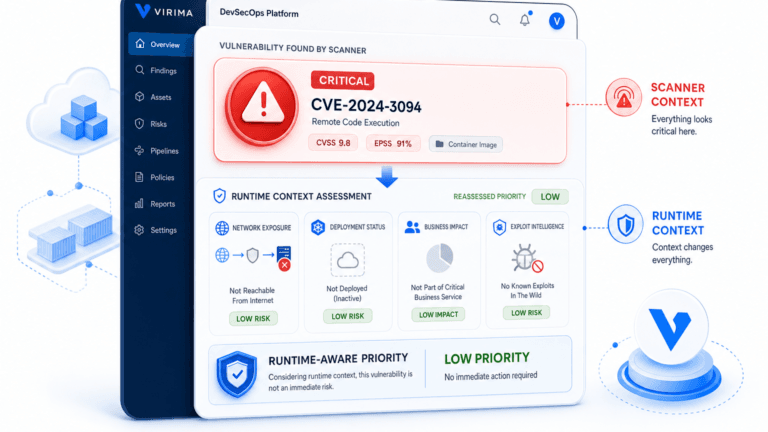
The reason most CSDM 5.0 journeys stall is a runtime truth problem. Organizations try to work through service modeling requirements with static CMDB data that is already weeks or months out of date when the audit begins. The audit team builds a service model on a foundation that shifts under them.
Trusted runtime truth changes the starting point. When the CMDB is discovery-sourced, continuously reconciled, and blast-radius-aware, the audit team works from an accurate picture of what actually exists and how it’s connected, not from a best-effort approximation from the last snapshot.
Virima’s CMDB automation and IT discovery give the CSDM audit team a foundation that holds. Automated CI population, multi-source reconciliation, and ViVID service mapping — built from the service definitions your team provides, together deliver the trusted runtime truth that CSDM 5.0 compliance requires across every layer, including the five hardest requirements above.
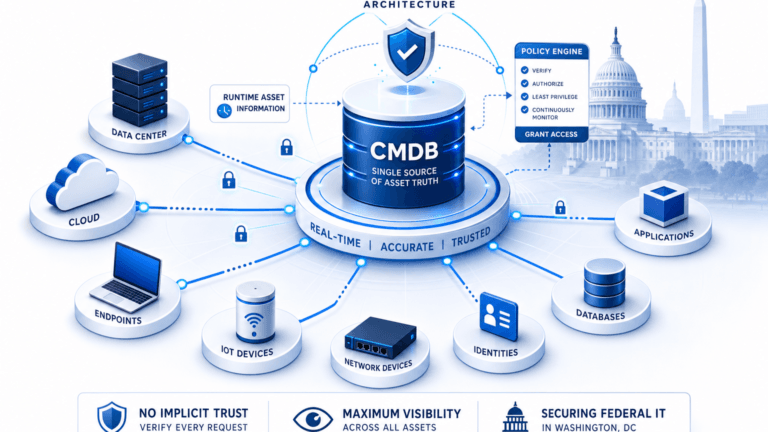
The closest K26 announcement to CSDM tooling was the Armis integration into the ServiceNow CMDB. Armis, acquired for $7.75 billion, provides continuous agentless asset intelligence covering nearly 7 billion connected assets across IT, OT, IoT, and cloud workloads, with data enriched directly into the ServiceNow CMDB.
ServiceNow positioned this as turning “a previously static inventory into a live picture of the attack surface.” What it does not address is the service modeling layer: Armis adds CI data but does not build the CSDM service hierarchy, business service relationships, or service offering linkages that CSDM 5.0 compliance actually requires.
CSDM 5.0 compliance is achievable. But it’s not achievable with manual CMDB maintenance and static discovery snapshots. The organizations that complete the CSDM 5.0 journey in 2026 will be the ones that treated runtime truth as the prerequisite, not the reward.
If your team is mid-audit, stalled on a compliance phase, or trying to assess where your CMDB actually stands against CSDM 5.0 requirements, Schedule a Demo, and we can run that assessment with you.