5 K26 Takeaways for IT Directors Who Couldn’t Make It to Vegas

Knowledge 2026 ran May 5-7 in Las Vegas. Three days, thousands of sessions, and more AI announcements than any IT director has time to properly synthesize before the next leadership meeting. If you were there, you know the signal-to-noise ratio at a conference this size is a real challenge. If you weren’t, you’re filtering a keynote highlights reel from several time zones away.
This post does that filtering. Here are the five K26 2026 takeaways that IT directors need to act on, not file away, heading into the second half of 2026
Takeaway 1: AI Agents Are Now a Product, Not a Roadmap Item
At K26 2026, ServiceNow confirmed the general availability of its L1 IT Service Desk AI Specialist — the first production release in its Autonomous Workforce platform — alongside 20 new AI specialists spanning IT operations, AIOps, SRE, CRM, HR, finance, legal, and security. Unlike task-based tools, these specialists execute complete workflows end to end, from intent to resolution, without human approval at each step. ServiceNow reported the L1 specialist is resolving assigned IT cases 99% faster than human agents in its own production help desk. IT specialists follow in June 2026; security and risk specialists reach general availability in September.
What this means for IT directors: The question has shifted from “should we evaluate AI agents?” to “are we operationally ready to deploy them?” That’s a different conversation, and it starts with data, not technology. AI agents require trusted, current runtime truth about your infrastructure before they can act safely. If your CMDB is stale or incomplete, you’re not AI-ready yet, regardless of your platform licensing.
The IT directors who see real productivity gains from AI agents in 2026 are the ones who treated CMDB accuracy as a prerequisite, not an afterthought.
Takeaway 2: Your CMDB Is Now an AI Dependency
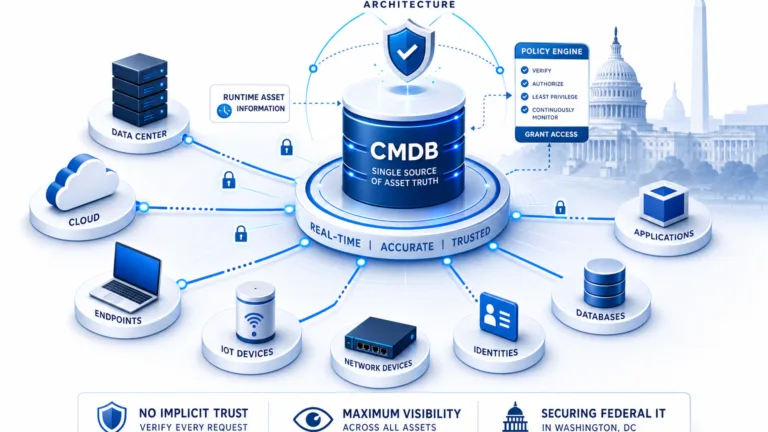
At K26, the clearest signal came from ServiceNow’s data platform announcement on Day 2. ServiceNow stated plainly: “Most enterprise AI fails not because the models are flawed, but because the data is fragmented across disconnected systems.” The announcement introduced Context Engine, which ServiceNow described as drawing from assets, workflows, people, and policies to ground every AI decision in a real-time operational context. All Autonomous Workforce specialists — across IT, security, HR, and finance — run on shared CMDB and Context Engine infrastructure. CMDB accuracy is now an architectural requirement, not a configuration best practice.
What this means for IT directors: The CMDB is no longer just an ITSM operational tool. It’s the intelligence substrate for every AI agent in your IT stack. CMDB health is now an AI readiness metric, and it belongs in leadership reporting alongside AI adoption KPIs.
A useful benchmark: CMDB accuracy below 85% means AI agents will underperform. Below 70%, they create more work than they save. Below 60%, they’re a liability. Where does your CMDB stand today?
Takeaway 3: CSDM Compliance Is No Longer Optional
K26 didn’t feature a dedicated CSDM 5.0 session, but the requirement was visible in the architecture of everything ServiceNow announced. The new Context Engine — the data foundation powering all Autonomous Workforce specialists — requires complete, current service data modeling to function at operational depth. Amit Zavery’s Day 2 keynote, “The Blueprint for Agentic Business,” described structured service data as the layer separating organizations that can act on AI decisions from those that can only receive recommendations. CSDM compliance is the structural prerequisite for AI execution at K26’s level of ambition.
What this means for IT directors: CSDM 5.0 compliance requires a level of CI relationship accuracy and service modeling depth that most organizations haven’t achieved. K26 rarely discusses the effort required to get there honestly. The organizations that access ServiceNow’s most advanced AI and automation capabilities first are the ones already working through the CSDM audit now, before it becomes a hard gate.
If you’re not at CSDM 4.0 compliance yet, CSDM 5.0 is a longer road than the conference implies.
Takeaway 4: Security and Automation Are Converging
K26’s Autonomous Security & Risk announcement addressed this convergence directly. John Aisien, SVP and GM for Security and Risk at ServiceNow, named the problem explicitly: “There’s detection in one stack, response in another, identity and permissions in a third, and asset visibility, if you have it, in yet another. The fragmentation — the seams between these different tools — are exactly what attackers exploit.” The answer ServiceNow presented: Armis for continuous agentless asset intelligence flowing live into the ServiceNow CMDB, and Veza’s access graph governing both human and AI agent identities together, enforcing least privilege at the point of action.
What this means for IT directors: “Policy-aware automation” captures the shift. AI agents can’t just act efficiently; they need to act within the boundaries of your security posture, change governance model, and compliance requirements. That means the runtime truth layer those agents query needs to carry governance context alongside operational context: what’s allowed, what requires approval, and what’s out of policy.
This is where CMDB and security operations start sharing a common data foundation, and where gaps in either domain become risks in both.
Takeaway 5: The Platform Dependency Question Got Louder
K26 did not address multi-platform environments directly, but the subtext was visible in the architecture. Action Fabric and the ServiceNow MCP Server open ServiceNow’s workflows to agents built on Claude, Copilot, and other external stacks. AI Control Tower added 30 new connectors spanning AWS, Google Cloud, Azure, SAP, Oracle, and Workday. The underlying assumption in every demo, however, was that authoritative runtime truth lives inside ServiceNow’s CMDB. The scenario where that CMDB is one of several operational data sources — not the single authority — was not addressed. Every K26 demo ran in a single-platform world.
What this means for IT directors: Every K26 demo runs in a single-platform world. Your production environment doesn’t. Most enterprise IT organizations run ServiceNow alongside Ivanti, Jira, HaloITSM, and other tools across different teams and workflows. Building AI readiness exclusively inside one platform’s native data model creates brittleness.
The more defensible path is a platform-agnostic Trusted Runtime Truth layer: discovery-sourced, openly integrated, and not tied to any single vendor’s model of your infrastructure.
What to Do With These Takeaways in the Next 30 Days
K26 2026 accelerated the enterprise IT roadmap across multiple dimensions at once. The organizations that benefit are the ones that treat the conference not as an announcement event but as a prioritization signal. A useful 30-day action list:
- Run a CMDB accuracy assessment. Before evaluating any AI agent capability, know your current baseline accuracy by CI class.
- Map your CSDM compliance gap. If you’re not at CSDM 4.0 compliance, CSDM 5.0 is a longer road than K26 implies.
- Audit your discovery coverage. What percentage of your CI records are discovery-sourced vs. manually maintained?
- Define “AI-ready data” thresholds. Not in abstract terms, but in specific accuracy thresholds for each CI class your agents will query.
- Identify your runtime truth dependencies. Which AI agent workflows do you plan to deploy, and what CMDB queries do they rely on?
If you want to run steps 1 and 5 together as a combined runtime truth readiness assessment, Schedule a Demo today— that’s exactly what we help IT directors do.