IT Operations Enhanced with Virima and ServiceNow

Virima and IT Operations Management (ITOM)
Virima’s ITOM Essentials combines advanced infrastructure IT discovery, dependency mapping, Service Asset and Configuration Management (SACM), and ViVID™ service mapping. The solution is designed to improve IT operations while supporting asset, service, security, risk, and compliance management. You can deploy it as a standalone solution or integrate it with leading ITSM platforms, including ServiceNow, Ivanti, Halo, Jira Service Management, and Xurrent, without costly displacements or workflow disruptions.
Ensure ITOM Health and More
Virima’s IT operations management solution, powered by ViVID™ service maps, delivers these benefits for IT teams:
- Taking risk out of change by providing impact analysis before change windows open
- Giving teams access to complete, current configuration and dependency data
- Accelerating root cause analysis with ViVID™-powered dynamic business service maps that display service-dependent infrastructure components alongside recently completed changes and open tickets
- Tracking hundreds of hardware and software configuration attributes for data center, edge, cloud migration, and IoT assets
- Providing customizable dashboards with actionable CMDB data, including assets by blueprint, location, recently updated CIs, migration status, and software inventory
Discovery Powers Dependency Mapping
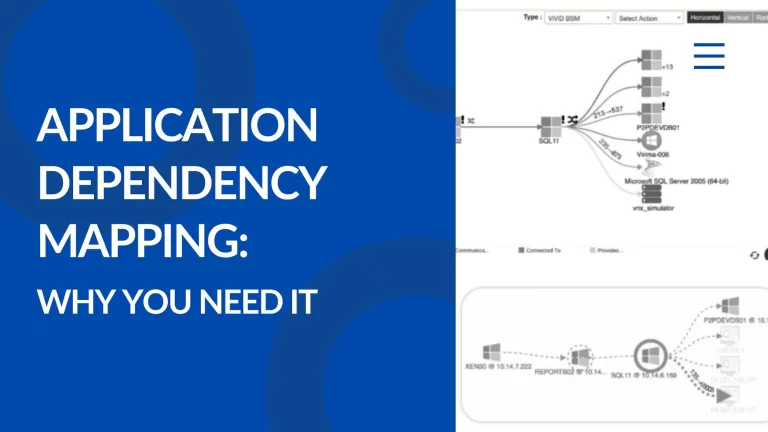
Virima’s discovery capabilities enable mapping of all infrastructure relationships, application dependencies, and host-to-host communications. This lets you connect business services with the underlying technology that supports them, build visual service representations, and quickly analyze the potential impact of any change or incident. When you combine strong discovery with dependency mapping, your teams plan changes with greater confidence and respond faster when something goes wrong.
A complete Configuration Management Database (CMDB) also supports governance. Gathering data from multiple sources lets teams track inventory, manage software licenses, strengthen security posture, and support audits for governance, risk, and compliance (GRC). As one of our posts on why a CMDB without discovery is just a static database explains, a CMDB goes stale the moment your environment changes, unless it is continuously fed by discovery.
Easy to Install and Configure
Virima’s solution requires no agents to deploy. It supports IP-based scanning with configurable subnets and ranges. Discovery probes, sensors, and blueprints prevent network overload from scan bursts without affecting device performance. Scan results clearly display successful and failed scans, along with the reasons for any failures. For teams evaluating
agentless discovery options, this predictable approach removes a common deployment barrier.
| See how Virima delivers Trusted Runtime Truth for your IT operations. Explore Trusted Runtime Truth → |
ServiceNow and IT Operations Management
ServiceNow is a widely adopted ITSM platform that has changed how IT operations are managed in large organizations. It offers a full suite of IT Service Management (ITSM) tools, including a CMDB and service mapping capabilities. Its CMDB tracks configuration items (CIs) and their relationships, giving IT teams the data they need to assess change impact, resolve incidents faster, and prevent recurring problems. When you pair it with Virima’s discovery layer, that CMDB stays current with significantly less manual effort.
Effective Service Mapping for Your Environment
Service mapping provides a visual picture of the relationships between IT services, applications, and infrastructure components. This helps organizations understand dependencies and the potential impact of changes or incidents on the IT environment.
ServiceNow integrates its service mapping capabilities with tools including Virima’s ViVID™ Service Mapping. This integration lets organizations build an accurate service map that supports change management, incident management, and related IT operations processes.
To implement effective service mapping for your organization, work through these four steps:
Define your services. Start by identifying the IT services your organization provides and their dependencies on applications and infrastructure components.
Collect and validate data. Gather data about your IT environment, including CIs, relationships, and dependencies. Keep that data current by running discovery scans alongside data validation processes.
Create a visual representation. Use ServiceNow and tools like ViVID™ Service Mapping to build a visual picture of your IT services and their dependencies, including cloud migration paths.
Keep the service map current. Update your service map regularly to reflect changes in your IT environment, including additions or removals of CIs, applications, or services.
How Service Mapping Supports Your Change Management Plan
Change management is a core discipline in IT operations management. It helps organizations minimize disruption and keep IT changes on track. Service mapping supports that process by providing a clear picture of dependencies and the potential impact of proposed changes.
By integrating ServiceNow with ViVID™ Service Mapping, you can build a change management plan that covers four areas:
Impact analysis. Assess the potential impact of proposed changes on IT services, applications, and infrastructure based on the current service map.
Risk assessment. Identify risks associated with proposed changes and develop strategies to address them before the change window opens.
Change approval. Establish a formal approval process that incorporates impact analysis and risk assessment results.
Communication and coordination. Keep all stakeholders informed about proposed changes and coordinate implementation across teams.
Integrating ServiceNow’s CMDB with its ITSM solutions improves every service management process because IT teams have current CI data, relationships, and dependencies available at every step. To understand how the ITSM-ITOM connection works in practice, here is how it plays out across the core ITSM disciplines.
Incident Management: Faster Resolution with CI Data
CMDB integration gives IT teams direct access to CI data, letting them quickly identify affected systems and components. This speeds up incident resolution, reduces downtime, and limits the business impact of outages.
Problem Management: Identifying Root Causes
Problem management focuses on finding and eliminating root causes of recurring incidents. CMDB integration lets IT teams analyze relationships between CIs, identify patterns that contribute to problems, and prevent future occurrences, improving overall IT environment stability.
Assessing the Impact of Changes on CIs
Knowing which CIs are affected before a change window opens is how you keep IT changes controlled. CMDB integration gives teams insight into the potential impact of changes on related CIs, supporting better risk assessment and reducing the likelihood of unintended service disruptions. For a deeper look at IT operations insights and ITOM governance, including how discovery feeds smarter change planning, see our full guide.
Service Catalog: Accurate Service Information
The service catalog is a central repository of all IT services your organization provides. CMDB integration ensures that accurate, current information about IT assets is available when users request and manage services, based on actual availability and resource status.
Knowledge Management: A Centralized CI Repository
Knowledge management involves creating, maintaining, and sharing information about IT services, processes, and infrastructure. CMDB integration supports a centralized repository of CI-related knowledge, giving IT teams and users fast access to relevant information, promoting self-service, and keeping decision-making grounded in current data.
As ITSM processes run and CIs change, CI data needs to stay current. Virima Discovery and ViVID™ service maps ensure that changes are reflected in the CMDB and represented visually through dynamic reports. Our post on simplifying IT operations with Virima discovery and mapping walks through how that cycle works in practice.
| Ready to ground your ServiceNow workflows in discovery-driven data? Schedule a demo → |
Quick Reference: Key Concepts in IT Operations
| What is IT operations management? IT operations management (ITOM) covers the day-to-day monitoring, configuration, and management of IT infrastructure, including servers, networks, applications, and cloud resources. ITOM platforms help teams track configuration items, analyze change impact, and keep services running. When ITOM is connected to a current CMDB, every operational decision is grounded in accurate, discovery-driven data. |
| How does Virima improve IT operations with ServiceNow? Virima improves IT operations by feeding discovery-driven CI data directly into the ServiceNow CMDB. Virima runs high-frequency discovery cycles across on-premises and cloud environments, maps application dependencies, and surfaces that data through ViVID™ service maps. ServiceNow uses this data to run incident, change, and problem management workflows on current, accurate configuration data. |
| What is a service map in IT operations? A service map is a visual representation of an IT service and its dependencies on applications, infrastructure, and other services. In IT operations, service maps help teams understand the impact of a change or incident before acting. Virima’s ViVID™ builds service maps from discovery data fed into ServiceNow, keeping them current as the environment changes. |
| Why is CMDB accuracy critical for IT operations? An inaccurate CMDB causes IT operations teams to make decisions on stale data, increasing change failure rates, extending incident resolution times, and creating blind spots for security and compliance. When AI agents rely on CMDB data to automate tasks, accuracy becomes even more critical, because a bad decision at machine speed is harder to reverse than a human one. |
Why CMDB Accuracy Matters for AI-Driven IT Operations
As enterprises deploy AI agents in IT operations to handle incident triage, change risk assessment, and remediation workflows, the accuracy of the underlying CMDB and dependency data becomes far more important. AI agents make decisions based on the CMDB data available to them. If that data is stale or incomplete, agents act on incorrect context, potentially worsening a change’s impact or missing a vulnerable dependency.
The discovery-powered, regularly refreshed data layer that Virima feeds into ServiceNow gives those agents the authoritative context they need to act at scale. A discovery-driven CMDB is a prerequisite for safe AI action in IT operations, not an optional enhancement. For a practical view of how ITOM vs. ITSM work together to support this foundation, see our complete guide.
Discovery-Sourced Data Is the Foundation Your IT Operations Need
Virima, combined with ServiceNow, creates an end-to-end IT operations workflow that helps businesses manage IT tasks more efficiently and gain a unified view of their environment. Virima offers both agentless and agent-based discovery, with built-in application dependency and service topology mapping. ViVID™ Service Mapping provides dynamic visual representations of IT infrastructure, application dependencies, business services, and ITSM process relationships.
These capabilities let organizations improve efficiency at every level, from service desk staff resolving tickets to leadership making strategic decisions about IT direction. The ITSM-ITOM connection that Virima and ServiceNow create is what turns configuration data into operational outcomes. You can explore more on the Virima CMDB for IT operations and network device discovery and CMDB accuracy to see how each layer contributes.
Frequently Asked Questions
What is the difference between IT operations management and IT service management?
IT operations management (ITOM) focuses on the day-to-day running of IT infrastructure, including monitoring, asset management, and configuration management. IT service management (ITSM) focuses on delivering IT services to end users through structured processes such as incident, problem, and change management. The two disciplines are most effective when connected through a shared, accurate CMDB.
How does Virima integrate with ServiceNow for IT operations?
Virima integrates with ServiceNow by feeding discovery-driven CI data directly into the ServiceNow CMDB. Virima’s agentless discovery scans the environment and maps application dependencies. ViVID™ service maps then provide visual context for change and incident workflows inside ServiceNow, keeping configuration data current with far less manual effort.
What is a CMDB and why does it matter for IT operations?
A Configuration Management Database (CMDB) is a centralized repository that stores information about all IT assets (configuration items, or CIs) and their relationships. IT operations teams rely on the CMDB to understand impact before making changes, resolve incidents faster, and give AI agents the accurate context they need to automate safely.
Can Virima’s service mapping replace ServiceNow’s native service mapping?
Virima’s ViVID™ Service Mapping is designed to integrate with ServiceNow rather than replace it. ViVID™ maps are built from discovery-driven data and fed into ServiceNow, giving teams a richer, more current picture of service dependencies than partially manual mapping typically provides.
How does the Virima and ServiceNow integration support change management?
When Virima’s CMDB data is available inside ServiceNow, change managers can run impact analysis directly against current CI relationships before approving a change. This reduces the risk of unintended outages and speeds up the change approval process by grounding every decision in data that reflects the actual IT environment.
What causes CMDB data to go stale in IT operations?
CMDB data goes stale when changes to the IT environment, such as new deployments, decommissioned assets, or configuration drift, are not captured and reflected back in the database. Manual update processes cannot keep pace with the speed of modern infrastructure changes. Discovery-driven CMDB tools address this by running high-frequency scans that automatically update CI records when changes are detected.
How does IT operations management affect incident resolution time?
Effective IT operations management reduces incident resolution time by giving teams accurate, current data about which CIs are involved in an issue, how they relate to other services, and what recent changes may have contributed. When that data lives in a discovery-fed CMDB connected to your ITSM platform, first-call resolution rates improve and mean time to repair (MTTR) drops.
What makes discovery-driven CMDB data different from manually maintained data?
Manually maintained CMDB data reflects the environment as it was when someone last updated it, which can be days, weeks, or months behind reality. Discovery-driven CMDB data is sourced directly from scanning the live environment, which means it captures unauthorized changes, shadow IT, and configuration drift that manual processes miss. For IT operations teams running change management or feeding AI agents, that difference is the gap between acting on truth and acting on assumption.