IT Discovery in Public Sector: Find Legacy Systems Before the Next Outage

A state health department opened a change window on a claims interface that every spreadsheet still called “low risk.” The interface sat on hardware that never appeared in the enterprise CMDB. It was funded by a grant program, run by a contractor, and known only to two people in a field office. When the change failed, benefit payments stalled for a full business day. Leadership did not ask for a better change form. They asked why nobody could name every system that touched the claims path.
That pattern is common across government and public sector IT. Departments procure, inherit, and extend systems on different budgets and timelines. Spreadsheets and tribal knowledge fill the gaps, while auditors and modernization programs still expect a defensible inventory. IT discovery in public sector replaces department folklore with evidence that matches what is running on the network.
What Is IT Discovery in Public Sector?
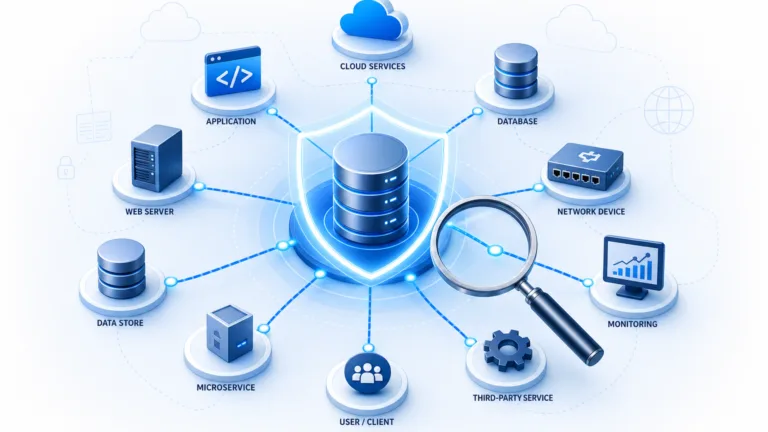
IT discovery in public sector is the practice of identifying compute, network, software, cloud, and related configuration items across agencies, bureaus, and shared services, then reconciling those findings into an authoritative CMDB. It covers data centers, remote sites, hybrid cloud accounts, and environments outside a single CIO’s direct payroll.
NIST Special Publication 800-128 frames configuration management as maintaining secure, known configurations across the system life cycle. That standard only works when inventory is complete enough to support baselines, change control, and continuous monitoring.
An authoritative public sector inventory typically requires:
- Coverage across department boundaries, not only the systems owned by central IT
- Discovery methods that work where agents cannot be installed on every legacy host
- Normalization of findings into consistent CI classes and ownership fields
- Relationship data that shows how applications depend on infrastructure
- Repeatable discovery cycles so the record does not freeze after one project scan
The Hidden Problem
| Situation | What happens |
|---|---|
| Each department keeps its own asset list | Central IT cannot answer enterprise questions for auditors or shared services |
| Grant-funded or contractor-run systems never enter the CMDB | Critical paths stay invisible until an outage or IG finding |
| Legacy hosts refuse modern agents | Inventory gaps cluster on the oldest, riskiest platforms |
| Cloud accounts proliferate under program budgets | SaaS and IaaS estates grow outside the enterprise discovery scope |
| Relationship maps are built once at go-live | Change boards approve work without current blast-radius context |
Why Is IT Discovery in Public Sector Important?
Public sector missions depend on systems that often predate current staff. GAO report GAO-25-107795 (July 2025) reviewed 69 federal legacy IT systems and identified 11 systems, maintained by 10 agencies, as most in need of modernization. Seven of those 11 systems were operating with known cybersecurity vulnerabilities. Several still rely on outdated languages and unsupported hardware. Modernization planning fails when leadership cannot first list what exists, who owns it, and what depends on it.
Federal civilian agencies also face explicit asset visibility expectations under CISA Binding Operational Directive 23-01. State and local entities may not share the same BOD text, yet inspectors and grant conditions still ask whether you can show a current inventory of systems that process citizen data.
An incomplete inventory raises breach and recovery costs. IBM’s public Cost of a Data Breach research shows multi-million-dollar average breach costs, with longer identification and containment when teams lack asset context. For agencies that serve regulated populations, unknown systems are unpatched systems, not a paperwork gap.
Four Failure Modes When Discovery Stops at the Department Wall
1. Modernization plans built on partial inventories.
Program offices fund replacement projects against lists that omit shadow interfaces and departmental databases.
Result: Scope creep, delayed cutovers, and dual-running costs that never appear in the original business case.
2. Vulnerability scanning that misses whole segments.
Scanners only assess what they are pointed at. Undocumented subnets and air-gapped lab networks stay dark.
Result: Leadership reports “green” patch metrics while residual risk lives on hosts nobody named.
3. Change and incident processes without dependency truth.
Service desks open tickets against CIs that do not map to the real runtime path.
Result: Longer MTTR, incorrect stakeholder notifications, and repeated emergency changes.
4. Audit and IG findings on incomplete inventories.
Teams rebuild inventories by hand before each review.
Result: Findings, remediation plans, and delayed certifications that block program funding.
The Real Cost of Getting Public Sector Discovery Wrong
For agency CIOs and IT directors
Board and council briefings need one view of mission systems. When discovery is departmental, executives cannot rank modernization spend or defend cyber budgets from a shared baseline. GAO’s note that many critical legacy systems still lack full modernization plans is partly an inventory problem: you cannot plan disposition for systems you cannot consistently identify.
For CMDB owners and operations teams
Manual reconciliation across bureaus consumes hours every week while production keeps changing. A CMDB without ongoing discovery input becomes a compliance artifact rather than an operations tool. See how empty discovery leaves a CMDB without discovery unable to support change and incident work.
For security, GRC, and audit teams
SecOps needs complete asset context for triage. GRC needs populations for control testing. Both fail when undocumented systems sit outside the system of record. Asset visibility gaps also weaken the link between inventory and vulnerability management that public sector cyber programs depend on.
For finance and procurement
Unknown hardware and software inflate support contracts and license true-ups. Shadow systems create spend that never hits the IT portfolio review. Discovery-backed inventory is the input finance needs to rationalize contracts across departments.
Agencies that need discovery-sourced ground truth need a shared inventory layer before modernization and cyber programs scale.
How Discovery and Mapping Fix Cross-Department Blind Spots
Public sector estates rarely yield to a single scanner profile. Effective programs combine methods and feed one CMDB.
Mechanism 1: Mixed agent and agentless coverage
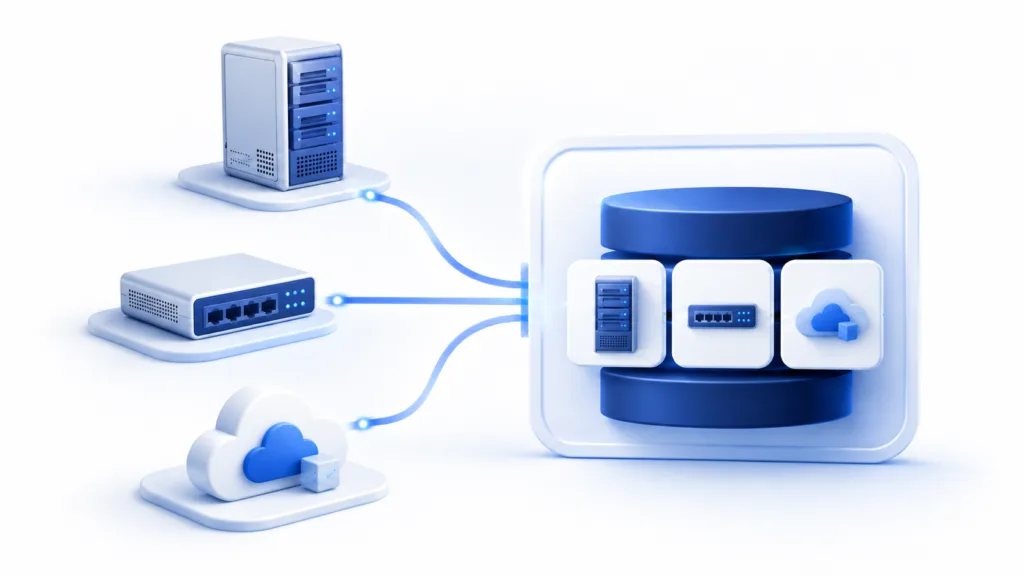
Agent-based discovery deepens hardware, software, and configuration detail on managed endpoints. Agentless, credential-based scanning reaches network devices and hosts where agents are blocked by policy or age. Together they reduce the “we cannot touch that box” excuse that keeps legacy systems invisible.
Mechanism 2: Cloud and data center discovery into one model
Program teams stand up cloud accounts faster than central IT updates CMDBs. Discovery that queries cloud APIs and on-premises infrastructure, then normalizes both into CI classes, keeps hybrid inventories coherent instead of multi-inventory sprawl.
Mechanism 3: Service maps after service definitions are provided
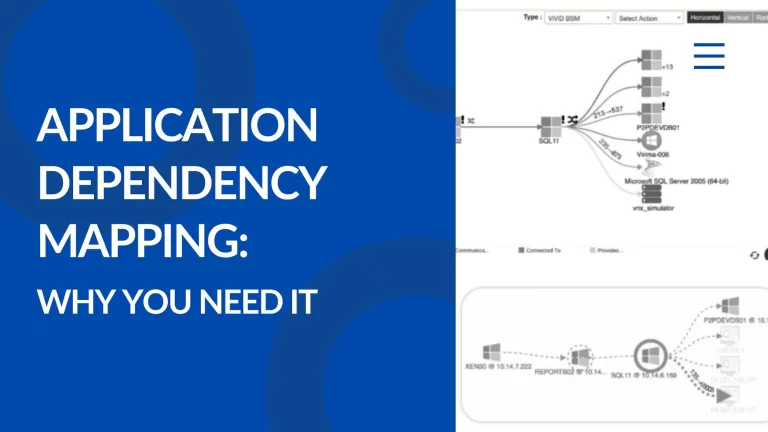
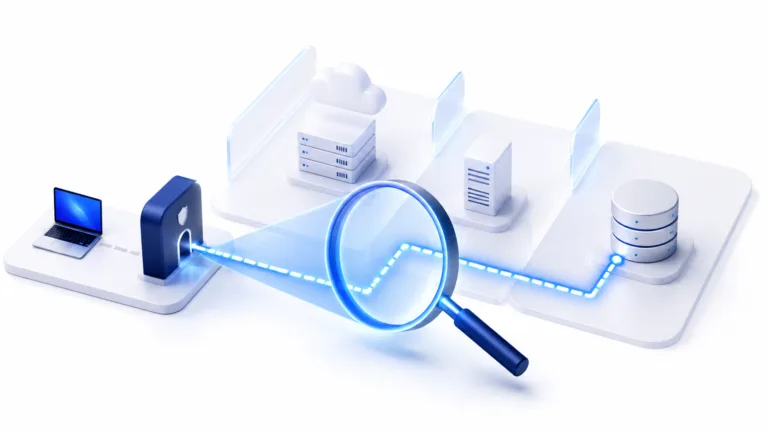
Dependency maps show blast radius for change and incident work. Service composition (which applications and sites make up a named business service) must be supplied by the agency, spreadsheet import, or enterprise architecture sources. Once definitions exist, mapping can build and maintain infrastructure relationships from discovery data.
Manual inventory vs discovery-fed CMDB
| Capability | Manual/departmental lists | Discovery-fed enterprise CMDB |
|---|---|---|
| Cross-department coverage | Depends on who returns the spreadsheet | Designed for multi-site, multi-credential scope |
| Legacy and OT-adjacent hosts | Often omitted | Targeted with agentless methods where allowed |
| Cloud accounts | Tracked in separate consoles | Normalized into shared CI classes |
| Relationship/blast radius | Stale Visio diagrams | Maps maintained from discovery plus service definitions |
| Audit evidence | Rebuilt before each review | Exportable from the system of record |
| Refresh cadence | Project-driven | Scheduled high-frequency discovery cycles |
Public Sector Discovery Examples in Practice
- Shared services consolidation. A state shared-services office must absorb three agency data centers. Discovery baselines every subnet before contracts transfer, so hidden appliances do not become surprise scope.
- Grant-funded program systems. A federal grantee runs a case-management stack on separate funding. Discovery brings those hosts into the enterprise CMDB with ownership tags the grant office recognizes.
- Mainframe and midrange adjacency. COBOL cores may stay, but surrounding Windows, Linux, and network gear still needs inventory for zero-trust and segmentation projects.
- Hospital or university public systems. Clinical or research labs often sit outside central IT standards. Credential-scoped discovery surfaces them without one agent policy for every lab.
How Virima Supports IT Discovery in Public Sector
Government estates mix legacy data centers, departmental networks, contractor gear, and cloud accounts. Virima connects discovery, CMDB, service mapping, and ITSM integrations as one inventory layer.
Core IT discovery capabilities
- Identifies IT assets across hybrid environments with agent-based and agentless scanning, plus API-based collection for cloud and platform sources
- Covers hosts that accept agents, hosts limited to credential-only access, and assets that live only in cloud provider inventories
- Feeds discovery findings into a shared CI model so teams stop maintaining parallel lists per bureau
- Targets coverage across the estate leadership is accountable for, not only systems central IT built last year
- Builds visual dependency maps once the agency provides service definitions (manually, by spreadsheet import, or via enterprise architecture sources)
- Supports blast-radius analysis for change and incident work from those maps
- Does not infer service composition automatically; definitions come from the agency, and map building uses discovery-sourced relationships against those definitions
- Overlays National Vulnerability Database (NVD) CVE context on Windows Servers for risk discussion tied to known inventory (Windows Servers only; pair dedicated scanners for broader multi-OS vulnerability management)
- Still discovers and CMDB-tracks Linux, network, cloud, and other CI types; see cybersecurity and IT asset visibility via CMDB
Flexible discovery methods
Virima uses three collection methods to maximize coverage across on-premises, cloud, and hybrid environments:
- Agent-based discovery for deep hardware, software, and configuration detail on managed endpoints where agents are approved
- Agentless discovery for credential-based network scanning when agents cannot be installed, common on legacy and tightly controlled hosts
- API-based discovery for cloud and platform inventories that authoritative provider APIs already expose
Public sector infrastructure is rarely uniform. Offices need all three methods under one reconciliation model so grant systems, field offices, and cloud program accounts do not fall out of scope.
Complete asset visibility
- Populates a centralized Configuration Management Database with discovered data
- Makes the CMDB a single source of truth for IT assets and their relationships
- Reduces CSV imports and spreadsheet reconciliation that stall audit cycles
- Uses CI relationship mapping, multi-source reconciliation, health scoring, and lifecycle tracking so CMDB owners can show what is complete, what is stale, and what still lacks an owner
Service mapping and risk management
- Combines machine-built dependency accuracy with human-provided service context through ViVID service mapping
- Lets agencies define which applications and sites make up each business service
- Builds and maintains the infrastructure dependency view used for impact path tracing and change risk discussion
- Closes the gap left by Visio diagrams drawn at go-live that no longer match production
- Keeps definition input and map building separated so mission owners control service composition
Compliance and security posture for procurement
- Helps procurement, security, and compliance teams clear vendor security review for discovery tools that need broad estate access
- Holds SOC 2 Type 2 and ISO/IEC 27001:2022 certifications for documented controls evidence when a discovery layer needs access across a large estate
- Supports customers working under HIPAA, PCI-DSS, SOX, and CMMC by maintaining documented asset inventories and defined security controls on the platform side
- Does not replace the agency’s GRC system of record; supplies inventory and relationship evidence those programs need for populations, change controls, and asset accountability
Audit readiness
- Supports audit preparation through software license and asset tracking
- Surfaces security risk identification in in-scope Windows Server CVE context
- Tracks cloud and virtual assets alongside configuration management verification against discovered state
- Gives ITAM and finance license and hardware lifecycle views without weekend spreadsheet merges
- Narrows the gap between provider bills and CMDB records through cloud and virtual tracking
- Helps teams show whether runtime state still matches approved baselines
Integration with existing public sector workflows
- Syncs discovery-sourced CI and relationship data into ServiceNow, Jira Service Management, Ivanti, HaloITSM, Xurrent, or Hornbill through the integrations layer rather than replacing the service desk
- Lets change, incident, and asset processes share the same inventory
- Gives security and GRC teams asset context inside tools they already use
Why this fit matters for government offices
- Combines multi-method discovery, CMDB population, maps from agency-defined services, vendor compliance certifications, and audit-oriented reporting for accurate IT asset inventory
- Supplies the inventory modernization and cyber programs need when systems on the path were never listed
- Supports prioritizing critical segments first when scope is large, rather than whole-estate coverage in one pass
- Lets leadership teams review Virima Trusted Runtime Truth before a scoped pilot
Moving from Department Lists to Enterprise Discovery
| Old approach | New approach |
|---|---|
| Each bureau owns a spreadsheet of “its” systems | Enterprise discovery scope with credential and network boundaries defined on purpose |
| One-time project scans before a migration | Recurring discovery cycles with CMDB reconciliation |
| Service maps drawn once in Visio | Service definitions maintained, infrastructure relationships refreshed from discovery |
| Audit evidence assembled under deadline | Inventory and ownership fields exportable from the CMDB year-round |
Benefits cascade
Phase 1: Baseline across departments.
Run discovery against agreed scopes. Reconcile into the CMDB. Tag ownership to the department and system owner of record.
Phase 2: Wire operations.
Connect CMDB data to change, incident, and vulnerability processes so tickets and scans reference the same CIs.
Phase 3: Govern modernization and cyber programs.
Use complete inventory and dependency context to sequence legacy retirement, segmentation, and control testing.
Getting started: five steps
- Define scope and credentials. List networks, domains, and cloud accounts in scope, including grant and contractor segments leadership agrees to cover.
- Choose discovery methods per segment. Agent where deep inventory is required; agentless where legacy or policy blocks agents; API-based where cloud inventories are authoritative.
- Reconcile into the CMDB. Deduplicate, assign ownership, and retire orphan records.
- Add service definitions for critical missions. Import or enter the business services that matter for citizen-facing and safety systems, then generate maps.
- Schedule ongoing discovery cycles. Keep the inventory on a cadence the agency can defend to auditors, not a one-time project artifact.
From Folklore Inventory to Defensible Public Sector Truth
Legacy and undocumented systems show up in failed changes, IG findings, and modernization programs that miss half the estate. IT discovery in public sector makes those systems visible across department lines, feeds the CMDB, and gives leaders a baseline they can defend.
If your agency still runs on departmental lists, start with a scoped discovery assessment on the networks and accounts that matter most. Request a demo to see Virima discovery, CMDB, and service mapping for public sector inventory programs.
FAQ
What is IT discovery in the public sector?
It is the practice of finding systems, software, network devices, and cloud resources across agencies and departments, then reconciling them into a shared CMDB so inventory matches what actually runs in production.
Why is IT discovery important for government agencies?
Legacy estates, grant-funded systems, and departmental silos hide assets from central IT. Discovery supplies the shared inventory modernization, cyber, and audit programs need before plans, controls, and funding cases can hold up under scrutiny.
How do agencies find undocumented legacy systems?
They combine agent, agentless, and API-based discovery across agreed network and cloud scopes, reconcile results into the CMDB, assign owners, and repeat discovery on a schedule so forgotten hosts cannot stay invisible.
Does service mapping automatically invent business services?
No. Agencies provide service definitions manually, by import, or via architecture tools. Mapping then builds and refreshes infrastructure dependency views from discovery data against those definitions for change and incident use.
Can discovery feed ServiceNow or other ITSM tools used in government?
Yes. Discovery-sourced configuration items and relationships can sync into common ITSM platforms so change, incident, and asset workflows share one inventory, without forcing a rip-and-replace of the service desk.