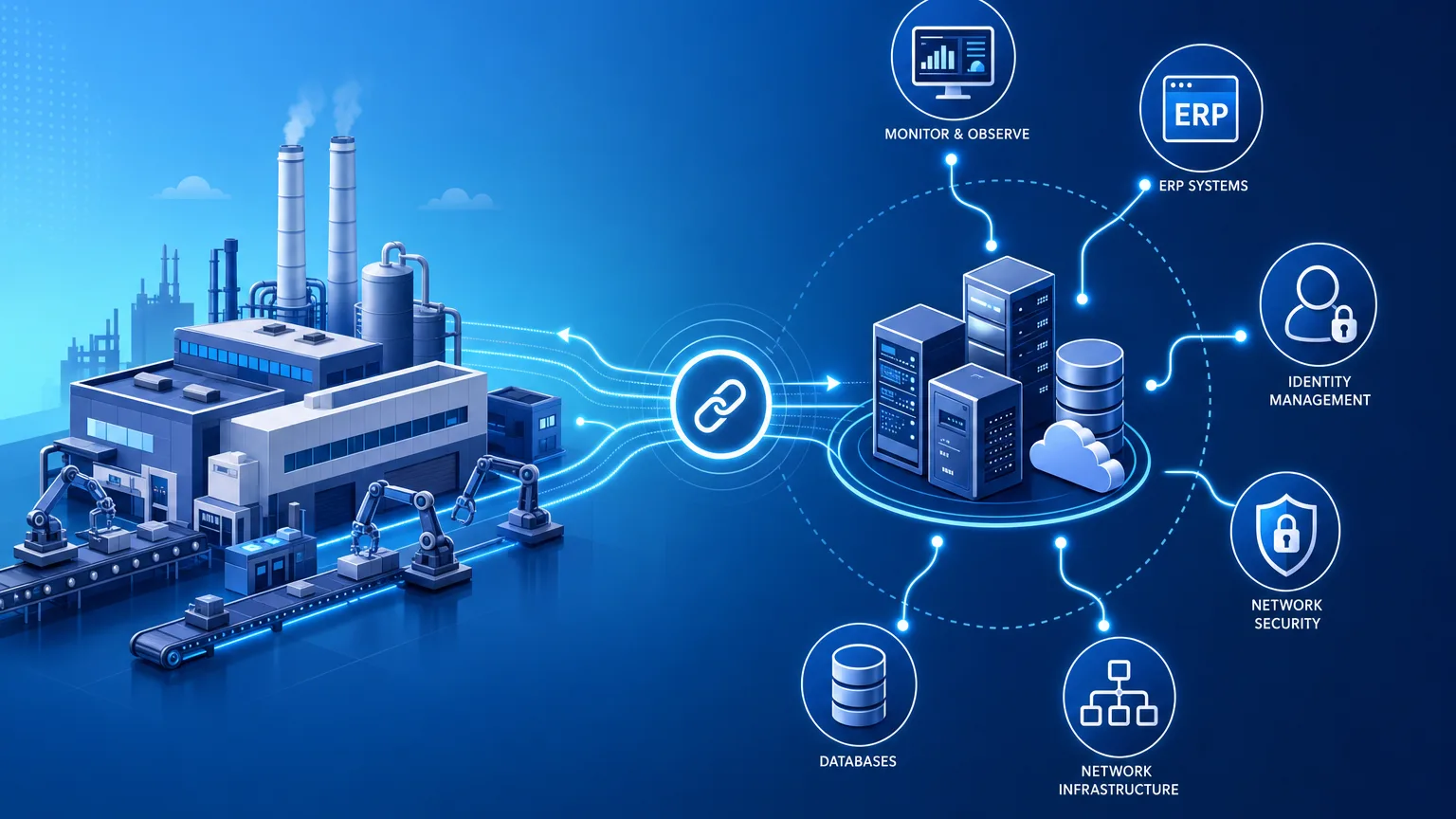
ITOM for Manufacturing: Monitoring the Enterprise Layer Behind Plant Ops

A production line can sit idle for reasons that have nothing to do with the machines on it. In July 2026, a ransomware incident forced dairy manufacturer fairlife to suspend U.S. production. The disruption did not occur because a filler line jammed, a pasteurizer failed, or a programmable logic controller (PLC) glitched. It happened because unauthorized actors accessed enterprise systems related to production, forcing IT teams to isolate network connections and suspend operations while determining security status.
This pattern is not isolated. When electronics manufacturer Data I/O faced ransomware, production stalled at the enterprise layer. Across discrete and process manufacturing, the systems taking plants down increasingly sit in corporate data centers: identity providers, ERP modules, MES integration middleware, and corporate network segments.
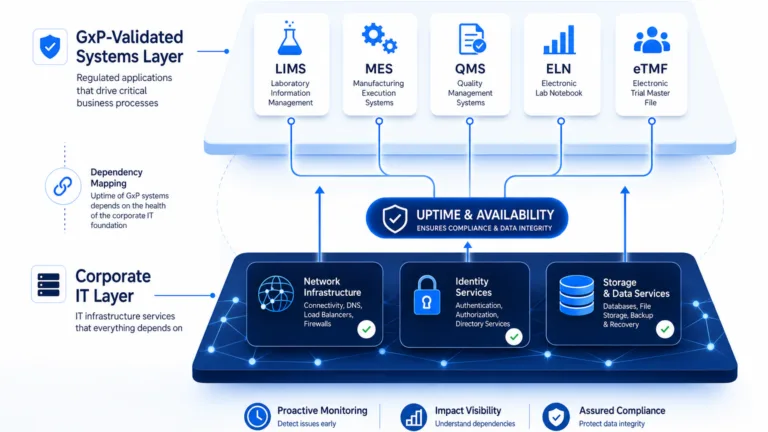
For IT Infrastructure and Operations Directors who own the corporate network, identity, ERP-integration, and data-center layer connecting enterprise IT to plant systems, that dependency chain is the risk that puts COOs and CISOs on every major incident bridge. Managing performance of those enterprise systems is now central to protecting plant uptime.
The Monitoring Story Manufacturing Already Knows
When ITOM for manufacturing enters the conversation, industry content usually defaults to the plant floor. Discussions quickly turn to SCADA dashboards, PLC telemetry, predictive maintenance sensors, and ICS protocols like Modbus, DNP3, EtherNet/IP, or PROFINET.
That operational technology (OT) layer matters, but it is a distinct discipline. Dedicated OT security platforms and asset discovery tools, including Virima’s companion coverage of manufacturing IT asset management and IT/OT convergence, address protocol-level discovery and machine visibility.
This piece addresses the layer directly above the plant floor: the enterprise IT infrastructure and business software stack that plant operations depend on every day. Maintaining uptime across corporate identity services, enterprise networks, database clusters, and inventory middleware requires a clear view of how these corporate systems connect to physical production lines.
What Shuts Down a Plant: the Enterprise Layer, Not the Machine
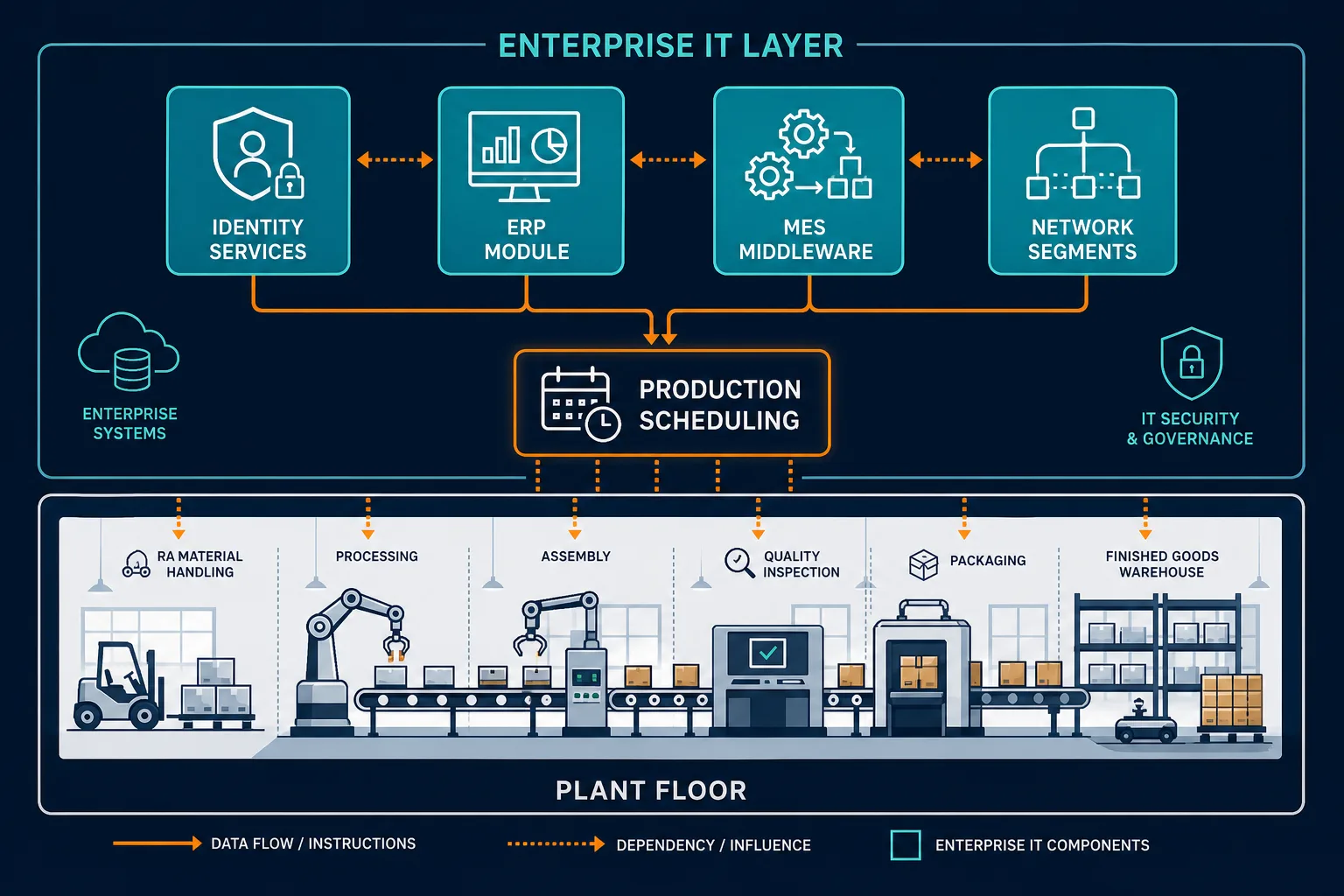
Modern manufacturing relies on tight integration between enterprise IT and plant operations. Enterprise resource planning systems push master production schedules to the shop floor. Warehouse management systems (WMS) direct inventory dispatch. Manufacturing execution systems process quality data and clear batches for final distribution. Identity and access management (IAM) platforms authenticate engineers and scripts accessing plant-adjacent control networks.
When an incident hits this enterprise IT layer, the plant floor suffers immediately. If Active Directory or SSO degrades during a security event, engineers and batch-clearing scripts lose MES access and safety rules block unvalidated runs. If ERP-to-floor integration buses or database clusters drop offline, material movements and finished-goods tags stop. When malware hits corporate subnets, teams isolate broad routes without a dependency map and sever legitimate feeds to plant controllers.
No physical machine failed. The plant stops because the enterprise IT layer became unreachable, unauthenticated, or untrusted.
Comparable patterns appear in electronics manufacturer Data I/O’s ransomware disruption and in Nitrogen ransomware campaigns targeting manufacturers. These are enterprise-layer stories, not machine failures on the floor.
Why the Enterprise-to-Plant Layer Remains a Blind Spot
Most enterprise IT operations teams monitor switches, databases, and servers with CPU, packet loss, and memory metrics. Those tools rarely answer the question manufacturing IT Directors need during an incident: which plant-operations process depends on this enterprise server or database?
Why do enterprise IT outages halt manufacturing plant operations even when no plant-floor machine fails?
Enterprise IT outages halt plant operations because modern production lines rely on corporate IT services for production scheduling, raw material dispatch, quality validation, and batch clearing. If an enterprise database, identity service, or ERP middleware link fails, plant operations freeze even if every physical PLC and SCADA machine on the floor is fully operational.
Plant floor engineering teams maintain detailed engineering schematics of physical machinery. Enterprise IT teams maintain general network diagrams and server inventories. The gap lies in the middle. The enterprise infrastructure connecting ERP environments to MES software and plant networks often lacks a clear, dynamic map linking infrastructure components to real-world production outcomes.
When a corporate database experiences latency, IT sees an application performance alert. What IT often does not see is that the database hosts the staging tables for plant-floor material dispatch, meaning three production lines may run out of staged inventory within forty-five minutes.
Plant Operations leaders feel that gap as idle lines. CISOs feel expanded ransomware blast radius across converged IT and OT. COOs and CFOs feel per-hour cost.
Why Incident Recovery Takes Days Instead of Hours
When enterprise IT dependencies remain unmapped, incident response becomes a slow process of elimination. Teams spend days confirming network security status, identifying affected scopes, isolating abnormal connections, and restoring services line by line.
What is the difference between OT plant-floor monitoring and enterprise IT monitoring in manufacturing?
OT plant-floor monitoring tracks physical machinery, PLCs, SCADA networks, and industrial protocols such as Modbus or PROFINET. Enterprise IT monitoring tracks corporate data centers, network subnets, identity providers, and ERP or MES software. Effective ITOM for manufacturing links corporate IT infrastructure directly to the plant-operations processes it supports.
The primary bottleneck during these outages is rarely a missing monitoring dashboard or an undetected server crash. The delay happens because teams lack a reliable map of system dependencies. Without clear visibility into blast radius and service topology, engineers cannot easily predict which plant systems will be impacted when a corporate switch is restarted, a firewall rule is modified, or an identity domain is isolated.
Recovery shifts from a targeted resolution to a cautious, step-by-step restoration process while plant lines remain idle. More dashboards on the OT side do not close that enterprise-layer gap. Knowing the dependency chain from enterprise infrastructure to plant-operations processes before an incident forces the question live does.
The Financial Impact of Enterprise IT Downtime
Unplanned downtime in industrial manufacturing carries severe financial consequences. Reporting on Siemens’ True Cost of Downtime research, summarized in industrial coverage such as Acronis’ analysis of unplanned OT downtime costs, puts unplanned downtime at the world’s 500 largest companies at roughly $1.4 trillion annually, about 11% of total revenue, up from 8% in 2019.
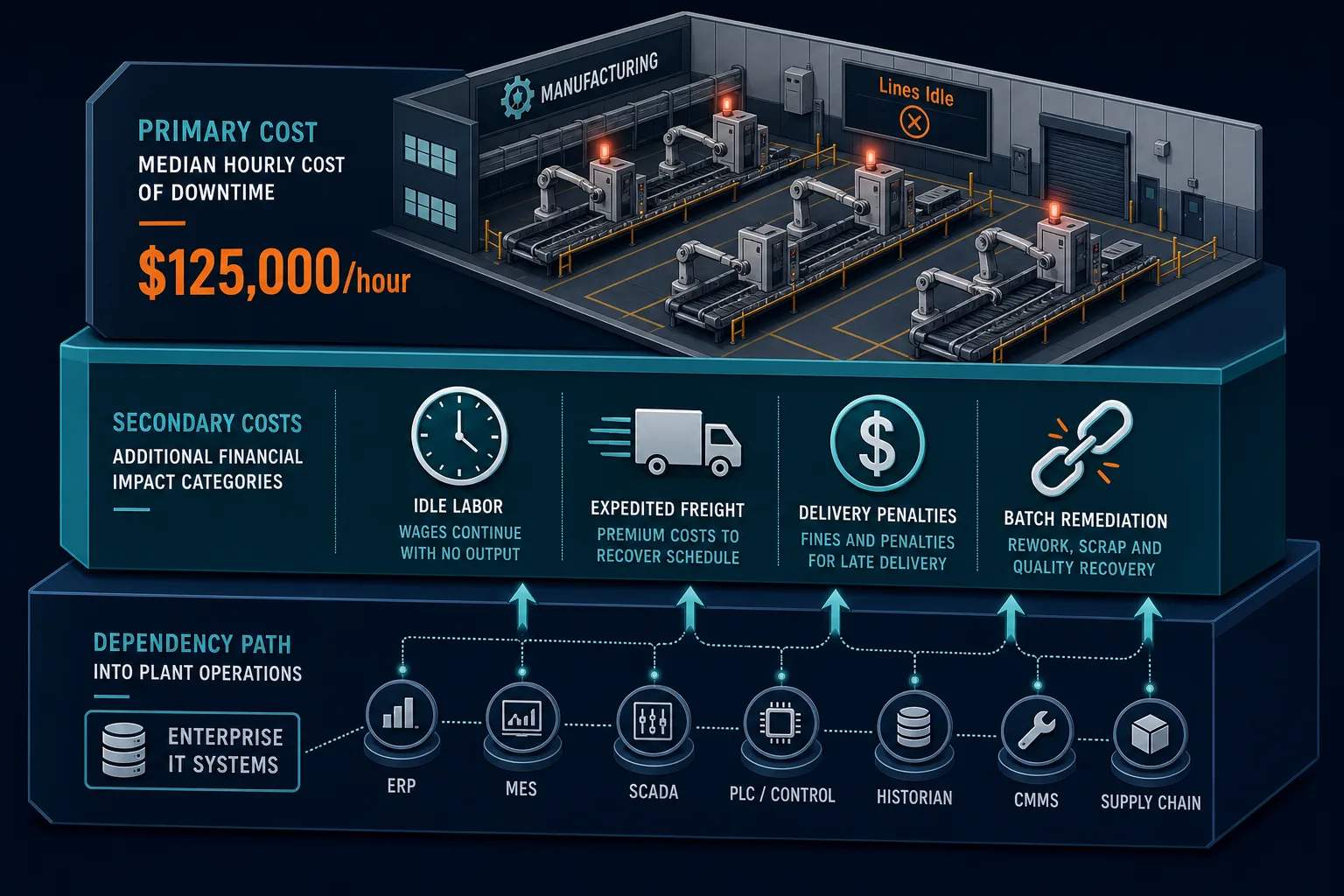
Industrial surveys, including ABB’s Value of Reliability study as cited in the same downtime reporting, indicate that general manufacturing faces a median downtime cost of approximately $125,000 per hour. In high-volume discrete manufacturing like automotive assembly, downtime costs can escalate above $2 million per hour.
How much does unplanned downtime cost enterprise manufacturers per hour?
Unplanned downtime costs general manufacturers a median of approximately $125,000 per hour, with high-volume facilities like automotive assembly exceeding $2 million per hour. Beyond direct lost output, financial impacts include idle labor, expedited freight, contractual delivery penalties, and complex batch-remediation procedures.
Beyond lost output, secondary costs stack quickly: idle direct labor while controllers wait on scheduling systems, expedited freight and delivery penalties, and batch scrap or quarantine when quality-tracking middleware drops mid-run in food, beverage, or chemical plants. Recovery speed is now a major cost lever for COO and CFO stakeholders.
Mapping Enterprise-to-Plant Dependencies Closes the Gap
Closing the enterprise-layer gap requires moving beyond basic infrastructure metrics. IT operations management must incorporate dependency and service mapping that connects corporate infrastructure configuration items (CIs) directly to plant-floor operational processes.
How does ITOM for manufacturing reduce plant risk during enterprise IT incidents?
ITOM for manufacturing builds dependency maps between corporate IT infrastructure (networks, servers, identity, ERP) and plant-floor operational services. When an enterprise IT component degrades or faces a security threat, those maps surface blast radius so teams can isolate threats and restore production-critical services with clearer priority.
In practice, that means high-frequency discovery cycles to populate servers, VMs, cloud instances, switches, and database clusters across corporate and plant-adjacent estates; connecting those CIs to applications, ERP modules, and integration middleware once service definitions are supplied; linking IT service groups to outputs such as Line 1 assembly scheduling or WMS inventory dispatch; and analyzing blast radius before isolation or change.
A CMDB-driven configuration management practice holds the relationship and change baseline IT and plant-operations leadership can defend. Paired with service mapping, teams see how corporate network and identity nodes support named operational services after those services are defined, so they can assess risk, manage change, and resolve incidents with production impact in view.
See how Virima maps dependencies across enterprise infrastructure with Trusted Runtime Truth.
For role context, see ITOM versus ITSM and what ITOM is and why it matters. Virima feeds discovery-sourced CMDB data and dependency maps into ITSM workflows used with ServiceNow, Jira Service Management, Ivanti, HaloITSM, Xurrent, and Hornbill via the integrations hub.
Where to Start: Scoping ITOM Against Plant Operations Impact
Building enterprise IT visibility for plant operations does not require mapping every corporate asset at once. Start with the highest-impact paths:
- Database clusters, message queues, and API gateways between corporate ERP and plant-floor MES
- Domain controllers, SSO services, and auth proxies used by plant terminals and batch scripts
- Firewalls, routers, and subnets between corporate networks and plant-adjacent DMZs
- Change control with map-based impact review on enterprise systems plant ops depend on
- Incident runbooks that prioritize tickets by production impact, not assumed IT/OT segmentation
What enterprise IT infrastructure should manufacturers map first to protect plant operations?
Manufacturers should first map identity and authentication services (Active Directory, SSO), ERP-to-MES integration middleware, database clusters hosting production schedules, and the network routing hardware connecting corporate IT to plant-floor DMZs. These components carry the highest risk of halting production during an IT outage.
Knowing the Chain Before the Incident
The outages shutting down manufacturing plants increasingly are not plant-floor machine failures, and they are not solved by watching more dashboards on the OT side. They are solved by knowing, before an incident, which enterprise IT systems feed the processes that keep a plant running.
IT Infrastructure and Operations Directors who can show Plant Operations, Security, and finance leadership a defensible map of that chain reduce idle-line risk and shorten recovery from gradual restore to scoped action.
Request a Virima demo to map enterprise IT dependencies that support your plant operations.
Frequently Asked Questions
Why do ransomware attacks on manufacturing corporate networks halt physical plant production?
Modern plants rely on enterprise IT for scheduling, quality clearing, material dispatch, and authentication. When teams isolate corporate networks to contain malware, plant systems lose those feeds and validations, so production stops even if factory machinery is untouched.
How does ITOM dependency mapping differ from traditional IT infrastructure monitoring tools?
Traditional IT infrastructure monitoring tracks component-level health metrics like CPU usage, ping response, and disk space. ITOM dependency mapping builds relational models between infrastructure components, application stacks, and business services. In manufacturing, it links corporate servers and databases directly to the plant-floor operational processes they sustain.
Does Virima ITOM replace dedicated plant-floor OT security or SCADA monitoring platforms?
No. Virima ITOM focuses on discovering, mapping, and managing enterprise IT infrastructure, business applications, and corporate service dependencies. Dedicated OT and ICS security tools monitor plant-floor PLCs, SCADA controllers, and proprietary industrial protocols. Virima complements OT tools by providing visibility across the enterprise IT layer supporting plant operations.
How does service mapping help IT teams during an active manufacturing outage?
During an outage, service mapping displays the blast radius of a failing or isolated IT component against defined services. Instead of searching through unmapped infrastructure, IT teams can identify which corporate software modules and plant-floor operations are affected, helping engineers prioritize recovery based on production impact.
How does Virima work with existing enterprise ITSM platforms?
Virima integrates with ITSM platforms including ServiceNow, Jira Service Management, Ivanti, HaloITSM, Xurrent, and Hornbill by feeding discovery-sourced CMDB data and dependency maps into change control, incident management, and asset workflows so tickets and changes carry accurate operational context.